
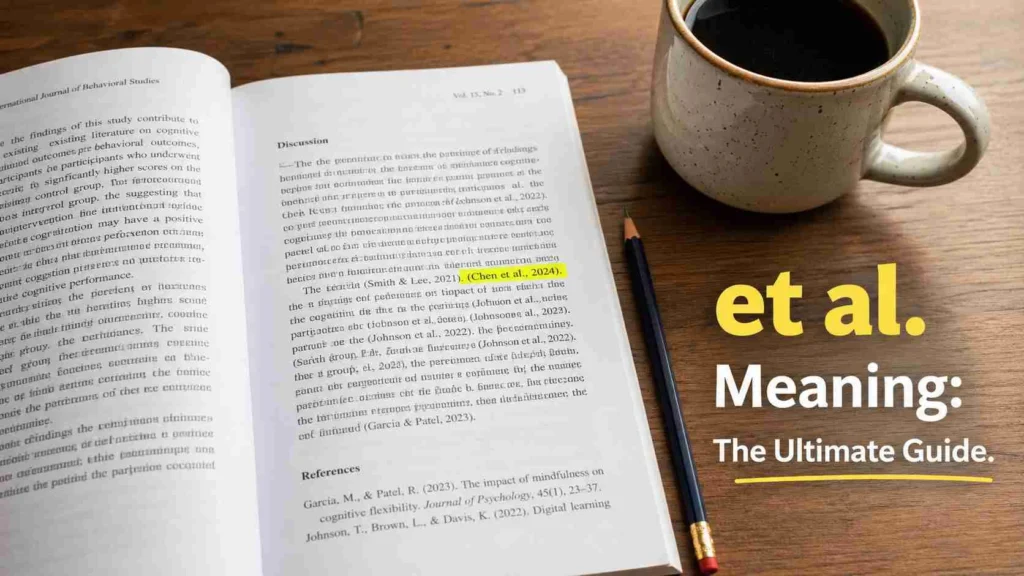

“Et al.” is a Latin phrase that means “and others.” It is commonly used in academic writing and research citations to shorten a list of multiple authors. For example, “Ali et al.” means Ali and other co-authors.
You’re staring at a research paper. Seven authors. Your citation is due tomorrow. Do you type out every single last name?
No. You don’t.
You type “et al.” and move on with your life.
But here’s the problem. Most people use et al without understanding what it actually means. They guess the punctuation. They mess up the spacing. And worst of all? They confuse it with etc.
Let’s fix all of that right now.
This guide covers the real et al meaning, how to use it across every major citation style, and the exact rules you need to follow. No fluff. No textbook lectures. Just clear, useful knowledge.
et al Definition
“et al.” is a Latin abbreviation for “et alii” (masculine/mixed group) or “et aliae” (feminine group), and it means “and others.”
Where it is used:
It is commonly used in academic writing and citations to shorten long lists of authors.
Example:
- Instead of writing: Ali, Sara, John, and Michael (2023)
- You write: Ali et al. (2023)
Key point:
It helps make references shorter and easier to read when there are multiple authors.
What Does et al Mean in Plain English
Let’s start with the simplest possible answer.
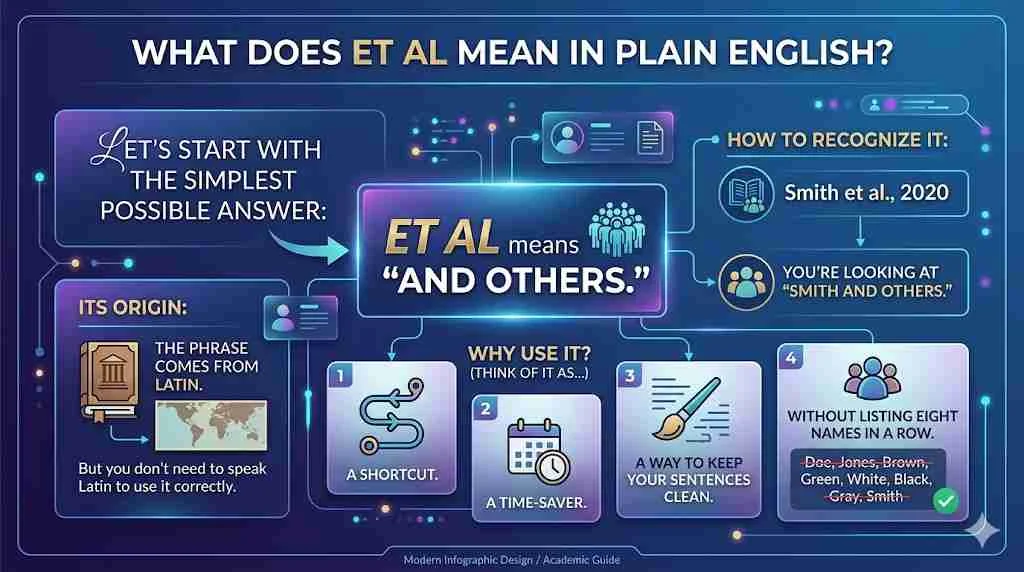
Et al means “and others.”
That’s it.
When you see Smith et al., 2020 in a citation, you’re looking at “Smith and others.”
The phrase comes from Latin. But you don’t need to speak Latin to use it correctly. Think of it as a shortcut. A time-saver. A way to keep your sentences clean without listing eight names in a row.
Here’s a real example:
The study by Richardson et al. (2023) found that short breaks improve focus.
Translation: Richardson and her fellow researchers discovered this.
You’re not ignoring anyone. You’re just being efficient.
The Full Form and Latin Origins
People often ask: what is the et al full form?
The answer depends on gender and number in Latin. But for your daily writing life, you only need to know one thing.
| Latin Phrase | Gender | Meaning | When to Care |
|---|---|---|---|
| et alia | Neuter | and other things | Rarely used |
| et alii | Masculine | and other men | Almost never |
| et aliae | Feminine | and other women | Almost never |
Here’s the truth. Modern academic style guides (APA, MLA, Chicago) ignore these gender distinctions. They treat et al. as a fixed, universal abbreviation. You don’t need to match the gender of the authors.
So stop worrying about alia vs alii. Just write et al. and move on.
Pronunciation note: Say “et ALL.” Rhymes with “met ball.” Never say “ee-tee” or “ay-tahl.” Those sound awkward and mark you as a beginner.
et al Meaning in Research & Academic Writing
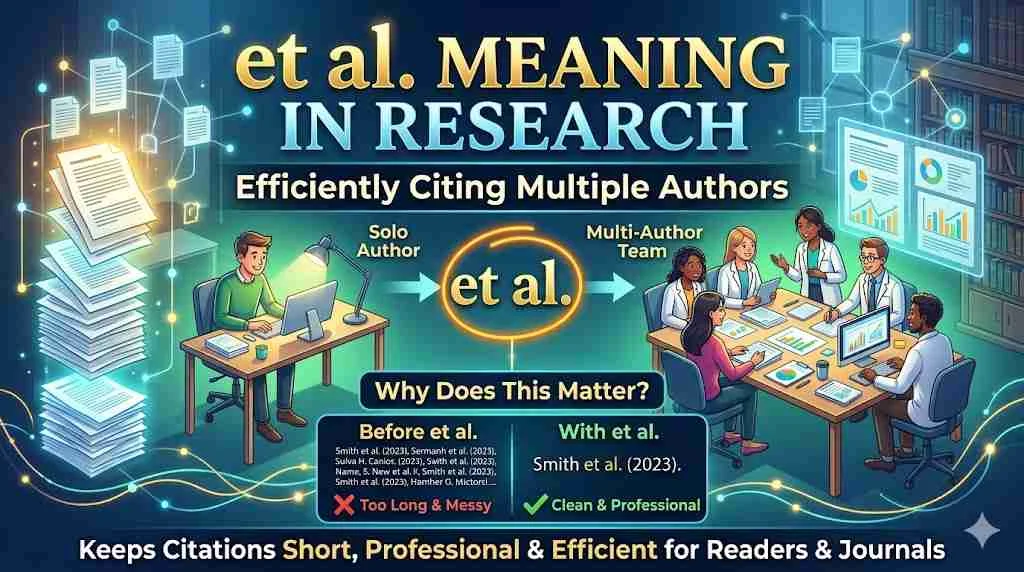
In research papers, et al meaning in research is very specific. It signals that a work has multiple authors. It tells your reader: “I’m citing a team here, not a solo author.”
Why does this matter?
Because academic writing is picky. Journals have strict word counts. Reference lists can’t run wild. Using et al keeps things clean and professional.
Let’s look at two versions of the same sentence.
Without et al:
(Rodriguez, Thompson, Williams, Jones and Clark, 2022)
With et al:
(Rodriguez et al., 2022)
Same meaning. Half the characters. Much easier to read.
That’s the et al meaning in academic writing boiled down. It’s a tool for clarity and brevity.
When to Use et al
This is where most guides get vague. They say “use et al for multiple authors” and stop there. But that’s not helpful.
Here are the real rules. Style guide by style guide.
APA 7th Edition (Most Common in Psychology, Education, Nursing)
In-text citations:
| Number of Authors | First Citation | Subsequent Citations |
|---|---|---|
| 1 author | (Smith, 2020) | (Smith, 2020) |
| 2 authors | (Smith & Jones, 2020) | (Smith & Jones, 2020) |
| 3 or more authors | (Smith et al., 2020) | (Smith et al., 2020) |
Key fact: In APA 7, you use et al. from the very first citation onward for three or more authors. No exceptions.
Reference list rule: Do not use et al. in APA reference lists for works with up to 20 authors. List all names. For 21 or more authors, list the first 19, then an ellipsis (…), then the final author.
Example (21+ authors):
Smith, J., Jones, A., Lee, B., Patel, N., Garcia, R., Kim, S., Brown, T., Davis, M., Wilson, C., Anderson, P., Thomas, L., Taylor, R., Moore, K., Jackson, D., Martin, S., White, J., Harris, A., Thompson, E., Martinez, F., … Clark, W. (2023).
MLA 9th Edition (Common in Literature, Languages, Humanities)
In-text citations:
| Number of Authors | Citation Format |
|---|---|
| 1 author | (Smith 45) |
| 2 authors | (Smith and Jones 45) |
| 3 or more authors | (Smith et al. 45) |
Notice the difference? MLA drops the comma before the page number. APA uses a comma and year.
Reference list rule: For three or more authors, list the first author followed by et al.
Example:
Smith, John, et al. The Modern Study. Oxford UP, 2022.
Chicago Style (Two Systems)
Chicago has two systems. Let’s break them down.
Notes and Bibliography (History, Arts):
| Number of Authors | First Note | Subsequent Notes | Bibliography |
|---|---|---|---|
| 1–3 authors | List all | List all | List all |
| 4+ authors | First author et al. | First author et al. | List all (up to 10) |
Author-Date (Sciences, Social Sciences):
| Number of Authors | In-Text Citation |
|---|---|
| 1–3 authors | List all |
| 4+ authors | First author et al. (even first citation) |
Key fact: Chicago is more flexible than APA or MLA. But that flexibility means you must check your journal’s specific guidelines.
et al Meaning in Text and Informal Writing
Outside of academia, et al meaning in text changes slightly.
In an email, a blog post, or a business report, using et al can sound stiff. Most readers won’t know what it means. And honestly? You don’t need it.
Here’s a quick comparison.
Formal (academic):
The study by Chen et al. (2024) demonstrates improved retention.
Informal (email to a colleague):
Chen and her team found better retention.
Both are correct. But the second one sounds more human.
So here’s a rule of thumb. Use et al in academic papers, journal submissions, and formal research reports. Skip it in emails, Slack messages, and casual writing. Just say “and others” or “the team.”
et al vs etc | The Confusion Ends Today
This is the most common mistake people make. And it’s an embarrassing one.
| Abbreviation | Means | Used For | Example |
|---|---|---|---|
| et al. | and others | People (authors, researchers) | Smith et al. (2023) |
| etc. | and so on | Things, objects, ideas | apples, oranges, etc. |
Wrong: The study included Smith et al., Jones et al., etc.
Right: The study included Smith et al., Jones et al., and others.
Why is mixing them wrong? Because etc refers to things. Et al refers to people. You wouldn’t list a person as a “thing.” That’s rude. And incorrect.
Memory trick: Think al for ali (people). Think etc for et cetera (extra things).
Punctuation and Formatting| Get These Small Details Right
Small mistakes make you look careless. Here’s exactly how to format et al.
Period Usage
- Always put a period after al (because it’s an abbreviation for alia/alii/aliae).
- Never put a period after et (because et is a complete Latin word meaning “and”).
Correct: et al.
Incorrect: et. al
Incorrect: et.al
Incorrect: et al (no period)
Spacing
- Always put a space between et and al.
- No space inside al.
Correct: et al.
Incorrect: et.al.
Italics
This one changes depending on the style guide.
| Style Guide | Italics or Plain |
|---|---|
| APA 7 | Plain (no italics) |
| MLA 9 | Plain (no italics) |
| Chicago | Italics (but many publishers override to plain) |
Safe bet: Use plain text unless your target journal explicitly asks for italics. Most modern style guides prefer plain.
Comma Before et al
This also varies.
- APA (in-text): No comma before et al. → (Smith et al., 2020)
- MLA (in-text): No comma before et al. → (Smith et al. 45)
- MLA (bibliography): Comma before et al. → Smith, John, et al. Title.
Confusing? Yes. But here’s a simple rule. When in doubt, check a real example from your style guide. Don’t guess.
Real Examples by Citation Style
Let’s put everything together. Here are real, copy-pasteable examples for each major style.
APA 7 (in-text)
(Rodriguez et al., 2022)
As Rodriguez et al. (2022) argued, sleep matters.
APA 7 (reference list – no et al for up to 20 authors)
Rodriguez, M., Lee, S., Patel, N., & Kim, J. (2022). Sleep and cognition. Academic Press.
MLA 9 (in-text)
(Rodriguez et al. 45)
MLA 9 (bibliography)
Rodriguez, Maria, et al. Sleep and Cognition. Academic Press, 2022.
Chicago (note – 4+ authors)
- Rodriguez et al., Sleep and Cognition (Chicago: Academic Press, 2022), 45.
Chicago (bibliography)
Rodriguez, Maria, Sung Lee, Nikhil Patel and Joon Kim. Sleep and Cognition. Chicago: Academic Press, 2022.
Harvard (common variant)
(Rodriguez et al., 2022, p. 45)
How to Pronounce et al Without Sounding Like a Beginner
Let’s settle this once and for all.
Correct pronunciation: “et ALL”
Rhymes with: “met ball” or “set call”
Wrong pronunciations:
| Wrong | Why It’s Wrong |
|---|---|
| “ee-tee al” | That’s spelling, not speaking |
| “ay-tahl” | Fake Latin affectation |
| “et al-ee” | Confusing et al with et alia |
Here’s a trick. Say the full phrase “and others” in your head. Then swap in “et al.” Same rhythm. Same stress.
“Smith and others” → “Smith et ALL”
Practice once. You’ll never forget.
Common Mistakes
Even experienced writers mess these up. Here’s your cheat sheet.
| Mistake | Fix |
|---|---|
| et. al | Remove the period after et. Write et al. |
| et.al | Add a space. Write et al. |
| et al (no period) | Add the period after al. |
| using et al for one author | Don’t. Just write the name. |
| using et al for two authors (APA) | Don’t. Spell both names every time. |
| et al in APA reference list | Don’t. List all names (up to 20). |
| mixing et al and etc | Never. They mean different things. |
| italicizing et al in APA | Don’t. APA uses plain text. |
Real-world example of a bad citation:
(Johnson, et. al., 2021)
Problems: Wrong comma placement (before et al), extra period after et, and the comma after the name is unnecessary.
Fixed:
(Johnson et al., 2021)
Clean. Correct. Professional.
When NOT to Use et al
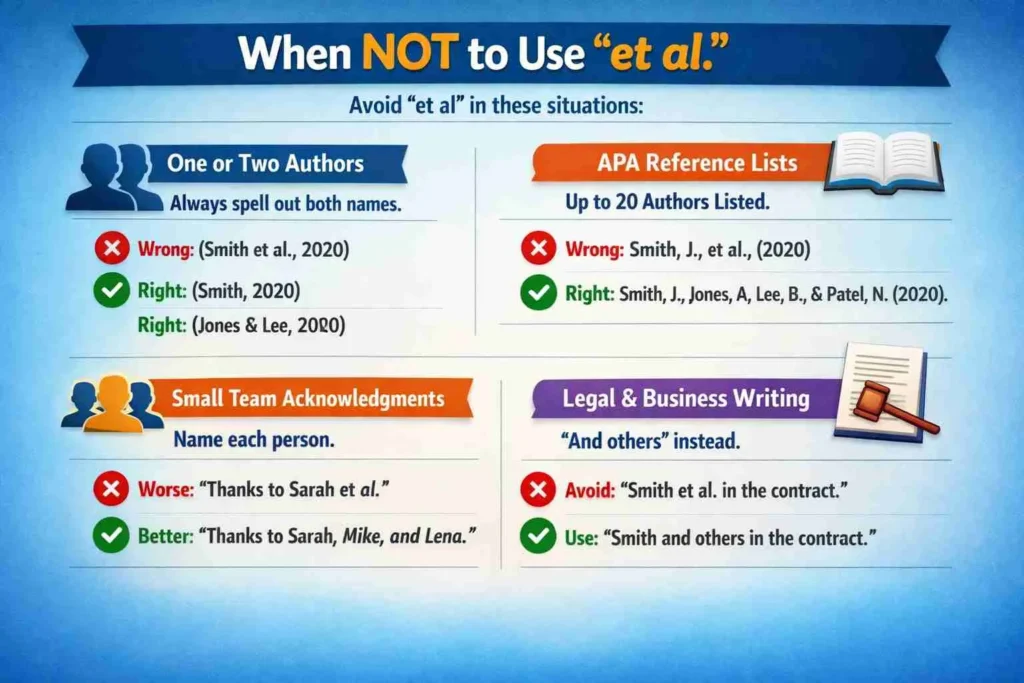
Knowing when not to use et al is just as important as knowing when to use it.
One or Two Authors
Never use et al for one or two authors. Spell their names every single time.
Wrong: (Smith et al., 2020) when only Smith wrote it.
Right: (Smith, 2020)
Wrong: (Jones et al., 2020) when Jones and Lee wrote it (APA).
Right: (Jones & Lee, 2020)
APA Reference Lists (Up to 20 Authors)
APA forbids et al in reference lists for works with up to 20 authors. List every name.
Wrong: Smith, J., et al. (2020).
Right: Smith, J., Jones, A., Lee, B., & Patel, N. (2020).
Small Teams in Acknowledgment Sections
If you’re thanking a small team (like three colleagues), spell their names. Using et al here feels dismissive.
Better: “Thanks to Sarah, Mike, and Lena.”
Worse: “Thanks to Sarah et al.”
Legal and Formal Business Writing
Legal documents avoid et al. They use “and others” spelled out. Stick to that tradition if you’re writing contracts, affidavits, or official corporate memos.
When the Reader Won’t Understand
If you’re writing for a general audience (not academics), skip et al. Most people won’t know what it means. You’ll lose them.
Example (blog post for general readers):
“A 2023 study by Chen and her team found…”
Not:
“A 2023 study by Chen et al. found…”
See the difference? One invites the reader in. The other puts up a small wall.
Why Does et al Exist
You don’t need a 500-word Latin history lesson. But here’s the useful context.
Journals in the 20th century faced a space crunch. Paper was expensive. Printing long author lists cost money. So editors adopted et al as a standard abbreviation.
It stuck. Then style guides formalized it.
Today, et al serves three purposes:
- Saves space in in-text citations.
- Reduces repetition when citing the same team multiple times.
- Creates consistency across disciplines so readers instantly recognize “and collaborators.”
That’s it. No mystery. No arcane ritual. Just practical efficiency.
Quick Reference Table | et al by Style Guide
| Style | In-Text Citation (3+ authors) | Reference List / Bibliography |
|---|---|---|
| APA 7 | (Smith et al., 2020) – even first citation | List up to 20 names. No et al. |
| MLA 9 | (Smith et al. 45) | First author + et al. |
| Chicago (notes) | Smith et al. – for 4+ authors | List up to 10 names. No et al. |
| Chicago (author-date) | (Smith et al. 2020) – for 4+ authors | List up to 10 names. No et al. |
| Harvard | (Smith et al., 2020, p. 45) | Varies. Often first author + et al. |
Pro tip: Bookmark this table. You’ll come back to it.
et al Meaning in Books and Journals
When you see et al meaning in books, it works the same way as in research papers. But there’s one small twist.
Some books use et al in their table of contents or chapter headings to indicate multiple contributors.
Example from an edited volume:
Chapter 7: “Memory and Aging” – Rodriguez et al.
That tells you Rodriguez wrote the chapter with others. It’s efficient. But in a full citation (like a bibliography), you’d still list all names in most styles.
et al meaning in journals is identical. Journals follow the same style guides: APA, MLA, Chicago, or their own house style. Always check the journal’s author guidelines before submitting.
Is et al Capitalized
No.
Et al is never capitalized unless it starts a sentence. But starting a sentence with et al is awkward and rare. Don’t do it.
Correct: Smith et al. (2020) argue…
Awkward: Et al. (2020) argue…
Just don’t.
Can You Use et al in an Email Signature
You can. But you probably shouldn’t.
Here’s why. Email signatures are for clear communication. Using et al in a signature (like “Marketing Team et al.”) looks try-hard and confusing. Recipients will wonder who “et al” refers to.
Better: “Marketing Team (Sarah, Mike, Lena)”
Worst: “Marketing Team et al.”
Save et al for citations. Leave it out of email.
How Many Authors Before Using et al
This depends entirely on your style guide.
| Style Guide | Number of Authors Before et al |
|---|---|
| APA 7 | 3 authors |
| MLA 9 | 3 authors |
| Chicago (notes) | 4 authors |
| Chicago (author-date) | 4 authors |
| Harvard (common variant) | 3 authors |
Most fields use the “3 or more” rule. But if you’re in history or arts (Chicago style), you’ll wait until 4 authors.
Always check. Never assume.
Does et al Include the First Author
Yes and no.
When you write Smith et al., you’re naming Smith and then saying “and others.” So Smith is included. The et al covers everyone else.
But here’s the key point. You never replace the first author with et al. The first author always appears by name. Only the subsequent authors get collapsed into et al.
Correct: Smith et al.
Incorrect: et al. (with no first author)
Real-World Examples in Paragraphs
Let’s see et al working naturally in real paragraphs.
1 Example (APA 7 in a literature review):
Recent work on sleep deprivation tells a consistent story. Williamson et al. (2021) found that losing even two hours of sleep reduces reaction time by 30%. Similarly, Patel et al. (2022) linked poor sleep to memory lapses. And Garcia et al. (2023) showed that recovery sleep doesn’t fully reverse the damage.
2 Example (MLA 9 in a humanities paper):
Critics have long debated the ending of Morrison’s novel. Smith et al. argue that the ambiguity is intentional (45). But Jones and Lee disagree, calling it a flaw (78). Chen et al. take a middle position, suggesting the author left multiple possibilities open (112).
3 Example (Chicago note in a history book):
- Roberts et al., The Industrial Revolution (London: Cambridge Press, 2020), 89–92.
See how natural that feels? You’re not forcing it. You’re just citing cleanly.
A Complete Checklist Before You Submit
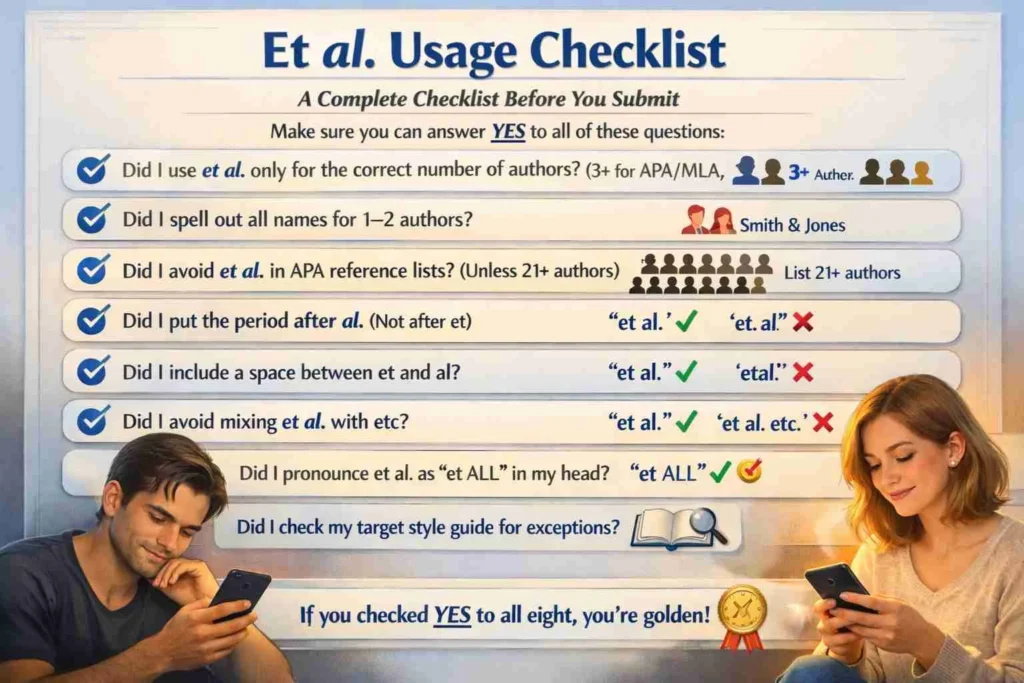
Run through this checklist before you turn in any paper or journal article.
- Did I use et al only for the correct number of authors (3+ for APA/MLA, 4+ for Chicago)?
- Did I spell out all names for 1–2 authors?
- Did I avoid et al in APA reference lists (unless 21+ authors)?
- Did I put the period after al (not after et)?
- Did I include a space between et and al?
- Did I avoid mixing et al with etc?
- Did I pronounce et al as “et ALL” in my head (not “ee-tee”)?
- Did I check my target style guide for exceptions?
If you answered yes to all eight, you’re golden.
The Bottom Line on et al Meaning
Here’s what you need to remember.
Et al means “and others.” It’s a citation shortcut for multiple authors. Use it correctly, and you save space while looking professional. Use it wrong, and you look like an amateur.
Follow the style guide rules. Punctuate carefully. Don’t confuse it with etc.
And when in doubt? Spell out the names. No one ever got marked down for clarity.
Now go write those citations. You’ve got this.
FAQs
Q1: What does “et al.” mean?
A: “Et al.” is a Latin abbreviation meaning “and others.” It is used to refer to additional people, usually authors, without listing all their names.
Q2: Where is “et al.” commonly used?
A: It is mainly used in academic writing, research papers, and citations when a source has multiple authors.
Q3: How do you use “et al.” in a sentence?
A: You use it after the first author’s name.
Example: Khan et al. (2022) studied climate change impacts.
Q4: Is “et al.” only used for authors?
A: Mostly yes, especially in academic references, but it can also mean “and others” in general contexts when referring to a group.
Q5: Do you need to italicize “et al.”?
A: It depends on the style guide. In many formats, it is not italicized, but some academic styles may require italics.
Conclusion
You made it. That was a lot of information, so let’s pull it all together into one simple takeaway. Et al means “and others.” Full stop. You use it in academic citations when a work has multiple authors. It saves space, keeps your writing clean, and follows well-established rules.
Here’s what you absolutely must remember: APA 7 uses et al for three or more authors in every in-text citation but never in the reference list (unless you have 21+ authors). MLA 9 uses et al for three or more authors in both in-text citations and the bibliography. Chicago uses et al for four or more authors in notes, while bibliographies usually list all names. Pronounce it “et ALL” never “ee-tee” or “ay-tahl.”
Discover More Related Articles:
- “RS” Mean in Text: You’ve Seen It Everywhere In 2026
- “ION” Mean in Text: Don’t Misunderstand This Slang In 2026
- “Chuzz” Meaning in Social Media: Why People Are Using It In 2026