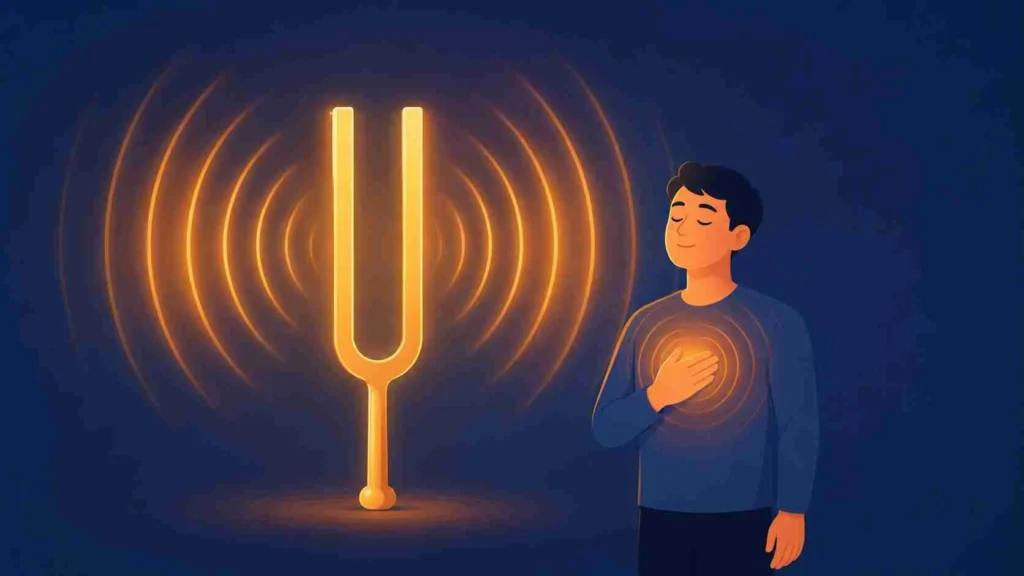

Resonate means an idea, story, or moment creates an emotional echo inside you. It’s not just understanding something intellectually; it’s feeling a physical or emotional response because the message matches your own experiences, values, or memories. When something resonates, your brain and body say “yes, that’s exactly it” before you even have time to think.
You hear a song from ten years ago. Suddenly you’re back in that car. That breakup. That summer. Your chest tightens before your brain even recognizes the melody. Resonate meaning.
You’ve read thousands of words about the resonate meaning. But here’s the only part you really need to remember.
Resonance lives in your body.
You don’t think your way into it. You don’t argue yourself into feeling it. It happens or it doesn’t. And when it does, you know. Your breath catches. Your eyes sting and your chest says yes before your brain finishes the sentence.
Don’t use “resonate” to sound smart. Use it when you actually feel that internal hum. When a line in a book, a lyric, a conversation, or even a single sentence makes you pause and think, Yeah. That’s me. Resonate meaning.
That’s resonance. That’s the real meaning.
Now you know it. Don’t misuse it. And next time you feel it, name it. Say to yourself, That resonated.
That feeling has a name. It’s called resonance.
Most people think “resonate” just means “agree with.” But that’s not quite right. Agreement lives in your head. Resonance lives in your chest, your gut, the back of your neck where goosebumps appear without permission.
By the time you finish this article, you’ll know the real resonate meaning. You’ll understand the psychology behind why certain messages stick. And you’ll never misuse the word again.
Let’s start with where the word actually comes from.
The Core Resonate Meaning Starts With Physics
Before “resonate” meant an emotional connection, it meant something much more literal. Something you can see and hear.
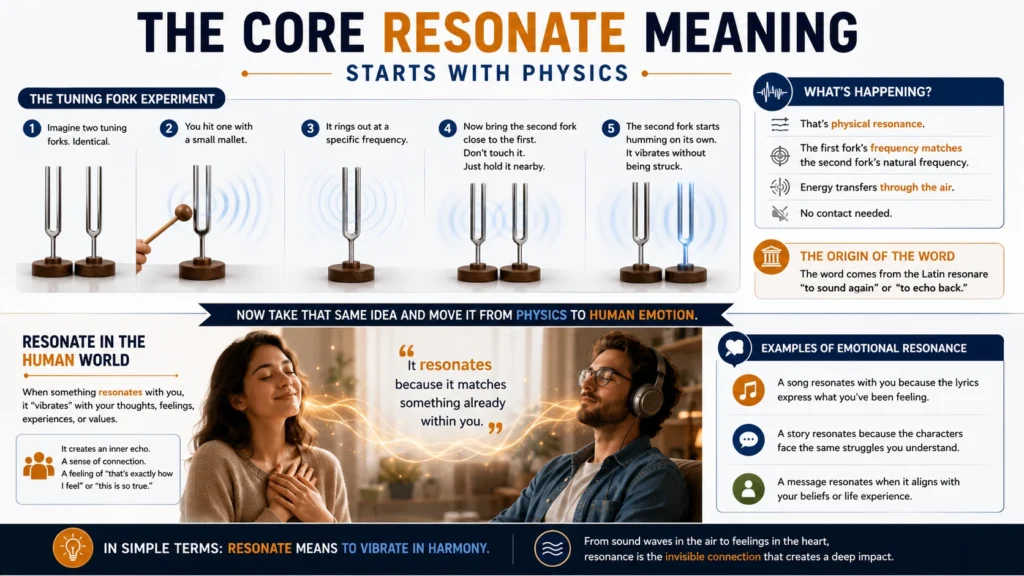
Imagine two tuning forks. Identical. You hit one with a small mallet. It rings out at a specific frequency. Now bring the second fork close to the first. Don’t touch it. Just hold it nearby.
The second fork starts humming on its own. It vibrates without being struck.
That’s physical resonance. The first fork’s frequency matches the second fork’s natural frequency. Energy transfers through the air. No contact needed.
The word comes from the Latin resonare “to sound again” or “to echo back.”
Now take that same idea and move it from physics to human emotion.
A story, a speech, a painting, or a single sentence hits your internal frequency. You don’t just understand it. You feel it. Your mind echoes back. That’s the metaphorical resonate meaning.
Plain English definition:
Resonate (verb): When something triggers an emotional or psychological response because it matches your existing experiences, values, or memories.
Here’s what resonance is not. It’s not simply agreeing with an opinion. It’s not finding something interesting. And it’s definitely not the same as “relating to” something more on that in a few minutes.
Resonance happens below your thinking brain. It bypasses logic and lands straight in feeling.
Pronunciation and Word Basics
Let’s get the mechanics out of the way so you can use the word with confidence.
| Element | Details |
|---|---|
| Word | Resonate |
| Pronunciation | /ˈrez.ə.neɪt/ (REZ-oh-nayt) |
| Syllables | Three. Rez – uh – nate |
| Part of speech | Verb (transitive and intransitive) |
| Common tense forms | Resonates, resonated, resonating |
| Noun form | Resonance |
| Adjective form | Resonant |
Stress tip: Put the emphasis on the first syllable. Say “REZ” clearly. Don’t say “ree-ZOH-nate” or “ruh-ZOH-nate.” Those sound like someone trying too hard to be academic.
Audio check: Say it out loud three times. Rez-oh-nayt. Rez-oh-nayt. Rez-oh-nayt. Good. Now use it in a short sentence. That speech resonated with me. Perfect.
Now that you know how to say it, let’s talk about the biggest mistake people make.
Resonate vs. Relate| The Critical Difference You Need to Know
Here’s where most people get tripped up.
You’ll hear someone say, “I really resonate with that character.” Or “This podcast resonates with my situation.”
Grammatically, those sentences are wrong. But beyond grammar, they confuse two related but different ideas: relating and resonating.
Let’s break this down clearly.
Relate To (Intellectual Understanding)
When you relate to something, you recognize a similarity. Your brain makes a comparison. You say, “Yes, I’ve had an experience like that.”
- It’s mostly cognitive.
- You can relate to something calmly.
- No strong emotion required.
Example: I relate to your struggle with morning meetings. I’m also tired at 9 a.m.
That’s fine. It’s accurate. But it doesn’t move you.
Resonate With (Emotional + Physical Sensation)
When something resonates with you, you feel an internal echo. Your body might respond. Your breathing changes and your eyes might sting. You don’t just understand you experience.
- It’s emotional and often physical.
- You can’t force it.
- It stays with you for days.
Example: When she described losing her father and still hearing his voice in quiet moments, that resonated with me. I felt the same ache in my own chest.
See the difference? One is a mental handshake. The other is a hug you didn’t know you needed.
Quick Comparison Table
| Relate To | Resonate With | |
|---|---|---|
| Primary location | Brain | Body + emotions |
| Feeling | “I see the similarity” | “I feel that truth” |
| Effort | Active comparison | Passive recognition |
| Intensity | Low to medium | Medium to high |
| Duration | Short | Can last hours or days |
| Example | “I relate to your budget issues.” | “Your story about failing then trying again resonated deeply.” |
Borrowed analogy to lock this in:
Relating is recognizing a street you’ve walked on before. You know the cracks in the sidewalk. You remember the corner store.
Resonating is hearing your own heartbeat echo off the walls of that street. The street isn’t just familiar. It’s yours.
So when someone says “I resonate with that,” gently correct them or at least know that the accurate phrasing is “That resonates with me.”
Real-World Examples of Resonate Meaning Across Different Contexts
Dictionary examples are boring. They give you a entence like “His speech resonated with the audience.” Technically correct. Emotionally useless.
Let’s look at how real humans use the resonate meaning in real situations.
Everyday Conversation
“I told my friend I feel invisible at family gatherings. She said she feels the exact same way. That really resonated with me.”
Why it works: Naming a quiet shame (invisibility) and hearing someone mirror it back creates an echo.
Literature
“In The Catcher in the Rye, Holden Caulfield’s disgust with ‘phony’ adults has resonated with teenagers for over seventy years. Why? Because every generation of teens feels the same alienation.”
Why it works: Holden names a feeling most adults forget they ever had. Teenagers feel seen.
Psychology
“A good therapist doesn’t just analyze you. They reflect your feelings back in new language. When they say, ‘It sounds like you’re carrying guilt that isn’t yours to carry,’ that sentence resonates because it releases something you couldn’t articulate.”
Why it works: Resonance often happens when someone gives you better words for your own experience.
Business and Marketing
“Most laptop ads list specs. RAM. Processor speed. Storage. But one famous ad just showed a young girl saying, ‘I’m going to change the world.’ No specs. That ad resonated because people don’t remember features. They remember identity and possibility.”
Why it works: Features appeal to logic. Identity appeals to the self. The self resonates longer.
Social Media
“A tweet that says ‘I’m tired but also bored but also overwhelmed but also fine???’ gets ten thousand retweets. Why? Because thousands of people feel that exact messy contradiction. The tweet names their unspoken reality.”
Why it works: Resonance loves precision. The more specific you get about a shared feeling, the stronger the echo.
Parenting
“Any parent has had the 3 a.m. moment with a crying baby and no sleep. When someone writes, ‘The nights are long but the years are short,’ that sentence resonates with every exhausted parent who also knows they’ll miss this someday.”
Why it works: It holds two opposite truths together. Long nights. Short years. That tension feels true.
Synonyms and Antonyms for Resonate With Nuance
Not all synonyms are created equal. Some work beautifully. Others miss the point entirely.
Best Synonyms
| Synonym | When to use it |
|---|---|
| Strike a chord | Informal, musical, everyday speech |
| Hit home | Strong impact, often sad or serious |
| Echo | Literary, softer than resonate |
| Reverberate | Stronger and more intense than resonate |
| Speak to someone | Conversational, slightly vague but useful |
| Land | Short and punchy. “Her joke landed.” “His point landed.” |
| Connect | Safe and clear, but less emotional |
Example swap: His words resonated with me. → His words struck a chord.
Weak Synonyms
| Synonym | Why to avoid |
|---|---|
| Relate | Different meaning (intellectual vs emotional) |
| Agree | Too logical, no emotional weight |
| Understand | Too shallow, requires no feeling |
| Appreciate | Sounds distant, almost academic |
| Recognize | Cognitive only, no body involvement |
Antonyms
| Antonym | Meaning |
|---|---|
| Fall flat | No response at all |
| Miss the mark | Attempted but failed |
| Leave cold | Actively no emotional reaction |
| Bounce off | Message hits but doesn’t enter |
| Mislead | Wrong frequency entirely |
Example: His apology fell flat. No one felt sorry for him. It left us cold.
The Psychology of Resonance| Why Some Things Stick and Others Don’t
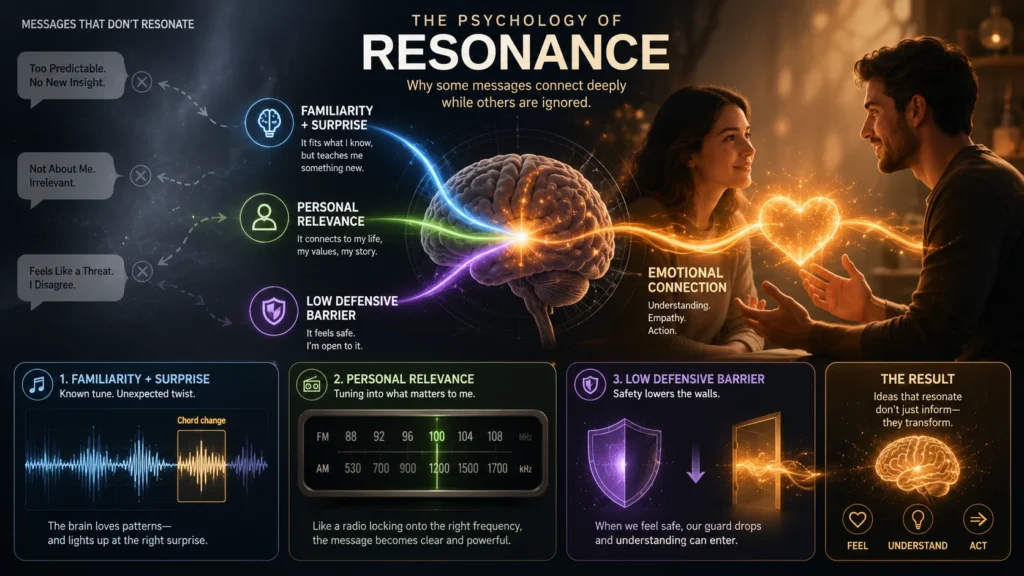
You’ve felt resonance. But have you ever wondered why one sentence hits you like a truck and another slides off like water on wax?
Psychologists and neuroscientists have studied this. The answer isn’t magic. It’s a recipe with three ingredients.
Ingredient 1: Familiarity Plus Surprise
Your brain loves patterns. It also loves small violations of those patterns. Too familiar = boring. Too surprising = confusing. The sweet spot is comfortably novel.
Think about your favorite song. You’ve heard it fifty times. But there’s one little chord change or one specific lyric that still gives you chills. That’s the surprise inside the familiar.
Same with words. When someone describes a feeling you know well but uses a metaphor you’ve never heard that tension creates resonance.
Example: “Grief is like having a broken leg that never heals. Some days you forget about it. Then you step wrong and the pain is exactly the same.”
You know grief. You’ve never heard that exact broken leg metaphor. That’s familiarity plus surprise.
Ingredient 2: Personal Relevance
Resonance isn’t universal. A story about the exhaustion of new parenthood will resonate with a sleep-deprived mom. It won’t resonate with a college student who’s never held a baby.
That doesn’t mean the story is bad. It means resonance requires matching.
Think of radio frequencies. You can broadcast the clearest signal in the world. But if your listener’s dial is on a different station, they hear nothing but static.
Here’s what creates personal relevance:
- Shared life stage (parenthood, grief, starting a career, divorce)
- Shared values (honesty, ambition, kindness, justice)
- Shared struggles (anxiety, loneliness, financial stress, imposter syndrome)
When a message matches your current life, your brain pays attention. When it matches your deeper values, your body pays attention.
Ingredient 3: Low Defensive Barrier
This is the one most people ignore. And it might be the most important.
You can have a familiar, surprising, personally relevant message. But if it makes someone feel attacked, judged, or shamed, it won’t resonate. It will bounce off.
Resonance requires safety.
Example of a message that fails:
“You fail because you’re lazy. You need to work harder.”
That might be true for some people. But it won’t resonate. It raises defenses. The listener thinks, You don’t know my situation. You’re not being fair.
Example of a message that resonates:
“I failed three times before I got it right. Each time I wanted to quit. I’m not special. I just didn’t stop.”
Same general idea (failure + persistence). But this version doesn’t attack. It shares. The listener thinks, That could be me. Maybe I’m not broken.
Low defensive barrier means:
- No blaming
- No shaming
- No “you should”
- Lots of “I struggled too”
- Vulnerability before advice
People don’t resonate with perfection. They resonate with honest struggle.
How to Use “Resonate” in a Sentence Without Sounding Pretentious
Let’s fix the most common errors. Once you learn these patterns, you’ll sound natural, not like a walking thesaurus.
The Golden Rule
Ideas resonate WITH people. People do NOT “resonate” ideas.
- ✅ Correct: That speech resonated with me.
- ❌ Incorrect: I resonated with that speech.
- ✅ Correct: Her story resonated with the whole team.
- ❌ Incorrect: The whole team resonated with her story.
Think of it this way. The idea has the power. The idea sends out the frequency. You’re the tuning fork that picks it up. So the idea does the resonating. You receive it.
More Correct Examples
The poem about moving to a new school resonated with the class because many had felt lonely too.
His comment about burnout didn’t resonate with me. I actually love my job.
Find a mission that resonates with your deepest values. Otherwise you’ll burn out.
That advertisement fell flat. Nothing resonated.
Common Mistakes to Avoid
| Mistake | Why it’s wrong | Fix |
|---|---|---|
| “I resonate with that.” | Grammatically backward | “That resonates with me.” |
| “This food resonates with my taste buds.” | Resonance is emotional, not physical preference | “This food reminds me of home.” |
| “The data resonates with our findings.” | Data doesn’t have emotional frequency | “The data matches our findings.” |
| “He resonates confidence.” | Wrong verb entirely | “He radiates confidence.” |
When Not to Use “Resonate” At All
Don’t force the word. Sometimes simpler is better.
Skip “resonate” when:
- You just like something. “This sandwich resonates with me” → “This sandwich is delicious.”
- You’re writing formal, neutral business reports. “The policy did not resonate with staff” → “Staff did not support the policy.”
- You’ve already used it twice in the same paragraph. Pick another word.
One more tip: If everything resonates, nothing does. If every movie, every speech, every tweet “resonates” with you, you’ve drained the word of its power. Save it for moments that actually move you.
The Tuning Fork Analogy
The tuning fork analogy isn’t just a cute comparison. It’s the most accurate way to understand the resonate meaning.
Let’s walk through it step by step.
The Physics
A tuning fork is a two-pronged metal tool. Hit it on a surface and it vibrates at a specific frequency. Middle C. A440. Whatever it’s tuned to.
Bring that vibrating fork close to another fork with the same frequency. The second fork will start vibrating too. No physical contact. Just invisible waves traveling through the air. Resonate meaning.
That second fork resonates.
The Human Translation
You are the second tuning fork. You have your own internal frequencies. Your fears. Your hopes and your secret shames and your quiet joys.
A message, a story, or a person sends out a frequency. If that frequency matches one of your internal frequencies, you vibrate too. You feel it in your body.
That’s resonance.
Why This Analogy Matters for Communication
If you want your words to resonate with someone, you have two options.
Option 1: Guess their frequency.
Hard. Requires deep empathy and luck.
Option 2: Tune your own fork to a common frequency.
Easier. Stick to universal human experiences.
What are universal frequencies?
- Feeling unseen
- Wanting to belong
- Fearing loss
- Loving someone imperfectly
- Trying and failing and trying again
Write from those frequencies. Your reader’s fork will start humming before they even realize it.
Examples of Resonance in Literature, Marketing and Daily Life
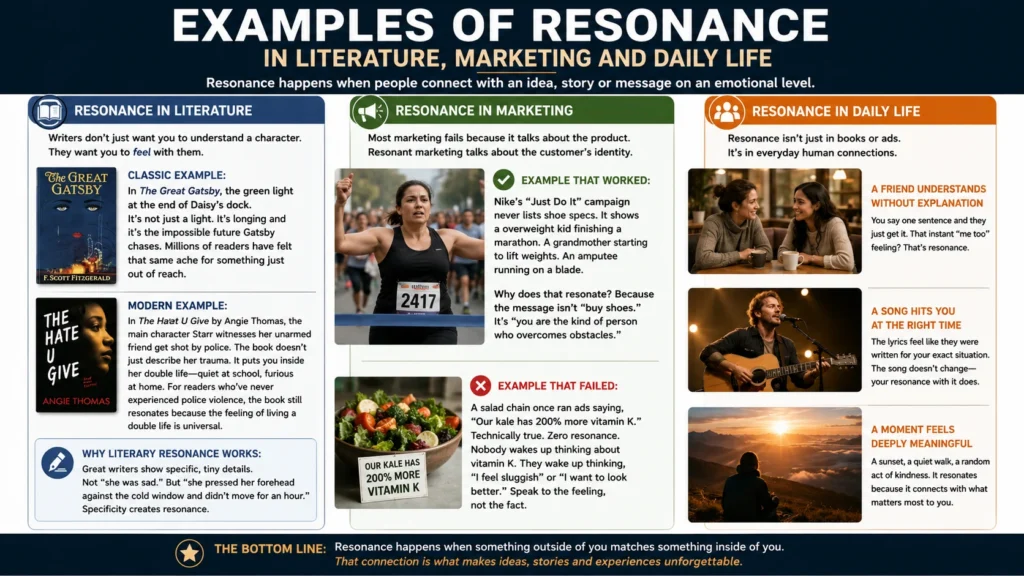
Let’s get concrete. Here’s how resonance shows up in three different worlds.
Resonance in Literature
Writers don’t just want you to understand a character. They want you to feel with them.
Classic example:
In The Great Gatsby, the green light at the end of Daisy’s dock. It’s not just a light. It’s longing and it’s the impossible future Gatsby chases. Millions of readers have felt that same ache for something just out of reach.
Modern example:
In The Hate U Give by Angie Thomas, the main character Starr witnesses her unarmed friend get shot by police. The book doesn’t just describe her trauma. It puts you inside her double life quiet at school, furious at home. For readers who’ve never experienced police violence, the book still resonates because the feeling of living a double life is universal.
Why literary resonance works:
Great writers show specific, tiny details. Not “she was sad.” But “she pressed her forehead against the cold window and didn’t move for an hour.” Specificity creates resonance.
Resonance in Marketing
Most marketing fails because it talks about the product. Resonant marketing talks about the customer’s identity.
Example that worked:
Nike’s “Just Do It” campaign never lists shoe specs. It shows a overweight kid finishing a marathon. A grandmother starting to lift weights. An amputee running on a blade. Why does that resonate? Because the message isn’t “buy shoes.” It’s “you are the kind of person who overcomes obstacles.”
Example that failed:
A salad chain once ran ads saying, “Our kale has 200% more vitamin K.” Technically true. Zero resonance. Nobody wakes up thinking about vitamin K. They wake up thinking, “I feel sluggish” or “I want to look better.” Speak to the feeling, not the fact.
Resonant marketing checklist:
- Does this mention the customer’s problem before the product’s feature?
- Does this make them feel understood, not sold to?
- Would they remember this tomorrow without a screenshot?
If yes, you have resonance.
Resonance in Daily Life
You don’t need literature or marketing to experience resonance. It happens in small moments every day.
A friend says, “I’m not okay” and you exhale because you haven’t been okay either.
A stranger on a podcast says, “I used to think confidence meant never being scared. Now I know it means being scared and doing it anyway.” You pause the episode and stare at the wall.
A four-year-old hands you a dandelion and says, “This is for you because I love you.” Your chest gets tight.
That’s resonance. No big words. No stage. Just a match between a message and your inner world.
Quick Reference| Resonate Meaning at a Glance
Here’s a cheat sheet for everything we’ve covered.
| Question | Short Answer |
|---|---|
| What does resonate mean? | Emotional echo. A message matches your inner world. |
| Is it the same as relate? | No. Relate is intellectual. Resonate is emotional + physical. |
| How do you pronounce it? | REZ-oh-nayt. Stress the first syllable. |
| Can people resonate things? | No. Ideas resonate with people. |
| What’s a good synonym? | Strike a chord, hit home, echo. |
| What’s an antonym? | Fall flat, leave cold. |
| When should I use it? | When something genuinely moves you not just when you like it. |
| When should I avoid it? | Formal neutral reports, simple preferences, or more than twice per page. |
FAQs
What does resonate mean in simple words?
It means something touches you emotionally because it feels true to your own life. Not because it’s logical. Because it’s real to you.
What does “resonate with me” mean?
It means I felt a personal connection. The message wasn’t generic. It felt like it was speaking directly to my specific experience or feeling.
How do you use resonate in a sentence for students?
“The poem about moving to a new school resonated with the class because many had felt lonely too.”
What’s the difference between resonate and strike a chord?
They’re synonyms. “Strike a chord” comes from music. It’s slightly more informal. Use either one. Just don’t say “strike a resonance.”
Why do some messages resonate more than others?
They hit on universal emotions (fear, hope, loss, belonging). They feel authentic not manufactured. And they arrive with a low defensive barrier. No judgment. Just shared experience.
Is resonate a formal word?
It’s neutral. You can use it in casual conversation (“That really resonated with me”) or in professional writing (“The campaign resonated with young voters”). It’s not too fancy. Just don’t overuse it.
Can a place resonate with someone?
Yes. “The old library resonated with me. I spent every summer there as a kid.” The place triggers memories and feelings. That counts as resonance.
Can a song resonate without lyrics?
Absolutely. Instrumental music resonates through melody, rhythm, and harmony. You might feel sad during a minor-key piano piece without a single word. That’s pure emotional resonance.
Conclusion
You’ve read thousands of words about the resonate meaning. But here’s the only part you really need to remember.
Resonance lives in your body.
You don’t think your way into it. You don’t argue yourself into feeling it. It happens or it doesn’t. And when it does, you know. Your breath catches. Your eyes sting and your chest says yes before your brain finishes the sentence.
Don’t use “resonate” to sound smart. Use it when you actually feel that internal hum. When a line in a book, a lyric, a conversation, or even a single sentence makes you pause and think, Yeah.
That’s resonance. That’s the real meaning.
Now you know it. Don’t misuse it. And next time you feel it, name it. Say to yourself, That resonated.
Discover More Related Articles:
- “YN” Mean on TikTok: You’ve Seen It Everywhere In 2026
- “HN” Mean in Text: Here’s What It Really Means in Text In 2026
- “FML” Mean in Text: The Truth Behind This Popular Expression In 2026