


PTO (Paid Time Off) is a workplace policy that combines vacation, sick leave, and personal days into a single bank of paid hours you can use for any reason. You earn or receive a set number of days per year and can take them for a vacation, a doctor’s appointment, or just a mental health day without having to explain yourself.
You’ve seen the letters on a calendar. “PTO” sits there in bold, blocking off a Tuesday or a full week. You get an email from a coworker: “Out on PTO, back Monday.” Another message pings in Slack: “Last day before PTO send me anything urgent.”
Everyone seems to know what it means. But does PTO mean the same thing in every situation? Not exactly.
In most workplaces, PTO stands for Paid Time Off. It’s a single bank of hours you can use for vacation, sick days, or personal errands. But in a text message? It could mean something else entirely. And inside an HR policy, the rules around PTO can get surprisingly complex.
This guide breaks down the real PTO meaning at work, in chat slang, in business emails, and inside actual employee handbooks. No fluff. Just clear definitions, real numbers, and practical advice you can use.
What Does PTO Mean?
Let’s start with the obvious but important part. PTO full form is Paid Time Off. That’s the gold standard definition in business, HR, and almost every professional setting.
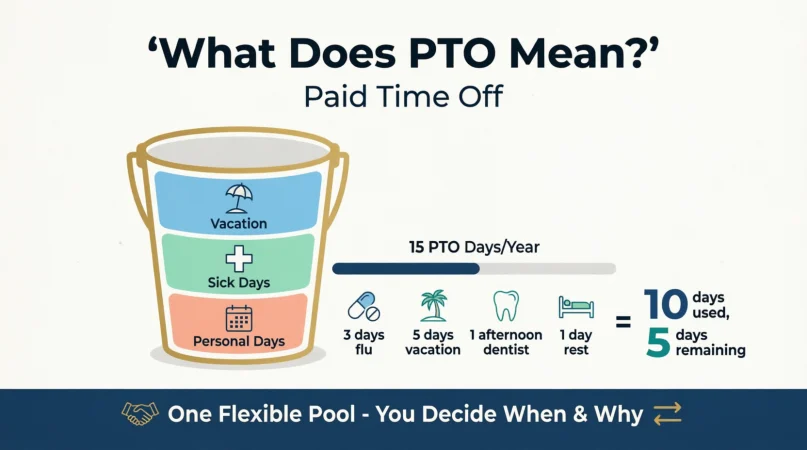
Here’s how it works. Instead of separating sick days from vacation days from personal days, a company rolls them into one bucket. You get a certain number of hours per year. You use them for whatever you need.
A simple example: Your job gives you 15 PTO days per year. You take three days for a flu, five days for a beach vacation, one afternoon for a dentist appointment, and another day just because you’re tired. That’s ten days total. You still have five left. All from the same pool.
That flexibility is the whole point of PTO. It treats you like an adult. You decide when you need time off and why.
PTO meaning in its purest form: paid leave you control, no questions asked (within reasonable policy limits).
PTO Meaning at Work | The HR Perspective
When you ask “what does PTO mean” in a job interview or an employee handbook, you’re really asking about money, freedom, and policy. Let’s unpack each piece.
How Does PTO Work in a Real Company
Most companies don’t just hand you all your PTO days on January 1. Some do, but most use a system called accrual.
Accrual means you earn PTO gradually as you work. For every hour you work, you get a small fraction of PTO time. A typical rate looks like this:
- Full-time employee (40 hours/week): Earns about 3 to 5 hours of PTO per week
- That works out to: Roughly 2 to 2.5 weeks per year for the first few years
Some employers front-load PTO instead. You get all your days on day one of the year. Then you use them as you go. If you leave mid-year, the company might deduct the unused, unearned portion from your final paycheck.
Real-world fact: According to the Bureau of Labor Statistics, private sector workers with paid leave average about 10 days after one year of service. After five years, that jumps to 15 days. After ten years, 17 days. And after twenty years? 20 days on average.
Bold truth: PTO isn’t a federal right in the United States. No federal law requires any paid vacation or paid sick days. Your PTO exists entirely because your employer chooses to offer it or because your state forces them to.
Unused PTO Rules | What Happens to Leftover Days
This part catches people off guard constantly. You finish the year with eight unused PTO days. Do you lose them? Get paid for them? Roll them over?
The answer depends on three things:
- Your employer’s written policy
- Your state laws
- Whether you quit or get fired
Use it or lose it policies are legal in many states but not all. California, Colorado, Montana, and Nebraska require employers to pay out unused, accrued PTO when you leave. New York? No such law. Illinois? Also no.
Here’s a simple breakdown:
| State | Payout Required on Departure? | Use-It-or-Lose-It Legal? |
|---|---|---|
| California | Yes | No |
| Colorado | Yes | No |
| New York | No | Yes (with notice) |
| Texas | No | Yes |
| Illinois | No | Yes |
| Montana | Yes | No |
If your company has a no cap on rollover, you can stockpile PTO for years. Some employees bank 300+ hours. But that creates a huge liability on the company’s books. That’s why many employers cap rollover at 1.5 times your annual accrual.
PTO vs Sick Leave | What’s the Real Difference
This comparison matters because some companies still keep sick leave separate from PTO. And that changes everything.
Traditional separate systems:
- Vacation days = 10 per year. Use them for fun or don’t use them at all.
- Sick days = 5 per year. Use them only for illness or doctor visits.
- Personal days = 2 per year. Use them for anything else.
PTO system:
- 15 days total. Use them for anything. No questions.
| Feature | PTO (Paid Time Off) | Separate Sick Leave |
|---|---|---|
| Use for vacation | Yes | No |
| Use for illness | Yes | Yes |
| Use for mental health day | Yes | Rarely allowed |
| Use for family event | Yes | No |
| Rollover common | Sometimes | Often required by law |
| Payout on departure | Depends on state | Rarely |
Why do employers switch to PTO? Simplicity. One policy. One tracking system. One set of rules. Employees like it too because they don’t have to lie about having a “stomach bug” to take a day off.
How Many PTO Days Are Normal in the US
Let’s get specific with numbers. No vague “it varies” answers.
First year on the job:
- 10 days (2 weeks) is standard
- 15 days is generous
- 5 days is stingy but legal
Three to five years:
- 15 days becomes typical
- Some companies bump you to 18
Five to ten years:
- 15 to 20 days is normal
- Top companies offer 25 at this tier
Ten to fifteen years:
- 20 to 25 days
- Senior individual contributors often hit 25
Executive level:
- 25 to 30+ days
- Plus unlimited PTO policies (more on that below)
Bold fact: The US has no federally mandated paid vacation. Compare that to the European Union, where all 27 member countries require at least 20 paid vacation days by law. France requires 30. The UK requires 28 (including public holidays).
So when you ask “how many PTO days are normal,” the real answer is “whatever your employer decides” but competitive companies offer 15 to 20 days to attract talent.
PTO Meaning in Chat, Text and Email
Not every “PTO” lives inside an employee handbook. You’ll see this abbreviation in texts, DMs, and emails too. The meaning shifts slightly, but not as much as you might think.
Meaning of PTO in Text | The Informal Slang
You get a text from a friend: “Can’t tonight. PTO tomorrow and I’m heading out of town.”
They almost certainly mean Paid Time Off. The same workplace definition. People use work abbreviations in casual conversation all the time. “Ugh, my PTO request got denied.” “Saving my PTO for December.”
Rare alternative meanings in chat:
- Please Turn Over (old school you’ll only see this on physical documents)
- Permission to Operate (engineering and industrial settings)
But 95% of the time, meaning of PTO in text is still Paid Time Off. Don’t overcomplicate it.
PTO Meaning in Email | What to Write and What to Avoid
Email is where PTO usage gets formal again. But too formal sounds robotic.
Good email example:
Subject: Out on PTO May 10–14
I’ll be on PTO starting Wednesday. Back in the office Monday the 17th. For urgent issues during that time, please reach out to Jane in accounting. Thanks.
Bad email example (too stiff):
Subject: Notification of Paid Time Off Utilization
Please be advised that I will be availing myself of my accrued paid time off benefits from May 10 through May 14. Kindly direct all inquiries to the appropriate delegate.
Don’t write like that second example. Just say “On PTO.” Everyone understands.
One pro tip: Always include coverage info. Tell people who to contact while you’re gone. That small courtesy saves everyone frustration.
PTO Meaning in Business and HR Policy | The Legal Reality
Now we get into the weeds. Because PTO stands for what in a legal document? And how does it interact with state and federal leave laws?
PTO Abbreviation Meaning | What HR Actually Tracks
Inside an HR system, PTO isn’t just a word. It’s a liability. Every earned PTO hour sits on the company’s balance sheet as money they’ll owe you someday. Big companies with thousands of employees track millions of dollars in unpaid PTO.
What HR tracks for each employee:
- Accrual rate per pay period
- Total PTO earned year to date
- PTO used year to date
- Current available balance
- Maximum cap on rollover
- Expiration dates for use-it-or-lose-it policies
- PTO payout rate (usually your current hourly wage)
That last one matters. If you get a raise, your unused PTO becomes more valuable. Some employees strategically save PTO through a promotion, then cash out at the higher rate.
Paid Leave Policy USA | How PTO Fits with FMLA and State Laws
FMLA stands for Family and Medical Leave Act. It gives eligible employees up to 12 weeks of unpaid, job-protected leave per year. Serious health conditions. Birth of a child. Caring for a sick family member.
FMLA doesn’t pay you. It just holds your job.
Here’s where PTO connects. You can often use your accrued PTO during FMLA leave to get paid. For example, you take six weeks off for surgery. FMLA protects your job. Your PTO covers your paycheck for those six weeks.
State paid family leave programs add another layer. New York, California, Washington, Massachusetts, Connecticut, Oregon, Colorado, and a few others have their own paid leave systems. They run alongside PTO but have different rules.
| State | Paid Family Leave Duration | Weekly Pay Cap (2025) |
|---|---|---|
| California | 8 weeks | $1,620 |
| New York | 12 weeks | $1,131 |
| Washington | 12 weeks | $1,456 |
| Massachusetts | 12 weeks | $1,149 |
| Colorado | 12 weeks | $1,100 (est.) |
Bottom line: PTO is company policy. State and federal laws add extra protections on top. Always read your employee handbook and check your state labor website.
How to Use PTO at Work | Smart Strategies
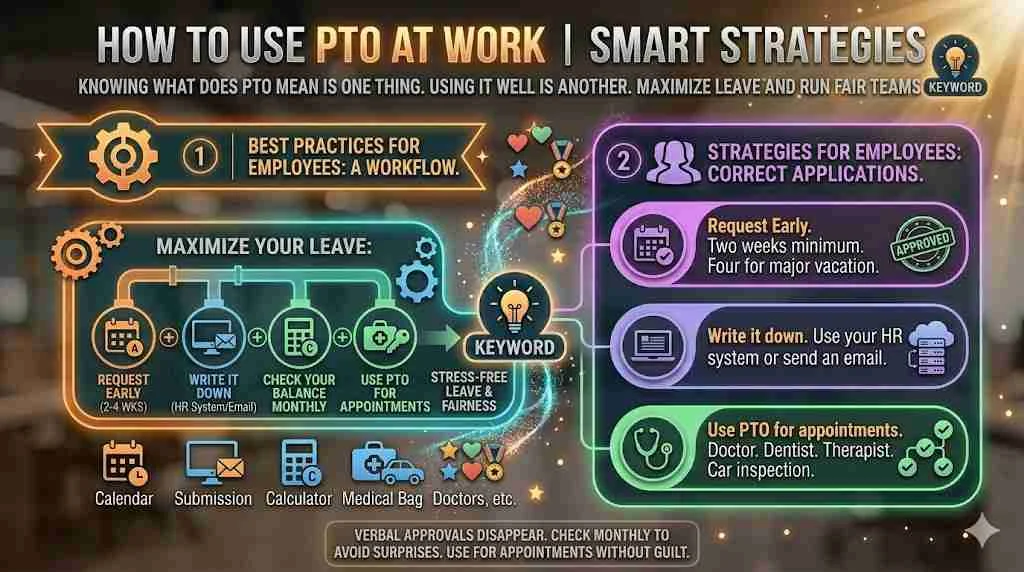
Knowing what does PTO mean is one thing. Using it well is another. These strategies help employees maximize their leave and help managers run fair teams.
Best Practices for Employees
Request early. Two weeks minimum. Four weeks for a major vacation. Last-minute PTO requests annoy managers and get denied more often.
Write it down. Use your HR system or send an email. Verbal approvals disappear from memory.
Check your balance monthly. Surprise negative PTO balances happen. Don’t let one sneak up on you.
Use PTO for appointments. Doctor. Dentist. Therapist. Car inspection if you work remote and need to step out. That’s exactly what PTO is for. Don’t feel guilty.
Don’t hoard unnecessarily. If your employer caps rollover at 40 hours, use everything above that. Losing earned time off is like throwing away money.
Schedule mental health days in advance. Put them on the calendar as “PTO personal” and take them guilt-free.
What Managers Need to Know About PTO
Approve fairly. If you deny one person’s request, you better have a solid business reason. Playing favorites destroys team morale.
Track proactively. Use your HR system’s reporting. See who hasn’t taken PTO in six months. Encourage them to take time.
Lead by example. Take your own PTO. Fully. Don’t answer emails. Don’t dial into meetings. Show your team that disconnecting is real.
Know state payout laws. If you manage someone in California and they quit, you must pay their unused PTO. If you don’t, the company faces penalties.
Unlimited PTO | What It Really Means
You’ve seen the job postings. “Unlimited PTO.” Sounds amazing, right? Take two months off. Travel the world. Come back refreshed.
The reality is different.
Unlimited PTO meaning: No set number of days. No accrual. No payout when you leave. You request time off, and your manager approves or denies it.
The catch: People with unlimited PTO often take less time than people with set PTO banks. Why? No benchmark. No “use it or lose it” pressure. And no guilt-free target.
Studies back this up. A study from the Society for Human Resource Management found that employees with traditional PTO took an average of 15 days off. Employees with unlimited PTO took only 10 days.
Bold truth: Unlimited PTO benefits employers more than employees. The company removes PTO liabilities from their books entirely. They owe you nothing when you leave. And they rely on social pressure to keep your time off reasonable.
If you have unlimited PTO, set your own target. Aim for 15 to 20 days. Schedule them early. Take them fully.
PTO Accrual Meaning | How to Calculate Your Real Rate
PTO accrual meaning is simple: how much PTO you earn per hour or per pay period.
Most companies calculate accrual weekly or bi-weekly. Here’s a real example.
You earn 15 days per year. That’s 120 hours (15 days × 8 hours). You work 52 weeks per year. So you accrue roughly 2.3 hours per week.
| Annual PTO Days | Total Hours | Weekly Accrual (40-hr week) |
|---|---|---|
| 10 | 80 | 1.54 hours |
| 12 | 96 | 1.85 hours |
| 15 | 120 | 2.31 hours |
| 18 | 144 | 2.77 hours |
| 20 | 160 | 3.08 hours |
| 25 | 200 | 3.85 hours |
Pro tip: Check if your employer allows partial day PTO usage. Many do. You can take two hours for a doctor’s appointment instead of burning a full day. That stretches your balance further.
FAQs
Is PTO paid leave?
Yes. The “P” in PTO stands for “Paid.” You receive your regular hourly wage or salary while on approved PTO.
What does PTO stand for in HR systems?
Paid Time Off. Same as everywhere else in business. Some older systems call it “annual leave” or “personal leave bank,” but PTO is the modern standard.
What is the difference between PTO and vacation?
Vacation is usually only for leisure travel or rest. PTO includes vacation plus sick time plus personal days. PTO is broader and more flexible.
Can my employer deny my PTO request?
Yes. Employers can deny PTO for legitimate business reasons like staffing shortages during a holiday week or a major deadline. But they can’t deny it unfairly based on discrimination or retaliation.
Do I lose my unused PTO when I quit?
Check your state law and your employee handbook. Some states require payout. Some don’t. And some companies voluntarily pay unused PTO even when not required. Never assume. Read your policy.
What does PTO mean in text from a coworker?
They’re telling you they’ll be out of the office on Paid Time Off. Don’t expect a reply until they’re back.
What is a good PTO policy for a small business?
Start with 10 days for first-year employees. Increase to 15 days after two years. Add 5 days after five years. No use-it-or-lose-it unless required by state law. Rollover up to 1.5 times annual accrual. That’s competitive for most industries.
Conclusion
PTO means Paid Time Off a single, flexible bank of paid leave hours you can use for vacation, sick days, personal appointments, or mental health breaks. In chat or text, assume the same definition unless context clearly says otherwise.
Know your company’s specific rules. Read your employee handbook. Check your state laws on payout and rollover. And most importantly use your PTO. That time belongs to you. Take it.
Discover More Related Articles:
- “A Burger and a Grape Snow Cone” Mean: in Social Media Slang Guide In 2026
- “Diddy” Meaning in Texting: When & How It’s Used In 2026
- “SMH” Mean in Text: Don’t Misuse This Acronym In 2026