

Ennui is a deep, weary dissatisfaction with life a hollow, listless ache where nothing feels worth doing. Unlike ordinary boredom that makes you restless for a new activity, ennui drains your desire to care about anything at all.
You pick up your phone. Swipe an app. Close it. Open another. Swipe again. Nothing feels right.
You aren’t sad. You aren’t angry. And you just feel… empty.
That strange, heavy stillness has a name. It’s ennui.
Most people confuse it with boredom. But boredom makes you restless. Ennui makes you still. It’s like sitting in a room where every wall is the same beige color. No exits. No windows. Just you and a quiet sense of “So what?”
This article walks you through the real ennui meaning, the psychology behind it, how to spot it in yourself, and most importantly what actually helps.
Let’s start with the definition.
What Ennui Really Means
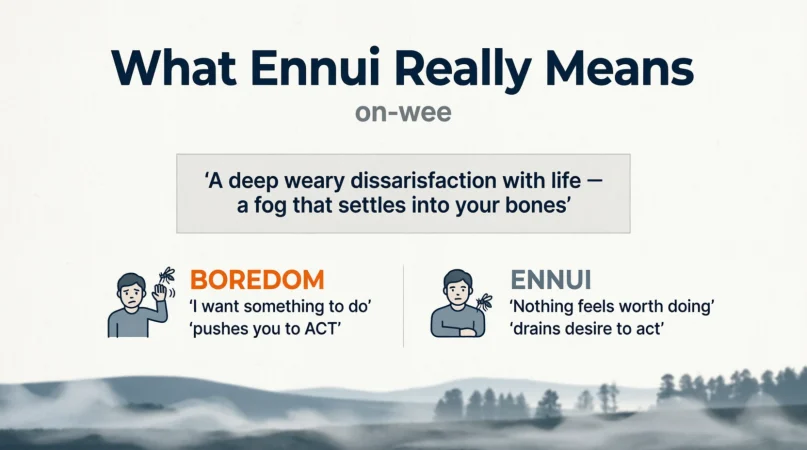
Ennui (pronounced on-wee) is a noun. It describes a deep, weary dissatisfaction with life. You feel a lack of meaning or stimulation. Not a temporary slump. More like a fog that settles into your bones.
Here’s the simplest breakdown:
- Boredom says: “I want something to do.”
- Ennui says: “Nothing feels worth doing.”
That difference matters. Boredom pushes you to act. Ennui drains your desire to act at all.
Think of it this way. Boredom is a mosquito buzzing in your ear. Annoying, but you’ll swat it. Ennui is realizing you don’t care if the mosquito bites you.
Quick Comparison| Boredom vs. Ennui
| Feeling | Duration | What you crave | Typical reaction |
|---|---|---|---|
| Boredom | Minutes to hours | A new activity, a distraction | You search for something fun |
| Ennui | Days to months | A reason to care | You lie on the couch staring at the ceiling |
The French Root You Should Know
The word ennui comes from Old French enui. That originally meant “annoyance” or “trouble.” Over time, the meaning deepened. By the 1700s, English speakers borrowed it to describe a more existential ache.
Here’s a fun twist. The same Latin root (inodiare, meaning “to make loathsome”) gave us the English word annoy. So ennui and annoyance are distant cousins. But where annoyance flares up and fades, ennui settles in for a long stay.
How Ennui Actually Feels
Let’s get specific. You can’t fix what you can’t name. And you can’t name it if you don’t recognize the symptoms.
People experiencing ennui often report these sensations:
- You wake up tired. Eight hours of sleep didn’t help.
- You start a hobby. Ten minutes later, you drop it.
- You scroll social media and feel nothing. No envy. No joy. No outrage.
- You ask yourself “What’s the point?” at least once a day.
- You lose excitement for things you used to love. Pizza? Video games? That trip you planned? Meh.
A Small Anecdote
Imagine you order your favorite meal. Let’s say it’s a spicy ramen. You loved it last week. You craved it yesterday. Tonight, it arrives at your table. Steam rises. It smells perfect.
But you just stare at it.
You take one bite. It tastes fine. But the feeling isn’t there. You put down your chopsticks. Not because you’re full. Because you don’t care.
That’s ennui.
Ennui vs. Depression | A Critical Difference
Some people worry ennui means they’re depressed. Not always. Here’s the distinction:
Depression often includes:
- Guilt or worthlessness
- Changes in appetite or sleep (too much or too little)
- Physical heaviness or slowness
- Thoughts of self-harm
Ennui can exist without those. You might eat normally. You might sleep fine. And you just feel… flat. Like the color has drained out of Tuesday afternoon.
Psychologists sometimes call this existential boredom or emotional fatigue. It lives in the gray zone between ordinary boredom and clinical depression.
Ennui Meaning in Psychology
You won’t find “ennui” in the DSM-5 (the manual therapists use to diagnose mental disorders). It’s not a clinical condition. But it is a recognized emotional state.
Researchers who study meaning in life often bump into ennui. One popular tool is the Meaning in Life Questionnaire (Steger and colleagues, 2006). People who score low on “presence of meaning” often describe feelings very close to ennui.
They say things like:
- “My life feels empty.”
- “I don’t understand what makes my life significant.”
- “Most days, I’m just going through the motions.”
Related Terms Psychologists Use
| Term | What it emphasizes |
|---|---|
| Existential boredom | Boredom tied to big questions (purpose, death, freedom) |
| Emotional fatigue | Feeling drained even without hard work |
| Chronic apathy | Long-term lack of interest or motivation |
| Anhedonia (mild form) | Reduced ability to feel pleasure |
Ennui sits right in the middle of these. Not quite any single one. But touching all of them.
Burnout vs. Ennui
People mix these up constantly. Let me fix that.
Burnout comes from too much. Too many hours. Too many demands. And too little recovery. You feel exhausted, cynical, and ineffective.
Ennui comes from too little. Too little meaning. Too little challenge. And too little novelty. You feel hollow, restless, and disconnected.
A burned-out nurse works double shifts and hates her job. A person experiencing ennui has a perfectly fine job but feels nothing while doing it. Different causes. Different solutions.
Where You’ve Seen Ennui Before
Writers and filmmakers love ennui. Why? Because it’s quiet. No car chases. No screaming fights. Just a person staring at a wall. And somehow that’s more unsettling.
Ennui in Literature
- Albert Camus’ The Stranger – The main character, Meursault, attends his mother’s funeral. He doesn’t cry. He doesn’t feel much at all. Later, he kills a man “because of the sun.” That’s not madness. That’s ennui warping a person’s relationship with consequence.
- Bret Easton Ellis’ Less Than Zero – Rich Los Angeles teenagers drift through parties, drugs, and sex. They feel nothing. The book opens with a line about people going to “see someone beat up.” That’s ennui as a cultural disease.
Ennui in Film
- Fight Club (the narrator) – Before Tyler Durden, the narrator suffers from textbook ennui. He buys furniture from catalogs. He watches his apartment burn. He says, “I felt like putting a bullet through the back of my skull.” That’s ennui with a desperate edge.
- Lost in Translation – Two Americans in Tokyo feel disconnected from everything. The luxury hotel. The weird TV commercials. Their own marriages. The whole movie drips with ennui.
Why Artists Keep Going Back to It
Ennui creates tension without loud noises. A character who feels nothing is unpredictable. They might do something wild just to feel alive. Or they might do nothing at all, which frustrates the audience. Both options make good drama.
How to Use “Ennui” in Real Life
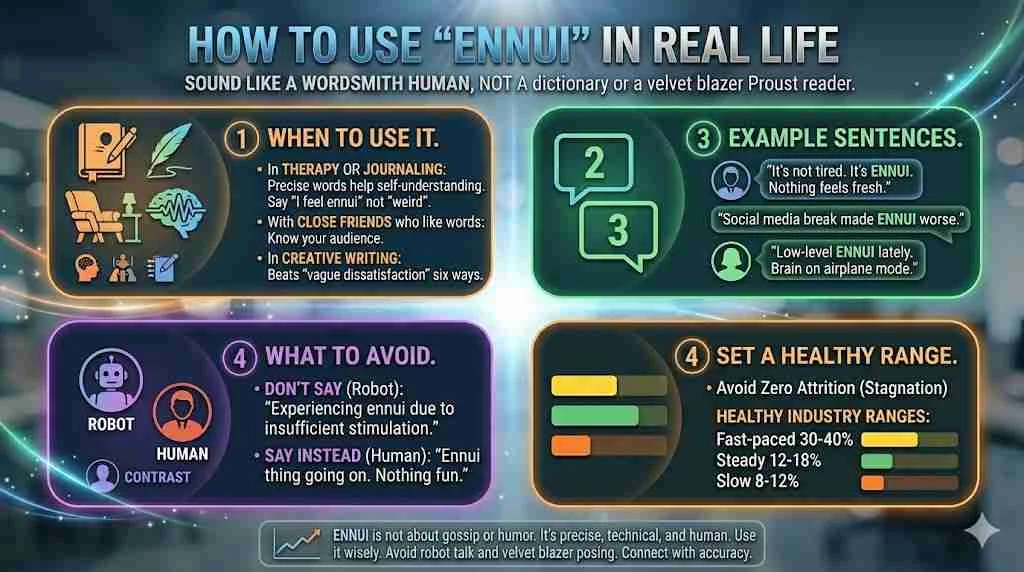
Let’s be honest. Dropping “ennui” at a party can make you sound like you own a velvet blazer and read Proust on purpose. But you can use it naturally. Here’s how.
When to Use It
- In therapy or journaling – Precise words help you understand yourself. Write “I feel ennui” instead of “I feel weird.”
- With close friends who like words – Some friends will appreciate the accuracy. Others will roll their eyes. Know your audience.
- In creative writing – Ennui beats saying “a vague sense of dissatisfaction” six different ways.
Example Sentences
- “It’s not that I’m tired. It’s ennui. Nothing feels fresh.”
- “After I quit social media for a week, my ennui actually got worse. That surprised me.”
- “I’ve just got this low-level ennui lately. Like my brain’s on airplane mode.”
What to Avoid
Don’t say: “I am currently experiencing ennui due to insufficient stimulation.”
Say this instead: “I’ve got this ennui thing going on. Nothing seems fun.”
See the difference? One sounds like a robot filing a complaint. The other sounds like a human talking to a friend.
The Science of Breaking Ennui
You want practical help. Not philosophy. So let’s get real about what actually moves the needle.
First, let me save you some time.
What Doesn’t Work
- Binge-watching more shows – You’ll feel worse afterward. Passive consumption feeds ennui.
- Endless scrolling – Short, meaningless dopamine hits make the hollow feeling deeper.
- Forcing positivity – Telling yourself “Just be grateful!” when you feel nothing creates shame. Not relief.
- Waiting for motivation – Ennui kills motivation first. If you wait for it to come back, you’ll wait forever.
What Actually Helps
Do one weird thing.
Walk backward for sixty seconds. Eat breakfast for dinner. Brush your teeth with your non-dominant hand. Small novelty interrupts the mental loop of “everything is the same.”
Create a tiny win.
Make your bed. Send one email you’ve been avoiding. Wash three dishes. Don’t aim for a full clean. Just one small action. Action creates momentum. Momentum fights apathy.
Change your physical environment.
Move your desk to face the window. Rearrange your living room. Put a different lamp on your nightstand. Your brain associates spaces with moods. Change the space, and you loosen the mood’s grip.
Try low-stakes risk.
Order food you’ve never tried. Take a different route home. Say hello to a stranger. Ennui thrives on predictability. Small risks reintroduce uncertainty. Uncertainty wakes your brain up.
Add a third place.
Sociologists call it a “third place” somewhere that isn’t work and isn’t home. A library. A climbing gym. A coffee shop where you know the barista’s name. Ennui often grows in isolation. Third places force low-pressure social contact.
A Quick Table of Actions vs. Results
| Action | Why it helps | Time needed |
|---|---|---|
| Walk backward for 1 minute | Breaks routine, forces novelty | 1 minute |
| Make your bed | Creates immediate sense of control | 2 minutes |
| Visit a new coffee shop | Changes environment, adds low-stakes social contact | 30 minutes |
| Try one new recipe | Engages creativity and senses | 45 minutes |
| Delete one app for 24 hours | Removes passive scrolling, creates boredom that leads to action | 5 seconds + 24 hours |
When Ennui Becomes Something Else
Most ennui passes. A few days or weeks of flatness doesn’t mean something is broken. But sometimes the feeling sticks around. And it changes.
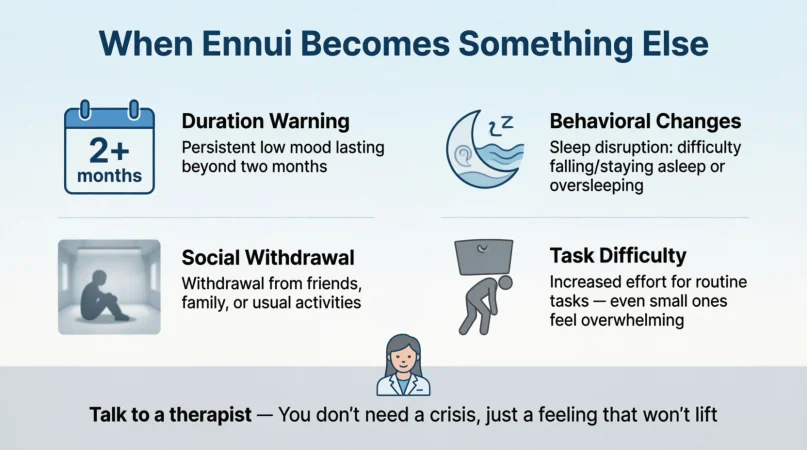
Watch for these warning signs:
- You’ve felt hollow for more than two months straight.
- Your sleep or eating habits shift significantly.
- You’ve stopped seeing friends entirely (not just less often).
- You think about death not with fear but with relief.
- Small tasks feel impossibly heavy.
If any of those sound familiar, talk to a therapist. Ennui can mask mild depression or dysthymia (persistent depressive disorder). A good therapist helps you untangle the two.
You don’t need a crisis to see a therapist. You just need a feeling that won’t lift. That’s enough.
FAQs
1. What does ennui mean in simple words?
Ennui means a feeling of emptiness and listlessness. You aren’t sad or angry. You just don’t care about much. Nothing excites you. Nothing feels worth doing. It’s like your emotional engine stalled but didn’t break down.
2. How is ennui different from boredom?
Boredom makes you restless. You want something to do. You might fidget or check your phone. Ennui makes you still. You don’t even want to want something. Think of boredom as a scratchy sweater. Annoying but easy to change. Ennui is realizing you don’t care what you wear.
3. Is ennui a mental health condition?
No. You won’t find ennui in the DSM-5 (the mental health diagnostic manual). It’s a normal emotional state, not a disorder. But chronic ennui can overlap with mild depression or dysthymia. If the hollow feeling lasts more than two months and affects your sleep or appetite, talk to a therapist.
4. How do you pronounce ennui correctly?
Say “on-wee.” The first syllable rhymes with “gone” but drops the G sound. The second syllable sounds like “we” as in you and me. Not “en-you-eye.” Not “enn-oo-ee.” Just on-wee. Say it three times fast. Now you sound French. Congratulations.
5. Can children experience ennui?
Yes but adults usually call it something else. A child who says “I’m bored” but rejects every activity suggestion might feel early ennui. Kids don’t have the vocabulary for existential emptiness yet. So they whine or flop onto the floor dramatically. Same feeling. Different outfit.
6. What’s the fastest way to snap out of ennui?
Do one small, weird thing right now. Stand up and spin in a circle. Put your left shoe on your right foot. Text a friend a single emoji with no explanation. Novelty breaks the loop. Ennui hates surprises. You don’t need a big life change. You just need one tiny crack in the routine.
7. Why do French words like ennui sound more serious than English ones?
French carries cultural weight for English speakers. We borrowed “ennui” in the 1700s when French was the language of sophistication. So “ennui” sounds deeper than “boredom” even though the root feeling exists everywhere. Call it a fancy label for a very ordinary human ache.
Conclusion
Here’s what I want you to remember.
Ennui means your brain is sending you a signal. Not a threat. Not a diagnosis. A signal.
The signal says: “This routine isn’t feeding me.” That’s useful information. You don’t fight a signal. You listen to it. Then you make small, weird, active changes until the signal fades.
You don’t need a vacation. And you don’t need to find your “passion.” You just need one tiny break in the pattern. Walk backward. Make your bed. Eat breakfast for dinner. See what shifts.
Now you have the word. You have the framework. And you have a few things to try.
Discover More Related Articles:
- “A Burger and a Grape Snow Cone” Mean: in Social Media Slang Guide In 2026
- “Diddy” Meaning in Texting: When & How It’s Used In 2026
- “SMH” Mean in Text: Don’t Misuse This Acronym In 2026