
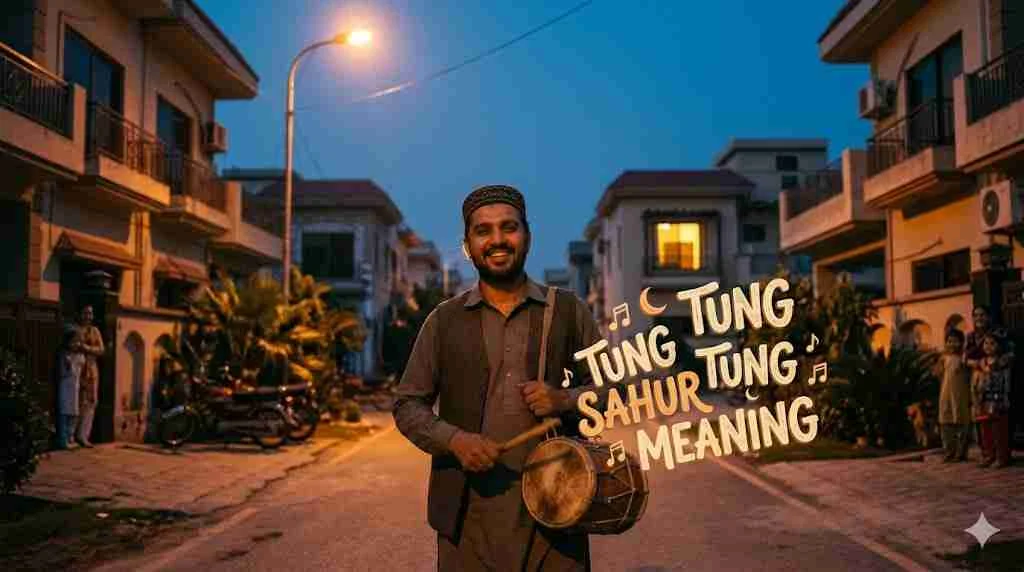

Tung tung tung sahur means the sound of a wooden drumbeat (“tung tung tung”) followed by a call to eat the pre-dawn meal (“sahur”) during Ramadan. It refers to a real Indonesian and Malaysian waking tradition where a neighborhood drummer walks the streets at 4 AM, and it later became a viral TikTok meme about the panic of oversleeping for the fast.
You have heard the sound on your For You page. Tung. Tung. Tung. Then a cheerful shout: “Sahur!”
If you do not celebrate Ramadan, the phrase probably sounds like nonsense. Three drum beats plus a word you have never heard. But for millions of Muslims across Indonesia, Malaysia, Brunei, and beyond, those three little taps mean something huge. three rings before sahur.
Tung tung tung sahur is not just a meme. It is not just a TikTok sound. It is a centuries-old waking call wrapped in modern internet humor. three tungs before sahur.
This article breaks down everything. You will learn the real tung tung tung sahur meaning, the Islamic practice behind it, the drum tradition most outsiders miss, and how a neighborhood wake-up ritual became a global viral trend.
No fluff. No copy-paste definitions. Just the actual story.
What “Sahur” Actually Means

Before you can understand the drumbeat, you have to understand the meal.
Sahur Is the Pre-Dawn Meal
Sahur (also spelled suhoor or sehri) refers to the meal Muslims eat before dawn during Ramadan. Fasting starts at true dawn (Fajr prayer time) and ends at sunset. Between those hours, no food or drink passes the lips.
Sahur happens in the dark. Early. Quietly.
Most families wake up between 4:00 and 5:00 AM depending on their location and the time of year. They eat something simple. Dates. Rice. Eggs. Yogurt. A lot of water. Then they stop eating the moment the morning call to prayer finishes.
Why Sahur Matters So Much
The Prophet Muhammad himself emphasized sahur. A well-known saying (hadith) states: “Eat sahur, for indeed in sahur there is blessing.”
That blessing is both spiritual and physical.
| Aspect | Why Sahur Helps |
|---|---|
| Physical | Gives your body slow-burning energy for the long day ahead |
| Spiritual | Follows a prophetic tradition, so it earns extra reward |
| Practical | Prevents the extreme hunger headaches that ruin your afternoon |
| Social | Families sit together in the middle of the night, which rarely happens otherwise |
Skipping sahur is allowed but discouraged. Many first-time fasters skip it and regret the choice by 2 PM.
Sahur vs Iftar | Two Very Different Meals
People confuse these two all the time. Here is the simple difference.
- Sahur = pre-dawn meal. Eaten in darkness. Quiet. Fast preparation.
- Iftar = meal to break the fast at sunset. Loud. Celebratory. Often a feast.
You say “sahur” when you wake someone up. You say “iftar” when you pass the dates and water around at sundown.
So when someone shouts “Sahur!” at 4 AM, they are not wishing you a good morning. They are telling you: Eat now or you will suffer later.
The Drum Tradition Behind “Tung Tung Tung”
Now we get to the sound. Where does the “tung tung tung” actually come from?
The Musaharati | Your 4 AM Neighborhood Drummer
Long before smartphones, alarm clocks, or TikTok, Muslim communities used a very simple technology: a person with a drum.
This person is called a musaharati (from the Arabic word sahar, meaning pre-dawn). Their job is simple. Walk through the streets before sunrise. Bang a small hand drum. Shout “Sahur!” Wake people up.
The tradition exists across the Muslim world, but it looks different depending on where you go.
| Region | What the Musaharati Uses | Typical Call |
|---|---|---|
| Egypt | Large frame drum (tabl) | “Wake up to worship God” |
| Turkey | Double-headed drum (davul) | “Sahur is blessed, get up” |
| Indonesia/Malaysia | Small wooden drum (beduk or rebana) | “Tung tung tung… Sahur!” |
| Palestine | Voice + small drum | Calls names of neighbors as a joke |
In Indonesia and Malaysia, the drum often makes a sound that English speakers write as “tung.” It is a dry, wooden thud. Not a metallic ring. Not a sharp crack. Just a warm, deep tung.
Three fast beats. Pause. The shout.
Tung. Tung. Or Tung. Sahur!
That exact rhythm entered the internet’s brain and never left.
Why Three Beats? Why Not Two or Four?
Three-beat patterns show up across traditional drumming for one simple reason: they grab attention without sounding aggressive.
A single beat is easy to ignore. Two beats sound like a mistake. Four beats start to feel like a march. But three beats? It is short enough to repeat. Long enough to break through sleep. And the odd number keeps your ear guessing.
Some musaharati drummers switch it up. Five fast beats. Two slow ones. But the classic “tung tung tung” stuck because it mimics a heartbeat accelerating. You hear it, and something in your chest says move.
A Real Morning in Jakarta During Ramadan
Let me paint a picture for you.
It is 4:15 AM in a crowded neighborhood in South Jakarta. The air is cool and damp. A few roosters have already started. You hear a motorcycle pass in the distance.
Then you hear it. Tung. Tung. Tung.
Not loud. Not scary. Just… present.
The drummer walks slowly. He carries a small wooden drum slung over one shoulder. A teenage boy follows him carrying a plastic bag of snacks to sell. The drummer pauses in front of each house. Three beats. A soft “Sahur, bro.” Then he moves on.
Windows flick on. Kitchen lights glow yellow. Somewhere a kettle starts to whistle.
By 4:45 AM, the drummer is gone. The streets are empty again. And everyone who needed to eat already has.
That is the real tung tung tung sahur meaning. A sound that says you are not alone in this fast.
The TikTok Meme Meaning | How a Drum Beat Went Viral

Now for the part you probably came for. How did a neighborhood wake-up call become a global meme?
The Short Version
Between 2021 and 2023, TikTok users in Indonesia and Malaysia started posting videos using a remixed “tung tung tung sahur” sound. The sound combined the real drumbeat with a deep bass boost and sometimes a comedic yell.
The videos followed a simple formula:
- Person sleeping peacefully in bed
- Tung tung tung plays
- Person’s eyes snap open
- Cut to them sprinting to the kitchen
- Caption: “When you hear the drummer but you only have 3 minutes before imsak”
Imsak is the time when fasting begins. If you miss sahur, you face a very long day with an empty stomach.
The Most Viral Examples
Here are three real meme formats that exploded.
- The Overreactor – Someone slams their hand on a table or wall to the beat of tung tung tung. Each “tung” gets louder and more aggressive. Final “sahur” is screamed.
- The Guilty Sleeper – A split screen. Top half shows a person pretending to sleep. Bottom half shows a clock ticking down. Tung tung tung plays. The person does not move. Caption: “Me pretending I didn’t hear so I can stay in bed.”
- The Wrong Audience – A non-Muslim friend tries to join the trend by yelling “tung tung tung sahur” at random times. The Muslim friend stares at the camera. Caption: “It’s 3 PM. Stop.”
None of these videos make fun of Ramadan. Instead, they make fun of themselves for oversleeping, overreacting, or treating the drummer like a jump scare.
Why This Meme Works So Well
Memes die fast on TikTok. A sound trends for two weeks, then disappears forever. But “tung tung tung sahur” keeps coming back every Ramadan. Here is why.
| Reason | Explanation |
|---|---|
| Relatable panic | Everyone has overslept for something important |
| Specific but universal | You do not need to be Muslim to understand “late = bad” |
| Built-in sound effect | The drumbeat is instantly recognizable and easy to remix |
| No gatekeeping | Muslim creators started the trend, so it feels authentic |
| Seasonal return | Ramadan moves each year, so the meme feels fresh again |
The best memes do not explain themselves. They just make you feel something. And “tung tung tung sahur” makes you feel a very specific kind of oh no.
Is the Meme Disrespectful? An Honest Answer
You might worry. Are these videos making fun of Islam? Should non-Muslims avoid the sound?
Let me give you a direct answer.
Most Muslims Find It Funny
I have watched dozens of reaction videos from Indonesian, Malaysian, and Arab creators. The overwhelming response is positive.
- “That is literally what my neighborhood sounds like every morning.”
- “Finally someone made a meme about our weird traditions.”
- “I showed this to my grandma and she laughed so hard she cried.”
Laughter is not disrespect. Laughing with your culture is healthy. Laughing at it can hurt. And this meme clearly falls into the first category.
Where the Line Is
Hypothetically, someone could take the sound and use it to mock fasting or Ramadan. That would cross a line. But I have not seen that happen at scale.
If you are a non-Muslim wondering you can use the sound, here is a simple test.
- Are you using it to show you overslept? Fine.
- Are you using it to say “haha Muslims wake up early for no reason”? Not fine.
- Did a Muslim friend share the meme with you first? Probably fine.
- Are you adding disrespectful text or symbols? Stop.
A Real Quote from a Reddit Thread
On r/indonesia, a user wrote this in 2022:
“I’m Muslim and I love the tung tung tung meme. That sound has been waking me up since I was a kid. Seeing it go viral feels like the world finally noticed something cool about our culture.”
That is the consensus. It is not mockery. It is recognition.
One-Sentence Summary for Different Audiences
Sometimes you just need a quick answer. Here is the tung tung tung sahur meaning broken down by who you are talking to.
| If you are talking to… | Say this… |
|---|---|
| A non-Muslim friend | “Sahur is the pre-dawn meal during Ramadan. Drummers walk around at 4 AM making a tung tung beat to wake people up.” |
| A TikTok-obsessed teen | “It is a funny sound based on real Ramadan drummers. People use it to show the panic of sleeping through sahur.” |
| Someone worried about disrespect | “The meme came from Muslim creators laughing lovingly at themselves. It is fine.” |
| A language nerd | “Onomatopoeia for a wooden drum plus an Islamic ritual term equals viral cultural shorthand.” |
| A journalist writing a serious piece | “A traditional waking practice from Southeast Asian Ramadan rituals adapted into a seasonal internet meme.” |
No need to overcomplicate it. The phrase means exactly what it sounds like: a drumbeat followed by an invitation to eat before dawn.
The Deeper Cultural Meaning Most Articles Miss

We have covered the definition, the drum tradition, and the meme. But let me give you something most blog posts skip.
Sahur Is a Quiet Act of Defiance
Fasting is hard. Waking up at 4 AM to eat cold rice and drink water before the sun rises feels unnatural. But Muslims do it anyway. And the drum helps.
That tung tung tung sound is proof that you are not the only one struggling. Your neighbor is awake too. The guy three blocks down is also spooning yogurt into his mouth in the dark. The teenager with the drum walked through the rain just to make sure you did not sleep through it.
Community shows up in strange forms. Sometimes it looks like a potluck. Sometimes it looks like a shared calendar invite. And sometimes it looks like a man with a wooden drum walking past your house at 4 AM repeating the same three beats for the entire month.
The Meme Preserves the Tradition
Here is something ironic. TikTok might actually save the musaharati tradition.
Young people in Jakarta and Kuala Lumpur often see the live drummer as old-fashioned. A relic. Something their grandparents talk about. But when that same sound becomes a viral meme with millions of views, suddenly it feels cool again.
Teenagers who ignored the real drummer now film themselves reacting to the TikTok sound. Some even go outside to find the real drummer. They record him. They post the video. And the cycle continues.
A meme can be a preservation tool. Not always. But in this case, the tung tung tung sahur meaning shifted from “annoying wake-up call” to “culturally iconic sound” because of the internet.
What Non-Muslims Should Take Away
If you are not Muslim, you do not need to memorize hadith or learn how to fast. But understanding this phrase gives you a small window into a billion people’s lived experience.
When you hear tung tung tung sahur on TikTok, you are not hearing a random noise. You are hearing:
- A parent waking up their children
- A college student boiling water before dawn
- A grandmother smiling because the drummer remembered her house
- A tired person choosing to fast anyway
That is the real meaning. Everything else is just rhythm.
National “Tung Tung Tung Sahur” Day
“National Tung Tung Tung Sahur Day” is not an official holiday, but rather a fun, internet-style meme concept inspired by Ramadan traditions. The phrase “tung tung tung sahur” imitates the sound of drumming or knocking used in some Muslim communities to wake people up for sahur, the pre-dawn meal before fasting begins.
Online, people jokingly refer to it as a “national day” to celebrate the nostalgic and humorous side of waking up early during Ramadan. It has become popular in memes, short videos, and social media posts where users recreate or exaggerate the traditional sahur wake-up call.
Quick Reference Table | All Key Terms
| Term | Meaning |
|---|---|
| Sahur | Pre-dawn meal during Ramadan |
| Suhoor | Same as sahur (Arabic spelling) |
| Sehri | Same as sahur (South Asian spelling) |
| Imsak | The time when fasting begins (stop eating) |
| Musaharati | The person who drums to wake people for sahur |
| Tung | Onomatopoeia for a wooden drum strike |
| Beduk | Large drum used in Southeast Asian mosques |
| Rebana | Small handheld frame drum |
| Fajr | Dawn prayer time; marks the start of fasting |
| Iftar | Meal to break the fast at sunset |
FAQs
What does “tung tung tung sahur” mean in English?
“Drum beat – pre-dawn meal.” It translates to the sound of waking up for Ramadan fasting.
Is “tung tung sahur” a real song?
No. It is not a published song or a traditional composition. It is a meme based on a real drum pattern that musaharati players have used for generations. No single artist owns it.
Where did “tung tung tung sahur” come from?
The phrase and sound come from Indonesia and Malaysia. That is where the tung onomatopoeia for the drum is most common. The tradition itself exists across the Muslim world, but the specific spelling and viral sound trace back to Southeast Asia.
Can non-Muslims say “tung tung tung sahur”?
Yes, but know the context. You are referencing an Islamic practice. Use it playfully, not mockingly. If you say it to a Muslim friend during Ramadan, expect them to laugh or pretend to run to the kitchen.
Why three “tungs”? Why not four or two?
Three beats mimic the common triple pattern used by Southeast Asian drummers. It is short, attention-grabbing, and rhythmically satisfying. Odd-numbered patterns also feel more urgent than even ones.
What is the difference between sahur and suhoor?
Spelling only. Sahur is the Indonesian and Malay spelling. Suhoor is the Arabic-to-English spelling. Sehri is common in South Asia. They all mean the exact same meal.
Does the drummer still exist in real life?
Yes, but less than before. In large Indonesian cities, many neighborhoods replaced live drummers with mosque loudspeakers playing a recorded drum sound. However, in smaller towns and villages, the live musaharati tradition continues every Ramadan night.
Is there a specific time for sahur?
Sahur can happen any time after midnight and before true dawn (Fajr). Most people eat between 4:00 and 5:00 AM depending on their local sunrise. The cutoff time is called imsak, usually 10 minutes before the morning prayer.
What does “tung tung tung sahur” mean?
“Tung tung tung sahur” is an onomatopoeic phrase that imitates the sound of a drum or object being beaten to wake people up for sahur, the pre-dawn meal eaten by Muslims before fasting during Ramadan. In many South Asian and Southeast Asian cultures, people used to walk through neighborhoods beating drums or making rhythmic sounds saying things like “tung tung” to alert others that it was time to wake up and eat before Fajr (dawn prayer).
What does “tung tung tung sahar” mean?
“Tung tung tung sahar” is a sound-based phrase that imitates the rhythm of drumming or knocking used to wake people up for sahur (suhoor), the early morning meal eaten by Muslims before fasting during Ramadan. The “tung tung tung” represents the beating sound of a drum or metal object, and “sahar/sahur” refers to the pre-dawn meal time.
Conclusion
Tung tung tung sahur means a drumbeat wake-up call for the pre-dawn Ramadan meal. The sound comes from real musaharati drummers in Indonesia and Malaysia. The meme started on TikTok between 2021 and 2023 as a relatable joke about oversleeping for sahur. Most Muslims find it funny and culturally affirming. Non-Muslims can use it respectfully as long as they understand the context.
The next time you scroll past a video with that familiar tung tung tung, do not skip it. Listen for a second. Someone out there is laughing at their own 4 AM panic. And somewhere across the world, a real drummer is walking a dark street, keeping an old tradition alive one beat at a time.
Discover More Related Articles:
- “A Burger and a Grape Snow Cone” Mean: in Social Media Slang Guide In 2026
- “Diddy” Meaning in Texting: When & How It’s Used In 2026
- “SMH” Mean in Text: Don’t Misuse This Acronym In 2026