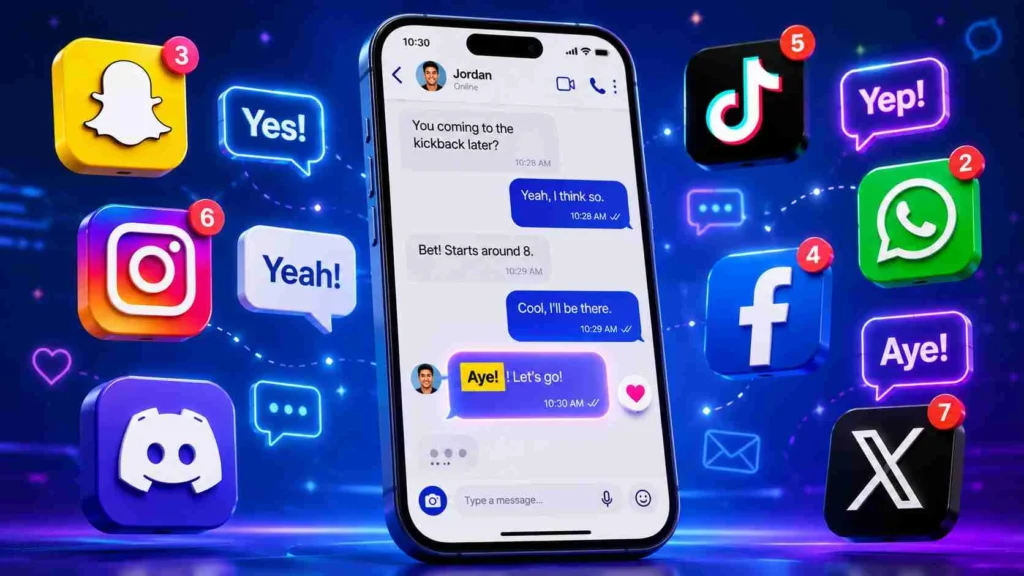

Aye is an informal English word that most commonly means “yes,” “I agree,” “okay,” or “I understand” in text messages, online chats, and social media conversations. Although it’s widely used as modern internet slang, aye is a real word with historical roots in British and Scottish English.
If you’ve received a message that simply says “aye,” you may wonder what the sender actually means. Is it another way of saying yes? Is it slang? Could it be a greeting, or does it carry a different meaning on social media?
The short answer is that aye usually means “yes,” “I agree,” or “I understand.” However, like many internet expressions, the meaning depends on the conversation, the relationship between the people chatting, and even the platform where it’s used.
You’ll see aye in text messages, gaming chats, online communities, and social media comments every day. Some people use it as a quick confirmation. Others use it to greet friends or get someone’s attention. In certain regions, it has been part of everyday speech for centuries. Online culture simply gave the word a new audience.
Understanding the aye meaning in text isn’t difficult once you see how people use it in real conversations. This guide explains every common meaning, where the word came from, how it differs from similar expressions, and when you should use it yourself.
What Does Aye Mean in Text?
The aye meaning in text is most commonly “yes.” It serves as an informal way to show agreement, acceptance, or confirmation during a conversation.
Unlike many modern texting terms, aye isn’t an abbreviation or acronym. It is a genuine English word that has existed for hundreds of years. The internet simply made it more popular among younger users and online communities.
When someone texts “aye,” they’re often responding positively without typing the full word “yes.” It feels casual, friendly, and relaxed.
For example:
Friend: Are you coming tonight?
You: Aye.
In this conversation, “aye” simply replaces “yes.”
Sometimes the word also means:
- I agree.
- Sounds good.
- That’s correct.
- I understand.
- I’m with you.
- Okay.
The exact meaning depends on what came before it.
Quick Definition
| Term | Meaning |
|---|---|
| Aye | An informal word meaning yes, I agree, okay, or I understand in text messages, chats, and conversations. |
Although the meaning looks simple, context changes everything. The same word can express excitement, confirmation, acknowledgment, or even serve as a greeting.
That’s one reason the word remains popular in digital communication.
Is “Aye” a Slang Word or a Real English Word?
Many people assume aye is internet slang because they first encounter it on Snapchat, TikTok, or Discord. In reality, it is much older than the internet.
The word has been part of the English language for centuries. Historically, it appeared in parliamentary voting, naval communication, and everyday speech in parts of Scotland, Northern England, and Ireland.
In traditional English, aye simply means yes.
Over time, online communities adopted it because it feels shorter, friendlier, and more expressive than typing “yes.”
Today, the word exists in two different worlds.
| Traditional Usage | Modern Internet Usage |
|---|---|
| Means “yes” | Means yes or agreement |
| Used in Scotland | Used worldwide |
| Formal voting and naval commands | Casual texting |
| Spoken conversation | Text messages and social media |
This makes aye both a legitimate English word and a modern internet expression.
Language constantly evolves. Words that once belonged to one region often spread worldwide through movies, music, gaming, and social media.
That’s exactly what happened with aye.
What Does Aye Mean in Texting?
The aye meaning in texting changes slightly depending on the conversation. While agreement remains the most common interpretation, people use it in several different ways.
Let’s explore the most common meanings.
Aye Means “Yes”
This is by far the most frequent use.
Instead of typing “yes,” many people simply write “aye.”
It sounds casual and natural.
Examples include:
A Person : Did you finish the assignment?
B Person : Aye.
Person A: Want pizza later?
Person B: Aye.
A Person : Are we meeting at eight?
B Person : Aye.
Each example uses the word exactly like “yes.”
Aye Means “I Agree”
Agreement goes beyond answering questions.
Sometimes someone shares an opinion, and another person responds with aye to show support.
For example:
Friend: That movie deserved the award.
You: Aye, it really did.
Friend: Summer is the best season.
You: Aye, definitely.
Here, aye expresses agreement instead of simply answering yes or no.
The tone feels supportive and conversational.
Aye Means “I Understand”
People also use aye to acknowledge information.
Imagine your friend explains the meeting schedule.
You reply:
Aye, got it.
This tells the other person that you’ve understood what they said.
You’ll often see this in:
- Team chats
- Workplace messaging
- Gaming communities
- Study groups
- Group conversations
It works almost like saying:
- Understood.
- Okay.
- Makes sense.
- I hear you.
Aye Means “Okay”
Sometimes the word doesn’t mean yes at all.
Instead, it simply acknowledges what another person said.
For example:
Mom: Dinner will be ready in twenty minutes.
You: Aye.
Friend: I’ll call you later.
You: Aye.
The response doesn’t necessarily express excitement.
It simply confirms the message was received.
Aye as Casual Acknowledgment
Many conversations don’t require a long response.
Instead of writing:
- Sounds good.
- I understand.
- Okay then.
- That’s fine.
People often reply with one simple word:
Aye.
Its simplicity makes conversations feel faster and more natural.
That’s one reason gamers and younger users prefer it.
Aye as a Way to Get Someone’s Attention
Interestingly, aye sometimes appears at the beginning of a message rather than the end.
For example:
Aye, listen to this.
Or:
Aye, guess what happened today?
In these situations, the word functions almost like:
- Hey.
- Yo.
- Listen.
- Excuse me.
The meaning shifts from agreement to grabbing someone’s attention.
Context tells you which interpretation fits.
Why “Aye” Feels More Personal Than “Yes”
Although both words share the same basic meaning, they create different impressions.
Compare these replies.
Reply One
Yes.
Reply Two
Aye.
The second response feels warmer and more conversational.
Many internet users prefer words that sound relaxed instead of formal.
That’s why casual alternatives continue growing in popularity.
Other examples include:
- Yeah
- Yep
- Yup
- Nah
- Yuppp
- Bet
- Sure
- For sure
“Aye” fits naturally into this group of informal responses.
Common Situations Where People Use Aye
You’ll encounter aye in many different conversations.
Some of the most common situations include:
| Situation | Example |
|---|---|
| Accepting an invitation | “Aye, I’ll come.” |
| Confirming plans | “Aye, see you then.” |
| Agreeing with an opinion | “Aye, you’re right.” |
| Answering a question | “Aye.” |
| Gaming chat | “Aye, ready.” |
| Group discussion | “Aye, sounds good.” |
| Classroom group project | “Aye, I’ll handle that part.” |
| Family conversation | “Aye, I’ll be home soon.” |
Notice how flexible the word is.
It works almost anywhere informal language is acceptable.
Why Has “Aye” Become So Popular Online?
Several factors explain why aye appears everywhere online today.
One reason is speed.
Shorter words make texting faster.
Another reason is personality.
Many people feel that “aye” sounds friendlier than “yes.”
Gaming communities also helped spread the word. Players often communicate quickly during matches, so brief responses become the norm.
Social media added another layer.
Creators on TikTok, Instagram, and streaming platforms frequently use regional speech, introducing millions of viewers to expressions they hadn’t heard before.
Music played a role as well.
Many hip-hop artists, rappers, and content creators casually say “aye” in songs and videos. Fans naturally adopt the same language in everyday conversations.
Over time, what started as a regional word became part of global internet culture.
Today, someone living thousands of miles away from Scotland might type aye every day without realizing the word has centuries of history.
How Context Changes the Meaning of Aye
One fascinating aspect of digital communication is that the same word can express different ideas depending on the situation.
Consider these examples.
| Text Message | Meaning |
|---|---|
| “Aye.” | Yes |
| “Aye, you’re right.” | I agree |
| “Aye, I understand.” | Acknowledgment |
| “Aye! Look at this!” | Getting attention |
| “Aye 😂” | Friendly excitement |
| “Aye lol.” | Casual response |
The surrounding words, punctuation, and even emojis influence the meaning.
That’s why experienced internet users rarely interpret slang based on a single word alone.
Instead, they read the entire conversation to understand the sender’s intent.
What Does Aye Mean on Social Media?
The aye meaning in text stays fairly consistent across social media platforms. In most cases, it still means “yes,” “I agree,” “okay,” or “I hear you.” However, every platform has its own communication style, which slightly changes how people use the word.
On fast-moving platforms, people prefer short replies over full sentences. That’s one reason aye has become so common. It saves time while still sounding friendly and expressive.
Here’s how people typically use aye across the biggest social media platforms.
Aye Meaning on Snapchat
Snapchat conversations are usually quick, casual, and personal. Most messages disappear after they’re viewed, so users often keep their replies as short as possible.
On Snapchat, aye commonly means:
- Yes
- Okay
- I agree
- Sounds good
- I saw your message
For example:
Friend: Wanna start a streak again?
You: Aye.
Friend: I’ll send the pictures tonight.
You: Aye, thanks.
Sometimes people begin a message with “Aye!” simply to grab someone’s attention.
For example:
Aye! Check your snaps.
In this case, the word acts more like “Hey!”
Aye Meaning on TikTok
TikTok has introduced countless slang words to millions of users, and aye is one of them.
In videos and comments, people use it to:
- Show agreement
- React to funny content
- Celebrate something exciting
- Join conversations
Examples include:
Aye, that’s actually true.
Aye 😂 I wasn’t expecting that.
Aye, this song is fire.
Many creators also say “Aye!” at the beginning of videos to immediately capture attention.
That energetic opening has become a recognizable style across entertainment content.
Aye Meaning on Instagram
Instagram combines messaging, comments, Stories, and Reels. Because of that, aye appears in several different situations.
People often use it when:
- Replying to Stories
- Commenting on posts
- Messaging friends
- Reacting to Reels
Examples:
Comment
Aye, this looks amazing!
Direct Message
Aye, I’ll be there around seven.
Story Reply
Aye 😂 that’s hilarious.
The tone usually feels supportive and positive.
Aye Meaning on WhatsApp
WhatsApp conversations often resemble real-life texting.
Here, aye usually replaces words like:
- Yes
- Sure
- Okay
- Got it
- Absolutely
Example:
Friend: Can you pick me up after work?
You: Aye.
Family Member: Don’t forget the groceries.
You: Aye, already wrote them down.
Since WhatsApp is commonly used among family and close friends, the word feels natural and conversational.
Aye Meaning on Discord
Discord communities move quickly, especially during live gaming sessions.
Players don’t have time to type long responses.
Instead, you’ll frequently see messages like:
Aye.
Aye, ready.
Aye, let’s go.
Aye, invite me.
In gaming communities, aye often means:
- Ready
- Confirmed
- Understood
- Let’s do it
The shorter the message, the faster teammates can react.
Aye Meaning on Facebook
Facebook supports everything from private chats to community discussions.
There, aye usually expresses agreement.
For example:
Aye, I completely agree with your point.
Or:
Aye, that’s exactly what happened.
People also use it in local community groups, especially in regions where aye has long been part of everyday speech.
Aye Meaning on X
On X, formerly known as Twitter, users communicate in short posts where every word counts.
As a result, aye often appears as:
- Agreement
- Surprise
- Excitement
- Humor
- A reaction to trending topics
Examples include:
Aye, that’s wild.
Aye 😂 facts.
Aye, couldn’t have said it better.
Because posts are concise, the word fits naturally into conversations.
What Does Aye Mean From a Girl?
One of the most searched questions online is “What does aye mean from a girl?”
The answer is surprisingly simple.
Most of the time, it means exactly what it would mean if anyone else said it.
Usually, it expresses:
- Agreement
- Confirmation
- A friendly response
- Casual conversation
For example:
You: Want to grab coffee tomorrow?
Her: Aye.
That simply means yes.
Another example:
You: That movie was incredible.
Her: Aye, I loved it too.
Here, she’s agreeing with your opinion.
Can “Aye” Be Flirty?
Sometimes.
The word itself isn’t flirtatious, but the surrounding conversation might be.
For example:
You: I’ve been wanting to see you all week.
Her: Aye 😊
The emoji, previous messages, and tone create the flirtation—not the word aye itself.
Never assume someone is flirting based solely on this expression.
Context matters far more than the vocabulary.
What Does Aye Mean From a Guy?
The aye meaning in text from a guy is generally identical.
It usually means:
- Yes
- Sure
- Sounds good
- I agree
- Understood
Example:
You: Are you joining us tonight?
Him: Aye.
Simple confirmation.
Another example:
You: That game was intense.
Him: Aye, especially the last round.
Again, the word expresses agreement.
Why Do Guys Use Aye Frequently?
Many people, especially in gaming communities, naturally adopt shorter replies.
Instead of writing:
- Absolutely.
- Definitely.
- That’s correct.
They simply type:
Aye.
It’s fast, clear, and friendly.
Why Do People Say “Aye” Instead of “Yes”?
Although both words share the same meaning, many people prefer aye because it feels more relaxed.
Several factors explain its popularity.
Faster Typing
Texting encourages speed.
Typing three letters instead of a full sentence keeps conversations moving naturally.
Casual Personality
“Yes” sometimes sounds formal.
“Aye” feels warmer and more conversational.
Compare these replies.
Yes.
versus
Aye.
The second response often sounds more approachable.
Regional Influence
People from Scotland, Northern England, and parts of Ireland have used aye in everyday speech for generations.
As movies, television, music, and online content reached global audiences, the word spread far beyond those regions.
Gaming Culture
Multiplayer games encourage rapid communication.
Players frequently type:
- Aye
- Go
- Push
- GG
- Nice
Short responses reduce distractions during gameplay.
Social Media Trends
Popular creators naturally influence language.
When millions of viewers hear creators say aye, many begin using it themselves.
That’s how internet vocabulary evolves.
How to Use Aye Correctly in Text Messages
Using aye is easy once you understand its purpose.
The word fits best in informal conversations.
Use It to Agree
Friend: We should leave early.
You: Aye.
Use It to Confirm Plans
Friend: Meet at six?
You: Aye.
Use It to Show Understanding
Boss: Please finish the report before noon.
You: Aye, understood.
Use It in Group Chats
Friend: Movie night on Friday?
You: Aye, I’m in.
Use It During Gaming
Teammate: Ready?
You: Aye.
When You Should Avoid Using Aye
Although it’s perfectly acceptable in casual conversations, there are situations where aye may sound too informal.
Avoid using it in:
- Business emails
- Job applications
- Academic essays
- Professional reports
- Legal documents
- Official customer communication
Instead, use clearer responses such as:
- Yes
- Certainly
- Absolutely
- Of course
- I agree
Professional settings usually favor standard English.
Examples of Aye in Text Conversations
Seeing real conversations makes the meaning much easier to understand.
| Situation | Conversation |
|---|---|
| Accepting an invitation | Friend: Dinner tonight? You: Aye. |
| Agreeing | Friend: That’s the best pizza in town. You: Aye, definitely. |
| Confirmation | Friend: See you tomorrow? You: Aye. |
| Gaming | Player: Ready? You: Aye, let’s go. |
| Family | Mom: Don’t stay out late. You: Aye. |
| Work Chat | Manager: Join the meeting at ten. You: Aye, I’ll be there. |
| Group Chat | Friend: Beach trip this weekend? You: Aye, sounds fun. |
| Understanding | Teacher: Submit it before Friday. Student: Aye, got it. |
| Greeting | Aye! Long time no see! |
| Attention | Aye, look what I found! |
| Celebration | Aye! We finally won! |
| Excitement | Aye! That’s amazing news! |
| Surprise | Aye, I didn’t expect that. |
| Support | Aye, you’ve got this. |
| Casual Reply | Friend: Thanks! You: Aye, anytime. |
Notice that every conversation feels informal and friendly.
That’s exactly where the word belongs.
Does Aye Always Mean “Yes”?
Not always.
Although yes remains the primary definition, the word changes meaning depending on how people use it.
For example:
| Expression | Intended Meaning |
|---|---|
| Aye. | Yes |
| Aye, you’re right. | Agreement |
| Aye! | Greeting |
| Aye, listen. | Getting attention |
| Aye 😂 | Friendly reaction |
| Aye, okay. | Acknowledgment |
This flexibility explains why the word appears in so many different conversations.
Rather than memorizing one fixed definition, pay attention to the surrounding messages.
Context almost always reveals the intended meaning.
Aye vs Other Similar Texting Words
When you chat online, you’ll notice that aye isn’t the only casual way to respond. People also use words like yeah, yep, yup, nah, and okay. While these expressions seem similar, each carries its own tone and personality.
Choosing the right word depends on the conversation, the people involved, and how casual you want to sound.
| Word | Meaning | Tone | Common Usage |
|---|---|---|---|
| Aye | Yes, I agree, okay | Friendly and informal | Texting, gaming, social media |
| Yeah | Yes | Casual | Everyday conversations |
| Yep | Yes | Relaxed | Friends and family |
| Yup | Yes | Very casual | Informal chats |
| Sure | Yes, willingly | Polite | Text and speech |
| Okay | Understood | Neutral | Personal and professional chats |
| Absolutely | Strong agreement | Enthusiastic | Any conversation |
| Nah | No | Informal | Casual conversations |
Although these words often mean the same thing, they create different impressions.
For example:
Friend: Are you coming tonight?
- Aye.
- Yeah.
- Yep.
- Sure.
Every reply means “yes,” yet each one sounds slightly different.
Aye often feels more expressive because it carries personality. That’s one reason many people enjoy using it online.
Aye vs Yes
Many readers wonder aye and yes are interchangeable.
In most casual conversations, they are.
However, they don’t always sound the same.
| Aye | Yes |
|---|---|
| Informal | Neutral |
| Friendly | Standard English |
| Popular in chats | Common everywhere |
| Often regional | Universal |
| Frequently used online | Used in all situations |
Consider these examples.
Text Message
Aye, I’ll be there.
Sounds relaxed.
Now compare it with:
Yes, I’ll be there.
This sounds slightly more formal.
Neither is wrong. They’re simply suited to different situations.
Aye vs Yeah
People also compare aye and yeah.
Both express agreement, but they developed differently.
Yeah is simply an informal version of “yes.”
Aye is an actual English word with centuries of history.
Today, both appear regularly in digital conversations.
Example:
Friend: That was a great movie.
Reply One
Yeah, it was.
Reply Two
Aye, definitely.
Both responses feel natural.
Aye vs Aye Aye
This is one of the biggest sources of confusion.
Although the phrases look almost identical, they don’t mean the same thing.
Aye
Means:
- Yes
- I agree
- Okay
- I understand
Example:
Aye, I’ll join you.
Aye Aye
“Aye aye” comes from naval communication.
It means:
“I understand your order and will carry it out.”
The phrase doesn’t simply mean yes.
Instead, it confirms that someone heard an instruction and intends to obey it.
Example:
Captain: Raise the anchor.
Crew Member: Aye aye, Captain.
Notice that saying only “aye” would not carry the same meaning.
Today, “Aye aye, Captain!” remains popular because of movies, television, cartoons, and internet memes.
Many people recognize the phrase immediately even if they’ve never served in the navy.
Common Misunderstandings About Aye
Like many internet expressions, aye is often misunderstood.
Let’s clear up a few common myths.
Aye Isn’t an Abbreviation
Many people assume every short word online is an acronym.
That’s not true.
Unlike terms such as:
- LOL
- BRB
- IMO
- SMH
Aye is a real English word.
It doesn’t stand for anything.
Aye Doesn’t Always Mean Yes
Although “yes” remains its primary definition, context changes everything.
Sometimes it means:
- I agree.
- I understand.
- Sounds good.
- Hey.
- Listen.
Always read the surrounding conversation before deciding what the sender meant.
Aye Isn’t Used Only in Scotland
Scotland helped make the word famous, but people now use it worldwide.
You’ll find it in:
- American text messages
- Canadian gaming communities
- Australian social media
- British conversations
- Online forums
- Discord servers
- TikTok comments
The internet erased geographical boundaries.
Aye Isn’t Always Flirty
Some people think receiving “aye” from someone they’re interested in must mean flirting.
Usually, it doesn’t.
Most of the time, it’s simply another way of saying yes.
If flirting exists, it comes from the conversation—not from the word itself.
Aye Isn’t Limited to Text Messages
Although this guide focuses on the aye meaning in text, people also say it aloud.
You’ll hear it in:
- Everyday conversations
- Live streams
- Podcasts
- Gaming voice chats
- Videos
- Music
- Regional speech
The internet simply expanded its popularity.
When Should You Use Aye in Messages?
Knowing when to use aye helps your conversations sound natural.
The word works best when you’re speaking casually.
Good situations include:
- Texting friends
- Messaging family
- Group chats
- Gaming communities
- Discord conversations
- Snapchat
- Instagram DMs
- WhatsApp chats
- TikTok comments
- Casual Facebook conversations
Example:
Friend: Pizza tonight?
You: Aye.
Simple.
Natural.
Friendly.
When You Should Avoid Using Aye
Some situations require more formal language.
Avoid using aye in:
- Job applications
- Business emails
- Professional reports
- Academic papers
- Legal documents
- Customer service responses
- Official announcements
Instead, choose:
- Yes
- Certainly
- Absolutely
- Of course
- I agree
Professional communication values clarity and consistency.
Is Aye Still Popular Today?
Absolutely.
The word continues to appear across almost every major messaging platform.
Several trends have kept it relevant.
Social Media
Short replies dominate online conversations.
Instead of writing full sentences, users often respond with one word.
“Aye” fits perfectly.
Gaming Communities
Competitive games reward quick communication.
Players naturally shorten common responses.
Examples include:
- Aye
- GG
- GLHF
- Nice
- Go
- Push
The fewer letters someone types, the faster they return to the game.
Streaming Culture
Popular streamers frequently use casual expressions while interacting with viewers.
Fans naturally adopt those same words in their own conversations.
Music and Entertainment
Many songs include “aye” as an energetic expression.
Listeners hear it repeatedly and begin using it themselves.
That’s how language spreads.
Global Internet Culture
Perhaps the biggest reason for its popularity is simple.
People from different countries communicate every day.
Words once limited to one region now travel worldwide within hours.
“Aye” became part of that shared digital vocabulary.
FAQs
What does aye mean in text?
The aye meaning in text is usually “yes,” “I agree,” “okay,” or “I understand.” The exact meaning depends on the conversation, but it almost always expresses agreement or acknowledgment.
What does aye mean in a text message?
In a text message, aye commonly replaces the word yes. People use it to confirm plans, answer questions, or show they agree with someone.
Is aye a slang word?
Today, many people use aye as internet slang, but it is actually a real English word that has existed for centuries. Online communities simply gave it renewed popularity.
Is aye an abbreviation?
No. Aye is not an abbreviation or acronym. It doesn’t stand for other words. It is an independent English word with its own meaning.
What does aye mean on Snapchat?
On Snapchat, aye usually means yes, okay, or sounds good. Sometimes people also use it to get someone’s attention by starting a message with “Aye!”
What does aye mean on TikTok?
On TikTok, people use aye to express agreement, excitement, humor, or support. You’ll often see it in comments and short video captions.
What does aye mean on Instagram?
On Instagram, aye appears in comments, captions, and direct messages. It generally means yes, I agree, or that’s true.
What does aye mean on WhatsApp?
In WhatsApp conversations, aye usually works as a casual replacement for yes or okay, especially between friends and family.
What does aye mean on Discord?
Discord users often say aye to confirm they’re ready, acknowledge instructions, or agree with teammates during conversations and gaming sessions.
What does aye mean on Facebook?
On Facebook, aye often expresses agreement in comments, replies, or Messenger chats. Its meaning stays consistent with general texting usage.
What does aye mean on X?
On X, formerly Twitter, aye commonly appears in reactions, replies, and posts to show agreement, excitement, or amusement.
What does aye mean from a girl?
Most of the time, it simply means yes or I agree. The word itself isn’t romantic. Any emotional meaning comes from the overall conversation rather than the word alone.
What does aye mean from a guy?
From a guy, aye usually means yes, okay, or sounds good. It’s a casual response rather than a hidden message.
Is aye the same as yes?
In most informal conversations, yes. Both words communicate agreement, although aye sounds more casual and conversational.
Can aye be used as a greeting?
Yes. Some people begin messages with “Aye!” to grab attention or greet someone, much like saying “Hey!” or “Yo!”
Why do people say aye instead of yes?
People often choose aye because it feels shorter, friendlier, and more relaxed. Regional speech, gaming culture, music, and social media have also contributed to its popularity.
Can aye mean okay?
Yes. Depending on the context, aye can simply acknowledge a message and mean okay, got it, or understood.
Is aye formal or informal?
Aye is considered informal in modern communication. It’s best suited for texting, social media, and casual conversations rather than professional writing.
How do you reply to aye in a text?
Your reply depends on the conversation. If someone says “Aye,” you can continue naturally with another question, provide more information, or simply acknowledge their response.
Conclusion
The aye meaning in text is straightforward once you understand the context. In most conversations, it simply means “yes,” “I agree,” “okay,” or “I understand.” Despite its popularity in modern texting, aye is not a newly invented slang term. It’s a genuine English word with a long history that has found new life in digital communication.
You’re chatting on Snapchat, commenting on TikTok, messaging friends on WhatsApp, or coordinating with teammates on Discord, aye offers a quick and friendly way to respond. Its flexibility makes it one of the most recognizable expressions in informal online conversations.
As with any slang or conversational term, context matters. Reading the surrounding messages helps you understand aye expresses agreement, acknowledgment, excitement, or simply grabs someone’s attention. Once you recognize these subtle differences, you’ll have no trouble understanding—or using—aye naturally in your own conversations.
Discover More Related Articles:
- “A Burger and a Grape Snow Cone” Mean: in Social Media Slang Guide In 2026
- “EYP” Mean in Text: What People Really Mean In 2026
- “ASF” Meaning in Chat Apps: Why People Use ASF In 2026