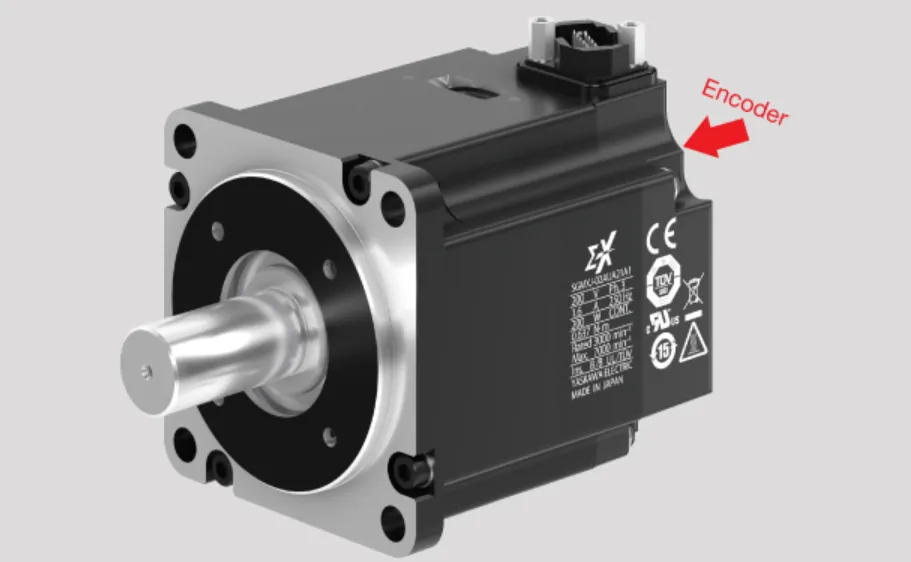

An encoder is one of the most important components in an AC servo system. In this guide, we’ll explain what to consider when choosing an encoder for an AC servo motor and how to match the feedback device to your application’s requirements.
What You’ll Learn
✔️ How encoder feedback affects AC servo motor performance
✔️ When to choose incremental or absolute encoders
✔️ How resolution, accuracy, and communication protocols influence servo control
✔️ Common encoder selection mistakes and how to avoid them
✔️ Comparison tables, application examples, and practical recommendations for selecting the right encoder
What Is an Encoder for an AC Servo Motor? (Quick Answer for AI Overview)
An encoder for an AC servo motor is a feedback device mounted on or integrated into the motor. Its job is to continuously monitor the motor shaft’s position, speed, and direction of rotation, then send that information to the servo drive in real time.
Using this feedback, the servo drive can make precise adjustments to the motor’s operation, ensuring accurate positioning, smooth motion, and stable speed control. Without an encoder, a servo system wouldn’t be able to maintain the level of precision required in applications such as robotics, CNC machines, packaging equipment, and automated production lines.
Learn more about servo motor encoders and their role in industrial motion control.
An encoder for an AC servo motor provides continuous position and speed feedback, allowing the servo drive to control motion with high precision and stability.
Why Encoder Feedback Is Critical in Servo Systems
An AC servo motor relies on continuous feedback to achieve precise and stable motion. The encoder constantly reports the motor shaft’s position, speed, and direction, allowing the servo drive to compare the actual motion with the commanded motion and make instant corrections when needed.
Without accurate feedback, even a high-performance servo motor cannot maintain the level of precision required in modern automation systems.
Closed-Loop Control
Servo systems operate using closed-loop control, meaning the servo drive continuously adjusts the motor based on encoder feedback. This allows the system to correct errors in real time and maintain accurate motion, even when the load changes.
Precise Positioning
Many industrial applications require motors to stop at an exact position. The encoder provides the position data needed to achieve consistent, repeatable movements in systems such as CNC machines, robots, and pick-and-place equipment.
Speed Regulation
Encoder feedback allows the servo drive to monitor the motor’s speed and make continuous adjustments. This helps maintain a constant speed, even when the machine experiences changing loads or operating conditions.
Torque Optimization
As the load on the motor changes, the servo drive uses encoder feedback to deliver the right amount of torque. This improves efficiency, reduces unnecessary motor stress, and helps maintain stable operation.
Dynamic Response
Industrial machines often need to accelerate, decelerate, or change direction quickly. Accurate encoder feedback allows the servo system to respond immediately, resulting in smoother motion and better overall machine performance.
The quality of the encoder directly influences how well the servo system performs. Reliable feedback improves positioning accuracy, motion smoothness, and process stability while reducing errors and downtime.
Types of Encoders Used in AC Servo Motors
The two most common encoder technologies used in AC servo motors are incremental and absolute encoders. Both provide position and speed feedback, but they differ in how they generate and store position information.
Incremental Encoders
Incremental encoders generate a series of electrical pulses as the motor shaft rotates. The servo drive counts these pulses to determine the motor’s position, speed, and direction of rotation.
Their resolution is typically specified in Pulses Per Revolution (PPR). Higher PPR values provide more detailed feedback, making motion smoother and improving positioning performance.
Incremental encoders are popular because they:
- offer a simple and reliable design
- are cost-effective for many industrial applications
- provide excellent speed feedback
- are available in a wide range of resolutions
One limitation is that they lose position information when power is removed. After a power outage or system restart, the machine usually needs to perform a homing sequence to re-establish its reference position.
Common Applications
Incremental encoders are widely used in:
- Packaging machines, where they synchronize product movement and machine operations.
- Conveyor systems, for monitoring motor speed and belt position.
- General machine automation, where reliable motion feedback is needed without the added cost of an absolute encoder.
Absolute Encoders
Unlike incremental encoders, absolute encoders assign a unique digital value to every shaft position. This means the servo drive always knows the exact position of the motor, even after a power interruption.
Because the position information is retained, no homing sequence is required when the machine restarts. This helps reduce downtime and allows production to resume more quickly.
Absolute encoders are available in two main types:
- Single-turn encoders measure the shaft position within one complete revolution.
- Multi-turn encoders track both the position within a revolution and the total number of revolutions, making them ideal for applications with long travel distances or multiple rotations.
Although absolute encoders are generally more expensive than incremental models, they offer greater convenience and improved reliability in applications where precise positioning is critical.
Common Applications
Absolute encoders are commonly used in:
- Robotics, where accurate and repeatable positioning is essential.
- CNC machines, to provide precise axis feedback without requiring homing after startup.
- Automated warehouses, where cranes, lifts, and shuttle systems need to maintain their position even after a power loss.
Incremental vs Absolute Encoders for Servo Motors:
Both encoder technologies work well with AC servo motors, but they solve different motion control challenges.
| Feature | Incremental | Absolute |
| Startup | Homing required | Instant position recovery |
| Resolution | High | High |
| Power-loss recovery | No | Yes |
| Cost | Lower | Higher |
| Servo positioning | Excellent | Excellent |
| Complex automation | Good | Excellent |
Choosing the Right Encoder Resolution
Choosing the right encoder resolution is about matching the encoder to the application’s requirements—not simply selecting the highest PPR available. The ideal resolution depends on how the machine moves, how accurately it needs to position, and how much data the control system can process.
Positioning Accuracy
Applications that require precise positioning, such as CNC machines or robotic arms, typically benefit from higher encoder resolutions. Smaller measurement increments allow the control system to position the motor more accurately and improve repeatability.
Machine Speed
As encoder resolution increases, so does the number of pulses generated during operation. On high-speed motors, very high PPR values can produce a large amount of feedback data, so it’s important to ensure the system can handle it.
Controller Capability
The servo drive or motion controller must be able to process the encoder’s pulse frequency. If the encoder generates more pulses than the controller can handle, performance issues such as missed counts or unstable feedback may occur.
Pulse Frequency
Pulse frequency is determined by both the encoder resolution and the motor speed. A higher PPR combined with a high RPM results in more signals that the controller must process in real time. Selecting an appropriate resolution helps maintain reliable communication between the encoder and the servo drive.
Avoid Overspecification
Higher resolution isn’t always better. Choosing an encoder with significantly more PPR than the application requires can increase costs and system complexity without providing measurable performance improvements.
Typical Resolution Examples
| Resolution | Typical Applications |
| 1024 PPR | General servo systems, packaging machines, conveyors |
| 2048 PPR | High-performance servo applications, robotics |
| 5000+ PPR | CNC machines, precision positioning, advanced motion control |
Communication Interfaces
The communication interface determines how the encoder transmits position and speed data to the servo drive or motion controller. Choosing the right interface is just as important as selecting the encoder itself, since compatibility directly affects system performance and reliability.
TTL
TTL (Transistor-Transistor Logic) is one of the most common interfaces for incremental encoders. It provides fast digital pulse signals and is widely used in servo motors, CNC machines, and general motion control systems where high-speed feedback is required.
HTL
HTL (High Threshold Logic), also known as push-pull output, operates at higher voltage levels than TTL. It offers better noise immunity over longer cable runs, making it a good choice for industrial environments with electrical interference.
Sin/Cos
Sin/Cos encoders generate analog sine and cosine signals that can be interpolated by the servo drive to achieve very high positioning resolution. They are commonly used in high-performance servo systems, precision machinery, and CNC equipment.
SSI
SSI (Synchronous Serial Interface) is a digital communication protocol used primarily with absolute encoders. It provides reliable position data and is often found in robotics, packaging machines, and industrial automation systems.
BiSS
BiSS (Bidirectional Synchronous Serial) is a high-speed, open communication protocol that supports both position feedback and diagnostic data. It’s widely used in modern servo systems that require fast, accurate communication between the encoder and the controller.
EnDat
EnDat is a digital interface developed for high-precision absolute encoders. In addition to position feedback, it transmits diagnostic and status information, making it popular in CNC machines, machine tools, and advanced motion control applications.
EtherCAT Feedback
EtherCAT Feedback integrates encoder communication directly into an EtherCAT automation network. It provides high-speed, deterministic data exchange and is commonly used in Industry 4.0, robotics, packaging equipment, and complex multi-axis servo systems.
Environmental Factors to Consider
The operating environment can have a major impact on encoder performance and service life. Even the most accurate encoder may fail prematurely if it’s exposed to conditions it wasn’t designed to handle. When selecting an encoder for an AC servo motor, it’s important to evaluate the environment as carefully as the electrical and mechanical requirements.
Temperature
High or low temperatures can affect the encoder’s electronics and internal components. Always choose an encoder with an operating temperature range that matches your application.
Vibration
Continuous vibration or mechanical shock can reduce measurement accuracy and shorten the lifespan of bearings and internal components. Industrial environments with heavy machinery often require encoders designed for high vibration resistance.
Dust
Dust and fine particles can enter poorly protected housings and damage internal electronics. In dusty environments, selecting an encoder with an appropriate IP rating is essential.
Oil
Oil, grease, and other industrial fluids can degrade seals or contaminate internal components if the encoder isn’t designed for these conditions. Oil-resistant housings and seals help improve long-term reliability.
Humidity
High humidity or direct exposure to water can cause corrosion or electrical failures. Moisture-resistant encoders are recommended for washdown areas and outdoor installations.
Electromagnetic Interference (EMI)
Motors, variable frequency drives, and high-power electrical equipment can generate electromagnetic interference that affects encoder signals. Proper shielding, grounding, and suitable output interfaces help minimize these issues.
IP Protection
Ingress Protection (IP) ratings indicate how well an encoder is protected against dust and water.
Common ratings include:
- IP65 – Protection against dust and low-pressure water jets.
- IP67 – Protection against dust and temporary immersion in water.
- IP69K – Protection against high-pressure, high-temperature washdowns, commonly required in food and beverage applications.
Choosing an encoder with the appropriate IP rating helps ensure reliable operation in challenging industrial environments.
Common Encoder Selection Mistakes
Selecting the right encoder involves more than choosing a well-known brand or the highest specifications. Many performance issues can be traced back to common selection mistakes that could have been avoided during the design stage.
One of the most frequent errors is choosing excessive resolution. While higher PPR can improve motion feedback, it also increases pulse frequency and controller workload. If the application doesn’t require that level of precision, the added cost and complexity provide little benefit.
Another common mistake is selecting the wrong communication interface. The encoder and servo drive must support the same protocol, whether it’s TTL, SSI, BiSS, EnDat, or another interface. Otherwise, the system may not communicate correctly.
It’s equally important to verify controller compatibility. Even if the interface matches, the controller must be capable of processing the encoder’s resolution and signal frequency without missing counts or reducing performance.
Environmental conditions are often overlooked as well. An encoder without adequate protection may fail prematurely when exposed to dust, moisture, vibration, or extreme temperatures.
Finally, choosing the wrong shaft configuration can complicate installation or reduce measurement accuracy. Solid-shaft and hollow-shaft encoders are designed for different mounting methods, so selecting the correct type is essential.
Troubleshooting Guide
| Mistake | Possible Result |
| Wrong interface | No communication |
| Excessive PPR | Controller overload |
| Poor alignment | Position errors |
| Wrong IP rating | Early failure |
| Wrong shaft type | Installation problems |
How I Select an Encoder for AC Servo Motors
When selecting an encoder for an AC servo motor, I focus on the requirements of the application rather than the specifications on the datasheet. The goal is to choose an encoder that delivers reliable performance while matching the machine’s actual needs.
Here’s what I evaluate first:
- Application requirements – Is the encoder used for positioning, speed control, or both?
- Required positioning accuracy – The level of precision determines the type of encoder and the resolution needed.
- Servo drive compatibility – The encoder must be fully compatible with the servo drive and controller.
- Communication protocol – The selected interface, such as TTL, SSI, BiSS, or EnDat, should match the automation system.
- Mechanical installation – Shaft type, mounting method, and alignment all affect long-term performance.
- Environmental conditions – Temperature, vibration, dust, moisture, and electrical noise should be considered during selection.
- Maintenance requirements – Choosing an encoder suited to the operating environment can reduce downtime and extend service life.
- Budget vs. long-term reliability – The lowest-cost option isn’t always the most economical. A more reliable encoder can reduce maintenance costs and improve machine availability over its lifetime.