
There is a version of the software industry that most people never get access to. Not because the ideas are not there or the problems worth solving do not exist but because the path from having a genuinely useful software idea to having a working product has historically run directly through either a computer science degree or a development budget that most individuals and small businesses simply do not have.
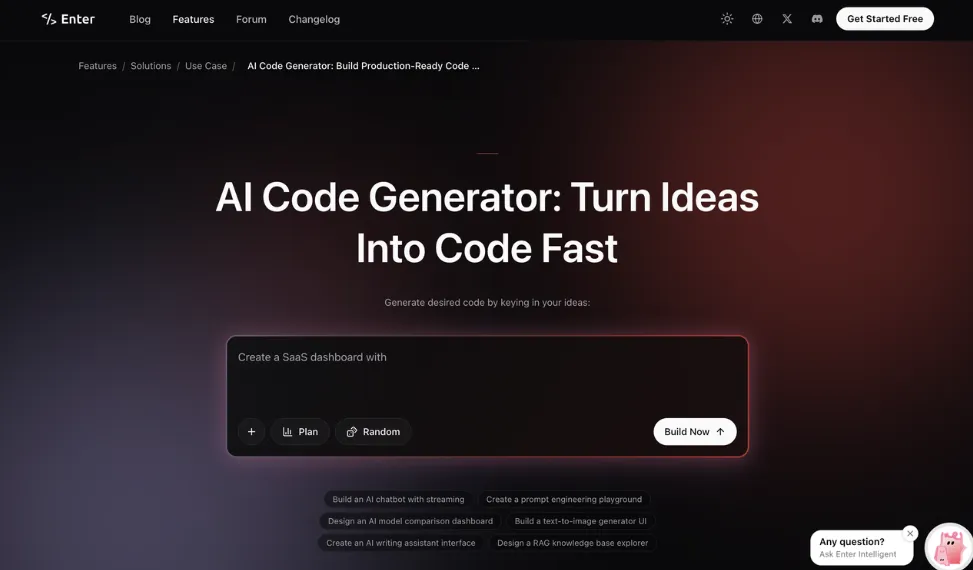
That barrier is collapsing faster than most people in the traditional software industry are comfortable acknowledging. The combination of no-code building tools, AI-assisted development, and platforms designed to make software creation accessible to people who think primarily in terms of problems and solutions rather than languages and frameworks is producing a genuinely new category of builder. People who would previously have had to either learn to code or hire a developer can now build functional, deployable software products with tools like a code maker that handles the technical implementation of ideas that the builder provides. Enter Pro has been useful for this new category of builder, and the broader shift it represents is worth understanding properly before deciding whether it applies to you.
The Idea Gap That Technical Barriers Created
Every industry has people inside it who can see problems clearly, who understand the workflow inefficiencies, the data gaps, the communication failures, and the repetitive manual processes that cost their organization time and money every week. Most of these people have had the experience of describing a software solution to a developer, watching it get built into something that partially addresses the problem, and then discovering that iteration costs almost as much as the original build and takes almost as long.
The frustration of this cycle has produced two outcomes. Some people gave up on software as a solution to operational problems and continued managing with spreadsheets and manual processes. Others learned enough about development to communicate more effectively with developers or to build simpler tools themselves. The no-code and AI-assisted development movement is producing a third outcome that is more interesting than either of the first two. People who deeply understand a problem are now building the solution themselves without intermediaries and the software they produce is better for it because the person who built it is the person who understood the problem most completely.
What Non-Technical Builders Are Actually Creating
The range of what non-technical builders are producing with modern no-code and AI-assisted tools is broader than most people who have not explored these tools recently would expect. Internal business tools that automate processes a small team was handling manually. Client-facing portals that give customers visibility into projects or orders without requiring custom development. Data collection and analysis tools that replace the manual spreadsheet work that was consuming hours of someone’s week. Simple but genuinely functional web applications that solve a specific problem for a specific user group.
None of these are replacing the complex, infrastructure-level software that requires deep technical expertise to build safely and reliably. But they are replacing a significant category of simpler software that was previously either never built because the development cost was not justified or built expensively by developers who understood the technical requirements but not the operational context the software needed to serve.
The non-technical builder who deeply understands their operational context is producing better simple software than the technical developer who understood the code but not the problem and the tools now exist to make that possible.
Choosing the Right Platform for a SaaS Product
The non-technical founder who has validated a software idea and wants to build it into a proper product that can be sold to other businesses faces a specific set of infrastructure decisions that can feel overwhelming without a technical background to frame them.
The good news is that the platform decision for a simple SaaS product is considerably more manageable than it appears from the outside. A proper SaaS website builder handles the infrastructure decisions that would otherwise require backend development expertise, the authentication, the subscription billing, the user management, and the deployment environment that a SaaS product needs to function reliably for paying customers rather than just as a prototype.
Understanding what the platform handles versus what still requires custom development is the most important clarity a non-technical founder can have before starting to build and the right platform makes that clarity relatively straightforward to achieve.
The Validation Problem That Most New SaaS Products Skip
The history of software products built by non-technical founders who skipped validation is a long and expensive one. The assumption that a problem you have personally experienced must be widely enough shared to support a viable software business is seductive and frequently wrong in the specific way that matters commercially. The problem exists. Other people have it. But they are not willing to pay for a software solution to it at a price that supports the business model the founder had in mind.
Validation before building is not a new idea and it is not specific to non-technical founders. But it is particularly important for builders who are newly capable of building things and therefore particularly susceptible to the excitement of building before confirming that what they are building has a market willing to pay for it.
A landing page that describes the product, collects email addresses from interested potential users, and ideally pre-sells access before the product exists is the minimum viable validation for a SaaS product and Enter Pro makes building that landing page fast enough that it can genuinely precede the product build rather than being an afterthought assembled after months of development.
Pricing a SaaS Product Without a Pricing Background
Non-technical founders building their first SaaS product consistently make the same pricing mistake in the same direction. They underprice, driven by the fear that asking too much will prevent adoption, without fully accounting for the commercial reality that software priced too low signals low value, attracts price-sensitive customers who churn at the first sign of a cheaper alternative, and generates insufficient revenue to support the ongoing development and support that a SaaS product requires to remain competitive.
The pricing conversation for a SaaS product is ultimately a conversation about value rather than about cost. What is the problem worth solving to the customer? What does not solving it cost them in time, money, or opportunity? A software product that saves a small business owner four hours a week is worth considerably more than the hourly rate of those four hours suggests because it also removes the cognitive load of the tasks being automated, the error risk of manual processes, and the constraint that limited time places on business growth.
Enter Pro gives non-technical founders building their first SaaS products enough flexibility to build and test different pricing presentations without requiring a developer to implement each iteration, which is important because pricing is one of the few things in SaaS that is almost never right the first time.
Building in Public as a Non-Technical Founder
One of the most effective marketing strategies available to non-technical founders building SaaS products is building in public, sharing the process of building, the problems encountered, the decisions made, and the progress achieved in a format that attracts an audience of potential users before the product is finished.
The non-technical founder has a particular advantage in this format because their perspective on building software without a technical background is genuinely interesting to a large audience of people who share that background and who are curious about whether they could do the same thing. The authenticity of someone figuring it out in real time, documenting the confusion and the breakthroughs honestly, builds an audience with a personal investment in the product’s success that conventional marketing cannot replicate.
Conclusion
The barrier between having a software idea and building a software product has not disappeared but it has dropped far enough that the question of whether to build something has changed from can I do this technically to is this worth building and who will pay for it. For the people with genuine domain expertise in a specific problem and the willingness to learn the tools that make building accessible, that shift represents an opportunity that did not exist five years ago and that the traditional software industry has not fully processed yet. The ideas have always been there. Now the tools to act on them are too.