Quick Answer 🔥
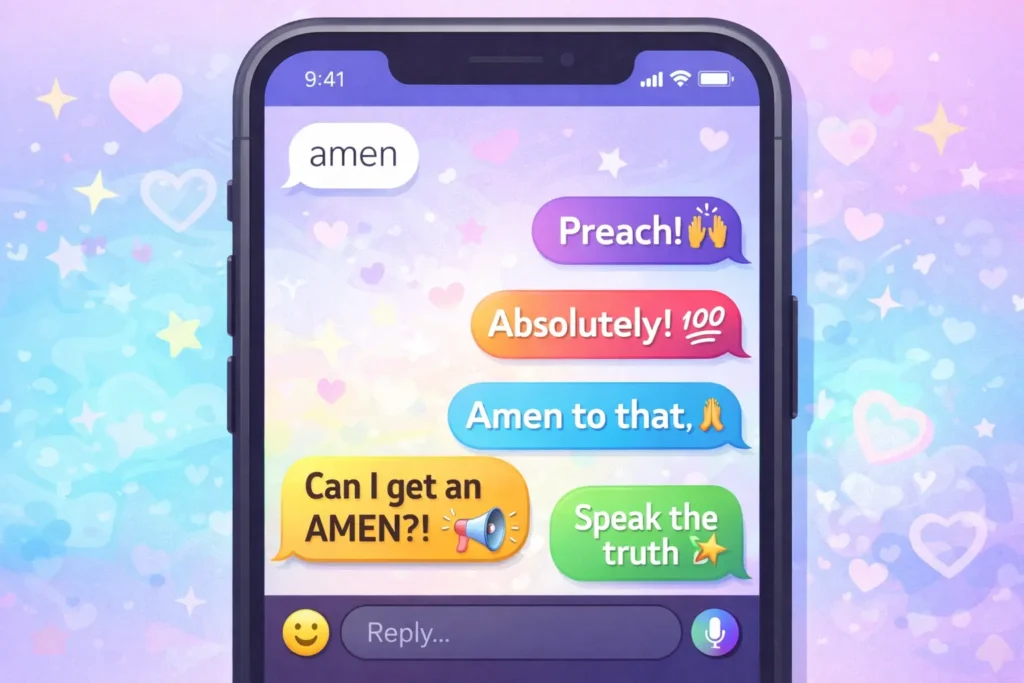
When someone says “amen,” they’re agreeing, affirming, or showing strong support for what was said. A great reply keeps that energy going or adds personality.
Top replies: “Preach,” “Say it louder,” “Facts only,” “We’re on the same page,” “Couldn’t have said it better”
You’ve probably seen it in texts, comments, or even real-life conversations. Someone drops an “amen,” and suddenly the vibe feels strong, supportive, and almost… spiritual. It’s your friend hyping you up, your crush agreeing with your rant, or a coworker backing your point, knowing how to respond to amen can take the moment from basic to memorable.
The right reply can make you sound funny, confident, sweet, or even a little flirty. And let’s be real, in today’s world of DMs, captions, and quick replies, your response matters more than ever. A boring reply kills the vibe. A smart one keeps the conversation alive.
So if you’ve ever paused and thought, “What do I even say after amen?” don’t worry. This list has you covered.
Funny Responses
“Now pass the collection plate.”
Example: After someone strongly agrees in a group chat.
Meaning: Turning the moment into a playful church joke.
“Choir said the same thing.”
Example: When your friend backs your rant.
Meaning: Everyone agrees with you.
“Preach louder for the people in the back.”
Example: In comments when someone agrees publicly.
Meaning: Say it louder, it’s facts.
“We about to start a sermon now.”
Example: When convo gets deep.
Meaning: Dramatic but funny exaggeration.
“Sunday service vibes only.”
Example: In playful group chats.
Meaning: Feels like a church moment.
“Blessings unlocked.”
Example: After someone agrees.
Meaning: Agreement = reward.
“Say less, we’re saved.”
Example: Instant support.
Meaning: Celebrating agreement humorously.
“Certified holy moment.”
Example: Dramatic convo.
Meaning: Making fun of intensity.
“Even the angels agree.”
Example: Reply to support or praise.
Meaning: Over-the-top approval.
“I knew I was preaching facts.”
Example: When proven right.
Meaning: Confident + funny.
“Can I get another amen?”
Example: Want more support.
Meaning: Calling for backup.
“We’re starting a movement now.”
Example: Opinion gets validation.
Meaning: Making it a big deal.
“Say it again for dramatic effect.”
Example: Strong agreement.
Meaning: Hyping it up.
“That’s divine confirmation.”
Example: Perfect timing agreement.
Meaning: Feels meant to be.
“I feel validated and blessed.”
Example: Someone supports you.
Meaning: Playful appreciation 🙏
Flirty Responses
- “Amen to us too?”
Example: Used when flirting after a positive convo.
Meaning: You’re subtly hinting at a romantic connection. - “Guess we’re aligned in more ways than one.”
Example: Used in a light romantic exchange.
Meaning: You’re suggesting compatibility. - “Careful, I might start liking you more.”
Example: Used when they agree with you.
Meaning: You’re teasing attraction. - “You always agree with me or just today?”
Example: Used playfully with a crush.
Meaning: You’re flirting while noticing their support. - “We’re kinda perfect at this point.”
Example: Used when both of you are vibing.
Meaning: You’re playfully boosting connection. - “Now that’s attractive energy.”
Example: Used after they agree with your idea.
Meaning: You’re complimenting their alignment. - “I like when you’re on my side.”
Example: Used casually in a flirty tone.
Meaning: You’re expressing appreciation with charm. - “Keep agreeing with me like that.”
Example: Used teasingly in DMs.
Meaning: You’re encouraging the vibe playfully. - “You’re making this too easy for me.”
Example: Used when they support your opinion.
Meaning: You’re flirting with confidence. - “We’re dangerously compatible.”
Example: Used when both share opinions.
Meaning: You’re hinting at chemistry. - “That’s why I like talking to you.”
Example: Used after agreement.
Meaning: You’re showing subtle affection. - “We might be onto something here.”
Example: Used in a growing connection.
Meaning: You’re hinting at deeper interest. - “Amen… and maybe a date?”
Example: Used boldly in flirting.
Meaning: You’re turning agreement into a move. - “Okay, now you’re winning me over.”
Example: Used when they keep agreeing.
Meaning: You’re showing attraction playfully. - “You get me too well.”
Example: Used in emotional flirting.
Meaning: You’re appreciating connection.
Polite Responses
- “I appreciate that.”
Example: Used in calm conversation.
Meaning: You’re acknowledging agreement respectfully. - “Glad we’re on the same page.”
Example: Used in discussions.
Meaning: You’re highlighting shared understanding. - “Thank you for that.”
Example: Used in formal or semi-formal settings.
Meaning: You’re expressing gratitude. - “That means a lot.”
Example: Used when agreement feels supportive.
Meaning: You’re valuing their response. - “Happy you agree.”
Example: Used casually.
Meaning: You’re acknowledging alignment. - “That’s reassuring.”
Example: Used in work or serious talks.
Meaning: You’re appreciating confirmation. - “I’m glad you feel that way.”
Example: Used politely in conversation.
Meaning: You’re validating their perspective. - “We’re aligned then.”
Example: Used in professional talks.
Meaning: You’re confirming agreement. - “That’s good to hear.”
Example: Used in neutral tone.
Meaning: You’re appreciating support. - “Appreciate your input.”
Example: Used at work.
Meaning: You’re being respectful. - “Thanks for backing that up.”
Example: Used in teamwork.
Meaning: You’re acknowledging support. - “That helps a lot.”
Example: Used in discussions.
Meaning: You’re valuing agreement. - “I respect that.”
Example: Used in calm dialogue.
Meaning: You’re showing mutual respect. - “That’s encouraging.”
Example: Used when agreement motivates you.
Meaning: You’re appreciating positivity. - “Glad we agree.”
Example: Used in simple exchanges.
Meaning: You’re confirming shared views.
Professional Responses
- “Agreed, that aligns with our goals.”
Example: Used in meetings.
Meaning: You’re reinforcing direction. - “Thank you for confirming.”
Example: Used in formal communication.
Meaning: You’re acknowledging agreement. - “That supports our approach.”
Example: Used in planning.
Meaning: You’re validating strategy. - “I appreciate the alignment.”
Example: Used in workplace discussion.
Meaning: You’re recognizing agreement. - “We’re moving in the right direction.”
Example: Used in team updates.
Meaning: You’re reinforcing progress. - “That’s helpful feedback.”
Example: Used in professional chats.
Meaning: You’re valuing their input. - “Good to have consensus.”
Example: Used in group decisions.
Meaning: You’re highlighting unity. - “That strengthens the plan.”
Example: Used in strategy talks.
Meaning: You’re reinforcing confidence. - “Noted and appreciated.”
Example: Used in emails.
Meaning: You’re acknowledging agreement. - “That confirms our direction.”
Example: Used in decision-making.
Meaning: You’re validating the path. - “We’re aligned on this.”
Example: Used in meetings.
Meaning: You’re confirming agreement. - “Thanks for the support.”
Example: Used in collaboration.
Meaning: You’re appreciating backing. - “That adds clarity.”
Example: Used in discussions.
Meaning: You’re valuing agreement. - “Agreed, let’s proceed.”
Example: Used when finalizing decisions.
Meaning: You’re moving forward. - “That’s consistent with our plan.”
Example: Used in structured talks.
Meaning: You’re reinforcing alignment.
Sarcastic Responses
- “Wow, groundbreaking agreement.”
Example: Used jokingly with friends.
Meaning: You’re teasing obvious agreement. - “Took you long enough.”
Example: Used playfully.
Meaning: You’re joking about delay. - “Shocking, you agree with me.”
Example: Used sarcastically.
Meaning: You’re teasing predictability. - “Alert the media.”
Example: Used jokingly.
Meaning: You’re exaggerating importance. - “Finally, some sense.”
Example: Used teasingly.
Meaning: You’re joking about being right. - “We’ve reached enlightenment.”
Example: Used humorously.
Meaning: You’re exaggerating agreement. - “Miracles do happen.”
Example: Used sarcastically.
Meaning: You’re joking about surprise. - “Guess I’m always right.”
Example: Used playfully.
Meaning: You’re teasing confidence. - “Who would’ve thought.”
Example: Used jokingly.
Meaning: You’re mocking predictability. - “Write this down, it’s rare.”
Example: Used with friends.
Meaning: You’re teasing uniqueness. - “This changes everything.”
Example: Used sarcastically.
Meaning: You’re exaggerating impact. - “Historic moment.”
Example: Used humorously.
Meaning: You’re joking about importance. - “Mark this day.”
Example: Used playfully.
Meaning: You’re exaggerating. - “The universe agrees.”
Example: Used sarcastically.
Meaning: You’re overhyping agreement. - “I’ll take that as a win.”
Example: Used jokingly.
Meaning: You’re celebrating agreement.
Cute Responses
- “Aww, you get me.”
Example: Used in sweet chats.
Meaning: You’re appreciating connection. - “We’re in sync.”
Example: Used casually.
Meaning: You’re highlighting harmony. - “That made me smile.”
Example: Used in warm conversations.
Meaning: You’re expressing happiness. - “You’re the best.”
Example: Used after agreement.
Meaning: You’re showing affection. - “That’s so sweet.”
Example: Used when agreement feels kind.
Meaning: You’re appreciating warmth. - “You always know.”
Example: Used playfully.
Meaning: You’re praising understanding. - “We think alike.”
Example: Used casually.
Meaning: You’re noting similarity. - “That’s why I like you.”
Example: Used warmly.
Meaning: You’re expressing affection. - “You’re adorable.”
Example: Used in playful chats.
Meaning: You’re being affectionate. - “That’s perfect.”
Example: Used in happy moments.
Meaning: You’re appreciating agreement. - “You’re too kind.”
Example: Used in gentle tone.
Meaning: You’re acknowledging support. - “I needed that.”
Example: Used emotionally.
Meaning: You’re appreciating reassurance. - “You made my day.”
Example: Used sweetly.
Meaning: You’re expressing joy. - “That means everything.”
Example: Used emotionally.
Meaning: You’re valuing agreement deeply. - “You’re my favorite.”
Example: Used playfully.
Meaning: You’re showing affection.
Chill And Casual Responses
- “Facts.”
Example: Used in quick replies.
Meaning: You’re agreeing simply. - “For real.”
Example: Used casually.
Meaning: You’re confirming truth. - “Exactly.”
Example: Used in conversation.
Meaning: You’re reinforcing agreement. - “You already know.”
Example: Used with friends.
Meaning: You’re confirming shared knowledge. - “No lies detected.”
Example: Used online.
Meaning: You’re confirming truth. - “Big facts.”
Example: Used casually.
Meaning: You’re strongly agreeing. - “Say less.”
Example: Used in quick chats.
Meaning: You’re accepting agreement. - “That part.”
Example: Used in comments.
Meaning: You’re highlighting agreement. - “We good then.”
Example: Used casually.
Meaning: You’re confirming alignment. - “Simple.”
Example: Used in quick replies.
Meaning: You’re keeping it minimal. - “Right.”
Example: Used in conversation.
Meaning: You’re agreeing casually. - “No doubt.”
Example: Used casually.
Meaning: You’re confirming certainty. - “All day.”
Example: Used in hype chats.
Meaning: You’re agreeing strongly. - “True that.”
Example: Used casually.
Meaning: You’re confirming agreement. - “100%.”
Example: Used in texts.
Meaning: You’re fully agreeing.
Confident Responses
- “I stand by that.”
Example: Used in debates.
Meaning: You’re confident in your opinion. - “Exactly my point.”
Example: Used in discussions.
Meaning: You’re reinforcing your stance. - “Glad you see it too.”
Example: Used confidently.
Meaning: You’re validating agreement. - “That’s how it is.”
Example: Used boldly.
Meaning: You’re asserting truth. - “Couldn’t be clearer.”
Example: Used in arguments.
Meaning: You’re reinforcing clarity. - “That’s the truth.”
Example: Used strongly.
Meaning: You’re asserting certainty. - “We’re locked in.”
Example: Used confidently.
Meaning: You’re confirming alignment. - “Exactly what I said.”
Example: Used assertively.
Meaning: You’re reinforcing correctness. - “No debate needed.”
Example: Used boldly.
Meaning: You’re shutting down argument. - “That’s settled.”
Example: Used in decisions.
Meaning: You’re closing the topic. - “I meant every word.”
Example: Used seriously.
Meaning: You’re standing firm. - “We’re not wrong.”
Example: Used confidently.
Meaning: You’re reinforcing correctness. - “That’s final.”
Example: Used strongly.
Meaning: You’re ending discussion. - “Exactly.”
Example: Used confidently.
Meaning: You’re reinforcing agreement. - “We said what we said.”
Example: Used boldly.
Meaning: You’re standing firm.
Emotional Responses
- “That really means a lot.”
Example: Used in heartfelt talks.
Meaning: You’re appreciating support deeply. - “I needed to hear that.”
Example: Used in emotional moments.
Meaning: You’re expressing relief. - “Thank you for understanding.”
Example: Used sincerely.
Meaning: You’re appreciating empathy. - “That hit me.”
Example: Used emotionally.
Meaning: You’re acknowledging impact. - “You get it.”
Example: Used in deep talks.
Meaning: You’re appreciating understanding. - “I feel heard.”
Example: Used emotionally.
Meaning: You’re expressing validation. - “That touched my heart.”
Example: Used sincerely.
Meaning: You’re showing appreciation. - “I appreciate you.”
Example: Used warmly.
Meaning: You’re valuing the person. - “That was needed.”
Example: Used emotionally.
Meaning: You’re acknowledging support. - “You always come through.”
Example: Used sincerely.
Meaning: You’re appreciating reliability. - “That gave me peace.”
Example: Used emotionally.
Meaning: You’re expressing calm. - “You made me feel better.”
Example: Used sincerely.
Meaning: You’re appreciating comfort. - “That’s comforting.”
Example: Used in tough moments.
Meaning: You’re expressing relief. - “I’m grateful for that.”
Example: Used sincerely.
Meaning: You’re appreciating support. - “That meant everything.”
Example: Used deeply.
Meaning: You’re expressing strong appreciation.
Sweet Responses
- “That’s really kind of you.”
Example: Used when someone agrees with you in a heartfelt way.
Meaning: You’re appreciating their kindness and support. - “You always know what to say.”
Example: Used in a warm conversation with a close friend.
Meaning: You’re acknowledging their emotional intelligence. - “That made me feel good.”
Example: Used after someone validates your feelings.
Meaning: You’re expressing genuine appreciation. - “You’re such a positive soul.”
Example: Used when someone responds with uplifting energy.
Meaning: You’re complimenting their kindness. - “I’m lucky to have you agree with me.”
Example: Used in a close relationship chat.
Meaning: You’re expressing gratitude and affection. - “That’s so thoughtful.”
Example: Used when someone agrees in a caring way.
Meaning: You’re appreciating their consideration. - “You always bring good vibes.”
Example: Used in a light, happy conversation.
Meaning: You’re praising their positive energy. - “That was really sweet of you.”
Example: Used after a supportive response.
Meaning: You’re acknowledging kindness. - “You just made my mood better.”
Example: Used when someone agrees during a rough moment.
Meaning: You’re appreciating emotional uplift. - “I love that energy.”
Example: Used in a fun, friendly chat.
Meaning: You’re celebrating their positivity. - “That’s why you’re special.”
Example: Used in a close connection.
Meaning: You’re expressing affection. - “You’re always so supportive.”
Example: Used in meaningful conversations.
Meaning: You’re recognizing their consistency. - “That’s genuinely comforting.”
Example: Used when agreement brings peace.
Meaning: You’re expressing emotional relief. - “You just made me smile big.”
Example: Used in cheerful chats.
Meaning: You’re sharing joy. - “That means more than you know.”
Example: Used in deep conversations.
Meaning: You’re expressing heartfelt gratitude.
Clever Responses
- “Great minds really do think alike.”
Example: Used when someone agrees with your opinion.
Meaning: You’re playfully highlighting intelligence. - “We just confirmed the obvious.”
Example: Used in casual chats.
Meaning: You’re reinforcing shared truth. - “That’s what logic sounds like.”
Example: Used in debates or discussions.
Meaning: You’re praising rational thinking. - “Consensus achieved.”
Example: Used in group conversations.
Meaning: You’re confirming agreement smartly. - “We’ve cracked the code.”
Example: Used jokingly after agreement.
Meaning: You’re exaggerating success. - “That’s a solid take.”
Example: Used in discussions.
Meaning: You’re validating a good opinion. - “We’re operating on the same frequency.”
Example: Used in intellectual conversations.
Meaning: You’re highlighting alignment. - “That’s a well-timed agreement.”
Example: Used in ongoing discussions.
Meaning: You’re appreciating timing. - “Evidence supports this.”
Example: Used humorously in debates.
Meaning: You’re reinforcing correctness. - “We’ve reached peak agreement.”
Example: Used playfully.
Meaning: You’re exaggerating alignment. - “That’s a smart confirmation.”
Example: Used in thoughtful chats.
Meaning: You’re acknowledging intelligence. - “Aligned and verified.”
Example: Used in a witty tone.
Meaning: You’re confirming agreement cleverly. - “That checks out perfectly.”
Example: Used in logical discussions.
Meaning: You’re validating accuracy. - “We’re synced intellectually.”
Example: Used in smart conversations.
Meaning: You’re highlighting shared thinking. - “That’s the conclusion we needed.”
Example: Used in group decisions.
Meaning: You’re wrapping up agreement smartly.
Dramatic Responses
- “And the truth has been spoken.”
Example: Used in intense or funny moments.
Meaning: You’re emphasizing importance dramatically. - “Let it be written in history.”
Example: Used jokingly after agreement.
Meaning: You’re exaggerating significance. - “This changes everything.”
Example: Used in dramatic tone.
Meaning: You’re overhyping agreement. - “A moment of pure clarity.”
Example: Used in deep conversations.
Meaning: You’re highlighting realization. - “The universe has spoken.”
Example: Used humorously.
Meaning: You’re exaggerating agreement as fate. - “And peace has been restored.”
Example: Used in group chats.
Meaning: You’re dramatizing resolution. - “Balance has been achieved.”
Example: Used playfully.
Meaning: You’re exaggerating harmony. - “This is the turning point.”
Example: Used in dramatic chats.
Meaning: You’re highlighting importance. - “Everything makes sense now.”
Example: Used after agreement.
Meaning: You’re expressing realization. - “The prophecy was true.”
Example: Used humorously.
Meaning: You’re exaggerating predictability. - “A revelation indeed.”
Example: Used in witty tone.
Meaning: You’re emphasizing clarity. - “This is destiny speaking.”
Example: Used playfully.
Meaning: You’re dramatizing agreement. - “And just like that, we agree.”
Example: Used in storytelling tone.
Meaning: You’re highlighting resolution. - “The truth always finds its way.”
Example: Used in deep tone.
Meaning: You’re emphasizing correctness. - “A legendary agreement.”
Example: Used humorously.
Meaning: You’re exaggerating importance.
FAQs
What does “amen” mean in texting?
It usually means strong agreement, support, or “that’s absolutely true.”
Can “amen” be flirty?
Yes, in the right context it can show connection and alignment, which can feel flirty.
Is it okay to use “amen” professionally?
In casual workplaces yes, but in formal settings it’s better to use neutral agreement phrases.
What if I don’t actually agree?
You can respond politely with something neutral like “I see your point.”
Can I reply with humor?
Absolutely. Funny replies often make conversations more engaging and memorable.
Conclusion
Knowing how to respond to amen might seem small, but it can completely change the energy of a conversation. Whether you go funny, flirty, chill, or professional, your reply shows personality and keeps the vibe alive.
The best part is you don’t have to stick to one style. Mix it up depending on who you’re talking to and the mood you’re in. Confidence, humor, and authenticity always win.
So next time someone drops an “amen,” don’t leave them hanging. Pick a reply, make it yours, and keep the conversation flowing. Save this list, share it with friends, and start replying like a pro.
Discover More Related Articles:
- 389 Respond When Someone Says “I’m Hungry”: That Make Them Laugh In 2026
- 350 Best Respond When Someone Says “I’m Tired”: Feel So Real In 2026