
Definition
PTSO stands for “Please Turn (the) Screen On” or “Permission To Speak Online.” Its exact meaning depends on context, but it is most commonly used in online chats, gaming or virtual meetings to either request visibility (screen on) or politely ask for permission to speak in a conversation.
Ever come across the abbreviation “PTSO” in a chat, meeting, or online forum and paused for a second trying to figure out what it means? You’re not alone. In today’s fast-paced digital communication, abbreviations pop up everywhere from gaming chats and Zoom meetings to social media threads and PTSO is one of those lesser-known but increasingly used terms.
Understanding the meaning of PTSO can help you avoid confusion, communicate more effectively, and even sound more polished in professional or casual conversations. You’re navigating workplace chats, online classes, or gaming lobbies, knowing how and when to use PTSO can make a noticeable difference.
In this complete guide, we’ll break down everything you need to know about PTSO meaning, including its origin, usage, tone variations, real-life examples, comparisons with similar abbreviations, and more.
What Does PTSO Mean?
At its core, PTSO has two primary interpretations:
1. Please Turn Screen On
- Common in online meetings, classes, or video calls
- Used to politely ask someone to enable their camera
2. Permission To Speak Online
- Used in formal chats, forums, or moderated discussions
- Indicates that someone is asking for the chance to speak or contribute
Quick Breakdown
| Abbreviation | Meaning | Context |
|---|---|---|
| PTSO | Please Turn Screen On | Meetings, classes |
| PTSO | Permission To Speak Online | Forums, discussions |
Origin of PTSO
Unlike mainstream abbreviations like “LOL” or “BRB,” PTSO doesn’t have a long-standing history. It emerged more recently with the rise of:
- Remote work culture
- Online education platforms
- Virtual meetings (Zoom, Teams, Google Meet)
- Gaming and live streaming communities
As digital communication became more structured especially in professional and educational environments there was a growing need for short, polite, and efficient phrases. That’s where abbreviations like PTSO came in.
Why It Gained Popularity
- Saves time in typing
- Maintains politeness
- Fits formal and semi-formal environments
- Reduces interruptions in structured discussions
How PTSO Is Used in Real Life
The meaning of PTSO depends heavily on the context in which it’s used. Let’s explore both common uses in detail.
1. PTSO in Online Meetings (Please Turn Screen On)
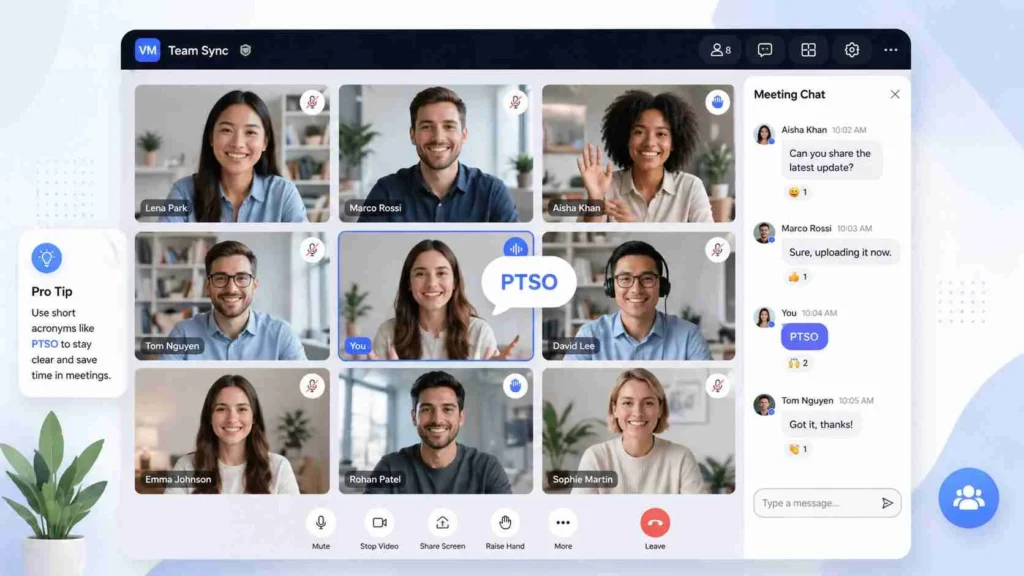
In remote work or online classes, instructors or managers may want participants to turn on their cameras for better engagement.
Example Situations:
- A teacher asking students to show their presence
- A manager encouraging team participation
- A host ensuring active involvement
Example Messages:
- “Hey everyone, PTSO for attendance check 😊”
- “Can you PTSO? We need to confirm identity.”
- “PTSO please, it helps with communication.”
Tone: Friendly to neutral
Intent: Polite request
2. PTSO in Discussions (Permission To Speak Online)
In structured environments like webinars, forums, or moderated chats, participants may use PTSO to request speaking rights.
Example Situations:
- Online panel discussions
- Group chats with moderators
- Classroom discussions
Example Messages:
- “PTSO, I’d like to add something.”
- “PTSO regarding the last point.”
- “PTSO 🙋♂️ I have a question.”
Tone: Formal and respectful
Intent: Seeking permission
Tone and Context Variations
The tone of PTSO can vary depending on how it’s used.
Friendly Tone 😊
- “Hey, PTSO please! Want to see everyone 😄”
- Used among peers or casual groups
Neutral Tone
- “PTSO for attendance.”
- Common in professional settings
Slightly Strict Tone ⚠️
- “PTSO immediately.”
- May sound authoritative or urgent
Example Table: PTSO in Different Contexts
| Scenario | Example Sentence | Tone |
|---|---|---|
| Online Class | “PTSO for attendance check.” | Neutral |
| Team Meeting | “Guys, PTSO so we can proceed.” | Professional |
| Gaming Chat | “PTSO bro, can’t hear you properly.” | Casual |
| Webinar | “PTSO, I’d like to contribute.” | Formal |
| Moderator Chat | “PTSO before speaking please.” | Polite |
Comparison With Similar Terms
IT may seem similar to other abbreviations, but each serves a unique purpose.
PTSO vs PTO
| Term | Meaning | Usage Context |
|---|---|---|
| PTSO | Permission to speak or turn screen on | Online communication |
| PTO | Paid Time Off | Workplace HR term |
PTSO vs AFK
| Term | Meaning | Usage Context |
|---|---|---|
| PTSO | Request action | Active conversation |
| AFK | Away From Keyboard | Inactive status |
BRB vs
| Term | Meaning | Purpose |
|---|---|---|
| PTSO | Asking permission or action | Engagement |
| BRB | Be Right Back | Temporary absence |
Alternate Meanings of PTSO
While the two main meanings dominate, PTSO can occasionally have other niche interpretations depending on context:
- Parent Teacher Student Organization (in schools)
- Public Transport Safety Office (rare institutional usage)
These meanings are far less common in casual or online communication.
When Should You Use PTSO?
Use PTSO when:
- You want to politely request someone to turn on their camera
- You need permission to speak in a structured discussion
- You’re in a professional or semi-formal environment
- You want to sound respectful and concise
When NOT to Use PTSO
Avoid using PTSO when:
- The conversation is highly informal (it may sound stiff)
- The audience may not understand abbreviations
- You’re writing formal emails (use full phrases instead)
Polite and Professional Alternatives
If you’re unsure about using abbreviations, here are better alternatives:
Instead of “PTSO” (Screen On)
- “Could you please turn your camera on?”
- “Kindly enable your video for better interaction.”
Instead of “PTSO” (Permission to Speak)
- “May I speak?”
- “I’d like to add something, if that’s okay.”
- “Can I share my thoughts?”
Real-Life Usage Tips
- Always consider your audience before using abbreviations
- Use emojis sparingly in professional settings
- Avoid overusing PTSO it can sound repetitive
- Pair it with polite language for better tone
FAQs
What does PTSO mean in texting?
In texting, PTSO usually means “Please Turn Screen On” or “Permission To Speak Online,” depending on the situation. It’s often used in group chats or online discussions to request action or participation.
Is PTSO a formal abbreviation?
PTSO is semi-formal. It’s acceptable in workplace chats, online classes, or moderated discussions, but not ideal for formal emails or official documents.
Where is PTSO commonly used?
PTSO is commonly used in virtual meetings, online classrooms, gaming chats, and webinars where communication needs to be structured or efficient.
Can PTSO be considered rude?
Not usually. However, if used without polite context or in a commanding tone, it might come across as slightly abrupt or authoritative.
What is the difference between PTSO and raising a hand emoji? PTSO is a text-based request for permission, while a raised hand emoji 🙋♂️ visually संकेत the same intent but in a more casual way.
What is the difference between PTSO and raising a hand emoji? PTSO is a text-based request for permission, while a raised hand emoji 🙋♂️ visually संकेत the same intent but in a more casual way.
Is PTSO used worldwide?
Yes, but it’s not universally recognized. Its usage is more common in English-speaking online environments and professional virtual settings.
Should I use PTSO in emails?
It’s better to avoid PTSO in emails. Instead, use full phrases like “May I speak?” or “Please turn on your camera.”
What are similar abbreviations to PTSO?
Similar abbreviations include BRB (Be Right Back), AFK (Away From Keyboard), IMO (In My Opinion), and FYI (For Your Information), though they serve different purposes.
Conclusion
Understanding PTSO meaning is more than just decoding an abbreviation it’s about improving how you communicate in digital spaces. It stands for “Please Turn Screen On” or “Permission To Speak Online,” the term reflects the evolving nature of online interaction, where clarity, politeness, and efficiency matter more than ever.
Used correctly, PTSO can make your communication smoother and more respectful, especially in professional or structured environments. However, it’s always important to consider your audience and context. When in doubt, opting for full phrases can ensure clarity and avoid misunderstandings.
As digital communication continues to grow, staying familiar with terms like PTSO helps you stay ahead, sound confident and engage more effectively in any online setting.
Discover More Related Articles:
- “Wyll” Meaning: How It Is Used in Online Conversations In 2026
- “Pookie” Meaning: How It Is Used in Chat & Social Media In 2026
- “FAFO” Meaning: In TikTok & Social Media Messages In 2026