
Definition
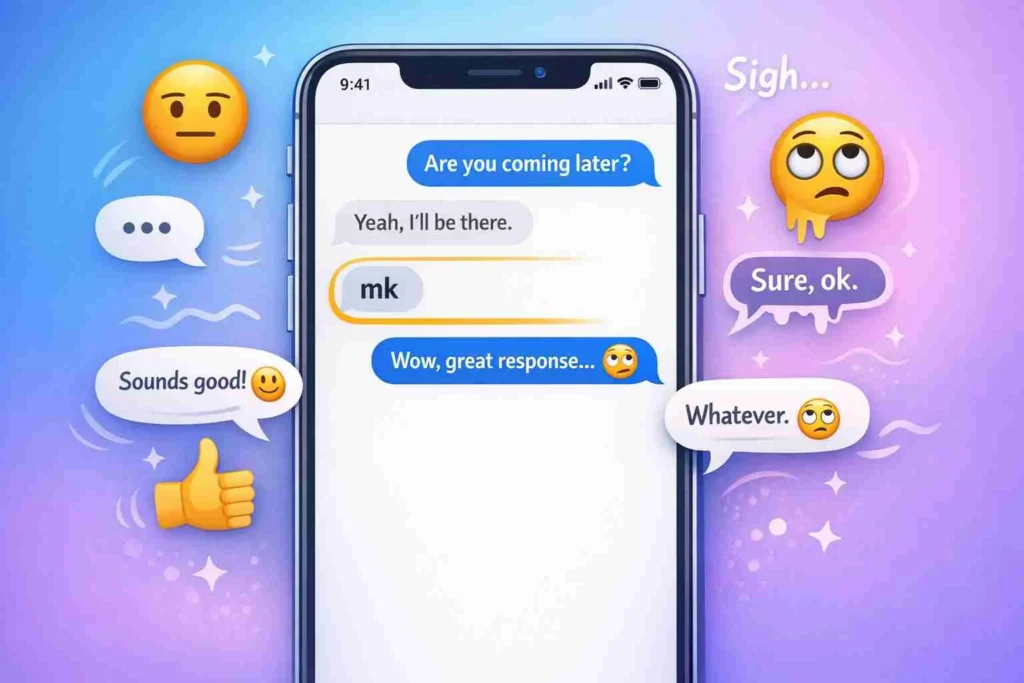
“MK” in text typically means “mmkay” or “okay,” often used to acknowledge something casually. Depending on tone, it can sound neutral, slightly dismissive, or even sarcastic.
If you’ve ever received a simple “mk” in a text message, you might have paused for a second wondering is that good, bad, or just… neutral? In today’s fast-paced digital communication, short abbreviations like “mk” have become incredibly common. They save time, simplify conversations, and sometimes even add subtle emotional tone without using full sentences.
But here’s the twist: “mk” isn’t always as straightforward as it looks. The meaning can shift depending on context, tone, punctuation, and even your relationship with the person texting you.
In this complete guide, we’ll break down everything you need to know about what “mk” means in text, how it’s used, when to use it (or avoid it), and how it compares to other similar abbreviations. By the end, you’ll never second-guess a simple “mk” again.
What Does MK Mean in Text?
At its core, “mk” is a shortened version of “mmkay” or “okay.” It’s commonly used in texting and online chats as a quick acknowledgment.
Key Meanings:
- Agreement: “mk” = okay, got it
- Acknowledgment: understood or noted
- Casual response: a laid-back way to reply
- Dismissive tone (sometimes): can imply disinterest or annoyance
Unlike a full “okay,” which feels more complete, “mk” is minimal and can feel emotionally neutral or even slightly cold depending on how it’s used.
Origin and Popularity of “MK”
The abbreviation “mk” comes from the spoken phrase “mmkay,” which itself is a casual, slightly drawn-out version of “okay.” Over time, this sound was shortened into text form as “mk.”
How It Became Popular:
- Early texting culture: Limited characters encouraged shorter words
- Chat apps and social media: Speed became more important than formality
- Casual communication trends: People began favoring minimal replies
Today, “mk” is widely used across:
- SMS texting
- Messaging apps (WhatsApp, Messenger, etc.)
- Social media DMs
- Online gaming chats
It’s especially popular among younger users, but people of all ages use it for quick responses.
How “MK” Is Used in Real Conversations
Understanding “mk” requires looking at context and tone. The same word can feel completely different depending on how it’s delivered.
1. Friendly or Neutral Tone
In casual conversations, “mk” simply means “okay.”
Examples:
- “I’ll call you later.”
→ “mk 👍” - “Meeting is at 3 PM.”
→ “mk, thanks!”
Tone: relaxed, informal, cooperative
2. Slightly Dismissive Tone
Sometimes, “mk” can feel like the person isn’t fully engaged.
Examples:
- “I think we should talk about this.”
→ “mk.” - “Can you help me with this?”
→ “mk”
Tone: uninterested, passive, or indifferent
3. Sarcastic or Annoyed Tone
When used alone or with punctuation, “mk” can signal irritation.
Examples:
- “You’re overreacting.”
→ “mk…” - “Whatever you say.”
→ “mk 🙄”
Tone: sarcastic, dismissive, or slightly annoyed
4. Playful or Light Tone
With emojis or friendly context, “mk” can feel soft and casual.
Examples:
- “Let’s get pizza tonight!”
→ “mk 😄” - “Don’t forget our plan!”
→ “mk haha”
Tone: easygoing, friendly
Example Table: Understanding MK in Context
| Situation | Text Message | Meaning | Tone |
|---|---|---|---|
| Agreement | “Meet at 6?” → “mk” | Okay, sounds good | Neutral |
| Confirmation | “Send the file.” → “mk 👍” | Got it | Friendly |
| Disinterest | “Let’s talk.” → “mk.” | Fine, but not enthusiastic | Dismissive |
| Sarcasm | “You’re wrong.” → “mk…” | Whatever | Annoyed |
| Casual chat | “See you soon!” → “mk 😄” | Sure | Light |
Tone Matters: Why “MK” Can Be Misunderstood
One of the biggest challenges with “mk” is that it lacks emotional clarity. Unlike longer responses, it doesn’t give much context.
Factors That Affect Meaning:
- Punctuation:
- “mk” = neutral
- “mk.” = colder or final
- “mk…” = hesitant or annoyed
- Emojis:
- “mk 😊” = friendly
- “mk 🙄” = sarcastic
- Conversation context:
- Serious topic = may feel dismissive
- Casual chat = totally fine
Tip: If you want to avoid confusion, consider adding a few extra words or emojis.
Comparison with Similar Text Abbreviations
“MK” is just one of many short responses used in texting. Here’s how it compares to others:
| Abbreviation | Meaning | Tone | When to Use |
|---|---|---|---|
| OK | Okay | Neutral | General use |
| K | Okay | Often blunt | Can seem rude |
| KK | Okay, got it | Friendly | Casual chats |
| MK | Okay/mmkay | Neutral to dismissive | Informal replies |
| Sure | Agreement | Polite | Professional or casual |
| Got it | Understood | Clear | Work or instructions |
Key Differences:
- “K” can feel harsh or abrupt
- “KK” feels warmer and more positive
- “MK” sits in the middle casual but potentially ambiguous
Alternate Meanings of “MK”
While “mk” usually means “okay,” it can have other meanings depending on context:
Less Common Uses:
- MK = Mark (as in names or labels)
- MK = Mortal Kombat (gaming context)
- MK = Model/Version (e.g., “MK II”)
- MK = Mkay (stylized slang)
These meanings are usually clear from context, so confusion is rare.
When Should You Use “MK”?
Good Situations:
- Casual conversations with friends
- Quick acknowledgments
- Informal texting
Avoid Using “MK” When:
- Talking about serious or emotional topics
- Communicating professionally
- You want to sound warm or enthusiastic
Polite and Professional Alternatives
If you want to sound more thoughtful or professional, here are better options:
Alternatives to “MK”:
- “Okay, sounds good”
- “Got it, thank you”
- “Understood”
- “Sure, I’ll do that”
- “Alright, noted”
These responses add clarity and avoid the risk of sounding dismissive.
Real-Life Usage Tips
- Match the tone of the conversation: If someone is formal, avoid “mk”
- Use emojis wisely: They can soften the tone
- Avoid overusing it: Repeated “mk” replies can feel lazy
- Be mindful in sensitive conversations: It may come across as uncaring
FAQs
What does MK mean in texting?
“MK” usually means “okay” or “mmkay.” It’s a short, casual way to acknowledge something in a conversation, often used in informal chats.
Is MK rude in text messages?
It can be, depending on the context. While “mk” is often neutral, it may come across as dismissive or uninterested if used alone or in serious conversations.
What’s the difference between MK and OK?
“OK” is more standard and clear, while “MK” is more casual and can sometimes feel less enthusiastic or slightly indifferent.
Does MK mean yes or no?
“MK” generally means yes or agreement, but in a passive way. It doesn’t strongly express enthusiasm or excitement.
Why do people say MK instead of OK?
People use “mk” for speed and convenience. It’s shorter and fits the fast-paced style of texting and online communication.
Is MK passive-aggressive?
It can be. In certain contexts, especially with punctuation like “mk…” or “mk.”, it may signal annoyance or sarcasm.
Can MK be used in professional messages?
It’s best avoided in professional settings. Use clearer and more polite alternatives like “Understood” or “Okay, thank you.”
What does MK mean from a girl or guy?
The meaning doesn’t change based on gender. It still means “okay,” but tone depends on context and how it’s written.
Conclusion
“MK” might be just two letters, but it carries more nuance than you’d expect. At its simplest, it means “okay” or “got it,” making it a convenient shortcut in casual conversations. However, its tone can shift from friendly to dismissive depending on context, punctuation, and delivery.
The key takeaway is this: context is everything. When used casually among friends, “mk” works perfectly fine. But in serious or professional conversations, it’s better to choose clearer and more expressive alternatives.
By understanding how “mk” works, you can communicate more effectively and avoid those awkward “Did they mean something by that?” moments.
Discover More Related Articles:
- “CYA” Meaning: Hidden Meaning You Should Know In 2026
- “LGHT” Meaning: What Everyone Is Using in Chats Right Now In 2026
- “CFS” Meaning Slang: What It Stands For, How to Use It & When It Fits In 2026