

Definition
Resignate in text typically refers to a mistaken or informal usage combining “resign” and “resonate,” often meaning to accept something, give up, or emotionally connect with a situation, depending on context.
If you’ve come across the term “resignate” in text messages or social media and found yourself confused, you’re not alone. This word often sparks curiosity because it doesn’t officially exist in standard English dictionaries yet it still appears in conversations, captions, and casual chats. So what does it really mean, and how should you interpret it when someone uses it?
In this guide, we’ll break down everything you need to know about the resignate mean in text, including its possible meanings, usage, tone, and real-life examples. It’s a typo, slang, or a mix of emotions, understanding this word can help you decode modern digital communication more effectively.
Origin and Meaning of “Resignate”
The word “resignate” is not officially recognized in standard English, but it has emerged from digital communication trends.
Possible Origins
- Typographical error: Most commonly, people intend to type “resonate” but mistakenly type “resignate.”
- Combination of words: It may also be a blend of:
- Resign → to give up or accept something reluctantly
- Resonate → to strongly connect or relate emotionally
- Internet slang evolution: Online platforms often create new hybrid expressions that gain meaning through usage rather than grammar rules.
Popularity of “Resignate” in Text
Even though it’s not a formal word, “resignate” appears frequently in:
- Social media captions
- TikTok comments
- Casual texting conversations
- Memes and relatable content
Why is it popular?
- People type quickly and make typos
- Informal communication doesn’t require strict grammar
- It can express complex emotions in a single word
What Does “Resignate” Mean in Different Contexts?
The meaning of “resignate” depends heavily on context. Here are the most common interpretations:
1. As a Mistyped “Resonate”
Most often, it is simply a typo of resonate.
Example:
- “That story really resignates with me.”
👉 Correct: “That story really resonates with me.”
Meaning: The person feels emotionally connected.
2. As a Mix of “Resign” and “Resonate”
In some cases, it expresses a feeling of acceptance mixed with emotional connection.
Example:
- “I just resignate with the situation.”
👉 Meaning: I accept the situation and feel emotionally aligned with it.
3. As a Slang for Giving Up
Sometimes it implies resignation or giving up.
Example:
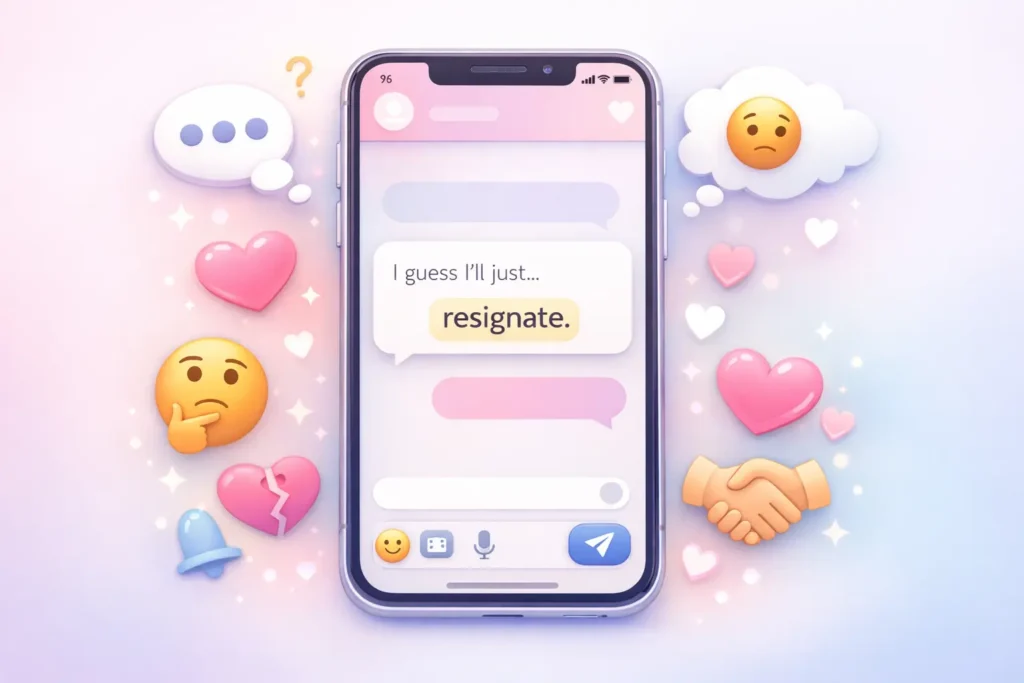
- “I guess I’ll just resignate and move on.”
👉 Meaning: I’m giving up and accepting the outcome.
Usage of “Resignate” in Real Conversations
Even though it’s not grammatically correct, people use it in casual contexts.
Common Usage Scenarios
- Emotional expression
- Casual chats with friends
- Online comments and posts
- Relatable or humorous statements
Tone Variations
| Tone Type | Example Sentence | Meaning |
|---|---|---|
| Friendly | “I totally resignate with that meme 😂” | Relatable feeling |
| Neutral | “Yeah, I just resignate with it.” | Acceptance |
| Negative | “I resignate… nothing I can do now.” | Giving up / frustration |
| Playful | “That resignates so hard lol” | Light, humorous connection |
Examples of “Resignate” in Text
Here are some real-style examples to help you understand better:
Emotional Context
- “After everything, I just resignate with how things turned out.”
- “That quote really resignates with my life right now.”
Casual Context
- “Not gonna lie, I kinda resignate with this situation.”
- “We all resignate sometimes 😅”
Social Media Style
- “Me watching life go downhill and just resignating 😂”
- “When you resignate instead of arguing… peace > drama”
Comparison: “Resignate” vs Similar Terms
Understanding similar words can help clarify the meaning.
| Word | Meaning | Usage |
|---|---|---|
| Resonate | To strongly connect emotionally | Formal & correct |
| Resign | To give up or quit | Formal |
| Relate | To understand or connect | Neutral |
| Accept | To agree or acknowledge | Neutral |
| Resignate | Informal mix / typo / slang | Casual, unclear |
Is “Resignate” a Correct Word?
No, “resignate” is not officially a correct English word.
However:
- It is widely understood in casual digital conversations
- People often use it knowingly or unknowingly
- Context determines its meaning more than grammar
Alternate Meanings of “Resignate”
Although uncommon, it can sometimes be interpreted as:
- A combination of emotional alignment and acceptance
- A stylized way of expressing “I’ve given up but understand the situation”
- A creative expression in online culture
Polite and Professional Alternatives
If you want to communicate clearly in formal or professional settings, avoid using “resignate.” Instead, use:
Better Alternatives
- “Resonate” → when expressing emotional connection
- “I understand and relate”
- “I accept the situation”
- “I acknowledge this”
- “I agree with this sentiment”
Example Transformation
- Casual: “This really resignates with me.”
- Professional: “This strongly resonates with me.”
Example Table for Better Understanding
| Context | Sentence Example | Meaning |
|---|---|---|
| Emotional | “That resignates with my story.” | Emotional connection |
| Acceptance | “I just resignate with it.” | Giving up / acceptance |
| Mistake | “This resignates with me.” | Typo for resonate |
| Slang | “We all resignate sometimes.” | Relatable feeling |
| Casual Humor | “Resignate and move on 😂” | Light-hearted acceptance |
Why Do People Use “Resignate” in Text?
Here are some reasons why the term keeps appearing:
- Typing mistakes while texting quickly
- Influence of autocorrect or predictive text
- Mimicking others’ usage on social media
- Creative expression in memes and captions
- Blending emotional meanings into one word
Tips for Using or Understanding “Resignate”
- Always check the context before interpreting
- Consider the person meant “resonate”
- Use it only in informal conversations
- Avoid using it in professional or academic writing
- When in doubt, ask for clarification
FAQs
What does resignate mean in text?
In texting, “resignate” is usually a typo or informal blend of “resonate” and “resign,” meaning either emotional connection or acceptance depending on context.
Is resignate a real word in English?
No, “resignate” is not officially recognized in standard English dictionaries, but it is commonly used in informal digital communication.
Why do people write resignate instead of resonate?
People often make typing errors, or autocorrect may change “resonate” into “resignate,” especially when typing quickly on mobile devices.
What does resignate mean in slang?
In slang, it can mean to emotionally accept something or to feel resigned about a situation, often with a casual or humorous tone.
Is resignate used in formal writing?
No, it is not suitable for formal or professional writing. It is best used in casual conversations only.
What is the correct word instead of resignate?
The correct word is usually “resonate” if referring to emotional connection, or “resign” if referring to giving up.
Can resignate have multiple meanings?
Yes, it can mean emotional connection, acceptance, or giving up, depending on how it is used in the sentence.
How should I respond when someone says resignate?
You can respond based on context, such as offering support, agreement, or understanding, since the word usually expresses emotion or acceptance.
Conclusion
The term “resignate” in text may not be an official English word, but it has found its place in modern digital communication. Most of the time, it is either a typo of “resonate” or a creative blend of emotions representing acceptance, emotional connection, or even giving up. Its meaning depends entirely on context, tone, and intent.
If you’re using it in casual chats, it can add personality and relatability to your message. However, in professional or academic settings, it’s best to stick to correct terms like “resonate” or “accept” for clarity and credibility.
Understanding such evolving internet language helps you stay fluent in modern communication while avoiding misunderstandings. So next time you see “resignate,” you’ll know exactly what the sender likely means and how to respond appropriately.
Discover More Related Articles:
- 450 Text Replies to ‘Wish You Were Here’: Witty and Bold Lines in 2026
- 550 Replies to “Chag Sameach”: How to Spread Blessings in 2026