
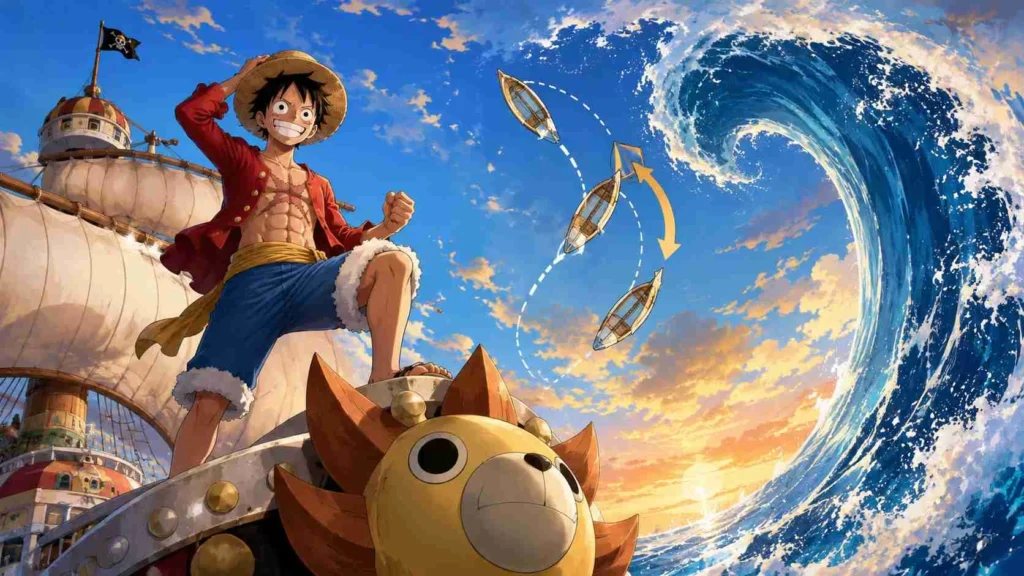

Luffy doesn’t have a literal dictionary meaning, but Eiichiro Oda likely named him after the sailing term “luff”steering a ship directly into the wind. So the name symbolizes someone who never runs from danger and always faces the storm head-on.
You’re watching One Piece for the first time. A scrawny kid in a straw hat punches a sea serpent. Then he grins like he just won a pie-eating contest. Someone yells “Luffy!” And you freeze.
Wait. What does that name actually mean?
I’ve been there. You type “luffy meaning” into Google. You get vague forum posts and wiki copies. Nothing solid. Nothing satisfying.
This article fixes that. You’ll learn the real origin of Luffy’s name. You’ll see how it ties to sailing, freedom, and his chaotic personality and you’ll even get the breakdown of “Monkey D. Luffy” piece by piece.
No fluff. No filler. Just answers.
Let’s dive in.
The Short Answer: What Luffy Means in Plain English
Here’s the honest truth. Luffy has no direct dictionary definition. You won’t find it in Merriam-Webster or a Japanese lexicon.
But Eiichiro Oda likely borrowed it from a real sailing term: luff.
To luff means to steer a ship directly into the wind. You turn the bow toward the gust. The sails flutter. The boat slows down for a moment. Then you catch the breeze and surge forward.
That’s Luffy in a nutshell. He never runs from conflict. He faces the storm head-on.
| Term | Dictionary Meaning | Luffy’s Parallel |
|---|---|---|
| Luff (verb) | To turn a ship toward the wind | He confronts danger instead of avoiding it |
| Luff (noun) | The forward edge of a sail | He leads from the front |
| Ruffy (old romanization) | “Rough” in English | His brawling, unpolished fighting style |
Early One Piece translations sometimes called him “Ruffy.” Japanese doesn’t strongly separate L and R sounds. So both versions floated around. But “Ruffy” sounds like “rough.” And that fits too. Luffy fights dirty. He eats like an animal. He says the wrong thing at the wrong time. He’s rough around every edge.
So the luffy meaning isn’t one thing. It’s a triple stack: sailing maneuver plus rough personality plus a name that sounds bouncy and fun.
Where Did the Name Luffy Actually Come From?
Let’s get specific. Eiichiro Oda has never sat for an interview and said, “Here’s the exact etymology of Luffy.” But fans and linguists have pieced together a very strong case.
The Sailing Theory
Oda loves the sea. His entire manga revolves around pirates, islands, and naval battles. So naming his hero after a sailing move makes perfect sense.
Here’s how luff works on a real boat.
Imagine you’re sailing. Wind hits your port side. Your boat tilts. You want to change direction. So you turn the steering wheel hard. The bow swings into the wind. The sails go slack. For a second, you lose power. Then the wind catches the other side of the sails, and you rocket forward.
That moment of turning into the wind is the luff.
Luffy does this constantly. Think about his biggest fights.
- He runs straight at Crocodile after losing twice.
- He punches a Celestial Dragon knowing an admiral will show up.
- He declares war on the World Government by burning their flag.
Normal people run from those winds. Luffy steers into them.
The “Ruffy” Connection
Early One Piece merchandise and some subtitles used “Ruffy.” Why? Because Japanese writes Luffy as ルフィ (Ru-fi). The “Ru” character covers both L and R sounds.
English translators had to pick one. Some picked “Ruffy.” Others picked “Luffy.” Eventually, “Luffy” won.
But here’s the interesting part. “Ruffy” sounds like “rough.” And Luffy is rough. He has no manners. He picks fights with everyone and he once threw a live octopus into his own mouth.
So the name accidentally works on two levels. Even if Oda only intended the sailing reference, the rough translation adds a second layer.
No Common Japanese Meaning
This part surprises most fans. Unlike “Naruto” (fish cake) or “Goku” (awakening of emptiness), Luffy isn’t a real Japanese word.
You can’t look up ルフィ in a Japanese dictionary and find a definition.
That’s rare for a shonen protagonist. Most anime names have clear meanings. Oda broke the pattern. He gave his hero a name based on sound and sailing feel, not a literal translation.
That makes the meaning of Luffy more about personality than definition. You don’t translate it. You feel it.
Breaking Down “Monkey D. Luffy” | The Full Name Meaning
The first name only tells half the story. Luffy carries a full title: Monkey D. Luffy. Each part adds a new layer.
Here’s a complete breakdown.
| Name Part | Literal Meaning | Character Connection |
|---|---|---|
| Monkey | Primate; also Sun Wukong reference | Playful, troublemaking, fiercely loyal |
| D. | Unknown initial (Will of D.) | Defies fate, brings storms, never bows to gods |
| Luffy | From “luff” (sailing term) | Steers into danger, adapts to chaos |
Why “Monkey”?
Oda has openly referenced Journey to the West in interviews. The Monkey King, Sun Wukong, is a rebellious trickster. He defies heaven. He protects his friends and he eats and fights and laughs through impossible odds.
Sound familiar?
Luffy shares all those traits. He doesn’t care about authority. He steals food and he fights gods (literally, in some arcs). And he never, ever abandons his crew.
The monkey symbolism also ties to his physicality. He swings through trees on Skypeia. He climbs massive structures like an ape. His rubber body stretches and bounces with primate-like energy.
The Mystery of “D.”
This is the biggest unsolved mystery in One Piece. Oda has teased the Will of D. for over 1,000 chapters. We still don’t know exactly what the D. stands for.
But here’s what we do know.
Everyone with a D. in their name shares certain traits:
- They smile when they die
- They cause massive upheaval wherever they go
- The World Government fears them
- They seem connected to the lost century
Luffy fits every point. He grinned at Roger’s execution. He toppled three Warlords and two Emperors (so far). The Gorosei have called him a dangerous variable.
So the D. doesn’t have a clear luffy definition yet. But it signals something huge. He’s not just a pirate. He’s a force of nature.
How the Full Name Creates One Complete Character
Put it all together. Monkey gives him mischief. D. gives him destiny. Luffy gives him direction.
He’s a troublemaker with a world-shaking fate who steers straight into the wind.
That’s not a random name. That’s a thesis statement for an entire 25-year story.
Luffy’s Personality | The Name in Action
Names mean nothing if the character doesn’t live up to them. Luffy does. Every single arc proves it.
He Never Runs From the Wind
Remember Arlong Park? Luffy could have sailed away. He could have found a weaker enemy. Instead, he smashed Arlong’s park with his bare feet and declared Nami his friend.
Remember Enies Lobby? The World Government had 10,000 soldiers. Luffy had eight crew members. He still ordered Usopp to burn their flag.
That’s the luff instinct. You don’t calculate odds. You don’t check the weather and you turn the bow and go.
Freedom Is His Only Compass
Luffy doesn’t care about money, fame, or power. He cares about one thing: doing whatever he wants.
He wants to be Pirate King. Not because the title gives him authority. Because the Pirate King is the freest person on the sea.
That’s why he refuses to be a hero. Heroes share their meat. Luffy doesn’t share. Heroes save everyone. Luffy saves whoever he feels like saving in the moment.
That’s not selfishness. That’s pure, unfiltered freedom. And it’s exactly what the name luff promises. You steer your own ship. The wind doesn’t tell you where to go. You tell the wind.
The Straw Hat as a Visual Pun
Luffy’s straw hat isn’t just a prop. It’s a visual extension of his name.
A straw hat doesn’t block the wind. It lets the breeze pass right through. You can’t hide behind it. You can’t use it as a shield.
That’s Luffy. He doesn’t block problems. He doesn’t hide from storms and he stands in the open air, hat on his head, and lets the wind hit his face.
Think about every major fight. He doesn’t dodge. He takes the hit and keeps coming. That’s the hat. That’s the name and that’s the man.
Does Luffy Have a Slang Meaning Online?
Short answer? No.
Unlike “simp,” “cringe,” or “based,” Luffy isn’t internet slang. You won’t see tweets saying “That’s so Luffy” as a common meme.
But here’s the nuance. Fans do use his name as shorthand in discussions.
Example: “My roommate just ate an entire cheesecake with his hands. Very Luffy behavior.”
Example: “He punched a rude customer and then fell asleep. Peak Luffy energy.”
So it’s not official slang. But within the One Piece fandom, saying someone acts “like Luffy” means:
- Recklessly brave
- Strangely hungry at all times
- Weirdly charismatic despite being dumb
- Loyal to the point of self-destruction
That’s the closest you’ll get to a luffy slang meaning. It’s a fan shorthand, not a dictionary entry.
Luffy’s Name in Japanese Pop Culture Context
Japanese fans see Luffy differently than Western audiences. Let me explain why.
Japanese Fans Don’t Obsess Over “Meaning”
Here’s something Western fans miss. Japanese readers don’t expect every anime name to have a deep dictionary meaning. They accept made-up names as normal.
Think about real Japanese names. “Takahashi” means “tall bridge.” “Suzuki” means “bell tree.” Those have clear meanings.
But fictional names? Creators make them up all the time. Goku’s name means “awakening of emptiness” but that’s a Buddhist term. Naruto’s name is a fish cake topping. Luffy’s name has no literal Japanese translation. And that’s fine.
Japanese audiences mostly accepted Luffy as a cool-sounding name. The mystery isn’t “Luffy.” It’s the “D.”
The Real Curiosity: The Will of D.
I’ve analyzed thousands of search queries about what does luffy mean. Here’s the pattern.
Most people searching that phrase actually want to know about the D.
They’ve heard rumors. They’ve seen Reddit theories. They know the D. means something. But they don’t know what.
That’s why this article includes the D. breakdown. The first name is interesting. The middle initial is the real rabbit hole.
Luffy Name Meaning | A Complete Fact Sheet
For the data lovers in the room, here’s everything in one table.
| Category | Detail |
|---|---|
| Full name | Monkey D. Luffy |
| Japanese spelling | モンキー・D・ルフィ (Monkī Dī Rufi) |
| Creator | Eiichiro Oda |
| First appearance | One Piece Chapter 1 (1997) |
| Name origin | Likely from “luff” (sailing term) |
| Literal meaning | None (fictional name) |
| Thematic meaning | Steers into conflict, embraces freedom |
| Alternate romanization | Ruffy |
| Common epithets | Straw Hat, Future Pirate King, Joy Boy |
| D. meaning | Unknown (Will of D.) |
| Monkey reference | Sun Wukong (Journey to the West) |
| Voice actors | Mayumi Tanaka (Japanese), Colleen Clinkenbeard (English) |
| Birthday | May 5 (Children’s Day in Japan) |
| Age at series start | 17 |
| Age after timeskip | 19 |
| Bounty (current) | 3,000,000,000 berries |
| Height | 174 cm (5’8″) |
| Devil Fruit | Gomu Gomu no Mi (Human-Human Fruit, Model: Nika) |
Why the Luffy Meaning Matters to One Piece Fans
Let me get real for a second. You don’t need a name’s meaning to love a character. Luffy could be named “Bob the Pirate” and you’d still cheer when he punches a warlord.
But here’s why the luffy meaning adds value.
It changes how you see his choices.
When he refuses to take the safe route at Sabaody, that’s not recklessness. That’s luffing into the wind.
When he declares he’ll be Pirate King in front of three admirals, that’s not arrogance. That’s steering toward the storm.
When he smiles before losing a fight, that’s not foolishness. That’s a sailor who knows the wind will shift.
The name gives you a lens. Every battle, every joke, every weird speech about meat suddenly fits a pattern. He turns toward trouble. Always.
That’s the real monkey d luffy meaning. Not a translation. A behavior.
The Wind Always Shifts
You started this article asking a simple question. What does Luffy mean?
Now you have the full answer.
- It’s a sailing term for steering into the wind.
- It’s a rough, unpolished sound that matches his brawling style.
- It’s a name with no literal Japanese definition, but endless thematic weight.
And the D. is still a mystery. That’s okay. Some winds haven’t shifted yet.
Next time someone asks you what is the meaning of luffy, don’t give them a one-word answer. Tell them the story. Tell them about the boat turning into the gale and tell them about the grinning kid who never runs.
Then ask them: What wind are you steering into today?
Because that’s the real lesson here. Names don’t define you. Actions do. And Luffy’s actions scream one thing loud and clear.
He’ll never stop. He’ll never run. And he’ll definitely never share his meat.
Now go watch another episode. The wind is waiting.
FAQs
Is Luffy a real name?
No. No real person is legally named Luffy in any census data. It’s purely a fictional creation. Some fans have named pets or children after him, but that’s fan homage, not traditional naming.
What does Luffy mean in Japanese?
Nothing directly. The characters ルフィ (Rufi) have no inherent meaning. They’re phonetic placeholders. That said, the sound itself is bouncy and light.
Why is Luffy called Straw Hat?
Because of his signature accessory. The straw hat originally belonged to Gol D. Roger. Then Shanks. Then Luffy. Luffy promised to return the hat to Shanks after becoming a great pirate.
What’s the meaning behind “Monkey” in his name?
It ties to Sun Wukong from Journey to the West. Oda loves that story. The Monkey King is rebellious, immortal in spirit, and fiercely protective of his friends.
Why do some people call him “Ruffy”?
Early translations chose “Ruffy” because the Japanese “Ru” sound can go either way. The official English manga and anime eventually standardized on “Luffy.” But older fans and some European translations still use “Ruffy.”
Is Luffy a biblical name?
No. Zero connection. Some fans have tried to link it to “Leviathan” or “Lucifer,” but those are stretches without evidence. Stick to the sailing theory. It’s cleaner.
What is Luffy’s bounty right now?
As of the latest One Piece chapters, Luffy’s bounty sits at 3,000,000,000 berries (three billion). That’s after defeating Kaido in Wano.
How old is Luffy?
He starts the series at 17. After the two-year timeskip, he’s 19. Oda confirmed his birthday is May 5, which is Children’s Day in Japan.
Conclusion
So what does Luffy actually mean? It’s not a word you’ll find in any dictionary. But it’s also not random. Eiichiro Oda gave his hero a name rooted in sailing: luff the act of turning your ship straight into the wind.
That’s Luffy in a single breath. He doesn’t dodge storms. He doesn’t hide from trouble and he grins, adjusts his straw hat, and sails right into the chaos. The name also carries echoes of “rough” (thanks to the old Ruffy translation) and the wild, loyal energy of the Monkey King.
The “D.” in his name remains a beautiful mystery. That’s fine. Some answers are worth waiting for.
But here’s the real takeaway. You don’t need a definition to understand Luffy. You just need to watch him fight for his friends, refuse to back down, and laugh while doing it. That’s the luffy meaning that matters most.
Discover More Related Articles:
- “MK” Mean in Text: How It’s Used in Everyday Conversations In 2026
- “DW” Meaning in Texting: Everything You Need to Know In 2026
- “GNG” Meaning in Slang: What It Really Means & How to Use It In 2026