
Mashallah means “God has willed it” in Arabic. Muslims say it to express admiration, gratitude, and protection from envy when they see something good or beautiful.
You just saw something amazing. Maybe a friend’s newborn baby. Or a sunset so perfect it looked fake. Or someone’s brand new car.
Your first instinct? Say Mashallah.
But what does that word actually mean? Why do over a billion people use it every single day? And are you using it right?
Let’s break it down. No fluff. Just real answers.
What Is the Mashallah Meaning in English?
You can also translate it as “What Allah wills.” Same idea. Humble. Beautiful. Direct.
Here’s the literal breakdown from Arabic:
| Arabic WordTransliterationEnglish Meaning | ||
|---|---|---|
| ما | Maa | What / Whatever |
| شاء | Shaa’ | He willed |
| الله | Allah | God |
So the full phrase says: Whatever God wills, happens.
That’s the core. But the real Mashallah meaning goes deeper than translation. It carries admiration, gratitude, and even spiritual protection.
Why Do Muslims Say Mashallah?
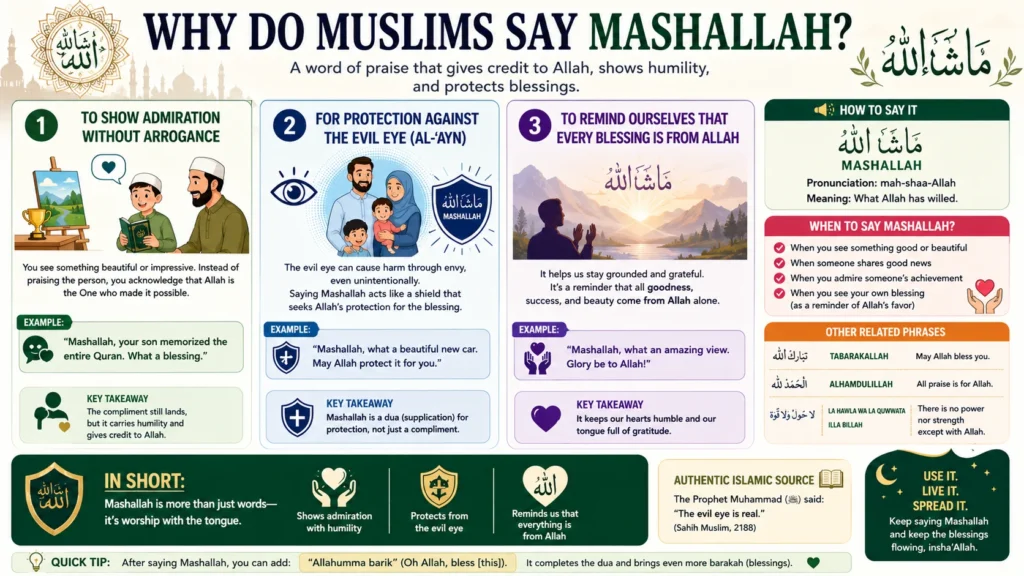
People say Mashallah for three main reasons. Let’s walk through each one.
Reason 1: To Show Admiration Without Arrogance
You see something beautiful. A child. A painting. A promotion at work.
If you just say “Wow, that’s great,” you risk sounding proud or jealous. Even accidentally.
Saying Mashallah shifts the spotlight. You’re not praising the person alone. You’re acknowledging that God made that good thing possible.
Example:
“Mashallah, your son memorized the entire Quran. What a blessing.”
See the difference? The compliment still lands. But now it carries humility.
Reason 2: For Protection Against the Evil Eye Al-‘Ay)
This is huge in many Muslim cultures.
The evil eye isn’t just superstition. It’s a real belief in Islam backed by authentic teachings. The Prophet Muhammad (peace be upon him) warned that the evil eye can bring down blessings.
How does it happen? Simple. Someone sees something nice, feels envy (even unintentionally), and that negative energy causes harm.
Saying Mashallah acts like a shield.
Think of it as verbal armor. You admire something and you protect it in the same breath.
Example:
You visit a friend’s new house. Instead of just saying “Gorgeous home,” you say “Mashallah, may God protect it for you.”
You’ve just paid a compliment and asked for divine protection. Two birds, one stone.
Reason 3: To Celebrate Blessings Out Loud
Gratitude grows when you share it.
When you see a blessing your own or someone else’s saying Mashallah turns a quiet thought into a spoken prayer.
You’re saying: I see this good thing. I know where it came from. And I’m grateful.
Example:
You finish a big project at work. You say to yourself: Mashallah, I couldn’t have done this without God’s help.
That’s not arrogance. That’s awareness.
Mashallah Meaning in Islam | The Spiritual Depth
The Mashallah meaning in Islam goes beyond politeness. It touches your core beliefs.
In the Quran, God says:
“And why did you not, when you entered your garden, say: ‘Maa shaa’ Allah, la quwwata illa billah’ (What Allah wills. There is no power except with Allah)?” (Quran 18:39)
That verse comes from the story of two men. One had a beautiful garden. The other had less wealth. The rich man bragged. The poor man advised him to say Mashallah.
The rich man didn’t listen. And he lost everything.
The lesson? Saying Mashallah keeps your ego in check. It reminds you that you don’t control outcomes. God does.
So when you say Mashallah, you’re doing three things spiritually:
- Acknowledging God’s will over your life
- Protecting blessings from envy and harm
- Training your heart toward humility
That’s powerful for a two-syllable word.
How to Pronounce Mashallah
Let’s fix the pronunciation once and for all.
Correct pronunciation: Mash-aa-LAH
Break it into three beats:
| Beat | Sound | Like in English |
|---|---|---|
| 1 | Mash | “mash” as in mashed potatoes |
| 2 | aa | “aa” as in father (open your mouth) |
| 3 | LAH | “lah” with stress on this syllable |
Common mistakes people make:
- Saying Mash-uh-luh (too soft, wrong vowels)
- Rushing the middle “aa” sound
- Putting stress on the first syllable (MASH-alah)
Quick trick: Say “Mash” then “Allah” quickly. Mash-Allah. Now merge them. Mashallah.
Listen to any Quran reciter say Maa shaa Allah. Copy that rhythm. You’ll get it in under a minute.
Mashallah vs Inshallah vs Alhamdulillah
This is where most people get confused. Let’s clear it up.
| Phrase | Meaning | When to Use | Example |
|---|---|---|---|
| Mashallah | God has willed it | After or during something good | Mashallah, you look so healthy. |
| Inshallah | If God wills it | For future plans or hopes | I’ll see you tomorrow, inshallah. |
| Alhamdulillah | Praise be to God | After any outcome (good or bad) | Alhamdulillah, we made it home safely. |
Real-Life Mix-Ups And How to Avoid Them
Wrong: “I passed my exam yesterday, inshallah.”
Why it’s wrong: Inshallah is for the future. The exam already happened.
Correct: “I passed my exam yesterday, alhamdulillah.”
Wrong: “Mashallah, I’ll start my new job next week.”
Why it’s wrong: Mashallah comments on something that already exists or is happening now. The job hasn’t started yet.
Correct: “I’ll start my new job next week, inshallah.”
Wrong: “Alhamdulillah, what a beautiful baby.”
Why it’s wrong: Alhamdulillah is general praise to God. But when you admire something specific, you say Mashallah to protect from the evil eye.
Correct: “Mashallah, what a beautiful baby.”
See the pattern?
- Past or present good thing → Mashallah
- Future hope or plan → Inshallah
- Gratitude after anything (good or bad) → Alhamdulillah
Mashallah Meaning in Urdu and Hindi
The Mashallah meaning in Urdu is identical to Arabic: “Allah ne jo chaaha.” (God willed what He willed.)
Same goes for the Mashallah meaning in Hindi: “Jo Allah ne chaaha.”
No change in meaning. No change in usage. The word travels unchanged from the Arabian Peninsula to South Asia.
In fact, you’ll hear Mashallah across:
- Pakistan (Urdu speakers)
- India (Hindi and Urdu speakers)
- Bangladesh (Bengali speakers)
- Turkey (Maşallah)
- Bosnia, Albania, Kosovo
- Iran (Persian speakers)
- Indonesia and Malaysia
This one phrase bridges cultures. A Pakistani grandmother and a Moroccan shopkeeper and a Nigerian schoolteacher all understand it the same way.
When to Say Mashallah
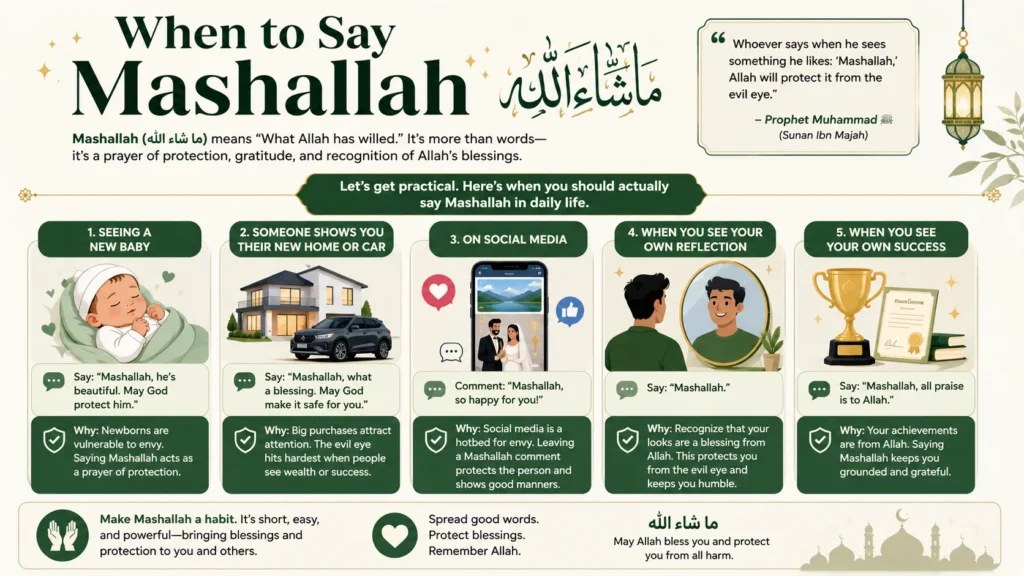
Let’s get practical. Here’s when you should actually say Mashallah in daily life.
Seeing a New Baby
Say: “Mashallah, he’s beautiful. May God protect him.”
Why: Newborns are vulnerable to envy. Saying Mashallah acts as a prayer of protection.
Someone Shows You Their New Home or Car
Say: “Mashallah, what a blessing. May God make it safe for you.”
Why: Big purchases attract attention. The evil eye hits hardest when people see wealth or success.
On Social Media
Someone posts a vacation photo. A wedding picture. An achievement at work.
Comment: Mashallah, so happy for you!
Why: Social media is a hotbed for envy. Leaving a Mashallah comment protects the person and shows good manners.
When You See Your Own Reflection or Success
Yes, you can say Mashallah for yourself.
Example 1: You look in the mirror after a workout. Mashallah, I’m getting stronger.
Example 2: You get a promotion. Mashallah, God blessed my hard work.
Why: Saying it for yourself stops arrogance before it starts. You’re not denying your effort. You’re just remembering who enabled it.
After Hearing Good News From a Friend
Friend: “I got engaged!”
You: “Mashallah! May God bless your union.”
Why: Celebrating without the phrase feels incomplete in many Muslim cultures. Mashallah turns congratulations into a blessing.
How to Reply When Someone Says Mashallah to You
Someone just said Mashallah to you. What do you say back?
No single correct answer. But here are natural, polite replies:
| Reply | Meaning | Best For |
|---|---|---|
| JazakAllah khair | May God reward you with good | Formal or religious settings |
| BarakAllahu feek | May God bless you | General use |
| Alhamdulillah | Praise be to God | Any situation |
| Thank you, mashallah | Simple gratitude + returning the blessing | Casual conversation |
| Ameen, and you too | Accepting the prayer for yourself and the other person | Close friends or family |
Don’t just say “thanks.”
It’s not wrong. But it misses the spiritual opportunity. A short Islamic reply completes the exchange beautifully.
Mashallah on Social Media and Texting
Times have changed. Mashallah isn’t just spoken anymore. It’s typed, tweeted, and texted constantly.
Common Spellings You’ll See
- Mashallah (most common)
- MashaAllah (capital A for respect)
- Ma sha Allah (spaces for clarity)
- Masha’Allah (with an apostrophe)
All are fine. No religious rule here. Pick one and stay consistent.
Emojis People Pair With Mashallah
- 🕌 (mosque)
- 🤲 (open hands, dua)
- ✨ (sparkles, blessing)
- 💚 (green, Islamic color)
- 😍 (strong admiration)
Texting Example
Friend sends a photo of their new puppy.
You reply: “Mashallah 😍 so cute! May God protect him.”
Perfect. Modern. Respectful.
Warning: Don’t Overuse It
Posting Mashallah under every single Instagram photo? That looks performative.
Use it when you genuinely feel admiration. Not as a checkbox. Sincerity matters more than frequency.
Mashallah vs Tabarakallah
You might also hear Tabarakallah. Let’s compare.
| Phrase | Meaning | Strength | When to Use |
|---|---|---|---|
| Mashallah | God has willed it | Mild to medium | Admiration + protection |
| Tabarakallah | Blessed is God | Stronger emphasis on blessing | Seeing extraordinary beauty or power |
Example difference:
You see a normal nice car. Mashallah.
You see a rare, million-dollar supercar. Tabarakallah, that’s incredible.
And you can use both. Tabarakallah just adds extra weight. It comes from the Quranic word tabaraka (blessed and exalted).
Common Misconceptions About Mashallah
Let’s kill some myths quickly.
Myth 1: Mashallah is only for religious events
Truth: People use it for everything. Food. Fashion. Sports. Even a good hair day.
Myth 2: Non-Muslims can’t say Mashallah
Truth: Arabic-speaking Christians and Jews say it naturally. So do non-religious Arabs. It’s a cultural phrase with religious roots. Anyone can say it respectfully.
Myth 3: You must say it out loud for it to work
Truth: Saying it in your heart counts. But out loud offers better protection from the evil eye. The Prophet recommended speaking blessings, not just thinking them.
Myth 4: Mashallah is only for avoiding jealousy
Truth: That’s one reason. But the main reason is humility and gratitude. Protection is a bonus.
Myth 5: Saying Mashallah too much is bad
Truth: No such thing. The more you acknowledge God’s will, the better. Just don’t say it robotically. Mean it each time.
How to Teach Mashallah to Kids
Kids pick up Mashallah fast. Here’s a simple way to explain it.
Say this to a child:
“When you see something nice, say Mashallah. It’s like telling God, ‘I see this good thing, and I know You made it possible.’ It also keeps away the jealous eye.”
Then practice with examples:
| What You See | What to Say |
|---|---|
| A friend’s new toy | Mashallah, that’s awesome |
| Your own drawing | Mashallah, I tried my best |
| A beautiful flower | Mashallah, God made this |
| Baby brother sleeping | Mashallah, so peaceful |
Make it a game. Every time they remember to say it, give a small reward. They’ll learn it naturally in weeks.
The Evil Eye and Mashallah | How Protection Actually Works
Let’s go deeper on the evil eye (Al-‘Ayn).
The Prophet Muhammad said:
“The evil eye is real. If anything could overtake destiny, it would be the evil eye.” (Sahih Muslim)
So this isn’t folklore. It’s a real spiritual reality in Islam.
How Does the Evil Eye Happen?
- Someone sees a blessing you have (health, wealth, beauty, children).
- They feel admiration mixed with a tiny bit of envy. Even unintentionally.
- That negative energy can cause harm: sickness, accidents, loss of that blessing.
How Does Mashallah Protect You?
When you say Mashallah, you do two things:
- You remind yourself (and others) that the blessing came from God.
- You ask for God’s protection over that blessing.
Think of it like this: Mashallah is a verbal lock on your blessings. Envy can’t break in easily.
What If You Forget to Say Mashallah?
Don’t panic. You can still say it later. Even days later.
Example: You admired a friend’s car yesterday but forgot to say Mashallah. Send them a message today: “By the way, mashallah on your car. May God protect it.”
That still works. Sincere late protection is better than no protection.
Mashallah Meaning for a Baby
Parents often name their child or announce a birth with Mashallah.
Why? Newborns are extremely vulnerable to the evil eye. Everyone wants to see the baby. Everyone compliments the baby. That’s a lot of attention.
So parents say Mashallah constantly in the first weeks. Sometimes they even write it on a banner or a birth announcement.
Example announcement:
“Mashallah, we welcomed a baby girl. Ameen for your kind prayers.”
If you visit a new baby, always say Mashallah before any compliment. And if you’re the parent, say it yourself when you look at your child. Protect your own blessing.
Mashallah in Popular Culture and Media
You’ve probably heard Mashallah in movies, songs, or TV shows without realizing it.
Music Examples
- French Montana (Moroccan-American rapper) uses Mashallah in lyrics.
- DJ Khaled says it frequently in interviews and on social media.
- Many South Asian pop songs include Mashallah as a casual praise phrase.
TV and Film
- Ramy (Hulu series) uses authentic Muslim phrases including Mashallah.
- Ms. Marvel (Disney+) features the phrase naturally in dialogue.
- Turkish dramas (Diriliş: Ertuğrul) use Maşallah constantly.
Sports
Muslim athletes like Mohamed Salah (Egypt) or Karim Benzema (France) often post Mashallah after wins or goals.
Example tweet after a goal: “Mashallah, thank God for this blessing.”
So the phrase isn’t stuck in religious books. It’s alive on your screen right now.
Mashallah Meaning in Chat and Texting
Younger generations have shortened Mashallah in texting. Here’s what you might see:
| Short Form | Meaning | When to Use |
|---|---|---|
| MASH | Mashallah | Very casual, close friends |
| MSA | Mashallah (abbreviation) | Rare, mostly online |
| M’Allah | Mashallah (slang) | Informal, Arabic speakers |
But caution: Don’t use short forms in formal or religious writing. Stick to the full word for respect.
Example text (casual):
Friend: “Just got tickets to the final game!”
You: “MASH brooo 😂”
That’s fine among friends. But don’t write “MSA” in a religious article or a condolence message. Know your audience.
The Difference Between Mashallah and Subhanallah
Another common confusion. Let’s fix it.
| Phrase | Meaning | Focus | Example |
|---|---|---|---|
| Subhanallah | Glory be to God / God is perfect | Awe at God’s creation or power | Subhanallah, look at those mountains. |
| Mashallah | God has willed it | Admiration + protection for a specific blessing | Mashallah, your garden is stunning. |
Key difference:
Subhanallah praises God directly. Mashallah praises the blessing while acknowledging God’s will.
You can say both.
“Subhanallah, what a beautiful sky. Mashallah, may God protect this view from my balcony.”
First phrase = awe at God’s work. Second phrase = protecting your personal blessing.
Mashallah Meaning in Arabic
For Arabic speakers, Mashallah carries grammatical and linguistic depth.
The phrase Maa shaa’ Allah is a conditional sentence. It implies: Whatever God wills (happens), and nothing happens without His will.
In classical Arabic, this structure affirms divine predestination (Qadr). Muslims believe God wrote everything before creation. Mashallah reminds you of that truth in six syllables.
Linguistic note:
Shaa’ (he willed) comes from the root sh-y-’ meaning “to will or intend.” Same root as mashiyyah (divine will). So every time you say Mashallah, you’re using a Quranic word with serious theological weight.
How to Use Mashallah in a Sentence
Let’s solidify everything with real sentences. Use these as templates.
For Appearance
- Mashallah, you look so healthy. Have you been working out?
- Mashallah, that bride is stunning.
- Mashallah, your skin is glowing.
For Achievements
- Mashallah, you graduated top of your class.
- Mashallah, your business is thriving.
- Mashallah, you memorized 30 chapters of Quran.
For Possessions
- Mashallah, this house is so peaceful.
- Mashallah, your car is brand new?
- Mashallah, that watch is beautiful.
For Children
- Mashallah, your son is so respectful.
- Mashallah, the twins are walking already.
- Mashallah, she has your eyes.
For Yourself
- Mashallah, I finished that project on time.
- Mashallah, I feel strong today.
- Mashallah, my family is healthy.
For Food
- Mashallah, this meal is delicious. Who cooked it?
- Mashallah, the barbecue smells amazing.
For Nature
- Mashallah, look at that sunset.
- Mashallah, the garden bloomed beautifully this spring.
For Good News
- Mashallah, I’m so happy for your promotion.
See the pattern? Say Mashallah before or during the compliment. Not after.
Mashallah Meaning Across Different Cultures
| Country / Region | How They Say It | Any Difference? |
|---|---|---|
| Saudi Arabia, Egypt, Jordan | Mashallah | Standard |
| Turkey | Maşallah | Same meaning, Turkish spelling |
| Iran (Persian) | Masha Allah | Same, often written separately |
| Pakistan, India | Mashallah (Urdu/Hindi) | Same meaning |
| Indonesia, Malaysia | Masya Allah | Same, slight spelling variation |
| Bosnia, Albania | Mashallah | Same, from Ottoman influence |
| Nigeria (Hausa) | Mashallah | Same, via Islamic scholarship |
| Western converts | Mashallah | Same, often transliterated phonetically |
No matter where you go, Mashallah means the same thing. That’s rare for a phrase this old.
When NOT to Say Mashallah
Believe it or not, there are times you should skip it.
Situation 1: During a Funeral or Tragedy
If someone lost a loved one, don’t say Mashallah. That implies God willed a bad thing for them. Technically true, but emotionally harsh.
Better: Inna lillahi wa inna ilayhi raji’un (To God we belong, to Him we return).
Situation 2: For Someone Who Dislikes Religious Phrases
Some Muslims feel uncomfortable with Arabic phrases. They might prefer simple English. Respect their preference.
Instead of Mashallah: “That’s wonderful. God bless.”
Situation 3: When You Don’t Actually Admire Something
Saying Mashallah while feeling jealous or angry? That’s hypocritical. Don’t fake it.
The phrase works best when your heart matches your tongue.
Mashallah in Business and Professional Settings
Can you use Mashallah at work? Yes, but carefully.
Appropriate Work Scenarios
- A Muslim colleague shows you their new office. Mashallah, congratulations.
- Your team hits a big sales number. Mashallah, great work everyone.
- A client shares good news about their family. Mashallah, that’s wonderful.
Inappropriate Work Scenarios
- In a formal legal document (obviously)
- With a non-Muslim colleague who might feel uncomfortable
- In a performance review (stick to professional language)
Rule of thumb: If you know the person is Muslim and you have a friendly relationship, go ahead. If not, stick to “congratulations” or “that’s great.”
The History of Mashallah
Where did Mashallah come from?
Pre-Islamic Arabs already believed in fate and envy. But Islam refined the phrase and gave it theological meaning.
The Quran codified it in Surah Al-Kahf (verse 18:39). After that, Mashallah spread with Islam across continents.
By the 8th century, you’d hear it from Spain (Andalusia) to India. By the 13th century, it reached Indonesia. Today? It’s global.
No other short phrase has traveled this far while keeping its original meaning intact. That’s rare in linguistics.
Mashallah in Art and Calligraphy
Arabic calligraphers love writing Mashallah. You’ll see it on:
- Wall art in Muslim homes
- Mosque domes and minarets
- Jewelry (necklaces, bracelets, rings)
- Digital Islamic art sold online
- Birth announcement cards
- Wedding invitations
Popular calligraphy styles for Mashallah:
- Thuluth (elegant, curved)
- Diwani (royal, ornate)
- Kufi (geometric, bold)
- Naskh (simple, readable)
You can buy Mashallah wall art for $20–$200 depending on size and material. Etsy and local Islamic shops sell them everywhere.
How to Respond If You Forget Mashallah
You complimented someone without saying Mashallah. Now you feel anxious.
Here’s what to do:
Step 1: Don’t panic. God is merciful.
Step 2: Say Mashallah now, even if late.
Step 3: Add a small prayer for protection.
Example: “Oh, I forgot earlier. Mashallah on your new car. May God protect it and you.”
That covers your mistake. Sincerity fixes forgetfulness.
Mashallah and Mental Health
Here’s something unexpected. Saying Mashallah can improve your mindset.
How?
- It trains your brain to notice good things (gratitude practice).
- It stops envy before it grows (emotional regulation).
- It reminds you that you’re not in control (reduces anxiety).
Psychologists call this external locus of control believing a higher power oversees outcomes. People with this belief often report lower stress levels.
So Mashallah isn’t just spiritual. It’s mentally healthy.
Try this for one week: Every time you feel proud, jealous, or admiring, whisper Mashallah. You’ll notice a shift in your mood. Guaranteed.
Mashallah Meaning in Hindi and Urdu
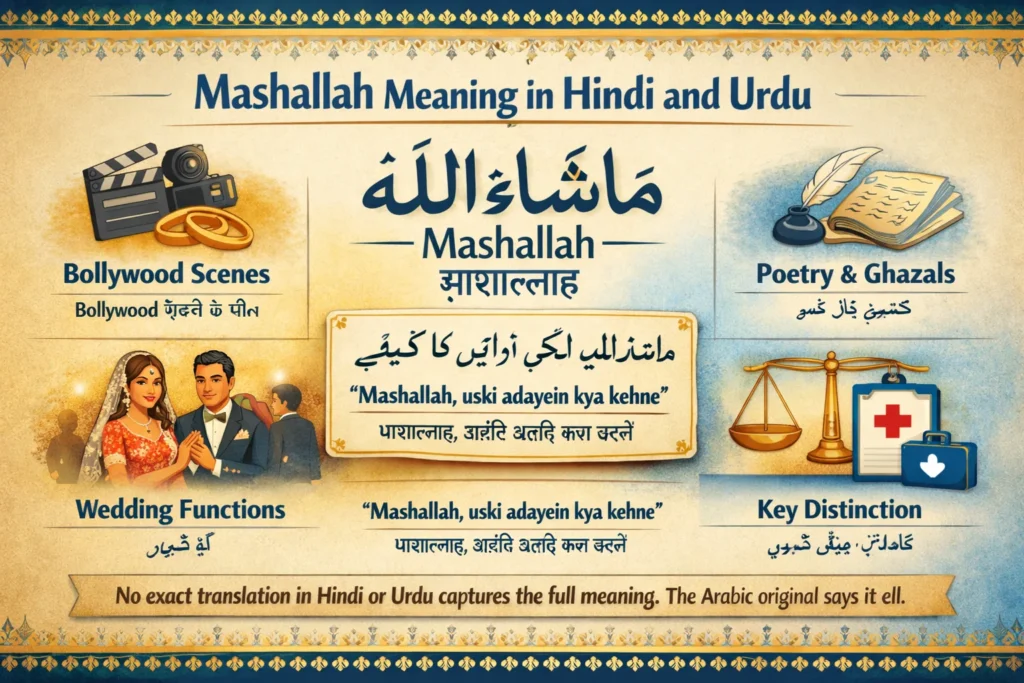
For Hindi and Urdu speakers, Mashallah feels like home. You’ll hear it in:
- Bollywood movies (especially in Muslim-family scenes)
- Daily conversations in Lucknow, Hyderabad, Karachi, Lahore
- Poetry (shers and ghazals often include Mashallah)
- Wedding functions (when seeing the bride or new home)
Example from Urdu poetry:
“Mashallah, uski adayein kya kehne”
(Mashallah, her grace is beyond words)
No direct Hindi or Urdu translation captures the full weight. So people just keep the Arabic original. That’s how powerful the phrase is. masha allah in english.
FAQs
Q: What does Mashallah mean?
A: God has willed it (or “What Allah wills”).
Q: When should you say Mashallah?
A: When you see something good, beautiful, or impressive like a new baby, a nice car, or someone’s success.
Q: Can you say Mashallah for yourself?
A: Yes. Saying it for yourself keeps you humble. Example: “Mashallah, I finished that project on time.”
Q: How do you pronounce Mashallah correctly?
A: Mash-aa-LAH. Stress the last syllable. Open your mouth for the middle “aa” sound like in “father.”
Q: What’s the difference between Mashallah and Inshallah?
A: Mashallah is for past or present good things. Inshallah is for future hopes or plans.
Q: What’s the difference between Mashallah and Alhamdulillah?
A: Mashallah expresses admiration and offers protection from the evil eye. Alhamdulillah is general gratitude to God for any outcome.
Q: How should you reply when someone says Mashallah to you?
A: You can say JazakAllah khair (may God reward you), BarakAllahu feek (may God bless you), or simply Alhamdulillah.
Q: Can non-Muslims say Mashallah?
A: Yes, respectfully. Arabic-speaking Christians and Jews use it too. Just understand its Islamic roots.
Q: Does Mashallah really protect from the evil eye?
A: Yes. That’s one of its main purposes in Islamic tradition. The Prophet Muhammad confirmed the evil eye is real, and saying Mashallah helps shield blessings from envy.
Q: Is Mashallah mentioned in the Quran?
A: Yes. Surah Al-Kahf (chapter 18, verse 39) includes the full phrase: “Maa shaa’ Allah, la quwwata illa billah” (What Allah wills. There is no power except with Allah).
Conclusion
You now know what Mashallah really means: God has willed it. But it’s more than a translation. This tiny phrase packs admiration, humility, protection from envy, and gratitude into three simple syllables. Say it when you see something beautiful. Say it for yourself to stay humble and say it to shield blessings from the evil eye.
Don’t overthink it. Next time you see something good a friend’s new baby, a gorgeous sunset, or even your own small win just let it out. Mashallah. Three words in one. A little prayer that takes half a second but carries real weight. Use it sincerely. That’s all that matters. ma sha allah meaning.
Discover More Related Articles:
- “MK” Mean in Text: How It’s Used in Everyday Conversations In 2026
- “DW” Meaning in Texting: Everything You Need to Know In 2026
- “GNG” Meaning in Slang: What It Really Means & How to Use It In 2026