
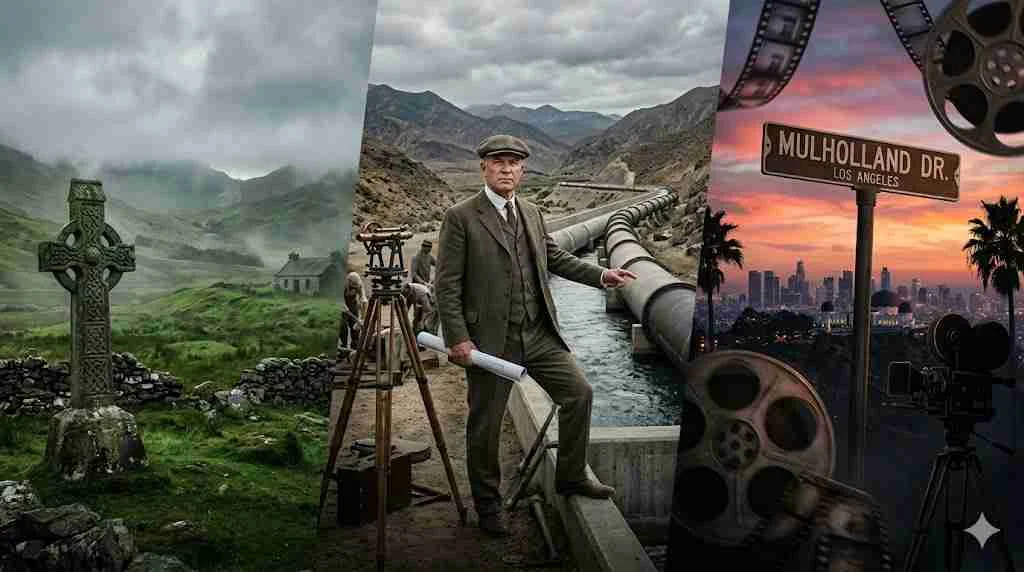

Mulholland is an Irish surname derived from the Gaelic Ó Maolchalann, meaning “descendant of the devotee of the calends” a reference to ancient Celtic religious observance.
What do an ancient Irish chieftain, a self-taught engineer who tamed a desert, and a surreal David Lynch film have in common?
The answer lies in one word: Mulholland.
You’ve probably heard it whispered in Hollywood circles or seen it flash across your screen during a late-night movie binge. But the mulholland meaning runs much deeper than most people realize.
This isn’t just a surname. It isn’t just a winding road in the Hollywood Hills. And it certainly isn’t just a mind-bending movie from the early 2000s.
The true mulholland meaning weaves together centuries of Irish heritage, the explosive growth of modern Los Angeles, and one of cinema’s most enduring puzzles. Each layer adds richness to the name, transforming it from a simple label into a cultural touchstone.
Let’s peel back these layers one by one.
The Irish Soul of Mulholland
Before the road. Before the movie. And before the controversy. There was a clan.
The mulholland meaning begins in ancient Ireland, where names carried weight and told stories of devotion, status, and lineage.
Breaking Down the Gaelic Roots
The surname Mulholland comes from the Gaelic Ó Maolchalann. Let’s break that down so you really understand what it means.
Ó means “descendant of.” Simple enough.
Maol translates to “devotee” or “follower.” It often referred to someone with religious dedication.
Chalann is the tricky part. This word means “calends” which was the first day of the month in the ancient Celtic calendar.
Put it all together, and you get “descendant of the devotee of the calends.”
That’s quite a mouthful. But what does it actually tell us about the people who carried this name?
It suggests that the original Mulhollands held some religious or ecclesiastical role. They were likely associated with marking time, observing religious festivals, or serving in a monastic setting. The calends were significant in Celtic Christianity, so this wasn’t a casual title.
The Ulster Connection
Most genealogical sources place the Ó Maolchalann clan firmly in Ulster, the northern province of Ireland. But here’s where it gets interesting.
Some historical records also connect the name to the Thomond region. That area covers modern counties like Limerick, Tipperary, and Clare in the southwest.
Why the spread? Migration, mostly. Irish clans moved around, married into other families, and sometimes fled conflicts. Over time, branches of the same family tree grew in different parts of the island.
The core mulholland meaning remained consistent though. Whether you were in Ulster or Thomond, your name still marked you as a follower of the calends.
Common Misconceptions About the Name
Let me clear up a confusion that pops up frequently.
Some older surname dictionaries claim Mulholland comes from Ó hUallacháin, which means “descendant of the proud one.” That’s a completely different root.
Modern etymology rejects this connection. The evidence for Ó Maolchalann is much stronger and more widely accepted by linguists and genealogists.
So if you’ve ever heard that mulholland meaning relates to pride or arrogance, you can confidently correct that assumption.
Spelling Variations Through History
Like many Irish names, Mulholland didn’t always look the way it does today.
You’ll find records with:
- Mullholland (double L variation)
- Mulhollan (dropping the final D)
- O’Mulholland (retaining the O prefix)
These variations popped up due to recording errors, phonetic spellings by English clerks, and personal preference. When Irish families immigrated to America, they often simplified or altered spellings to fit English conventions.
The Surname in Modern Times
Today, the Mulholland surname appears across the English speaking world. The largest concentrations remain in Ireland, the United States, the United Kingdom, Canada, and Australia.
The meaning of Mulholland as a surname has become a point of pride for many families. People research their genealogy, visit Ireland to trace their roots, and pass down stories about their Celtic heritage.
William Mulholland | The Irish Immigrant Who Shaped LA
Now we move from ancient Ireland to the American West.
The mulholland meaning took a dramatic turn when a young Irishman named William Mulholland arrived in Los Angeles.
From Belfast to the Golden State
William Mulholland was born in Belfast, Ireland, in 1855. His family had deep roots in the region, carrying the name that had been in Ulster for centuries.
But the Ireland of his youth faced hardship. The Great Famine had devastated the country. Opportunities were scarce.
So in 1872, at just seventeen years old, William left for America. He worked as a sailor for a time, then landed in Los Angeles in 1877.
Los Angeles was a dusty frontier town then. Maybe fifteen thousand people lived there. The streets were unpaved, and water came from a muddy river that ran through the middle of everything.
A Self-Taught Engineer
William Mulholland had very little formal education. He’d attended school only until age fourteen in Ireland.
But he had something better: an insatiable curiosity and a gift for practical engineering.
He started working for the Los Angeles Water Company in 1878. By 1886, he’d become its superintendent. He learned everything on the job hydraulics, pipe systems, terrain mapping. He read textbooks at night and applied what he learned during the day.
The man had a photographic memory too. He could walk miles of pipeline and recall every junction, every slope, every potential weakness.
The Los Angeles Aqueduct: A Monumental Achievement
Here’s where the mulholland meaning becomes inseparable from LA itself.
By the early 1900s, Los Angeles was growing fast but facing a crisis. The Los Angeles River couldn’t keep up with demand. The city needed more water to survive, let alone thrive.
Mulholland had a vision. He looked east to the Owens Valley, about 233 miles away. The valley had water. Lots of it. The problem was getting it over mountains and across deserts to LA.
His solution was audacious: build an aqueduct.
The key facts about the Los Angeles Aqueduct:
| Feature | Detail |
|---|---|
| Length | 233 miles |
| Construction years | 1908-1913 |
| Primary engineer | William Mulholland |
| Cost | ~$23 million (1913 dollars) |
| Water capacity | ~260 million gallons per day |
| Number of workers | Up to 3,000 at peak |
| Tunnels | 43 total, combined length of 53 miles |
The project was engineering brilliance. Workers cut through granite mountains. They built siphons across deep valleys. They laid pipe across the Mojave Desert where temperatures soared past 110 degrees.
And in November 1913, the water arrived.
Mulholland stood before the crowd at the official opening and delivered what might be the most understated speech in engineering history:
“There it is. Take it.”
He didn’t need grand words. The aqueduct spoke for itself.
The California Water Wars
We can’t discuss the mulholland meaning without confronting the controversy.
The Los Angeles Aqueduct didn’t just appear from nowhere. It took land, water rights, and political maneuvering.
Mulholland and his allies used questionable tactics to acquire water rights in the Owens Valley. They bought land, claimed rights, and sometimes misrepresented their intentions. When local farmers and ranchers realized what was happening, they fought back.
This became known as the California Water Wars.
The most violent confrontation happened in 1924 when Owens Valley residents dynamited sections of the aqueduct. They wanted to stop the water theft. They failed.
The mulholland meaning became entangled with greed, power, and the lengths people will go to build a city in a desert. Some see Mulholland as a visionary. Others see him as a land thief.
Both interpretations hold truth.
The St. Francis Dam Disaster
Then came the tragedy.
On March 12, 1928, the St. Francis Dam collapsed. The dam was one of Mulholland’s projects, designed to store water for the growing city.
It failed catastrophically.
The St. Francis Dam Disaster at a glance:
| Aspect | Detail |
|---|---|
| Date | March 12-13, 1928 |
| Time of failure | Just before midnight |
| Dam height | 185 feet |
| Water released | ~12.5 billion gallons |
| Death toll | Over 400 confirmed |
| Towns destroyed | Two (many smaller settlements) |
| Aftermath | Complete professional ruin for Mulholland |
The flood wave swept down the Santa Clara River valley, destroying everything in its path. Entire families vanished. The death toll exceeded 400 people.
William Mulholland took full responsibility. He testified before the inquiry and accepted blame. He retired from public service, a broken man.
And he died in 1935, his reputation forever split between achievement and disaster.
Mulholland Drive| The Scenic Road
Now we come to the most visible piece of the mulholland meaning puzzle: the road itself.
The Geographic Reality
Mulholland Drive isn’t one continuous road. It’s a series of connected thoroughfares that wind through the Hollywood Hills and the Santa Monica Mountains.
The road runs from Griffith Park in the east to the Pacific Ocean in the west. It passes through some of the most expensive real estate in the world.
Key facts about Mulholland Drive:
| Feature | Detail |
|---|---|
| Total length | Approximately 21 miles |
| Eastern terminus | Griffith Park |
| Western terminus | Pacific Coast Highway |
| Highest elevation | ~1,400 feet |
| Named after | William Mulholland |
| Year built | 1920s |
| Famous sections | Mulholland Scenic Overlook |
The Engineering Purpose
Why build a road along the spine of the Hollywood Hills?
The original purpose was practical. The road gave engineers access to the aqueduct lines that ran through the hills. It allowed maintenance, inspection, and repair.
Over time, its purpose expanded. The road became a scenic drive for Angelenos seeking views of the city below. On clear days, you could see from the San Gabriel Mountains to the Pacific Ocean.
The Celebrity Factor
Location matters.
Mulholland Drive became synonymous with Hollywood glamour because of where it sits. The road borders the Hollywood Hills, home to countless celebrities, directors, and producers.
Homes along Mulholland Drive feature some of the most stunning views in Los Angeles. They also offer privacy, a precious commodity in the entertainment industry.
The Scenic Overlook
One spot in particular captures the mulholland meaning for visitors: the Mulholland Scenic Overlook.
Located just west of the 405 Freeway, this viewpoint offers panoramic views of the San Fernando Valley. It’s a popular spot for tourists, photographers, and locals taking a break.
The overlook features signage explaining the history of Mulholland and the aqueduct. It connects the name to the land in a way that few other places do.
David Lynch’s “Mulholland Drive”| The Cinematic Legend
The mulholland meaning entered pop culture permanently in 2001 when David Lynch released his masterpiece.
The Film’s Genesis
“Mulholland Drive” started as a television pilot. ABC commissioned it, expecting a conventional murder mystery. Lynch delivered something far stranger.
The network passed on it.
But producer Pierre Edelman and Studio Canal saw potential. They funded the film’s completion, and Lynch expanded the pilot into a feature.
The result was a film that would top critics’ polls for years. In 2016, BBC Culture asked 177 critics to name the best film of the 21st century. “Mulholland Drive” came in first.
The Plot (As Much as There Is)
Explaining the plot of “Mulholland Drive” is like describing a dream. It shifts, it contradicts itself, and it refuses to stay in one place.
Here’s a basic framework:
A woman named Betty arrives in Hollywood, full of hope and ambition. She meets an amnesiac woman who calls herself Rita. They try to figure out Rita’s identity while navigating a world of casting directors, mobsters, and a mysterious blue box.
Key themes in the film:
| Theme | Expression |
|---|---|
| Dreams vs. reality | The film shifts between fantasy and harsh truth |
| Hollywood’s dark side | Betrayal, exploitation, destroyed ambitions |
| Identity | Who are we when we forget our past? |
| Guilt | The lead character’s psychological burden |
| Love and betrayal | The tragic core of the story |
The ending (spoiler warning) reveals that the hopeful Betty is a fantasy. The real character, Diane, is a failed actress who has murdered her lover. The dream is her escape from unbearable guilt.
The Road as Symbol
The mulholland meaning in the film extends to the road itself.
The opening scene shows a limousine on Mulholland Drive at night. The road curves dangerously. The driver pulls over. A woman jumps out, terrified.
This establishes the road as a space of transition. You enter. You leave. What happens in between is never quite certain.
Lynch uses the road to symbolize the Hollywood Dream itself. Beautiful. Seductive. Dangerous. And ultimately, for many, a dead end.
The Ending Explained
The ending of “Mulholland Drive” remains one of cinema’s greatest puzzles.
In the final scenes, Diane sits in her apartment, overwhelmed by guilt. She hallucinates her dead lover Camilla (the “Rita” of the dream) coming back to life. The blue box opens. Everything collapses.
The final shot shows the Cowboy, a mysterious figure from the dream, speaking in a theater.
“Silencio,” he says.
It’s a warning and a resignation. The dream is over. Reality is too painful. The mulholland meaning becomes an embrace of the lie over the truth.
The Film’s Impact on the Name
Before 2001, Mulholland Drive was just a street. After 2001, it became shorthand for psychological complexity, dream logic, and Hollywood’s hidden darkness.
Film students analyze it. Critics debate it. Fans rewatch it endlessly.
The mulholland meaning today includes this cinematic legacy. You can’t talk about Mulholland without someone mentioning the film.
The Cultural Significance of Mulholland
Let’s step back and look at the bigger picture.
Three Layers, One Name
The mulholland meaning works on three distinct levels:
1. The Historical Layer
The Irish surname that connects to ancient Gaelic religion and Celtic calendars. The clan history that spans centuries.
2. The Geographic Layer
The Los Angeles aqueduct. The engineering achievement. The winding road through the Hollywood Hills. The panoramic views of the city below.
3. The Cultural Layer
The David Lynch film. The cinematic masterpiece. The symbol of dream versus reality. The exploration of Hollywood’s dark heart.
Why This Matters Today
We don’t usually think about names deeply. We use them casually, without considering their weight.
But the mulholland meaning shows us something important. Names carry history. They carry geography. They carry culture. A single word can open doors to centuries of human experience.
For people researching their genealogy, the mulholland meaning connects them to Irish roots. It’s a link to ancestors they never knew but whose blood flows in their veins.
For residents of Los Angeles, the name connects them to the city’s foundational story. The water that made LA possible came because of Mulholland’s vision and the road that bears his name.
For film lovers, the name evokes a particular aesthetic. Dreams, nightmares, neon lights, and lost souls in the Hollywood Hills.
The Mulholland Paradox
Here’s what makes the mulholland meaning so compelling: it contains its own contradiction.
William Mulholland built the aqueduct that enabled LA’s growth. He also built a dam that killed hundreds. He was a visionary engineer and a deeply flawed man.
The movie explores the same paradox. The dream of Hollywood attracts hopeful young actors. The reality chews them up and spits them out. Beauty and horror coexist.
The Irish roots add another layer of paradox. The name came from religious devotion. Its bearer created a city of pleasure and excess. Heritage and modernity collide.
Practical Takeaways
If you’re visiting Los Angeles, here’s how to engage with the mulholland meaning.
Visit the Mulholland Scenic Overlook
Located off Mulholland Drive near the 405 Freeway, this spot offers breathtaking views of the San Fernando Valley. The signage explains the history of the road and the aqueduct.
Drive the Route
Take Mulholland Drive from Griffith Park to the Pacific Coast Highway. The drive takes about an hour without traffic. Stop at viewpoints along the way.
Watch the Film
Watch “Mulholland Drive” with attention to how Lynch uses the location. The film is available on most streaming platforms.
Research Your Genealogy
If you carry the Mulholland name, research your family history. Start with census records, immigration documents, and family stories.
The Future of the Mulholland Meaning
Names evolve. The mulholland meaning continues to develop.
New generations discover the film. New residents move into the Hollywood Hills. And new genealogists trace their Irish roots.
The name will likely remain significant for years to come. Its layers of meaning Celtic, engineering, cinematic, cultural offer something for everyone.
FAQs
What does Mulholland mean in Irish?
The mulholland meaning in Irish comes from the Gaelic Ó Maolchalann. This translates to “descendant of the devotee of the calends.” The calends were the first day of the month in the ancient Celtic calendar.
Is Mulholland a common last name?
Mulholland appears as a surname throughout the English speaking world. The largest populations exist in:
- Ireland (especially Ulster)
- United States
- United Kingdom
- Canada
- Australia
Where does the name Mulholland originate?
The name originates in Ireland, specifically in Ulster. Some branches also developed in the Thomond region of southwest Ireland.
What is the Mulholland Drive meaning?
Mulholland Drive is a scenic road in the Hollywood Hills of Los Angeles. It was named after William Mulholland, the engineer who built the Los Angeles Aqueduct. The road has become culturally significant due to David Lynch’s film “Mulholland Drive.”
How do you pronounce Mulholland?
The standard pronunciation is mull-HOL-ənd. The emphasis falls on the second syllable.
What is the Mulholland Drive movie about?
The film follows a young actress’s dream of Hollywood success. It shifts between a hopeful fantasy and a tragic reality. The film explores themes of identity, guilt, love, and betrayal, all centered around the iconic road.
Who was William Mulholland?
William Mulholland was an Irish immigrant who became the chief engineer of the Los Angeles Water Department. He built the 233 mile Los Angeles Aqueduct, enabling the city’s growth. His later career ended tragically with the St. Francis Dam disaster.
Why is Mulholland Drive famous?
The road became famous for three reasons: its status as a scenic drive, its connection to William Mulholland, and its title role in David Lynch’s acclaimed 2001 film.
Conclusion
The mulholland meaning defies simple explanation. It’s not just a surname. It’s not just a road. And it’s not just a movie.
From the Gaelic devotion of ancient Ireland to the engineering audacity of the Los Angeles Aqueduct, from the winding curves of the Hollywood Hills to the dreamlike sequences of David Lynch’s masterpiece, Mulholland represents a rich tapestry of human achievement, ambition, and complexity.
The name tells a story of migration, of building a city from dust and water. It tells a story of fame, of dreams fulfilled and shattered. It tells a story of identity, of wondering where we come from and who we really are.
The next time you see the name Mulholland on a street sign, a surname, or a film poster you’ll know what it really means. And it’s so much more than you thought.
Discover More Related Articles:
- “GNG” Meaning Slang: Everything You Should Understand In 2026
- “TBD” Meaning Slang: What It Means, How to Use It & When It Matters In 2026
- “OMS” Meaning in Slang: How People Use It in Conversations In 2026