


5150 is a section of California law that authorizes the involuntary psychiatric detention of an individual for up to 72 hours when they pose a danger to themselves, a danger to others, or are gravely disabled due to a mental health disorder.
The number 5150 carries weight. You’ve probably overheard it in casual conversation, spotted it on a Van Halen album, or heard police dispatchers mention it on a TV drama. But here’s the uncomfortable truth most people miss: the 5150 meaning runs far deeper than pop culture trivia. It’s a legal lifeline, a civil rights flashpoint, and a deeply human intervention that affects thousands of Californians every single year.
When someone says “he got 5150’d,” they’re referencing something profoundly serious. A 5150 hold isn’t a joke, a mark of shame, or a criminal record it’s California’s emergency mental health safety net. And understanding its nuances could one day help you, your family member, or a friend navigate a terrifying situation with clarity instead of confusion.
Let’s define the 5150 definition right upfront: Section 5150 of the California Welfare and Institutions Code authorizes the involuntary detention of an individual for up to 72 hours. The legal grounds require that the person presents as a danger to themselves, a danger to others, or is gravely disabled due to a mental health disorder.
Definition of 5150
A 5150 is a legal term in California that refers to an involuntary 72-hour psychiatric hold for someone who is believed to be a danger to themselves, a danger to others, or unable to provide for their basic needs because of a mental health condition. The purpose of a 5150 hold is to allow mental health professionals to evaluate the person, ensure their immediate safety, and determine whether further treatment is needed.
The Historical Roots | Why 5150 Exists
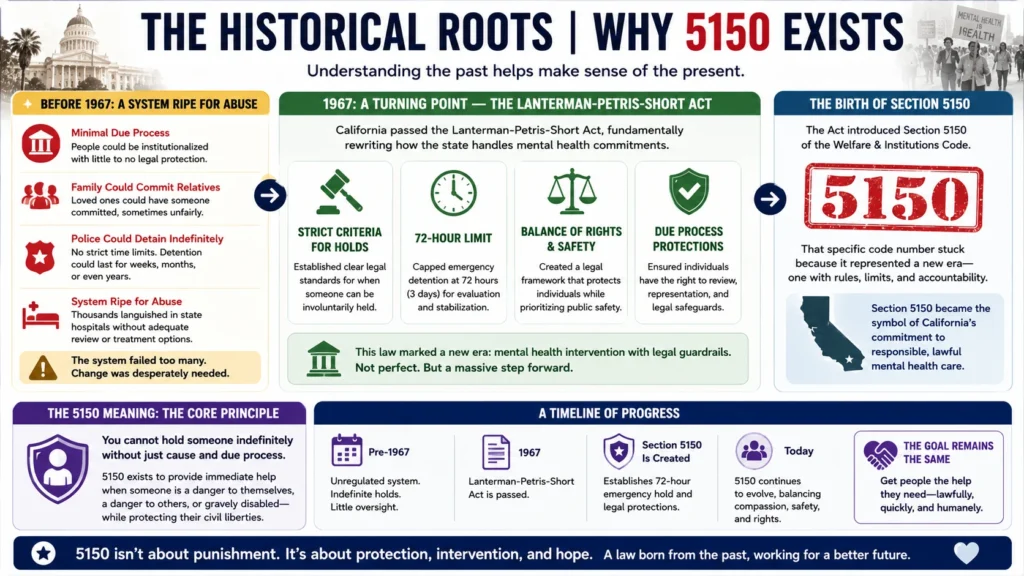
Before diving into the 5150 meaning for today’s world, we need to rewind to 1967. That year, California passed the Lanterman-Petris-Short Act, a piece of legislation that fundamentally rewrote how the state handled mental health commitments.
Prior to this law, California could institutionalize people for extended periods with minimal due process. Families could commit relatives. Police could detain individuals indefinitely. The system was ripe for abuse, and thousands languished in state hospitals without adequate review or treatment options.
The Lanterman-Petris-Short Act changed everything. It established strict criteria for involuntary holds. It capped emergency detention at 72 hours. And it created a legal framework that balanced public safety with individual civil liberties.
And it introduced Section 5150. That specific code number stuck because it represented a new era one where mental health intervention had legal guardrails. The system wasn’t perfect then and it isn’t perfect now. But the 5150 meaning from a legal perspective centers on one core principle: you cannot hold someone indefinitely without just cause and due process.
What Does 5150 Mean in Legal Terms?
Here’s where we get into the weeds of the 5150 definition. The California Welfare and Institutions Code Section 5150 states explicitly that a peace officer, licensed mental health professional, or designated member of a mobile crisis team can take someone into custody.
But only if that person meets one of three criteria:
| Legal Criterion | Real-World Application |
|---|---|
| Danger to Self | Suicidal ideation with a plan, self-mutilation, refusal to eat or drink for extended periods, or engaging in reckless behavior that clearly threatens survival |
| Danger to Others | Making credible threats of violence, displaying aggressive behavior, possessing a weapon with intent to harm, or acting in a way that reasonably suggests imminent physical harm to another person |
| Gravely Disabled | An inability to secure food, clothing, or shelter due to a mental illness, or an inability to recognize one’s own need for treatment even when symptoms are severe |
A 2024 update under Senate Bill 43 expanded the “gravely disabled” definition to include substance use disorders, which means more people now qualify for intervention. This change reflects a growing recognition that addiction and mental illness often intertwine and require equally urgent responses.
The 5150 Meaning in Police Code
Ask any police officer in California about the 5150 code meaning, and they’ll likely tell you it’s one of the most common calls they handle. Law enforcement frequently encounters individuals in active mental health crises. For many officers, initiating a 5150 psychiatric hold is standard procedure when they suspect someone needs immediate psychiatric care.
But here’s what most people don’t realize: The police code 5150 isn’t just for officers. Yes, law enforcement uses it regularly. However, the law also permits licensed clinicians and crisis response team members to initiate a 5150 hold. You don’t need a badge to make the call.
What’s changed in recent years is the approach. Many California police departments now deploy mental health crisis intervention teams alongside officers. These specially trained professionals attempt to de-escalate situations before a 5150 hold becomes necessary. The goal isn’t to slap a label on someone it’s to connect them with appropriate care while minimizing trauma.
What Happens During a 5150 Psychiatric Hold?
Now let’s walk through the actual experience of a 5150 hold. If you’ve ever wondered “what does 5150 mean in practice,” this section answers that question with step-by-step clarity.
Step 1: The Initial Contact
The process begins when someone observes behavior that triggers a 5150 meaning evaluation. Maybe a family member calls 911. Perhaps a teacher notices dangerous signs. Often, the individual themselves might attract police attention during a public episode.
At this stage, the responding officer or clinician makes a judgment call. They observe behavior, ask questions, and assess immediate risk. If they determine that the person meets one of the three legal criteria, they initiate the hold.
Step 2: Transportation to a Psychiatric Facility
Once a 5150 hold is initiated, the individual must be transported to an approved psychiatric facility. This is rarely a comfortable experience. Many patients arrive in police vehicles. Some resist. The system tries to minimize trauma, but the reality is that involuntary transport feels coercive by definition.
The receiving facility must be designated to handle psychiatric emergencies. Not every hospital qualifies. Urban areas have more options; rural counties often rely on fewer resources, which can create bottlenecks.
Step 3: Evaluation and Initial Treatment
Within the psychiatric facility, medical staff conduct a comprehensive what does 5150 mean assessment. They review the patient’s mental state. They take medical histories. And they evaluate suicide risk and violence potential.
Doctors often begin treatment during the 5150 hold. This might involve medication stabilization, individual therapy, or both. The 72-hour window is actually quite short for meaningful psychiatric intervention, so facilities focus on crisis stabilization rather than long-term solutions.
Step 4: The Decision Point
Before the 72-hour clock expires, the treating psychiatrist must decide on next steps. There are three options:
- Release the patient if they no longer meet the criteria
- Transition to voluntary treatment if the patient agrees to stay
- File for a 5250 hold if the patient still poses a danger
The 5250 hold extends detention to 14 days. This requires more rigorous documentation and a formal certification process. The 5150 meaning shifts at this stage because you’ve moved from emergency evaluation to active treatment planning.
How Long Is a 5150 Hold?
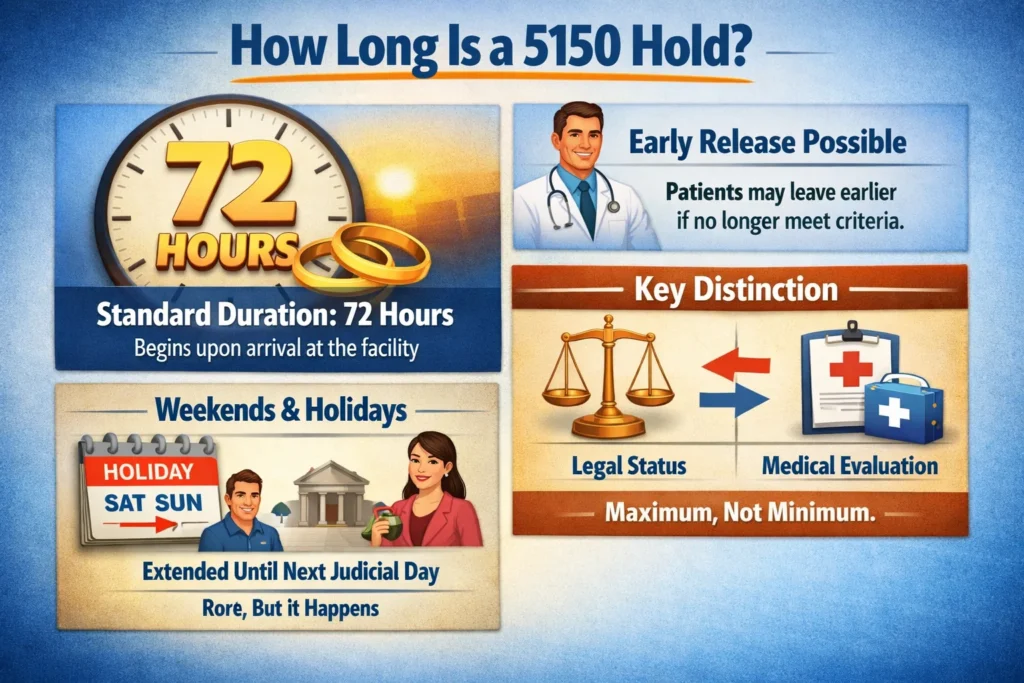
The standard 5150 hold duration is 72 hours. That 72-hour clock starts when the patient arrives at the psychiatric facility, not when the police first make contact. This distinction matters because transport times can stretch the overall detention period significantly.
But here’s an important nuance: The 72-hour limit represents a maximum, not a minimum. Many patients get released before the clock runs out. If a doctor determines that the criteria no longer apply, the patient can leave earlier.
What about weekends and holidays? The law states that if the 72-hour hold ends on a weekend or holiday, the facility can extend detention until the next judicial day. This ensures that someone doesn’t get released into an empty courthouse or a closed social services office.
Who Can Place Someone on a 5150 Hold?
Many people assume only police can initiate a 5150 hold. This is incorrect. The law explicitly authorizes multiple categories of individuals:
- Peace officers
- Licensed mental health professionals
- Designated members of mobile crisis response teams
- Licensed clinical social workers
- Psychiatric nurses in some circumstances
- Physicians in emergency departments
What about family members? Relatives cannot directly place someone on a 5150 hold. However, they can and often do call authorities who then make the assessment. A family’s report of dangerous behavior frequently initiates the process.
What about ordinary citizens? If you witness someone in crisis, you can contact police or a mobile crisis team. But you personally cannot detain them. That’s reserved for trained professionals.
Can Someone Refuse a 5150 Hold?
The short answer is no that’s the involuntary part of the 5150 meaning. However, the right to refuse certain treatments within the hold is more complicated.
Patients can refuse some medications under California law, but doctors can override refusal in emergency situations. If a patient’s behavior poses immediate danger to themselves or others, providers can administer medication forcibly.
The ethical tension here is real. A 2024 study published in Bioethics examined the ethics of overriding patient refusal during psychiatric holds. The researchers found that forced interventions sometimes provide necessary stabilization but often cause significant psychological harm. There’s no easy answer, and good clinicians weigh each situation carefully.
5150 vs. 5250: Understanding the Difference
Let’s clarify the 5150 vs 5250 distinction because confusion abounds.
| Aspect | 5150 Hold | 5250 Hold |
|---|---|---|
| Duration | Up to 72 hours | Up to 14 days |
| Trigger | Immediate danger or grave disability | Continued danger after initial hold |
| Who initiates | Peace officers or clinicians | Mental health professionals |
| Certification | No formal court certification required | Requires formal certification and review |
A 5250 hold isn’t automatic. The psychiatric facility must provide documented evidence that the patient still meets the legal criteria after the initial 72-hour period. Patients also have the right to request a hearing to contest the extended hold.
What Does 5150 Mean in Slang?
Now let’s talk about the cultural elephant in the room. The 5150 slang meaning has taken on a life of its own and not necessarily in ways that mental health advocates appreciate.
In slang usage, 5150 can mean:
- Someone who is acting crazy or erratic
- A person who needs mental health intervention
- A situation that has spiraled out of control
- A person who is emotional or unreasonable
You might hear it used as:
- “He’s completely 5150 today”
- “She got 5150’d at the club”
- “That’s a 5150 situation for sure”
The slang meaning of 5150 has roots in both prison culture and law enforcement jargon. In prisons, inmates would use the code to describe peers who appeared mentally unstable. Police adopted it as shorthand for “emotionally disturbed subject.”
And then pop culture amplified it. Van Halen’s 1986 album titled *5150* prominently featured the band in straitjackets. The imagery cemented the connection between the number and mental instability in the public consciousness.
But here’s the problem with slang: it trivializes. Using 5150 as a casual insult minimizes the genuine suffering of people experiencing psychiatric emergencies. It also perpetuates stigma, making it harder for people to seek help without fear of judgment.
The 5150 Meaning in Mental Health Context
Stepping away from slang, the 5150 mental health meaning is profoundly serious. This hold represents an intervention designed to save lives. It’s a recognition that mental illness can manifest as acutely dangerous behavior that requires immediate professional response.
The mental health system in California is deeply strained. Emergency departments often hold patients for hours or even days because psychiatric beds are scarce. A 5150 hold doesn’t guarantee immediate placement in a psychiatric unit it guarantees evaluation, but the actual treatment environment may be an overcrowded emergency room.
What happens after a 5150 mental health hold? Ideally, patients transition to appropriate ongoing care. In reality, many leave with a referral and no guarantee of follow-up. Community mental health resources are often underfunded, leaving patients to navigate a fragmented system on their own.
Patient Rights During a 5150 Hold
Understanding your rights during a 5150 psychiatric hold is crucial. Here’s what the law protects:
- The right to know why you’re being held. The facility must inform you of the reasons.
- The right to refuse treatment except in emergency situations.
- The right to contact an attorney or an advocate.
- The right to receive visitors subject to facility rules.
- The right to a hearing if you challenge the hold.
- The right to be treated with dignity and respect.
Patients also have the right to make phone calls to family, friends, or legal representatives. However, facilities can restrict these calls if they pose a security risk.
What about medication refusals? This is where rights get complicated. A patient can refuse non-emergency medication, but doctors can administer emergency treatment if they determine immediate danger exists.
What Is the 5150 Meaning in California Law?
The 5150 definition is uniquely Californian. You won’t find this code number in New York, Texas, or Florida. Each state has its own statutory framework for involuntary psychiatric holds.
In California, the legal landscape has shifted recently. Senate Bill 43, effective in 2024, expanded the definition of “gravely disabled” to include people with severe substance use disorders. This means someone whose addiction renders them unable to meet basic needs now qualifies for a 5150 hold.
The broader legal framework includes:
- Welfare and Institutions Code Section 5150 (72-hour hold)
- Welfare and Institutions Code Section 5250 (14-day hold)
- Welfare and Institutions Code Section 5260 (30-day hold for suicide risk)
- Welfare and Institutions Code Section 5270 (14-day hold for aggressive behavior)
Each section builds on the previous one. The 5150 meaning as the entry point matters because it initiates the entire process.
Common Misconceptions About 5150 Holds
Let’s clear up some persistent myths because misinformation makes a difficult experience even worse.
Myth #1: A 5150 hold shows up on your criminal record.
False. A 5150 psychiatric hold is a civil detention, not a criminal charge. It does not create a criminal record.
Myth #2: You can never own a firearm after a 5150 hold.
This one is more complicated. A 5150 hold does trigger a prohibition on firearm ownership under California law. However, individuals can petition to restore their rights after five years under certain conditions.
Myth #3: Once you’re 5150’d, you’ll always be treated differently.
While stigma exists, many people go on to lead full, healthy lives after a psychiatric hold. The experience doesn’t define your future.
Myth #4: Only police can initiate a 5150.
As we covered earlier, licensed mental health professionals and designated crisis workers also have this authority.
The Psychological Impact of a 5150 Hold
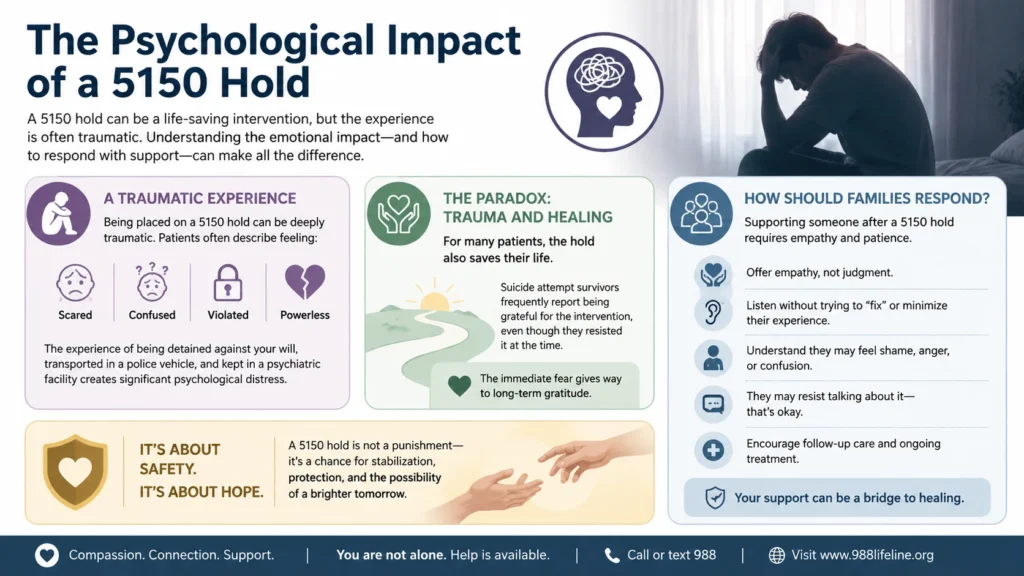
Being placed on a 5150 hold can be deeply traumatic. Patients often describe feeling scared, confused, and violated. The experience of being detained against your will, transported in a police vehicle, and kept in a psychiatric facility creates significant psychological distress.
But here’s the paradox: For many patients, the hold also saves their life. Suicide attempt survivors frequently report being grateful for the intervention, even though they resisted it at the time. The immediate fear gives way to long-term gratitude.
How should families respond? Supporting someone after a 5150 hold requires empathy and patience. The patient may feel shame or anger. They may resist discussing the experience. Gentle support, nonjudgmental listening, and encouragement to follow up with treatment can make a meaningful difference.
Crisis Prevention and Alternatives to 5150 Holds
Not every mental health crisis requires a 5150 hold. California has invested in alternatives to reduce the frequency of involuntary detentions.
Crisis intervention teams (CIT) pair police with mental health professionals. These teams respond to emergency calls with de-escalation expertise. Their goal is to resolve situations without resorting to holds whenever possible.
Mobile crisis units send mental health professionals directly to the scene. They can evaluate and connect individuals with services without law enforcement involvement. These units reduce trauma and often produce better outcomes.
Warm lines and peer support offer non-emergency mental health support. People in distress can call and speak with trained peers who understand their experience. These services prevent some crises from escalating to the 5150 level.
The Ethics of Involuntary Detention
The 5150 meaning from an ethical perspective raises profound questions. When is it okay to override someone’s autonomy? How do we balance safety against freedom?
Critics argue:
- The 5150 system is too easily abused. People use it to silence inconvenient individuals.
- The criteria are subjective. What one clinician calls “danger to self,” another might see as normal distress.
- The system disproportionately affects marginalized groups, including people of color and unhoused populations.
Proponents argue:
- 5150 holds prevent suicides and homicides.
- The 72-hour limit provides a check on governmental power.
- Without this system, many people would receive no help during acute crises.
The truth lies in the middle. The 5150 system is imperfect but necessary. Reform efforts focus on reducing trauma, improving access to alternative services, and ensuring equitable application.
What Comes After a 5150 Hold?
The end of a 5150 hold doesn’t mean the end of mental health needs. In fact, the post-hold period is often the most critical.
Voluntary treatment options: Patients who agree to continue treatment can access outpatient therapy, medication management, and support groups. Many people do well with ongoing care.
Community resources: The patient’s county mental health department can provide referrals. Case managers help coordinate services. But these resources vary widely across California urban counties often have more options than rural ones.
The problem of follow-through: Many patients discharge from a 5150 hold and immediately lose connection to care. They may lack insurance. They may not have transportation. And they might feel too ashamed to continue treatment. These barriers are significant, and addressing them requires systemic improvement.
Facts and Figures About 5150 Holds
Let’s ground this discussion in data. Understanding the scale of 5150 holds provides crucial context.
- Hundreds of thousands of Californians experience a 5150 hold annually. Exact numbers fluctuate depending on the reporting year.
- The majority of holds involve people with severe mental illness, schizophrenia, or bipolar disorder.
- Suicide risk is the most common reason for initiating a 5150 hold.
- Males account for approximately 60% of holds.
- The unhoused population represents a disproportionately high number of 5150 detentions.
What these numbers tell us: Mental health resources are stretched thin. Many people only receive care when they reach a crisis point. The 5150 system functions as a safety net but it’s a net with holes.
5150 Meaning in Pop Culture
The number 5150 has permeated entertainment and popular culture. Here are some notable moments:
Van Halen’s *5150* album (1986) remains the most famous cultural reference. The band’s photo in straitjackets reinforced the connection between 5150 and mental instability.
Knott’s Berry Farm created a “Fear VR 5150” Halloween attraction in 2016. Mental health advocates protested, calling it exploitative. The attraction quickly closed.
High-profile celebrity holds have brought attention to the system. Britney Spears’ 2008 hold, Amanda Bynes’ 2013 hold, and Kanye West’s 2016 hold each generated significant media coverage.
The television show Psych featured a character named “5150” in an episode. The reference underscores how deeply embedded the code has become in cultural consciousness.
“5150” as a brand name appears on clothing lines, musical groups, and even a BBQ sauce. The commercial use of a mental health code raises uncomfortable questions about appropriation.
Why the 5150 Meaning Matters Today
Mental health awareness has increased dramatically over the past decade. People are more willing to talk about depression, anxiety, and suicide prevention. But gaps in understanding remain.
The 5150 meaning matters because:
- It represents a legal intervention that many will encounter directly or indirectly.
- Understanding the process reduces fear and anxiety.
- Knowledge empowers families to advocate effectively.
- Recognizing the difference between slang and reality reduces stigma.
Stigma kills. When people fear being labeled “5150,” they avoid seeking help. That avoidance can be fatal. Normalizing conversations about mental health holds saves lives.
How to Support Someone on a 5150 Hold
If someone you care about is placed on a 5150 psychiatric hold, here’s how you can help:
- Stay calm. Your response sets the tone for the entire experience.
- Call the facility. Find out where the patient is and what the visitation policies are.
- Visit if possible. Your presence matters, even if the patient seems unresponsive.
- Advocate for their rights. Ensure they’re being treated with dignity.
- Plan for discharge. What happens after the hold ends matters enormously.
- Follow up. Don’t let them fall through the cracks.
One caution: Some patients will be angry with you, especially if you initiated the hold. That’s okay. Your job is to ensure their safety, not to be popular.
Financial and Legal Consequences of a 5150 Hold
A 5150 hold has financial implications that many overlook.
Insurance coverage: Most health insurance plans cover psychiatric emergency services. But deductibles and co-pays can still apply. The cost of a 72-hour hold can run into the thousands of dollars.
Firearm rights: As mentioned, a 5150 hold triggers a prohibition on firearm ownership. The patient must petition for restoration, which is not guaranteed.
Employment consequences: While a 5150 hold doesn’t appear on a criminal background check, it could affect jobs requiring security clearances or certain professional licenses.
Driving privileges: A 5150 hold does not automatically affect a driver’s license. However, certain medications could impair driving, and doctors may recommend restrictions.
5150 and Children| What Parents Should Know
Minor children can be placed on a 5150 hold too. The process for minors includes additional safeguards and family involvement.
Parents should understand:
- A child can be held for 72 hours under the same criteria.
- Parental consent is not required for initiation, but notification is.
- Juvenile facilities have specific protocols for psychiatric holds.
- Follow-up care planning often includes family therapy.
What if your child is acting out? Mental health crises in children often look like defiance, anger, or school refusal. These behaviors may or may not justify a hold. The key is assessment by qualified professionals.
Real Stories | What a 5150 Hold Looks Like
Case Example #1: Sarah, a 28-year-old graduate student, stopped eating and sleeping for three days. Her roommate called a crisis team when Sarah started talking about suicide. The clinician initiated a 5150 hold. Sarah spent 72 hours in a psychiatric facility, received medication, and connected with a therapist. Two years later, she’s doing well and says the hold saved her life.
Case Example #2: Michael, a 52-year-old veteran with PTSD, got into a confrontation with a neighbor. He made threats and was acting erratically. Police initiated a 5150 hold. At the facility, doctors discovered he had stopped his medication. With stabilization, Michael returned to his previous level of functioning within a week.
Case Example #3: Rosa, a 65-year-old woman with dementia, wandered away from home and couldn’t find her way back. Police picked her up and initiated a 5150 hold for grave disability. The hold allowed social workers to assess her safety and connect her family with support services.
These stories highlight: The 5150 system is not perfect, but it serves a vital function. Each case is unique; each outcome depends on the quality of care received.
The Future of 5150 Holds in California
California’s mental health system is changing. New laws, increased funding, and evolving attitudes are reshaping the landscape.
Senate Bill 43 expanded the grave disability definition. This change will likely increase the number of holds for substance use disorders.
Mobile crisis teams are expanding statewide. The goal is to reduce law enforcement involvement in mental health emergencies.
Community-based alternatives are growing. Instead of defaulting to emergency holds, the system is developing options for voluntary care.
Advocacy groups continue to push for patient rights and reduced coercion. The debate between safety and autonomy remains unresolved.
How to Write an Effective 5150 Hold Petition
For professionals who initiate holds, documentation matters. Here are the key elements:
- Clear behavioral observations (not just subjective impressions)
- Direct quotes from the individual showing dangerousness
- Specific dates and times of relevant incidents
- Collateral information from family, friends, or witnesses
- Medical history relevant to the current crisis
The petition must demonstrate probable cause to believe the person meets one of the three legal criteria. Vague language invites legal challenges.
Resources for 5150 Education and Support
If you want to dive deeper into the 5150 meaning and related topics, these resources provide reliable information:
- California Department of Health Care Services offers guidance on mental health laws.
- National Alliance on Mental Illness California provides advocacy and support resources.
- Mental Health America of California offers education and policy analysis.
- Local county behavioral health departments are the front-line providers.
For immediate crises:
- 988 Suicide & Crisis Lifeline provides 24/7 support.
- Crisis Text Line offers text-based crisis intervention.
- Mobile crisis teams operate in most California counties.
FAQs
1. What does 5150 mean?
A: 5150 is a term that comes from a section of California law referring to an involuntary psychiatric evaluation when a person is believed to be a danger to themselves, a danger to others, or unable to care for themselves due to a mental health crisis.
2. Why is it called a 5150?
A: The name comes from California Welfare and Institutions Code Section 5150, which gives authorized professionals the ability to place someone on a temporary mental health hold for evaluation.
3. What does a 5150 hold mean?
A: A 5150 hold means a person may be taken for a short-term mental health assessment by trained professionals to determine if they need further care or support.
4. Is 5150 only a legal term?
A: No. While it started as a legal and mental health term, “5150” is also used in slang, music, and pop culture to describe something unusual, extreme, or chaotic.
5. What does 5150 mean in slang?
A: In slang, people sometimes use “5150” to describe someone acting wildly, unpredictably, or “crazy,” but this usage can be insensitive because it comes from a serious mental health context.
6. Is being placed on a 5150 hold the same as being arrested?
A: No. A 5150 hold is a mental health evaluation process, not a criminal arrest. Its purpose is to provide assessment and possible support.
7. How long does a 5150 hold last?
A: In California, a 5150 hold generally allows up to 72 hours for psychiatric evaluation and treatment assessment, though the outcome depends on the individual situation.
8. Why is 5150 a popular term in culture and media?
A: The term became widely recognized through movies, television, music, and everyday conversations because of its connection to extreme behavior and its memorable number-based name.
9. What is 5150 Mean?
A: 5150 refers to a section of California law that allows a person experiencing a severe mental health crisis to be placed on an involuntary psychiatric hold for up to 72 hours if they are considered a danger to themselves or a danger to others.
Conclusion
The 5150 meaning is layered. It’s a law, a crisis intervention, a cultural reference, and a source of stigma all at once. Understanding its dimensions is not an academic exercise it’s a practical necessity for anyone living in or connected to California.
Remember that a 5150 hold is not a judgment. It’s not a label. It’s a response to an acute situation. The people who experience holds are not fundamentally broken; they’re experiencing a temporary crisis that requires professional attention. 5150 meaning police.
And here’s the most important takeaway: Mental health crises happen. They happen to successful people. They happen to parents. And they happen to veterans. No one is immune. Having compassion for those experiencing a 5150 hold and for their families builds a healthier, more understanding community.
Discover More Related Articles:
- “GNG” Meaning Slang: Everything You Should Understand In 2026
- “TBD” Meaning Slang: What It Means, How to Use It & When It Matters In 2026
- “OMS” Meaning in Slang: How People Use It in Conversations In 2026