

Definition
TBD is an abbreviation that stands for “To Be Determined.” In slang and everyday communication, it’s used to indicate that a decision, detail, or outcome has not yet been finalized but will be decided later.
You’ve probably seen “TBD” in text messages, emails, social media captions, or even official schedules and wondered exactly what it means in context. Is it casual? Professional? Lazy? Strategic?
The truth is, TBD is one of the most versatile abbreviations in modern communication. It bridges both informal slang and professional usage, making it a go-to phrase when something is pending, undecided, or intentionally left open.
In this guide, you’ll learn everything you need to know about TBD meaning in slang, including its origin, tone, examples, comparisons, and how to use it correctly in different situations. tbd slang.
What Does TBD Mean in Slang?
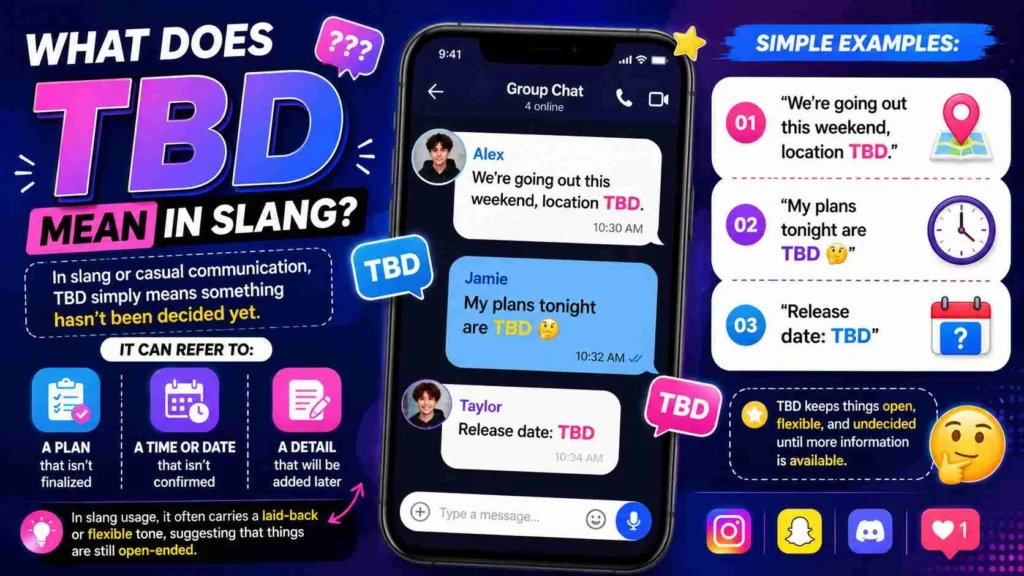
In slang or casual communication, TBD simply means something hasn’t been decided yet. It can refer to:
- A plan that isn’t finalized
- A time or date that isn’t confirmed
- A detail that will be added later
Simple Examples:
- “We’re going out this weekend, location TBD.”
- “My plans tonight are TBD 🤔”
- “Release date: TBD”
In slang usage, it often carries a laid-back or flexible tone, suggesting that things are still open-ended.
Origin and Evolution of TBD
Where Did TBD Come From?
The abbreviation TBD (To Be Determined) originated in formal and administrative contexts, particularly in:
- Military and government documentation
- Event planning schedules
- Project management systems
Initially, it was used in official paperwork to indicate that a decision would be made later after further consideration or information.
How It Became Slang
Over time, as digital communication evolved especially with texting, emails, and social media TBD became more casual and widely used.
Today, it’s common in:
- Group chats
- Instagram captions
- Tweets and comments
- Informal planning conversations
Why It Became Popular
- Saves time (short and efficient)
- Universally understood
- Fits both formal and informal settings
- Reflects modern flexible lifestyles
How TBD Is Used in Real Life
TBD is extremely flexible. It can be used in personal, social, and professional contexts.
1. In Casual Conversations
People use TBD when they don’t want to commit yet.
Example:
- “Let’s meet tomorrow, time TBD.”
👉 Tone: Friendly and flexible
2. In Professional Settings
TBD appears in emails, agendas, and reports.
Example:
- “Meeting agenda: Speaker – TBD”
👉 Tone: Neutral and formal
3. In Social Media & Captions
It’s often used humorously or creatively.
Example:
- “Big announcement coming soon… details TBD 👀”
👉 Tone: Mysterious or engaging
4. In Event Planning
Used when details are still being finalized.
Example:
- “Wedding venue: TBD”
👉 Tone: Informational
Tone and Context: What Does TBD Really Imply?
Depending on how and where you use it, TBD can have slightly different tones.
| Context | Tone | Meaning Implication |
|---|---|---|
| Casual chat | Relaxed / flexible | Not decided yet, no pressure |
| Work email | Professional / neutral | Awaiting confirmation |
| Social media | Playful / suspenseful | Teasing future info |
| Planning events | Practical / informative | Details pending |
| Negative context | Slightly dismissive | Delay or lack of decision |
Example Sentences with Context
Here are some real-life examples showing how TBD works in different tones:
Friendly Tone 😊
- “Dinner plans tonight are TBD, but I’m excited!”
- “Movie night location: TBD 🍿”
Neutral Tone 😐
- “Project deadline: TBD.”
- “Speaker for the event: TBD.”
Playful / Teasing Tone 😏
- “Something big is coming… date TBD 👀”
- “Surprise reveal: TBD 🔥”
Slightly Negative / Indecisive Tone 😬
- “Our strategy is still TBD…”
- “Response timeline: TBD (again?)”
Comparison with Similar Terms
TBD is often confused with other abbreviations. Here’s how it compares:
| Term | Full Form | Meaning | Key Difference |
|---|---|---|---|
| TBD | To Be Determined | Not decided yet | Decision pending |
| TBA | To Be Announced | Will be announced soon | Decision already made, not shared |
| TBH | To Be Honest | Expressing honesty | Not related to planning |
| TBC | To Be Confirmed | Awaiting confirmation | Decision made but needs verification |
Key Takeaway:
- TBD = Not decided
- TBA = Decided but not revealed
- TBC = Almost final but needs confirmation
Alternate Meanings of TBD
While “To Be Determined” is the most common meaning, TBD can occasionally have other interpretations depending on context:
- To Be Decided (same meaning, slightly different wording)
- Total Body Disorder (rare, medical slang)
- Technical Business Development (industry-specific)
👉 However, in everyday slang and communication, TBD almost always means “To Be Determined.”
When Should You Use TBD?
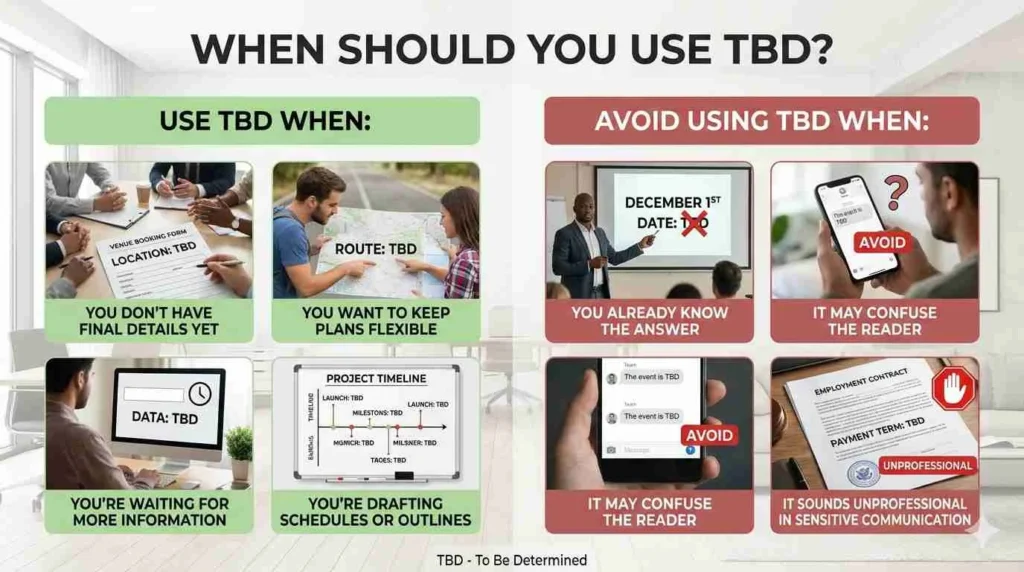
Use TBD When:
- You don’t have final details yet
- You want to keep plans flexible
- You’re waiting for more information
- You’re drafting schedules or outlines
Avoid Using TBD When:
- You already know the answer
- It may confuse the reader
- It sounds unprofessional in sensitive communication
Polite and Professional Alternatives to TBD
Sometimes, especially in formal communication, you may want to replace TBD with more polished language.
Professional Alternatives:
- “To be finalized”
- “Pending decision”
- “Under consideration”
- “Yet to be confirmed”
- “Details forthcoming”
Example:
Instead of:
- “Meeting time: TBD”
You could say:
- “Meeting time will be confirmed shortly.”
Example Table: TBD in Different Situations
| Scenario | Sentence Example | Tone |
|---|---|---|
| Texting a friend | “Hangout plans: TBD 😄” | Casual |
| Work email | “Project timeline: TBD” | Professional |
| Social media | “Launch date TBD 🚀” | Exciting |
| Event planning | “Venue: TBD” | Informative |
| Frustration | “Everything is still TBD…” | Negative |
Common Mistakes to Avoid
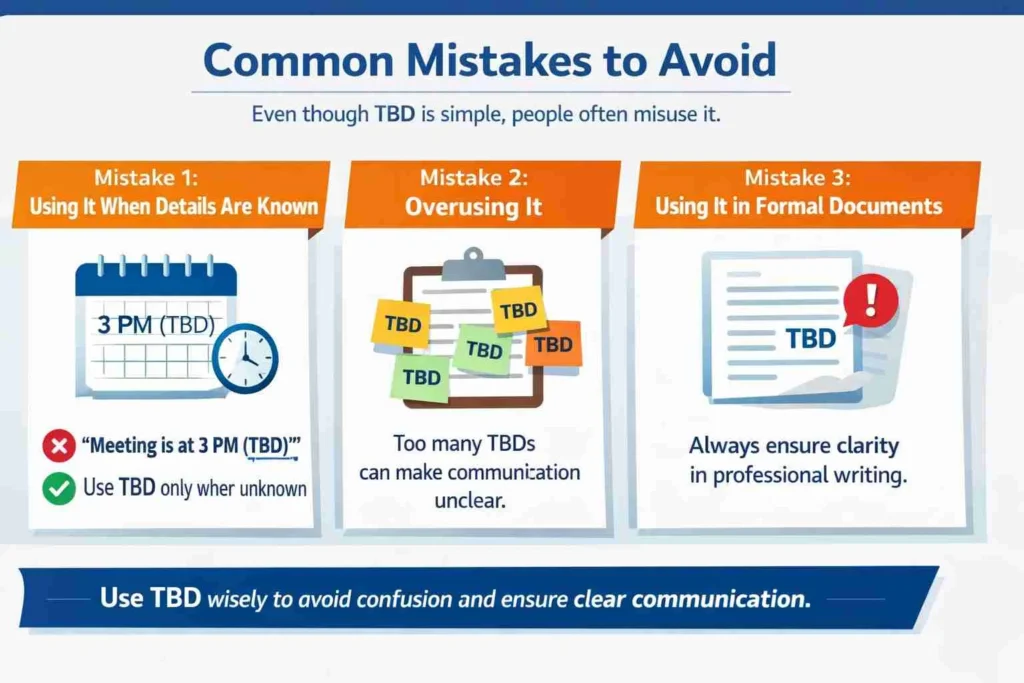
Even though TBD is simple, people often misuse it.
Mistake 1: Using It When Details Are Known
❌ “Meeting is at 3 PM (TBD)”
✔ Use TBD only when unknown
Mistake 2: Overusing It
Too many TBDs can make communication unclear.
Mistake 3: Using It in Formal Documents Without Context
Always ensure clarity in professional writing.
Why TBD Matters in Modern Communication
TBD reflects something deeper about how we communicate today:
- Flexibility is valued
- Plans often change
- Quick communication is essential
It’s a small abbreviation that carries a big message:
👉 “We’re not there yet but we will be.”
FAQs
1. What does TBD mean in texting?
In texting, TBD means “To Be Determined,” indicating that plans or details haven’t been decided yet and will be confirmed later.
2. Is TBD formal or informal?
TBD works in both formal and informal contexts, but it’s more commonly used casually in conversations and professionally in schedules or documents.
3. What is the difference between TBD and TBA?
TBD means a decision hasn’t been made yet, while TBA means the decision has been made but not yet announced.
4. Can TBD be used in emails?
Yes, TBD is commonly used in professional emails, especially when discussing schedules, timelines, or pending decisions.
5. Does TBD mean canceled?
No, TBD does not mean canceled; it simply means the details are not yet decided.
6. Is it rude to say TBD?
Not at all it’s neutral, but overuse in uncertain situations might appear indecisive.
7. Can TBD be used on social media?
Yes, it’s widely used on social media, often to build suspense or tease upcoming announcements.
8. What should I say instead of TBD in professional writing?
You can use alternatives like “to be finalized,” “pending confirmation,” or “details forthcoming.”
Conclusion
TBD is more than just a simple abbreviation it’s a reflection of modern communication where flexibility and speed matter. You’re planning a weekend hangout, drafting a business proposal, or teasing a big announcement online, TBD helps you communicate uncertainty clearly and efficiently.
The key is knowing when and how to use it. In casual contexts, it feels relaxed and natural. In professional settings, it keeps communication clear without overcommitting. And when used creatively, it can even build curiosity and excitement.
So next time you’re unsure about a detail, don’t overthink it just say TBD and keep things moving.
Discover More Related Articles:
- “ETA” Meaning: What It Stands For & Why Everyone Searches It In 2026
- “PMO” Meaning in Text: What It Stands For & How It’s Used In 2026
- “Kroner” Meaning: A Beginner’s Guide to Scandinavian Currency In 2026