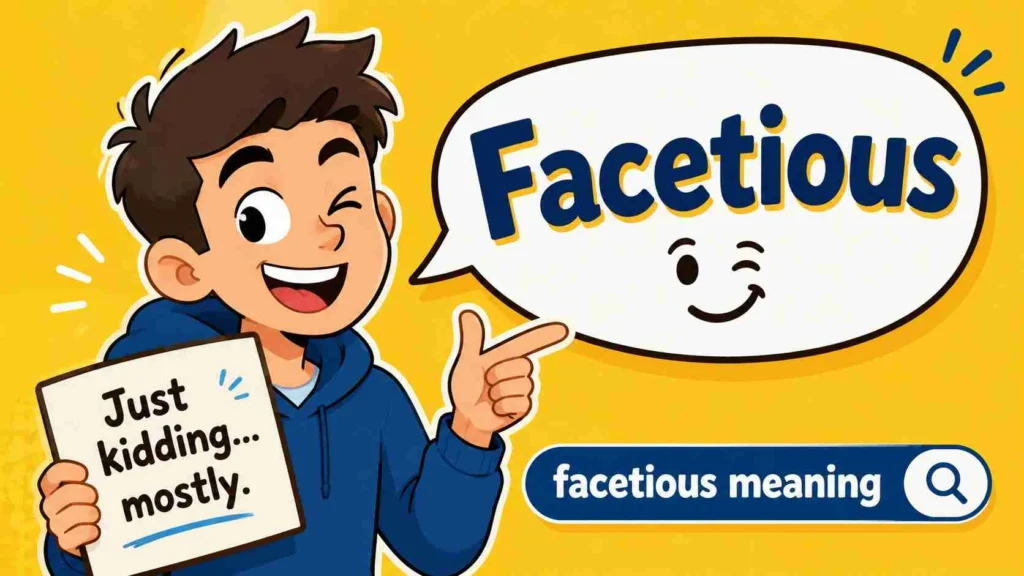

Facetious means treating a serious issue with playful, inappropriate humor but without any cruel intent. Think of it as joking at the wrong time in a way that teases rather than wounds sarcasm bites, but facetiousness just tickles.
You’ve probably called someone “facetious” and meant “sarcastic.”
You were wrong.
Don’t worry. Most people make that mistake.
Here’s the real facetious meaning in plain English: treating a serious issue with deliberately inappropriate humor, but without any cruel intent.
Think playful, not mean.
A facetious person cracks a joke during a tense meeting. A sarcastic person throws shade. One makes you exhale through your nose. The other makes you check your feelings.
This guide gives you the full picture. You’ll learn pronunciation, real examples, the big difference between facetious and sarcastic, and exactly when to keep your mouth shut.
No dictionary reprint. No fluff. Just how humans actually use this word.
What Does Facetious Mean?
Let’s keep this simple.
Facetious (adjective): Saying something you don’t literally mean, but for laughs, not for cruelty.
That’s it.
The word describes a specific kind of humor. It’s not a roast. It’s not a punch-down and it’s a playful nudge.
Think of a friend who makes a silly joke at a weird time. You know they don’t mean harm. You still roll your eyes. That’s facetious humor.
Here’s a quick example:
- Serious situation: Grandma’s funeral.
- Facetious remark: “Well, she finally quit smoking.”
- Your reaction: Awkward chuckle. Not anger.
The person saying it isn’t a monster. They’re just bad at reading the room. The humor is inappropriate, but the intent isn’t malicious.
That’s the core of the facetious meaning. Inappropriate + playful + zero malice.
Why People Confuse Facetious With Sarcasm
Let’s address the elephant in the room.
You’ve heard someone say, “Stop being facetious” when they really meant “Stop being sarcastic.”
Why does this happen?
Two reasons.
First, the words sound academic. Most people don’t use them daily. So the brain grabs the closest match. Sarcasm is common. Facetious is not. They become interchangeable in casual speech.
Second, both involve saying the opposite of what you mean. That overlap confuses everyone.
But here’s the truth: sarcasm and facetiousness live on different planets.
| Trait | Facetious | Sarcastic |
|---|---|---|
| Intent | Playful, lighthearted | Cutting, mocking, or critical |
| Tone | Goofy or teasing | Bitter or scornful |
| Target’s reaction | Eye roll or chuckle | Sting or defensiveness |
| Hurts feelings? | Rarely | Often |
| Example | “Oh great, another Monday.” (smiling) | “Oh great, another Monday.” (rolling eyes) |
Sarcasm bites. Facetiousness tickles.
Here’s a real-world test. Say your line. Watch the other person’s face.
- If they laugh, you were facetious.
- If they flinch, you were sarcastic.
- If they stare blankly, you were neither. You were just awkward.
How to Pronounce Facetious | Without Sounding Like a Robot
Let’s get the sound right.
You don’t want to say this word confidently and mess it up. That’s worse than using the wrong word.
Correct pronunciation: fuh-SEE-shuss
Break it into three pieces:
- fuh (like “duh” with an F)
- SEE (like the verb)
- shuss (rhymes with “push” but with a soft “sh”)
Put together: fuh-SEE-shuss.
Here’s a weird but useful memory trick.
The word facetious contains every vowel in order. A-E-I-O-U. No other common English word does that except “abstemious.”
So say this silly sentence:
“Fa ther ce ases ti ckling ou r s on.”
Pull the first vowel from each word. A-E-I-O-U. That’s facetious.
Stupid? Yes. Effective? Also yes.
Common wrong versions to avoid:
- “Fay-shuss” (no)
- “Fah-set-ee-uss” (definitely no)
- “Fah-see-tee-ous” (please no)
Stick with fuh-SEE-shuss. Four syllables. Smile when you say it. That fits the playful meaning anyway.
Facetious Examples in Real Life
You need real sentences. Not the kind from a 1980s grammar workbook.
Here’s how actual humans use the word facetious.
At work
Imagine a team meeting. Sales are down. Your boss looks stressed.
You say: “I’d say our quarterly report is a masterpiece… if masterpieces were written by raccoons on caffeine.”
That’s facetious. You’re not actually insulting the report. You’re using absurd humor to lighten the mood.
Warning: Don’t say this to every boss. Some will fire you. Know your audience.
In a relationship
Your partner forgets to take out the trash. Again.
You smile and say: “You’re absolutely right. I love taking out the trash. It’s my favorite hobby.”
Your tone matters here.
- Smiling and winking? Facetious.
- Flat voice and crossed arms? Sarcastic.
- Silent treatment? That’s a whole different problem.
On social media
A news post about a heatwave says temperatures will hit 100 degrees.
You comment: “Finally. Perfect weather for my fur coat collection.”
That’s facetious humor. No one owns 12 fur coats. You’re being playful. Most people will get it. Someone will still reply “actually it’s bad for animals.” Ignore that person.
In everyday chat
Friend: “I’m on a new diet.”
You: “Me too. I only eat air and disappointment.”
That’s a classic facetious reply. It’s not mean. It’s not even really about them and it’s just verbal play.
When it fails
Here’s a bad example.
Your coworker says their pet just died.
You say: “Well, at least you don’t have to buy food anymore.”
That’s not facetious. That’s cruel. The difference is timing and topic. Some situations are off-limits. We’ll cover that later.
Facetious Synonyms | Softer Words to Use Instead
Sometimes you don’t want to say “facetious.” It sounds like a vocabulary flex.
Use these synonyms instead. They carry the same playful energy without the SAT flashback.
| Synonym | Vibe | Example |
|---|---|---|
| Witty | Smart and funny | “That was a witty reply to his question.” |
| Tongue-in-cheek | Obvious joking | “Her tongue-in-cheek comment made everyone laugh.” |
| Joking | Simple and clear | “I was just joking. Relax.” |
| Lighthearted | No weight to it | “He kept a lighthearted tone during the game.” |
| Flippant | Slightly disrespectful | “Her flippant answer annoyed the teacher.” |
Pro tip: “Flippant” has a negative edge. Use it when someone’s joke crosses a line. “Facetious” stays neutral to positive.
Facetious Antonyms
Need the opposite of facetious? Here’s your list.
| Antonym | Meaning | Example |
|---|---|---|
| Earnest | Sincere and serious | “She gave an earnest apology.” |
| Solemn | Deeply serious | “The room fell silent and solemn.” |
| Grave | Important and somber | “This is a grave matter.” |
| Sincere | No jokes, honest | “His sincere thanks meant a lot.” |
| Straight-faced | No expression, no humor | “He told the lie straight-faced.” |
Remember: A knock-knock joke isn’t facetious. A joke about a tax audit? That’s getting warmer. A sincere compliment? That’s the opposite.
Facetious vs Sarcastic: The Deep Dive
This deserves its own section. Most people get this wrong. Let’s fix it permanently.
The Intent Test
Ask one question: Does the speaker want to hurt or play?
- Hurt = sarcastic
- Play = facetious
That’s the whole ballgame.
The Tone Test
Listen to their voice.
Sarcasm drips. It’s slow. It emphasizes the wrong word. It sounds like honey covering a thorn.
Facetiousness bounces. It’s quicker. It often comes with a smile or a raised eyebrow.
Real examples side by side
Scenario: You spill coffee on your shirt.
- Sarcastic friend: “Great. Just great. Really impressive.”
- Facetious friend: “Bold fashion choice. Brown stains are definitely in this year.”
One makes you feel worse. One makes you laugh at yourself.
Scenario: Your team loses a game badly.
- Sarcastic coach: “Brilliant performance out there. Truly world-class.”
- Facetious coach: “Well, we gave them a chance to feel good about themselves.”
See the difference? Sarcasm cuts. Facetiousness winks.
Can something be both?
Rarely. But yes.
When sarcasm becomes so over-the-top that it circles back to funny, it crosses into facetious territory.
Example: “Oh sure, because that worked perfectly last time.” (Said with a huge fake smile and jazz hands.)
That’s playful sarcasm. Some call it “facetious sarcasm.” Linguists roll their eyes at that phrase. But humans use it.
Facetiousness vs Irony vs Sarcasm
Let’s clean up the whole family tree.
Irony says the opposite of what you mean, often without humor.
Example: “What beautiful weather” during a hurricane.
No joke. No laugh. Just a statement of obvious falsehood.
Sarcasm is verbal irony plus attitude plus intent to mock.
Example: “What beautiful weather, Einstein.” (It’s raining sideways.)
Now you’re mocking someone. The “Einstein” makes it personal.
Facetiousness is playful irony plus zero malice plus often absurd.
Example: “What beautiful weather. I’m canceling my beach plans.”
You don’t have beach plans. You’re not mocking anyone. You’re just being silly.
One scenario, all three
Your friend parks terribly. Half the car hangs over the line.
- Irony: “Great parking job.” (No smile. Just fact.)
- Sarcasm: “Great parking job, genius.” (You’re mocking them.)
- Facetious: “Great parking job. Let’s hire you for valet.” (Teasing but friendly.)
Same words. Different intent. Different outcome.
When Being Facetious Backfires
Facetiousness isn’t always safe. Sometimes it blows up in your face.
Here’s when to keep the joke to yourself.
Different cultures
Some cultures value direct sincerity. A facetious comment in Japan might confuse or offend. Germany also leans straightforward. Your playful joke becomes an insult.
Travel tip: Learn the humor culture before joking. Or stick to sincere compliments. Nobody ever got in trouble for saying “thank you.”
Text messages
This is the big one.
Without tone, “Sure, I’ll get right on that” reads as rude. Not funny. Not playful. Just passive-aggressive.
Add a winky face? Now it’s facetious. 😉
Add a period at the end? Now it’s sarcastic again.
Texting is terrible for nuanced humor. Use facetiousness carefully. Or don’t use it at all in work chats.
Serious topics
Some topics are off-limits.
- Illness
- Death
- Recent trauma
- Financial ruin
- Divorce
Don’t be facetious here. It’s not clever. It’s cruel. Even if you mean well, it lands like a brick.
Example: Friend says their parent has cancer. You say “Well, at least they’ll lose weight.” That’s not facetious. That’s monstrous. Don’t do it.
Power dynamics
Your boss can be facetious to you. You probably cannot be facetious back.
That’s not fair. But it’s true.
A manager says “Looks like someone wants to work overtime!” That’s playful. An employee says “Looks like someone wants a pay cut!” That’s a trip to HR.
Know the hierarchy. Save your facetiousness for equals.
When the listener doesn’t know you
New friend? First date? Work acquaintance?
Avoid facetiousness. They don’t know your baseline yet. They can’t tell if you’re joking or weird.
Build rapport first. Earn the right to be playful.
How to Use Facetious in a Sentence
You want a formula. Here it is.
Serious situation + obviously untrue statement + playful delivery = facetious.
That’s it.
Now fill in the blanks.
Examples:
- “When the waiter asked if I wanted dessert, I said facetiously, ‘No thanks, I hate chocolate.’”
- “She made a facetious remark about the broken elevator: ‘Guess we needed the exercise anyway.’”
- “His facetious tone disappeared the second he saw her crying.”
Common mistake: Using “facetiously” as an adverb in every sentence. Mix it up.
Say:
- “In a facetious way…”
- “Jokingly…”
- “She was being facetious when she said…”
Variety keeps your writing human.
Facetious Person Meaning
Calling someone “a facetious person” says a lot.
It means they use playful humor often. Sometimes at the wrong time. But never to hurt.
Positive traits of a facetious person:
- Quick-witted
- Doesn’t take themselves too seriously
- Can lighten a tense room
- Usually likable
Negative traits of a facetious person:
- Bad at reading serious moments
- Can seem immature
- May annoy sincere people
- Sometimes hides real feelings behind jokes
Example: Your coworker who always has a one-liner. People either love them or find them exhausting. That’s a facetious person.
Famous facetious people (likely):
- Ryan Reynolds (his Twitter is a masterclass)
- The late Robin Williams (playful, fast, often inappropriate)
- Any friend who says “I’m fine” with a dramatic sigh and a smirk
Facetious Comment Meaning And Why It Flops
A facetious comment is a one-off joke. Usually at a slightly wrong moment.
Examples:
- During a serious budget meeting: “Or we could just print more money.”
- After someone shares bad news: “Well, that’s one way to start a Tuesday.”
- When a friend complains about traffic: “Just fly. Oh wait. You can’t.”
Why facetious comments flop:
- The timing is off. Too soon after bad news? It’s not funny. It’s painful.
- The listener doesn’t get the joke. Now you look weird.
- You misread the room. Everyone else is serious. You’re joking. You become the villain.
How to recover from a flopped facetious comment:
Say “Sorry. That was a bad joke. I shouldn’t have said that.”
Don’t explain. Don’t defend. Just apologize. Move on.
Facetious Tone Meaning | How to Hear It
Tone is everything. Facetious tone has three markers.
Marker one: Upward lilt at the end. Like a question but not quite.
Marker two: Slightly faster speech. The joke wants to land before the listener catches on.
Marker three: A micro-smile. The speaker’s mouth twitches even if they try to stay serious.
How to identify facetious tone in writing:
Writers signal it with:
- “She said with a smirk”
- “He joked”
- Air quotes in dialogue
- Exaggerated word choices
Example: “Oh sure, because that always works.” (The italics do the tone’s job.)
If you can’t hear tone (text, email, chat): Assume sincerity. Don’t guess facetiousness. You’ll be wrong half the time.
Facetious Humor Meaning
Facetious humor is the sweet spot. It’s inappropriate but not offensive. Playful but not dumb.
Three ingredients of good facetious humor:
- Absurdity – The joke is obviously false.
- Timing – It interrupts seriousness but not grief.
- Warmth – The speaker clearly likes the listener.
Examples of great facetious humor:
- At a wedding: “I give this marriage six months.” (Said with a huge grin. Everyone laughs because it’s so obviously wrong.)
- During a power outage: “Well, at least we can’t see the dust anymore.”
- After a spilled drink: “That floor was too dry anyway.”
Bad facetious humor (don’t do this):
- At a funeral: “He always did hate Mondays.” (Too soon. Too real.)
- After a layoff: “More time for naps!” (People just lost income. Not funny.)
- To a stranger: “You look like you’ve seen better days.” (You don’t know their story.)
Test before you speak: Would I say this to my grandmother? If no, reconsider.
Facetious Behavior Meaning
Behavior can be facetious too. It’s not just words.
Facetious behavior includes:
- Exaggerated facial expressions – Huge eye rolls, fake gasps, over-the-top nods
- Playful sabotage – Moving someone’s coffee mug one inch to the left
- Mock seriousness – Saluting after a silly request
- The slow clap – For something that obviously doesn’t deserve applause
Real example: Your friend asks you to pass the salt. You stand up. You bow and you present the salt like a royal offering. That’s facetious behavior.
When it’s annoying: Doing this every time. Once is funny. Twenty times is exhausting.
Facetiously Meaning
“Facetiously” is just the adverb. It means “in a facetious manner.”
Example: “He facetiously raised his hand when the teacher asked who didn’t do the homework.”
Fun fact: “Facetiously” also contains all five vowels in order. A-E-I-O-U. Y is extra. But the word uses Y too. So it’s technically A-E-I-O-U-Y in order.
That’s useless trivia. But now you know.
When to use “facetiously” vs “facetious”:
- Facetious = adjective (describes a noun): “Her facetious remark landed well.”
- Facetiously = adverb (describes a verb): “She spoke facetiously.”
Don’t stress this. Most readers won’t notice the difference.
Facetiousness Meaning
“Facetiousness” is the noun. It means the quality of being facetious.
Example: “His facetiousness made him popular at parties but insufferable at meetings.”
You don’t need this word often. Use “humor” or “playfulness” instead. “Facetiousness” sounds clinical.
Save it for formal writing or when you want to sound smart. Use it once per article max.
What Does Facetious Mean in Chat?
Chat and text change everything.
In WhatsApp, iMessage, or Slack, “facetious” usually means “I’m joking but not being sarcastic.”
Real chat example:
A Person : “I’m quitting my job to become a professional napper.”
B Person : “Is that real?”
A Person : “No, I’m being facetious.”
Shorthand in chat: People just say “jk” or “/s” for sarcasm. Facetiousness doesn’t have its own tag. Use words instead.
Emojis that signal facetiousness:
- 😉 (winky face – the universal “I’m playing”)
- 🙃 (upside down smile – “this is silly”)
- 😅 (sweat smile – “I know this is awkward”)
Warning: Without these emojis, your facetious comment looks mean. Add the winky face. It costs nothing.
Facetious Meaning in Urdu and Hindi
Language learners often ask for translations. Here’s the closest match.
Urdu: مسخرہ پن (muskhara pan) – clownishness, playful mockery
Hindi: हंसी उड़ाना (hansi udana) – light mockery, not cruel
Neither is perfect. Both capture the playful, non-malicious tone.
Example in Urdu: “وہ مسخرہ پن سے بول رہا تھا” (He was speaking facetiously.)
Example in Hindi: “उसने हंसी उड़ाते हुए कहा” (She said it facetiously.)
Cultural note: South Asian communication often values indirectness. Facetiousness can work well in casual settings with friends. But with elders or authority figures? Avoid it. Sincerity wins.
Is Facetious Positive or Negative?
Neutral to slightly positive.
It’s positive when:
- The room is relaxed
- Everyone knows each other well
- The topic isn’t serious
- You use it once or twice, not constantly
It’s negative when:
- The situation calls for sincerity
- The listener feels mocked
- You use it to avoid real emotions
- You’re the only one laughing
Quick test: If someone says “You’re so facetious” with a smile, it’s a compliment. If they say it with a flat voice, it’s a criticism.
Can Facetious Be Offensive?
Yes. Facetious can absolutely offend.
It offends when:
- The topic is sensitive. Death, illness, trauma, money problems – stay serious.
- The listener doesn’t know you’re joking. Strangers, new colleagues, first dates – not the time.
- You’re in a power imbalance. Your boss, a police officer, a judge – don’t test them.
- The culture values directness. Some cultures have zero tolerance for playful irony.
Real example that caused offense:
A man made a facetious comment about his wife’s cooking at a dinner party. He said “At least it’s not poison.” He meant it playfully. She cried. The room went silent. That was five years ago. He still hears about it.
Rule of thumb: If you have to ask “Is this okay?” it’s not okay. Save it for people who already know your humor.
What Is a Facetious Person Like?
Let’s build a complete picture.
A facetious person typically:
- Uses humor to deflect discomfort
- Hates awkward silences
- Speaks first, thinks second
- Is popular in casual settings
- Can seem insincere to serious types
- Often hides anxiety behind jokes
- Learns the hard way when to shut up
In friendships: They’re the class clown. Fun in short bursts. Exhausting over long weekends.
At work: Risky. Some managers love the energy. Most want professionalism. Know your office culture.
In romance: Great for flirting. Terrible for fighting. A facetious partner might joke during a serious argument. That doesn’t end well.
Famous example: Chandler from Friends. Every line is a joke. Lovable but also clearly avoiding real feelings. That’s a facetious person.
Facetious vs Humorous
All facetious comments are humorous. Not all humorous comments are facetious.
Humorous is the big umbrella. It covers everything funny.
Facetious is a small corner under that umbrella. It means humor + inappropriateness + playfulness.
Examples to clarify:
- Humorous but not facetious: A stand-up comic’s planned set. Nothing inappropriate. Just jokes.
- Facetious but not purely humorous: A joke about a tragedy that’s too soon. You laugh uncomfortably. That’s the facetious zone.
Think of it this way:
- Humor = all pizza
- Facetiousness = pineapple pizza
- Some people love it. Some hate it. Either way, it’s a specific taste.
Facetious vs Joking
“Joking” is broader and safer.
Joking: Any statement not meant seriously. Can be kind, silly, absurd, or mean.
Facetious: Joking + inappropriate timing + playful tone.
Example:
- Joking: “I’m the king of the world!” (Normal joke. No stakes.)
- Facetious: “I’m the king of the world!” during a friend’s job loss. (Wrong timing. Playful intent.)
Key difference: Joking works anywhere. Facetious works only in specific contexts. Use “joking” 90% of the time. Save “facetious” for when the timing is intentionally off.
When to Use the Word Facetious
Use this simple flowchart in your head.
1 Step : Is the situation serious?
- No → Just say “joking” or “playful.”
- Yes → Go to step two.
2 Step : Do you know your audience well?
- No → Don’t use the word. Stay sincere.
- Yes → Go to step three.
3 Step : Are you describing your own joke or someone else’s?
- Your own joke → Say “I’m being facetious” to clarify intent.
- Someone else’s remark → Say “That was facetious” to explain why it wasn’t mean.
Example of correct use:
“Wait, did he just insult me?”
“No, he was being facetious. He likes you.”
Example of incorrect use:
“That’s so facetious.” (Said about a normal joke. You sound like a vocabulary textbook.)
Etymology of Facetious
You don’t need a boring lecture. Here’s the quick story.
Latin root: facetus – witty, elegant, fine.
16th century French: facétie – a joke, a prank, a witty saying.
English evolution: The word originally meant “polished humor” – the kind clever aristocrats used. Over time, it shifted to “inappropriately playful.” Now it means “joking at the wrong time but meaning no harm.”
The vowel trick again: Facetious contains A-E-I-O-U in order. So does abstemious. That’s it. Two words in English. Use this fact at parties. People will either love you or avoid you.
Common Mistakes With Facetious And How to Fix Them
Mistake one: Using it as a synonym for sarcastic.
Fix: Remember the intent test. Sarcasm hurts. Facetiousness teases.
Mistake two: Overusing the word.
Fix: Use it once per conversation max. After that, say “joking” or “playful.”
Mistake three: Mispronouncing it.
Fix: fuh-SEE-shuss. Practice three times right now.
Mistake four: Using it in serious writing.
Fix: Don’t. Academic papers don’t need “facetious.” Save it for blogs, chats, and casual speech.
Mistake five: Explaining the joke.
Fix: If you say “I’m being facetious” after every sentence, you’re doing it wrong. Let the humor land or fail on its own.
FAQs
What does facetious mean in simple words?
Joking about something you shouldn’t joke about, but in a playful way.
Is facetious rude?
Not usually. But timing is everything.
How do you remember the difference between facetious and sarcastic?
Facetious = funny face. Sarcastic = sharp teeth.
Can a compliment be facetious?
Yes. “Nice tie. Did your dog pick it out?” That’s playful teasing, not a real insult.
What’s the opposite of facetious?
Earnest, sincere, or grave.
Does facetious have a negative connotation?
Sometimes. It depends on tone and context.
Can you be facetious in text without emojis?
Rarely. Use a winky face or spell out “I’m joking.”
Is facetious a common word?
No. Most people use “sarcastic” incorrectly instead. Now you know better.
Conclusion
Facetious isn’t sarcasm’s twin. It’s the playful cousin who shows up to a funeral with a whoopee cushion. The intent makes all the difference. Sarcasm cuts. Facetiousness winks. Once you hear that difference, you can’t unhear it.
Use this word sparingly. Don’t be the person who says “facetious” three times in one conversation. Save it for when someone’s joke lands awkwardly but not cruelly. Or when you need to defend your own ill-timed humor. A simple “I’m being facetious” works better than a long explanation.
Next time someone calls you sarcastic, smile and ask: “Or was I being facetious?” Then watch them blink. You just leveled up your vocabulary game without sounding like a dictionary. Now go be playfully inappropriate. Just read the room first.
Discover More Related Articles:
- “OBO” Meaning Explained: How to Use It in Sales & Negotiations In 2026
- “DTF” Meaning in Chat: What It Really Means & How It’s Used In 2026
- “White Heart” Meaning: Pure Love, Friendship & Peace Symbol In 2026