
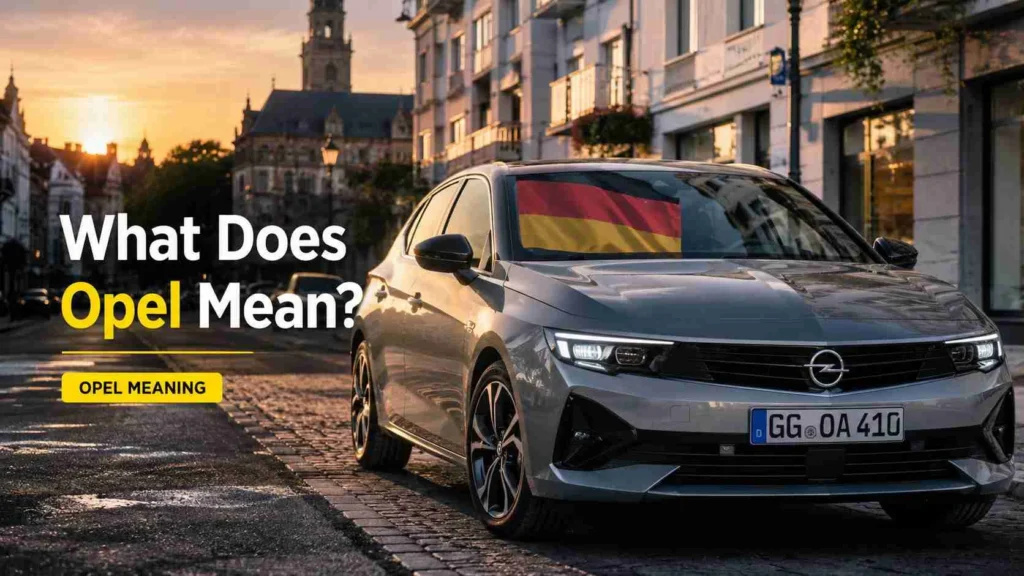

Opel is a German surname with no dictionary definition it refers exclusively to the automobile manufacturer founded by Adam Opel in 1862. The name carries no translation in English, Urdu, or Hindi; it simply honors the family that started with sewing machines and built one of Europe’s most enduring car brands.
Ever passed a car with a lightning bolt on its grille and wondered what “Opel” actually means? You’re not alone. Thousands of people search for the Opel meaning every single month. Some expect a deep philosophical definition. Others hope for a cool Latin root or a hidden acronym. But the truth is simpler and far more interesting.
Let me cut straight to the point. Opel has no dictionary definition. It’s not an English word. It’s not a technical term. Opel is a German surname plain and simple. The car brand took its name from a real person: Adam Opel. That’s it.
But don’t close the tab just yet. The real story behind that name involves sewing machines, bicycles, a family of bold sons, and one of the most surprising ownership histories in the auto industry. By the end of this article, you’ll know exactly what Opel means, how to say it without embarrassment, and why the name survived for over 160 years.
Let’s dive in.
The Opel Meaning in One Sentence
Before we dig deep, here’s your fast answer.
Opel means nothing in English, Urdu, or Hindi. It is a family name from 19th-century Germany. The brand exists because Adam Opel stamped his name on his factory doors in 1862. No hidden message. No secret translation. Just a man who built things.
| Language | Meaning |
|---|---|
| English | No meaning (proper noun) |
| Urdu | No meaning (transliteration: اوپیل) |
| Hindi | No meaning (transliteration: ओपेल) |
| German | No meaning (surname only) |
That honesty might disappoint some readers. But real knowledge beats fake poetry every time.
Opel Meaning in English | Why You Won’t Find It in a Dictionary
Open any standard English dictionary. Search for “Opel.” You’ll find nothing. That’s because Opel is a proper noun, not a common noun. It names a specific thing a car company rather than describing a category of things.
Think of other family-name car brands: Ford, Chevrolet, Toyota, Honda, Ferrari, Porsche. None of those have dictionary definitions either. You don’t ask, “What does Ford mean?” You ask, “Who was Ford?”
Same rule applies here.
However, a tiny exception exists. In rare genealogical contexts, “Opel” appears as a surname with possible old meanings (more on that later). But for 99.9% of people, the Opel meaning is simply: the German automaker founded by Adam Opel.
So if someone asks you, “What does Opel stand for?” The correct answer is: It doesn’t stand for anything. It stands for a family.
Opel Meaning in Urdu and Hindi | What Searchers Actually Want
Many Urdu and Hindi speakers search for “Opel meaning” expecting a local translation. I’ll give you the honest answer.
اوپیل (Urdu) and ओपेल (Hindi) are direct transliterations. They carry no native meaning. Urdu speakers would simply recognize Opel as a foreign car brand from Germany, just like Toyota or BMW. No poetic hidden definition exists in Persian or Sanskrit roots.
Why do people search for this? Two reasons. First, some brand names do have beautiful meanings in other languages. Second, translation tools sometimes incorrectly treat “Opel” as a common noun.
But here’s the real fact: Adam Opel never spoke Urdu. His name doesn’t magically acquire new meanings across borders. It remains a German surname you’re in Karachi, Delhi, or Berlin.
| Language | Script | Meaning Status |
|---|---|---|
| Urdu | اوپیل | No meaning (transliteration only) |
| Hindi | ओपेल | No meaning (transliteration only) |
| Punjabi | ਓਪਲ | No meaning |
| Bengali | ওপেল | No meaning |
Don’t let anyone sell you a fake “secret meaning” for clicks. The truth is clean and simple.
How to Pronounce Opel Correctly
Here’s a quick test. Say “Opel” out loud right now.
Did you say “Oh-PELL”? That’s wrong. Did you say “Ah-pull”? Also wrong.
Correct German pronunciation: OH-pel
- First syllable: “OH” (like the letter O)
- Second syllable: “pel” (rhymes with “bell” but shorter)
- Stress always on the first syllable. Not the second.
Think of “Opel” like “apple” but with an O instead of A. OH-pul. Fast and flat. No rising tone at the end.
In English-speaking countries, you’ll hear “Oh-PELL” constantly. Car dealers say it. Commercials used to say it. But that’s an anglicized mispronunciation. Germans will understand you, but they’ll also know immediately that you’re not a local.
Here’s a simple trick. Say these two words back to back: soap + pull. Now say them faster. Soap-pull. Soap-pull. That’s almost exactly “Opel” with a slight German flattening of the vowel.
Practice this three times:
- OH-pel
- OH-pel
- OH-pel
Now you sound like you know what you’re talking about.
Opel Origin and Etymology | Where the Name Actually Comes From
Let’s go back in time. Way back.
The Opel surname first appears in written records during the 16th and 17th centuries in the Hesse region of central Germany. That’s the area around Frankfurt and Kassel. At that time, surnames were still becoming fixed. People took names from their jobs, their father’s name, their house, or their land.
So what does “Opel” mean as a surname? Scholars suggest a few possibilities. None are 100% certain, but all are educated guesses.
Theory 1 (most accepted): “Opel” comes from a Low German or Dutch root. “Op” means “up” or “upper.” “El” might be an old form of “noble” (from adal in Old German). So Opel could mean “upper noble” a person from a higher social standing or elevated land.
Theory 2: “Opel” might refer to an elder or ancestor. Some Germanic dialects used “op” as a prefix for “over” or “above,” and “el” as a short form of “elders.” So an Opel could be the “head of the family” or the “village elder.”
Theory 3 (least likely but interesting): “Opel” could be a topographic surname for someone living on high ground. “Op” (up/above) + “el” (old word for a settlement or hill). So an Opel lived “up on the hill.”
Here’s the honest truth. Nobody knows for sure. Surname etymology from 400 years ago is often guesswork. What matters is that by the early 1800s, the Opel family lived in the town of Rüsselsheim, near Frankfurt. And in that family, a boy named Adam was born.
| Theory | Proposed Meaning | Likelihood |
|---|---|---|
| Upper noble | “Op” (up) + “el” (noble) | Moderate |
| Village elder | “Op” (above) + “el” (elders) | Moderate |
| High ground dweller | “Op” (up) + “el” (hill/settlement) | Low |
Who Was Adam Opel? The Man Behind the Name
Adam Opel was born on May 9, 1837 in Rüsselsheim, Germany. His father, Philipp Wilhelm Opel, worked as a locksmith. The family was solidly middle class not rich, not poor.
Young Adam trained as a locksmith too. But he had bigger dreams. In 1862, at just 25 years old, he traveled to Paris and saw something that changed his life: sewing machines. They were new, mechanical, and magical. Back then, sewing by hand took forever. A sewing machine could do in minutes what took hours.
Adam returned to Rüsselsheim and opened a small workshop in his parents’ barn. He started manufacturing sewing machines under his own name: Opel. That’s the birth of the brand. Not cars. Not bicycles. Sewing machines.
| Year | Event |
|---|---|
| 1837 | Adam Opel born |
| 1862 | Opens sewing machine workshop |
| 1868 | Moves to first real factory |
| 1884 | Begins making high-wheel bicycles |
| 1886 | Starts making safety bicycles |
| 1895 | Adam Opel dies unexpectedly |
Adam never saw a single Opel car. He died of typhoid fever in 1895 at age 58. The automobile craze was just beginning. But his five sons Carl, Wilhelm, Heinrich, Friedrich, and Ludwig carried his name forward.
The Sons Who Built the Cars
After Adam’s death, his widow Sophie and their five sons faced a choice. Keep making sewing machines and bicycles, or gamble on these new “horseless carriages.”
They gambled.
In 1899, the Opel brothers signed a licensing deal to build cars designed by a man named Friedrich Lutzmann. That first Opel car was clunky, underpowered, and not very good. But it wore the Opel name proudly.
By 1902, Opel built its own designs. By 1907, Opel was Germany’s largest car manufacturer. The name grew faster than anyone expected.
Key fact: Adam Opel never built a car. His sons did. But the meaning of Opel as a family legacy comes directly from Adam’s decision to put his name on that first sewing machine workshop.
Why Is Opel Called Opel? The Simple Answer
People love to search for hidden meanings. “Does Opel stand for something?” “Is it an acronym?” “Was it a code name?”
No. No. And no.
Opel is called Opel because Adam Opel’s name was on the factory door. That’s it. The same reason Ford is called Ford. The same reason Ferrari is called Ferrari.
This might feel anti-climactic. But real history is often simple. Not every brand name hides a clever puzzle. Sometimes a family just builds good products and stamps their name on every single one.
Compare Opel to other car brand names:
| Brand | Name Origin |
|---|---|
| Opel | Founder’s surname |
| Ford | Founder’s surname |
| Toyota | Founder’s surname (Toyoda, modified) |
| Mercedes | Daughter’s name of a major investor |
| Jaguar | Symbolic animal name |
| Lotus | Symbolic flower name |
Opel sits firmly in the “founder’s surname” category. No mythology. No poetry. Just a man who knew how to build things.
Opel Surname Meaning | For the Genealogy Fans
Let’s shift gears. What if you actually are an Opel? What if you carry this last name and want to know its deeper roots?
First, congratulations. You share a last name with millions of cars and a rich industrial history.
The Opel surname today is extremely rare. Fewer than 10,000 people worldwide likely carry it. Most live in Germany, especially in Hesse (the original home region). Smaller numbers appear in the Netherlands, the United States (Midwestern states like Ohio and Illinois), and a scattering of other countries.
If your last name is Opel, here’s what you likely know:
- Your ancestors probably came from central Germany
- Your family name was established by the 1600s
- You have no automatic relation to Adam Opel (the surname is older than him)
The possible old meanings, again:
- Upper noble (most likely)
- Village elder (second most likely)
- High ground dweller (least likely)
No genealogical DNA test will confirm these. But they give you a sense of identity. Your name probably meant something like “the respected one on the hill.” Not bad for a surname.
Opel Brand Meaning Today | What the Name Stands For
Names evolve. The meaning of Opel in 2025 isn’t just “Adam Opel’s surname.” It’s a brand promise a set of associations baked into the name by over 120 years of carmaking.
So what does the Opel brand mean today?
- German engineering without the luxury price tag. You don’t pay BMW or Mercedes money for an Opel. But you still get solid German design and manufacturing.
- Practicality over flash. Opels aren’t sports cars (except the old GT). They’re family hatchbacks, sedans, wagons, and small SUVs. They work hard and don’t complain.
- European identity. Opel feels European in a way that Ford Europe or GM Europe never did. Even under American ownership (GM from 1929 to 2017), Opel kept a German soul.
- Reliability with character. Opels aren’t Toyota-level boring. They have quirks. The Astra handles better than a Golf. The Corsa feels playful. The Insignia drinks highway miles like coffee.
Here’s a table of what Opel does not mean:
| Not This | Because |
|---|---|
| Luxury | No direct competitor to Mercedes S-Class |
| American | Founded German, still German-led |
| Exotic | No supercars, no V12 engines |
| Rare | Millions of Opels on European roads |
The lightning bolt logo? That arrived in the 1960s. It symbolizes electricity, speed, and energy. It doesn’t change the Opel meaning just adds visual punch.
A Detailed Timeline | Opel Ownership History
The Opel name survived five major ownership phases. Each one shaped what the brand means today.
1862–1929: The Family Era
Adam Opel and his sons ran the company. They built sewing machines, then bicycles, then cars. By the 1920s, Opel was Germany’s largest carmaker, with 37% market share. The family name was gold.
1929–2017: The General Motors Era
The Great Depression hit. Opel needed cash. GM bought 80% of Opel in 1929, then the rest in 1931. For nearly 90 years, Opel was GM’s German arm.
Good things happened: The Kadett, Ascona, and Manta became legends. Bad things happened too: GM starved Opel of investment in the 1990s and 2000s. The brand lost money for almost two decades straight.
2017–2021: The PSA Era
GM finally sold Opel (and its UK twin Vauxhall) to PSA Group, the French owner of Peugeot and Citroën. PSA paid $2.3 billion. Opel returned to European hands.
PSA did what GM couldn’t: cut costs, share platforms, and turn a profit. Within 18 months, Opel was profitable again.
2021–Present: The Stellantis Era
PSA merged with Fiat Chrysler to form Stellantis, the world’s fourth-largest automaker. Opel now sits alongside Peugeot, Citroën, Jeep, Ram, Fiat, Alfa Romeo, and Maserati.
| Era | Years | Key Change |
|---|---|---|
| Family | 1862–1929 | Founding and growth |
| GM | 1929–2017 | American ownership, global scale |
| PSA | 2017–2021 | French-led turnaround |
| Stellantis | 2021–present | Mega-merger era |
Key fact: The name “Opel” never changed. Through wars, mergers, sales, and scandals, that family name stayed on the grille. That’s resilience.
Opel vs. Vauxhall | Same Cars, Different Badges
Here’s a twist that confuses many people.
In the UK, Opel cars wear a different name: Vauxhall. Same platforms. Same engines. Same interiors. Even the same factories often build both versions.
Why? History and brand loyalty.
Vauxhall started as a separate British car company in 1857 (originally a pump maker, then engines, then cars). GM bought Vauxhall in 1925 and Opel in 1929. For decades, GM kept both brands alive in their home markets.
By the 1980s, Opel and Vauxhall shared almost everything. But Brits trusted the Vauxhall name. Germans trusted Opel. Changing either would cost millions in lost sales.
So today, the exact same car is an Opel Astra in Berlin and a Vauxhall Astra in London. Badge engineering at its most extreme.
| Market | Brand Name |
|---|---|
| Germany | Opel |
| UK | Vauxhall |
| Rest of Europe | Opel (mostly) |
| Russia (historical) | Opel |
Fun fact: For a brief period in the 1990s, GM sold some Opel models in the US under the Saturn brand. But never as Opels. The American market never really met Opel.
Popular Opel Models and What Their Names Mean
The Opel meaning stays constant. But individual model names? Those have real definitions. Here’s a quick guide to Opel’s lineup and where the names come from.
Opel Corsa (1982–present)
- Origin: Latin cursus
- Meaning: “Race” or “run”
- Fits a small, nimble hatchback perfectly.
Opel Astra (1991–present)
- Origin: Greek/Latin aster
- Meaning: “Star”
- Successor to the Kadett. A star in the compact class.
Opel Insignia (2008–2022)
- Origin: Latin insignia
- Meaning: “Badges of rank or honor”
- A large sedan that aimed for premium vibes.
Opel Mokka (2012–present)
- Origin: Coffee (Mocha)
- Meaning: Named after the Yemeni port city of Mocha, famous for coffee beans
- Pure marketing choice. No deep automotive meaning.
Opel Zafira (1999–2019)
- Origin: Arabic safira
- Meaning: “To travel”
- A compact MPV for families on the move.
Opel Kadett (1936–1940, 1962–1991)
- Origin: German Kadett
- Meaning: “Cadet” (military trainee)
- The smaller sibling to the larger Admiral and Kapitän.
Opel GT (1968–1973, 2007–2009)
- Origin: Italian Gran Turismo
- Meaning: “Grand touring”
- A small, sexy sports coupe. Collectors love the original.
Notice that none of these change the meaning of Opel itself. They just show how the brand plays with language.
The Lightning Bolt Logo | A Visual Identity
The name “Opel” alone didn’t sell cars. People needed a symbol. That’s where the lightning bolt comes in.
In 1963, Opel launched a massive rebranding campaign. The goal: make Opel feel modern, fast, and energetic. An advertising agency designed a horizontal lightning bolt slicing through the word “Opel.” The bolt represented:
- Electrical engineering prowess
- Speed and acceleration
- Youthful energy
By 1970, the bolt became a standalone emblem. No text needed. Drivers recognized that jagged line instantly.
Does the lightning bolt change the Opel meaning? Not literally. But it added a layer of visual meaning that the name alone lacked. Today, you can’t separate the two.
Opel Today | 2025 Snapshot
Let’s ground this in the present. What’s Opel doing right now?
- Electrification: Opel offers electric versions of the Corsa, Mokka, Astra, and Zafira. The brand pledged to go fully electric in Europe by 2028.
- Production footprint: Main plants in Rüsselsheim (Germany), Eisenach (Germany), Szentgotthárd (Hungary), and Ellesmere Port (UK for Vauxhall version).
- Sales (approx.): 670,000 vehicles globally in 2024. Down from peak of 1.5 million in the 1990s, but stable and profitable.
- Key markets: Germany (home), UK (as Vauxhall), France, Italy, Spain, Poland. Minimal presence outside Europe.
The Opel meaning in 2025 is no longer about sewing machines. It’s about affordable German EVs, practical family transport, and a brand that refused to die under indifferent owners.
Common Misconceptions About the Name Opel
Let’s clean up some internet junk. You’ll find false facts everywhere. Here’s the truth.
Myth 1: “Opel stands for Original Parts European Line”
False. No such acronym exists. This is pure backronym invention.
Myth 2: “Opel means ‘open road’ in Latin”
False. “Opel” doesn’t appear in any Latin text. Someone made this up.
Myth 3: “The Opel family changed their name from something else”
False. The family used “Opel” for at least 400 years. No evidence of a change.
Myth 4: “Opel was a Nazi brand”
Complicated. Like all German companies, Opel used forced labor during WWII. That’s a dark fact. But the brand itself wasn’t founded by Nazis or ideologically Nazi-owned. GM controlled Opel during the Nazi era, and GM executives cooperated with the regime. That’s a real historical stain. But the name “Opel” didn’t mean “Nazi.” It meant “family business under terrible circumstances.”
Be careful with oversimplifications.
Why Understanding Opel Meaning Matters for Car Enthusiasts
You might still be wondering: “Why does any of this matter?”
Here’s why. Knowing the Opel meaning changes how you see the brand.
When you see an Opel on the road, you’re not looking at a faceless corporation. You’re looking at 160 years of family history. You’re seeing a name that survived sewing machines, bicycles, two world wars, American ownership, French ownership, and now a Dutch-Italian mega-merger.
That’s not nothing.
Car brands with deep human roots feel different. Volkswagen means “people’s car” a political slogan. BMW stands for “Bavarian Motor Works” a bureaucratic description. But Opel? Opel is just Adam Opel. A locksmith’s son who turned a barn workshop into an industrial empire.
That’s the kind of story you remember.
FAQs
Is Opel a German brand?
Yes. Founded in Rüsselsheim, Germany in 1862. Still headquartered in Rüsselsheim today. The cars are developed and engineered in Germany, though production spans several European countries.
Who owns Opel now?
Stellantis N.V., the multinational automotive group formed in 2021 from the merger of PSA Group (Peugeot, Citroën, Opel) and Fiat Chrysler Automobiles.
Does Opel sell cars in the US?
Not since the 1970s. GM briefly imported Opels through Buick dealers in the 1950s–70s. Then they stopped. Today, Opel has no US dealerships. Some shared GM platforms existed (like the Buick Regal being an Opel Insignia), but never under the Opel badge.
What does Opel mean in French?
Nothing. Same as English. It’s a German surname. French speakers just pronounce it differently (Oh-pell with a softer L).
How rare is the Opel surname?
Very. Global estimates suggest under 10,000 living people. Most in Germany. Some in the US, Netherlands, and Brazil.
What does the Opel logo mean?
The lightning bolt (introduced 1964) symbolizes electricity, energy, and speed. It has nothing to do with the name’s origin. Adam Opel never used a lightning bolt. His sons added it decades later.
Was Adam Opel Jewish?
No. The Opel family were Protestant Christians. This misconception sometimes appears online due to the surname sounding vaguely similar to Jewish surnames like “Oppenheimer.” There’s no evidence to support it.
What’s the most famous Opel car?}
Debatable. The Kadett (over 10 million sold), the Manta (cult classic), and the Corsa (Europe’s perennial bestseller) all have strong claims.
Conclusion
Let’s bring this home.
The Opel meaning isn’t hidden in a dictionary. It’s not a clever acronym. It’s not a Latin phrase or a secret code.
Opel means a family.
Opel means German craftsmanship.
And opel means survival through change.
It means a name that refused to disappear.
Next time you see that lightning bolt badge, don’t search for a translation. Just nod and remember the man who started it all in a small German town with a sewing machine.
Say the name right. OH-pel.
Discover More Related Articles:
- “Glaze” Meaning Slang: What It Really Means in Internet Conversations In 2026
- “67” Meaning Slang: How It’s Used in Online Conversations In 2026
- “Cap” Slang Meaning: From Street Language to Social Media in 2026