
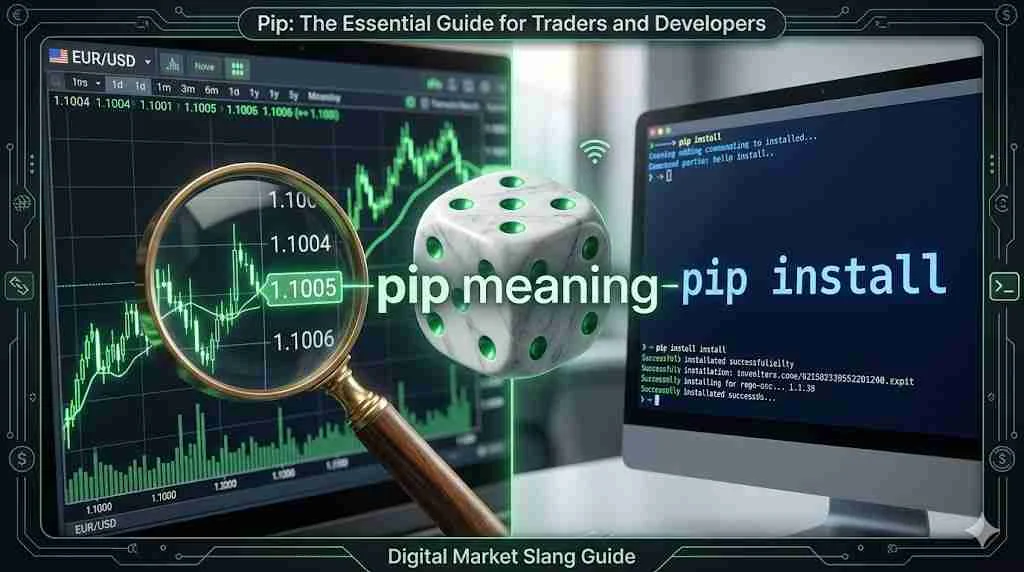

A pip (Percentage in Point) is the smallest standard price move in forex trading, typically 0.0001 for most currency pairs. For Python programmers, pip is a command-line tool that installs packages – type
pip installto add libraries instantly.
A pip acts like the heartbeat of a currency pair. Tiny but telling. You blink and miss one. But over hours, those heartbeats decide whether a trade makes money or loses it.
Yet here’s the twist. The word “pip” doesn’t mean the same thing to everyone.
Ask a forex trader. They’ll say Percentage in Point. Ask a Python developer. They’ll tell you Pip Installs Packages. Ask a board game fan. They’ll show you the little dots on a die.
This guide covers every real meaning. No dictionary fluff about fruit seeds. Just the definitions you actually searched for.
You’ll learn the primary pip meaning in trading first. Then the slang. Then the dice. Finally the software version. Each section gives you examples, tables, and calculations you can use today.
What Does Pip Mean in Trading?
Let’s start where most people land. The financial markets.
In forex, pip stands for Percentage in Point. Some traders also call it Price Interest Point. Both mean the same thing: the smallest standard price move a currency pair can make.
Most pairs use four decimal places. So one pip equals 0.0001.
But there’s an exception. Any pair with the Japanese Yen (JPY) uses two decimal places. There, one pip equals 0.01.
Why does this matter? Because brokers quote prices differently. If you don’t know where the pip sits, you can’t calculate profit or loss.
Here’s a quick reference table:
| Currency Pair | Decimal Places | One Pip Move |
|---|---|---|
| EUR/USD | 4 | 0.0001 |
| GBP/USD | 4 | 0.0001 |
| USD/CHF | 4 | 0.0001 |
| USD/JPY | 2 | 0.01 |
| GBP/JPY | 2 | 0.01 |
Example time. EUR/USD moves from 1.1050 to 1.1051. That’s one pip. Just one tiny step up.
Now imagine USD/JPY moving from 110.25 to 110.26. Also one pip. But notice the decimal difference. Same concept, different scale.
Traders love pips because they’re universal. A trader in London and a trader in Tokyo both count the same way. Points aren’t universal. One point could be a dollar in stocks but ten dollars in futures. Pips remove that confusion.
Think of pips like inches on a ruler. You don’t measure a room in miles. You don’t measure currency moves in raw dollars. You use pips.
Percentage in Point vs Price Interest Point
You’ll see both expansions online. Which one is correct?
Both. But Percentage in Point shows up more often in official forex education. It makes sense mathematically. A pip represents a tiny percentage of the quoted currency.
Price Interest Point is older. Some veteran traders prefer it. But the industry leans toward Percentage in Point.
Don’t stress over this. No broker will quiz you. Just know that both refer to the same 0.0001 move.
How to Calculate a Pip Value
Knowing what a pip is doesn’t help unless you know what it’s worth. One pip on a tiny trade might be 10 cents. One pip on a large trade could be $100.
The formula is simple:
Pip value = (1 pip / exchange rate) * trade size
Let’s break that down.
Example 1: EUR/USD
- Trade size: 1 standard lot (100,000 units)
- Exchange rate: 1.1050
- 1 pip = 0.0001
(0.0001 / 1.1050) * 100,000 = $9.05 per pip
So if EUR/USD moves 10 pips in your favor, you make $90.50. If it moves against you, you lose the same.
Example 2: USD/JPY
- Trade size: 1 standard lot (100,000 units)
- Exchange rate: 110.25
- 1 pip = 0.01
(0.01 / 110.25) * 100,000 = $9.07 per pip
See the pattern? Pip values hover around $9 to $10 for standard lots.
What about smaller trade sizes? Here’s a clean table:
| Lot Type | Units | Pip Value (EUR/USD at 1.1050) |
|---|---|---|
| Standard | 100,000 | $9.05 |
| Mini | 10,000 | $0.91 |
| Micro | 1,000 | $0.09 |
Pro tip: Most brokers now use fractional pips or pipettes. That’s a fifth decimal place. So you’ll see EUR/USD quoted as 1.10505. The last digit (5) is a pipette. Ten pipettes make one full pip.
Why do brokers do this? Tighter spreads. They can offer 0.8 pip spreads instead of a full 1 pip. That saves you money on every trade.
Pip Movement in Action
Let’s walk through a real trade.
You buy EUR/USD at 1.1050. You place a take-profit at 1.1070. That’s a 20-pip target.
You place a stop-loss at 1.1030. That’s a 20-pip risk.
Your trade size is one mini lot (10,000 units). Pip value = $0.91.
If price hits your take-profit: 20 pips * $0.91 = **$18.20 profit**
If price hits your stop-loss: 20 pips * $0.91 = **$18.20 loss**
See how clean that is? No complex math. Just pips times value.
Why traders love this system. You can focus on the number of pips first. Then calculate the dollar value second. It separates strategy from money management.
Pip vs Point vs Tick | The Confusion Killer
New traders mix these up constantly. Don’t be that person.
Pip: 0.0001 in forex. Used only for currency pairs.
Point: Varies by market. In stocks, 1 point equals $1. So Apple moving from $175 to $176 is a one-point move. In futures, a point might be much larger. S&P 500 futures move in quarter-point increments (0.25).
Tick: The smallest possible price movement of a futures contract. Often smaller than a point. For E-mini S&P 500 futures, one tick is 0.25 points.
Here’s a comparison table:
| Term | Market | Size | Real Example |
|---|---|---|---|
| Pip | Forex | 0.0001 | EUR/USD 1.1050 → 1.1051 |
| Point | Stocks | $1.00 | Tesla $250 → $251 |
| Tick | Futures | 0.25 (ES) | S&P 500 futures 4500.00 → 4500.25 |
Never use these interchangeably. Brokers love when you do because you’ll miscalculate your risk. A 10-point stop in stocks is a $10 risk. A 10-pip stop in forex could be $90. Huge difference.
Why Pips Matter for Risk Management
Here’s where most beginner traders fail. They focus on winning or losing. They don’t focus on how much they risk per pip.
Stop losses in pips. Let’s say you set a 20-pip stop on EUR/USD with a mini lot. That’s roughly $18 risk. You can handle that. But if you set a 100-pip stop, that’s $90 risk. Same trade size, very different outcome.
Position sizing using pips. This is the pro move.
Formula: Position size = Risk amount / (stop loss in pips * pip value)
Example:
- You risk $100 total on the trade
- Your stop loss is 25 pips
- Pip value for a mini lot = $0.91
100 / (25 * 0.91) = 4.39 mini lots
Round down to 4 mini lots. That keeps your risk under $100.
Without this math, you’re guessing. Guessing leads to blown accounts.
“Ignore pips and you ignore your profit and loss. Calculate your pip value before you place any trade.”
Spread Measured in Pips
The spread is the difference between the bid price (what you sell at) and the ask price (what you buy at). Brokers measure spreads in pips.
A tight spread might be 0.5 to 1 pip on EUR/USD during London trading hours. A wide spread could be 10+ pips on an exotic pair like USD/TRY.
Why this matters. You pay the spread every time you enter and exit a trade. If the spread is 2 pips and your target is 10 pips, you’ve already lost 20% of your potential profit before the trade starts.
Check your broker’s average spreads before opening an account. Lower is almost always better for day traders.
Pip Slang Meaning (British English)
Not every pip lives on a price chart.
In British slang, calling someone “a pip” means they’re charming, amusing, or pleasantly odd. It’s old-fashioned. You won’t hear it in London clubs. But you’ll find it in British novels and period dramas.
Example: “That little girl is a real pip. She told the funniest joke at dinner.”
Zero connection to forex. Zero connection to trading. But search engines show this meaning often enough that we have to mention it.
Some older Americans also use this phrase. My grandmother used to say, “Oh, he’s a pip!” about a funny uncle. It’s not an insult. It’s a warm, quirky compliment.
Dice Pip Meaning
Pull out a standard six-sided die. Those tiny white dots on each face? Those are pips.
Each dot equals one pip. So a die showing three dots has three pips. A die showing five dots has five pips.
Board game enthusiasts use this term daily. “Roll a six-pip” means roll a six. “Move four pips” means move four spaces.
Fun fact: Dice pips follow a specific arrangement. Opposite sides always add up to seven. One opposite six. Two opposite five. Three opposite four. That pattern creates balanced randomness.
Gamblers, Dungeons & Dragons players, and craps dealers all use dice pips. But they rarely call them “pips” out loud. They just say dots or numbers. The term lives more in rulebooks than at the table.
Pip in Python
Now for the coders in the room.
In Python programming, pip stands for Pip Installs Packages. Yes, that’s a recursive acronym. Programmers love those.
Pip is a command-line tool. It downloads and installs Python packages from the Python Package Index (PyPI). Think of PyPI like an app store for code.
Common pip commands:
bash
pip install requests
This downloads the Requests library. Now you can use it in your Python script.
bash
pip list
Shows every package you have installed.
bash
pip uninstall numpy
Removes the NumPy library from your system.
bash
pip install pandas==1.5.0
Installs a specific version of Pandas. Not the latest one. Version 1.5.0 exactly.
bash
pip freeze > requirements.txt
Creates a snapshot of all your installed packages. Other developers can use that file to replicate your environment.
Why did they name it pip? The original Python package installer was called easy_install. It had problems. A new tool emerged called pip. The name stuck. Later, someone joked it stood for “Pip Installs Packages.” The community adopted that as the official backronym.
Today, pip comes bundled with Python 3.4 and later. You don’t install it separately. Just open a terminal and type pip.
Real-world analogy: Imagine you’re building a house. You need bricks, wood, and nails. Pip is the delivery truck. It fetches exactly what you need from the warehouse (PyPI) and puts it in your workshop (your project folder).
Over 400,000 packages live on PyPI. Pip can install any of them in seconds. That’s why Python dominates data science, web development, and automation. The ecosystem is massive, and pip unlocks it.
Quick Comparison | Financial Pip vs Python Pip
| Feature | Forex Pip | Python Pip |
|---|---|---|
| Full form | Percentage in Point | Pip Installs Packages |
| Industry | Finance / Trading | Software Development |
| Function | Measures price movement | Installs code libraries |
| Example | EUR/USD moves 15 pips | pip install flask |
| Common user | Forex trader | Programmer |
These two meanings never overlap. A trader won’t type pip install into MetaTrader. A coder won’t calculate pip value in Jupyter Notebook. But search engines see both. So we cover both.
Pip Calculation Examples for Beginners
Let’s walk through three real scenarios. No theory. Just numbers.
Scenario 1: You win a trade
- Pair: GBP/USD
- Entry: 1.3000
- Exit: 1.3025
- Difference: 25 pips
- Trade size: 1 mini lot (10,000 units)
- Pip value at entry: ~$0.77 (since GBP/USD rate changes the math)
25 pips * $0.77 = $19.25 profit
Scenario 2: You lose a trade
- Pair: USD/CAD
- Entry: 1.3500
- Stop loss triggered: 1.3460
- Difference: 40 pips against you
- Trade size: 0.5 mini lots (5,000 units)
- Pip value: roughly $0.37 per pip
40 * $0.37 = $14.80 loss
Scenario 3: You hold over a news event
- Pair: USD/JPY
- Bank of Japan announces a surprise rate change
- Price jumps 80 pips in 30 seconds
- Trade size: 2 mini lots (20,000 units)
- Pip value at that moment: ~$1.81 per pip
80 * $1.81 = $144.80 profit if you were positioned correctly
See how pips turn into real dollars? The math is simple. The discipline to calculate before each trade is what separates pros from amateurs.
Pipettes | The Fifth Decimal
Modern brokers quote prices with five decimal places for most pairs. That final digit is a pipette.
Example: EUR/USD 1.10505
- 1.1050 is the pip value
- The last 5 is a pipette
- Ten pipettes = one full pip
Why use pipettes? Spreads. A broker can offer a 0.8 pip spread instead of 1 full pip. That means you pay less to enter and exit trades.
For JPY pairs, pipettes live at the third decimal. USD/JPY 110.255 means 110.25 is the pip, and the final 5 is a pipette.
Most traders ignore pipettes for profit calculations. But they matter for spread costs. Over hundreds of trades, those fractions add up.
Lot Size and Pip Value Relationship
Lots and pips work together like gallons and miles per gallon.
- Standard lot = 100,000 units = $10 per pip (approx)
- Mini lot = 10,000 units = $1 per pip (approx)
- Micro lot = 1,000 units = $0.10 per pip (approx)
- Nano lot = 100 units = $0.01 per pip (rare, but some brokers offer it)
If you have a $500 account, trading standard lots is insane. A 50-pip move against you wipes out your entire account. Start with micro lots. Build up slowly.
If you have a $50,000 account, micro lots are too small. You’d need 500 pips to make a meaningful return. Use mini or standard lots instead.
Match your lot size to your account size. That’s the golden rule.
Why Beginners Misunderstand Pip Meaning
Three reasons.
First, they think all markets use the same terminology. Stocks use points. Forex uses pips. Futures use ticks. Each market evolved separately. Learn each system on its own.
Second, they ignore the JPY exception. They calculate USD/JPY as 0.0001 per pip and wonder why their numbers are wrong. Always check the pair before you calculate.
Third, they confuse pip value with pip movement. A 10-pip move on EUR/USD with a micro lot is $0.90. A 10-pip move on GBP/JPY with a standard lot could be $80. The movement is the same. The value is wildly different.
Read that last paragraph twice. It’s the most common mistake in forex.
Pip Calculators | Use Them or Lose Money
You can do the math by hand. But why risk a decimal error?
Free pip calculators exist everywhere. Most forex brokers include one in their trading platform. MetaTrader 4 and 5 have built-in pip value displays.
What to input:
- Currency pair
- Account currency (USD, EUR, GBP, etc.)
- Trade size in lots
- Current exchange rate (auto-fills on most tools)
What you get:
- Pip value in your account currency
- Value per pip move
- Sometimes a risk calculator too
Use a pip calculator before every trade. Even the pros do it. Especially the pros do it.
Pip Meaning in Other Contexts
These show up in search data but aren’t worth a full section.
Pip as a seed. Apple pips. Orange pips. That’s the original Latin meaning. “Pip” comes from “pippin,” meaning a seed. But unless you’re a botanist or writing a mystery novel (looking at you, Sherlock Holmes), you won’t use this.
Pip as a character name. Pip from Great Expectations by Charles Dickens. Pip from the animated movie Pip about a puppy. Common nickname for Philip or Pippa.
Pip as a sound effect. “The little clock went pip pip pip.” British English for a high-pitched beep.
None of these will help you trade or code. But now you know.
FAQs
How much is one pip worth in dollars?
Depends on your trade size.
- Standard lot (100,000 units) = ~$10 per pip
- Mini lot (10,000 units) = ~$1 per pip
- Micro lot (1,000 units) = ~$0.10 per pip
These numbers shift slightly based on the exchange rate. But $10 per standard lot is a safe rule of thumb for USD-based pairs.
Can pip values change during a trade?
Yes. If you trade USD/JPY and the dollar weakens dramatically, your pip value changes. The formula uses the current exchange rate. Rates move constantly. So pip value moves too.
What’s a pip in cryptocurrency trading?
No universal standard. Some crypto exchanges copied forex. There, 1 pip = 0.0001 BTC/USD. Others use “points” or “ticks.” Check your exchange’s glossary before trading crypto. Don’t assume they follow forex rules.
Is pip the same as a basis point?
No. A basis point is 0.01% (0.0001 in decimal). That looks similar to a pip. But basis points apply to interest rates and bond yields. Pips apply to currency prices. A 25 basis point rate hike by the Federal Reserve moves bond markets. A 25 pip move in EUR/USD moves forex markets. Different tools for different jobs.
What does pip mean in texting or social media?
Usually nothing. Occasionally, someone uses “pip” as a cute abbreviation for “person in picture.” That’s rare. Most likely, they mean the forex or coding definition.
Do all forex brokers use the same pip size?
Most do. But some brokers advertise “zero pip spreads” or “fractional pip pricing.” Always check their product disclosure. A few outliers still use 5-digit quoting as full pips. Those brokers confuse beginners. Avoid them.
Conclusion
Pip meaning changes with context. But two definitions dominate.
For financial traders, a pip is Percentage in Point – 0.0001 for most currency pairs. It measures price movement, calculates profit and loss, and manages risk. Master pip value before you trade real money.
For Python developers, pip is Pip Installs Packages – the command-line tool that fetches libraries from PyPI. Type pip install once and unlock thousands of open-source packages.
The slang and dice meanings exist. You’ll see them in crosswords and old books. But they’re not why you came here.
Next steps:
- If you trade, open your broker’s platform right now. Find the pip value display. Practice calculating risk on a demo account.
- If you code, open your terminal. Run
pip list. See what packages you already have. Then trypip install cowsayfor a silly demo. - If you’re just curious, you’re done. You now know more about pips than 90% of casual searchers.
Pips are small. But they add up. One pip won’t make you rich. Ten thousand pips might. Respect the tiny unit. It holds more power than you think.
Discover More Related Articles:
- “Medusa Tattoo” Meaning: Symbolism & Cultural Significance In 2026
- “IIRC” Meaning: What It Stands For, How to Use It & When It Sounds Right In 2026
- “Sigma” Meaning Slang: Why Everyone Is Talking About Sigma Personality In 2026