
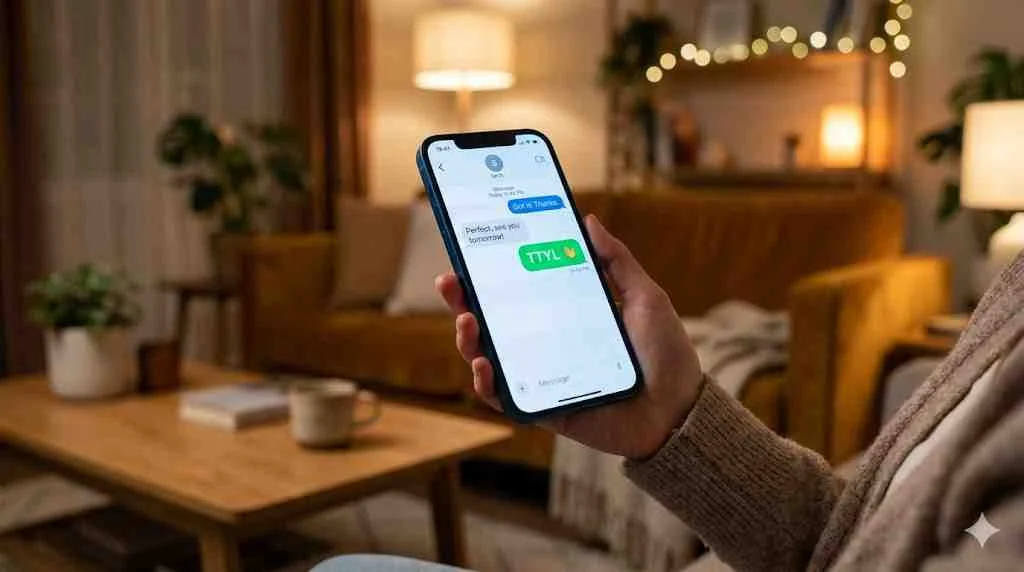

TTYL stands for “Talk to you later.” It’s a casual texting acronym people use to end a chat warmly without promising an exact return time. You’ll see it in WhatsApp, Instagram DMs, SMS, and group messages whenever someone wants a friendly, open‑ended goodbye.
You’ve seen it a million times. A friend ends a chat with “ttyl.” Your group chat goes quiet after someone types it. Maybe you’ve even used it yourself without thinking twice.
But what does TTYL really mean?
Is it a promise to talk again? A polite way to escape a boring conversation? Or just another piece of internet slang that stuck around longer than anyone expected?
Let’s find out.
What Does TTYL Mean?
Here’s the short answer.
TTYL stands for “Talk to you later.”
That’s the TTYL full form. Four words packed into four letters. People use it to end a conversation in text, chat, or instant messaging. It signals a friendly goodbye without shutting the door completely.
Unlike “goodbye,” which can sound final, or “see ya later,” which feels a bit vague, TTYL carries a specific tone. It says: I’m done talking for now, but I’m not mad, and we’ll probably chat again soon.
You’ll find the TTYL meaning in chat apps like WhatsApp, Instagram DMs, Snapchat, and even old-school SMS. It’s a staple of casual texting language.
Quick comparison table:
| Slang | Full Form | When to Use |
|---|---|---|
| TTYL | Talk to you later | Ending a casual chat warmly |
| BRB | Be right back | Stepping away for a few minutes |
| GTG | Got to go | Leaving quickly, less warm |
| CYA | See ya | Very casual, sometimes playful |
| TTFN | Ta-ta for now | Older slang, more whimsical |
So when someone asks, “What is TTYL in texting?” you can answer with confidence: it’s a friendly, open-ended goodbye.
A Quick Look Back | Where Did TTYL Come From?
The TTYL abbreviation didn’t appear yesterday. It actually traces back to the early days of internet chat rooms.
Think AOL Instant Messenger (AIM). Think IRC channels. And think MSN Messenger and Yahoo Chat. Back in the late 1990s and early 2000s, typing speed mattered. Everyone wanted to send messages faster. So acronyms exploded.
TTYL became popular because it solved a real problem. People needed a polite way to log off. Saying “Goodbye” felt stiff. Typing “I have to go now, but I will speak with you at another time” took forever. TTYL fixed both issues.
From there, it jumped to SMS texting. Then to smartphones. Then to every major chat platform we use today.
Here’s a fun fact: TTYL was so common in early 2000s teen culture that it appeared in TV shows, song lyrics, and even school yearbooks. It wasn’t just slang. It was a cultural marker.
Today, the TTYL slang meaning hasn’t changed much. The context has just expanded. Now your boss might ironically use it on Slack. Your mom might type it without knowing what it stands for. And teens still use it daily, sometimes without even thinking.
How People Actually Use TTYL Meaning in Chat
Let’s get specific. Theory is fine, but real usage tells the real story.
The TTYL meaning in chat changes slightly depending on who you’re talking to and where. Below are real-world examples broken down by platform and relationship.
TTYL Meaning in Text (SMS / iMessage)
In standard text messaging, TTYL signals a natural end to a conversation.
Example 1:
“Hey, dinner’s ready. Gotta run. ttyl!”
What it really means: I enjoyed this chat, but real life is calling. Let’s pause here.
Example 2:
“Not sure when I’ll be free again. ttyl for now.”
What it really means: I’m busy or overwhelmed, but I’m not ghosting you.
In both cases, the speaker leaves room for future contact. No hard feelings. No pressure.
TTYL Meaning in Chat (WhatsApp, Messenger)
Group chats love TTYL. One person says it, and others follow.
Example:
Person A: “Alright, I’m heading out. ttyl everyone”
Person B: “ttyl”
Person C: “👋 ttyl”
What it really means: I’m exiting the group conversation politely. No need for individual goodbyes.
This works especially well in large family chats or friend groups where saying goodbye to each person separately would take forever.
TTYL on Instagram and Snapchat
On platforms built for quick, visual communication, TTYL plays a different role. It often appears after a rapid back-and-forth exchange.
Example (Instagram DM):
“Haha that meme killed me 💀 ttyl!”
What it really means: That was fun. I’m logging off now, but I’ll catch your stories later.
On Snapchat, you might see TTYL sent as a text overlay on a selfie. The person waves or smiles. The message feels warmer than a plain “bye.”
Ironic TTYL Usage at Work (Slack, Teams)
Here’s where things get interesting. Adults now use TTYL humorously in professional settings.
Example (Slack public channel):
“Meeting starts in 2 minutes. ttyl 😅”
What it really means: I’m joking. We’re about to sit in the same room. But I’m pretending this is casual chat.
Using TTYL at work signals familiarity. It says: We’re not that formal here, and I trust you to get the joke.
But be careful. Using TTYL with a senior executive or a new client could backfire. Context matters.
TTYL vs Similar Slang | A No-Confusion Guide
People mix up texting acronyms all the time. Let’s clear that up.
Below is a practical breakdown of TTYL and its closest cousins.
TTYL vs BRB
- TTYL means you’re leaving the conversation entirely for a while. Hours? A day? Unclear.
- BRB means you’ll return in minutes. Bathroom break. Coffee run. Short pause.
Example:
“BRB, doorbell” → Back in 60 seconds.
“ttyl, got class” → See you after class or tomorrow.
TTYL vs GTG
GTG stands for “Got to go.” It’s more abrupt than TTYL.
- GTG sounds rushed. You might use it when someone catches you off guard.
- TTYL sounds planned. You’re ending the chat on your own terms.
Example:
“Sorry, my mom is yelling. GTG.”
Versus
“Anyway, good talking. ttyl!”
The first one feels like an emergency exit. The second feels like a normal closing.
TTYL vs CYA
CYA means “See ya.” It’s short, punchy, and very casual.
- CYA works best with close friends. It can sound a little flippant.
- TTYL works with more people. Even acquaintances.
Example:
“CYA at practice” → Very relaxed.
“ttyl, take care” → A bit warmer, slightly more thoughtful.
TTYL vs TTFN
TTFN means “Ta-ta for now.” Tigger from Winnie the Pooh made it famous.
- TTFN sounds playful or old-fashioned.
- TTYL sounds neutral and modern.
You probably won’t use TTFN unless you’re being ironic or quoting something. Stick with TTYL for everyday chat.
Quick reference table:
| Acronym | Full Form | Vibe | Best For |
|---|---|---|---|
| TTYL | Talk to you later | Warm, open-ended | Friends, family, casual chats |
| BRB | Be right back | Short pause | During active conversation |
| GTG | Got to go | Rushed exit | Sudden interruptions |
| CYA | See ya | Very casual, playful | Close friends only |
| TTFN | Ta-ta for now | Whimsical, dated | Ironic or nostalgic use |
When NOT to Use TTYL
Just because you can use TTYL doesn’t mean you should. Smart communicators know when to put certain slang away.
Here are four situations where the TTYL meaning in chat works against you.
1. After a Serious or Emotional Conversation
Imagine someone just shared difficult news. They opened up about a loss, a breakup, or a health scare.
Now imagine replying: “ttyl”
That feels terrible, right? Because it is.
TTYL belongs to light, low-stakes chats. Using it after something heavy makes you look dismissive. Even if you don’t mean it that way.
Better alternative: “I’m here if you need to talk more. Talk soon.”
2. In Professional Settings (Unless You’re Very Close)
Most workplaces still expect a baseline of professionalism. Even relaxed startups have limits.
Sending “ttyl” to your boss after a project update seems off. Sending it to a client would be outright strange.
Better alternative: “Thanks for your time. Speak with you later.”
Save TTYL for colleagues you message daily about non-urgent things. And even then, read the room first.
3. To End a Fight or Disagreement
Arguments don’t end well with TTYL.
The other person will likely read it as: I’m done with this conversation, and I don’t care enough to resolve it.
That’s probably not what you intend. But that’s how it lands.
Better alternative: “Let’s take a break and talk again when we’re both calmer.”
4. When You Actually Mean Goodbye Forever
TTYL promises a future conversation. Even if it’s a soft promise, it’s still a promise.
If you know you won’t talk to someone again, don’t use TTYL. That’s misleading. It creates false hope or confusion.
Better alternative: “Take care of yourself.” Or say nothing at all.
Real-world analogy:
Using TTYL in the wrong moment is like waving cheerfully at a funeral. The gesture itself isn’t bad. But the timing ruins everything.
Why TTYL Endures
You’d think TTYL would have died by now. After all, we have better tools. Voice messages. Video calls. Reaction GIFs. Emojis that cry, laugh, or explode.
So why is the TTYL meaning in text still relevant?
Three big reasons.
Reason 1: Speed and Convenience
Typing “Talk to you later” takes effort. TTYL takes less than a second. On a tiny keyboard, with autocorrect fighting you, every letter saved matters.
People don’t want friction. TTYL removes it.
Reason 2: Tone Neutrality
Here’s something surprising: TTYL carries almost no emotional baggage.
“Goodbye” can sound sad. “See ya” can sound cold. “Take care” can sound overly serious.
TTYL just sounds… fine. Friendly enough. Not too warm. Not too cold. It’s the Goldilocks of chat goodbyes.
Reason 3: Cross-Generational Appeal
Teens use TTYL. So do millennials. So do many Gen Xers who adopted early internet slang.
That’s rare. Most slang dies within a single generation. “Groovy,” “rad,” “fly” — all faded. TTYL stuck because it’s useful, not just trendy.
Even parents who barely understand texting know what TTYL means. That alone is a minor miracle.
Common Misunderstandings About TTYL Meaning
Let’s bust a few myths. These misconceptions pop up all the time.
Misunderstanding 1: “TTYL means I don’t want to talk again.”
False.
Most people use TTYL precisely because they do want to talk again. It’s a warm exit, not a cold shoulder.
If someone wants to end contact, they’ll just stop replying. That’s ghosting. TTYL is the opposite of ghosting.
Misunderstanding 2: “TTYL is outdated. No one uses it anymore.”
False.
Check any current list of common texting acronyms. TTYL still appears. It may not trend on TikTok, but it shows up constantly in private messages.
Just because something isn’t new doesn’t mean it’s dead. People still say “thanks” and “please.” Those aren’t outdated either.
Misunderstanding 3: “TTYL is only for teenagers.”
False.
Teenagers use it, yes. But so do adults in casual settings. The difference is frequency. Teens might use it daily. Adults might use it weekly. Either way, it’s alive and well.
Misunderstanding 4: “You have to actually talk later if you say TTYL.”
False.
This one trips people up. TTYL is a social lubricant, not a binding contract.
You don’t owe someone a future conversation just because you typed four letters. Most people forget they even said it. It’s a habit, not a promise.
Think of it like saying “see you later” to a cashier. You don’t actually plan to see them later. It’s just polite.
TTYL Meaning in Different Contexts
Here’s a handy guide. Bookmark it. Screenshot it. Share it with a confused friend.
| Context | What TTYL Really Implies |
|---|---|
| Close friends texting | “Let’s pick this up later. Love you, bye.” |
| Casual acquaintances | “This was nice. I’m done for now.” |
| Dating app chat | “I’m interested but busy. Don’t overthink it.” |
| Family group chat | “Love you all. I’m logging off.” |
| Online gaming | “Good game. I’m done playing.” |
| Work Slack (ironic) | “This meeting could’ve been an email. 😅” |
| Customer support chat | (Don’t use this. Ever.) |
| Classroom Discord | “Class is starting. Talk after.” |
| Facebook Messenger | Neutral, friendly exit. Works anywhere. |
Notice a pattern? TTYL works best when the stakes are low and the relationship is solid.
How to Respond When Someone Says TTYL
You don’t have to overthink your reply. Most people don’t expect anything fancy.
Here are natural responses, ranked by effort.
Low effort (totally fine):
- “ttyl”
- “👋”
- “k” (only if you’re very close)
Medium effort (warmer):
- “ttyl, take care”
- “Later!”
- “Sounds good, ttyl”
Higher effort (extra thoughtful):
- “ttyl! Text me when you’re free”
- “Talk soon. Have a good one”
- “ttyl, let’s catch up properly this weekend”
Match your response to the relationship. Don’t send a paragraph to someone who barely types full sentences.
Fun Facts About TTYL You Probably Didn’t Know
Let’s lighten things up. Here are some genuinely interesting tidbits.
- TTYL appeared in the Oxford English Dictionary in 2011. That’s when slang becomes official.
- A 2004 study on teen texting found TTYL in the top 10 most common acronyms. Twenty years later, it still ranks.
- Some parents use TTYL wrong. They think it means “type to you later” or “talk tomorrow, you loser” (no, really).
- There’s a song called “TTYLXOX” by Bella Thorne. The XOX means hugs and kisses. The song peaked at number 97 on the Billboard charts.
- You can say TTYL out loud. People will laugh, but you can. “Tee-tee-why-ell” sounds ridiculous, and that’s part of the fun.
TTYL vs Other Goodbye Slang from Different Eras
Language changes fast. Here’s how TTYL stacks up against other farewell slang from the last few decades.
| Era | Slang Goodbye | Meaning | Still Used? |
|---|---|---|---|
| 1990s | Later skater | Playful, surfer-adjacent | Rarely |
| 1990s–2000s | TTYL | Talk to you later | Yes |
| 2000s | Catch you on the flip side | Very casual, a bit long | Sometimes (ironic) |
| 2010s | Bye Felicia | Dismissive, pop culture reference | Yes (as a joke) |
| 2020s | Slay later | Very online, very extra | Rare |
TTYL wins for longevity. It’s not the coolest or the edgiest. But it’s the most dependable.
How to Teach TTYL Meaning to Someone Who Doesn’t Text Much
Maybe you’re reading this because a parent, grandparent, or coworker asked you: “What does TTYL mean?”
Here’s a simple script.
Say this:
“TTYL stands for ‘Talk to you later.’ People type it at the end of a text or chat when they want to end the conversation nicely. It’s like saying ‘bye for now’ but faster. You don’t have to actually talk later. It’s just polite.”
Then show an example:
Open your phone. Type: “Dinner’s ready. ttyl!”
Let them see it in action.
Finally, practice together:
Ask them to send you a practice text ending with TTYL. When you get it, reply warmly. “Great job! That’s exactly right.”
Most people learn slang best by doing, not by reading definitions.
TTYL Meaning in Pop Culture
TTYL pops up more often than you’d think.
- In the movie “Juno” (2007), characters use TTYL naturally in texting scenes.
- On “iCarly” (2007–2012), TTYL appears in episode titles and dialogue.
- In the song “TTYL” by Loona (2018) , the acronym carries a flirty, friendly tone.
- On “RuPaul’s Drag Race” , queens have used TTYL as a catchphrase when leaving the workroom.
Pop culture keeps TTYL alive. Every new mention introduces it to another generation.
FAQs
Is TTYL rude?
No. Not usually. TTYL is considered polite and friendly in most casual contexts. The only time it feels rude is after a serious conversation or during a disagreement.
Can I say TTYL out loud?
You can. People will likely smile or laugh because it sounds silly. But it’s perfectly understandable. Just don’t use it in a job interview.
What’s the difference between TTYL and TTFN?
TTYL is modern and neutral. TTFN is older and more playful. TTFN sounds like something a cartoon character would say. Stick with TTYL for everyday use.
Do adults actually use TTYL?
Yes. Adults in their 30s and 40s who grew up with early internet slang still use TTYL regularly. Adults older than that may recognize it but rarely type it themselves.
What does TTYL mean on Snapchat?
Same as everywhere else: “Talk to you later.” On Snapchat, people often pair TTYL with a waving selfie or a casual snap of their surroundings.
Is TTYL only for texting?
No. You’ll also see it in online games, forum comments, Discord servers, and even some email sign-offs (very informal ones).
What does TTYL mean from a girl vs a guy?
Nothing different. TTYL doesn’t carry gender-specific meaning. It reads the same regardless of who types it.
Should I use TTYL with my boss?
Probably not. Unless your boss regularly uses casual slang with you, skip it. Stick with “Talk to you later” or “Thanks, bye for now.”
Conclusion
TTYL isn’t just random internet junk. It’s a clever little tool that helps millions of people end conversations every single day without awkwardness or pressure.
Use it when you want to be friendly but brief. Avoid it when things get heavy or professional. That’s the whole secret. Now go text with confidence. ttyl 👋
Discover More Related Articles:
- “JOI” Meaning Slang: How It’s Used in Online Conversations In 2026
- “ISO” Meaning Slang: From Online Posts to Marketplace Use In 2026
- “PTSO” Meaning Slang: How to Use It & Real-Life Examples In 2026