
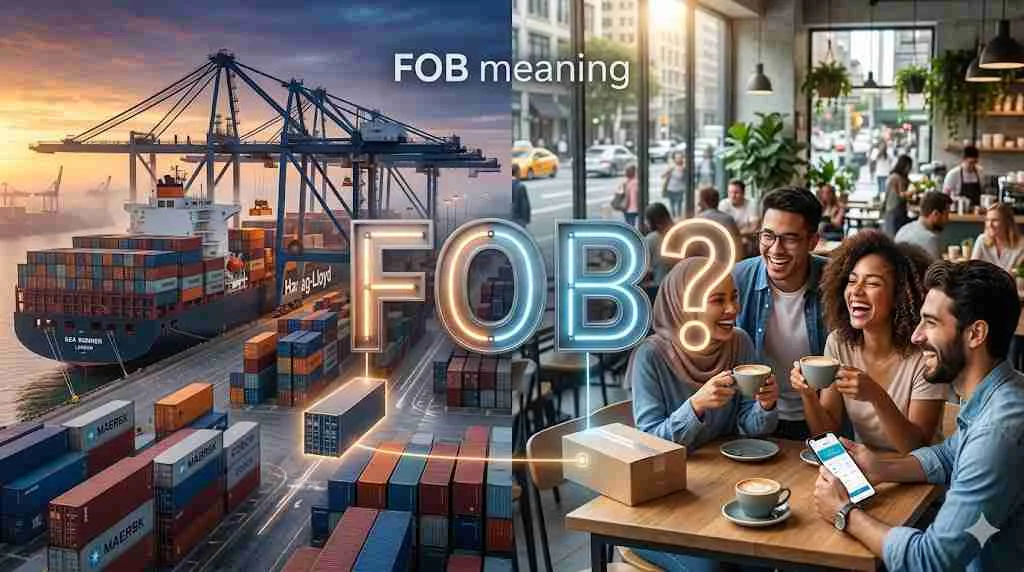

FOB stands for two very different things: Free On Board in shipping (seller loads goods onto a vessel, then buyer assumes all risk and freight costs) or Fresh Off the Boat in slang (a sometimes derogatory, sometimes reclaimed term for recent immigrants). Context is everything mix them up and you could botch a contract or offend someone.
You just saw “FOB” on a shipping invoice. Or maybe you heard someone call a coworker “FOB” under their breath. Two totally different worlds use the same four letters. One gets goods across oceans. The other describes people crossing borders.
So which meaning do you need right now?
Let’s clear this up once and for all.
What FOB Actually Stands For
FOB has two completely separate expansions. Neither is wrong. Context is the only thing that matters.
In global trade and logistics: Free On Board
In casual speech and pop culture: Fresh Off the Boat
A freight forwarder uses the first one daily. A teenager on TikTok might use the second one without ever touching a shipping manifest.
This guide breaks down both meanings in brutal detail. You’ll learn exactly when to use each one, how to spot the difference, and why mixing them up can cost you money or embarrass you in conversation.
Free On Board | The Shipping Powerhouse
Let’s start with the heavy hitter. Free On Board appears on millions of contracts every single year.
The Real FOB Full Form in Trade
Free On Board is an official Incoterm. The International Chamber of Commerce (ICC) created and maintains these rules. The latest version is Incoterms 2020.
Here’s what Free On Board actually means: the seller delivers goods onto a vessel chosen by the buyer. Once those goods cross the ship’s rail (or get loaded onboard under current rules), the buyer assumes all risk.
Simple on paper. Messy in real life.
How FOB Works in Real Shipping
Imagine you run a bicycle company in Chicago. You order 2,000 bike frames from a factory in Ho Chi Minh City. Your contract says FOB Ho Chi Minh port.
Step by step, here’s what happens:
The Vietnamese factory packs every frame into export-ready cartons. They truck the cartons to the port. They pay for export customs clearance. And they lift each carton onto the ship you selected.
The moment the last carton touches the ship’s deck, your risk begins. If a crane drops that carton into the water two seconds later? Your loss. Not the factory’s.
That feels scary. But FOB also gives you control. You choose the shipping line. And you negotiate the freight rate. You decide on marine insurance.
FOB Shipping Point vs FOB Destination | The Critical Difference
Most people mess this up. Don’t be most people.
These two FOB variants shift cost, risk, and ownership in very different ways.
| Aspect | FOB Shipping Point | FOB Destination |
|---|---|---|
| Risk transfer moment | When carrier picks up goods at seller’s dock | When goods arrive at buyer’s door |
| Who pays freight | Buyer pays all freight | Seller pays all freight |
| Ownership timing | Buyer owns goods during transit | Seller owns goods during transit |
| Insurance responsibility | Buyer must insure from origin | Seller should insure until delivery |
| Typical use case | Large buyers with logistics muscle | Retail buyers wanting simplicity |
FOB Shipping Point example: You buy 10,000 phone cases FOB Shipping Point from a Shenzhen supplier. The truck catches fire two miles from the factory. You just ate 10,000 melted phone cases. Your insurance better be good.
FOB Destination example: Same phone cases, but FOB Destination Los Angeles. Truck catches fire in Utah. Supplier eats the loss. You don’t lift a finger except to find another supplier.
Which one should you choose? If you have better shipping rates than your supplier, use FOB Shipping Point. If you want zero risk until products hit your dock, demand FOB Destination. But expect suppliers to charge you more for that privilege.
Who Pays What Under FOB?
Let’s break down every single cost.
Seller pays for:
- Export packaging
- Inland transport to named port
- Loading charges at origin port
- Export customs clearance
- Proof of delivery documentation
Buyer pays for:
- Main ocean or air freight
- Marine insurance (strongly recommended)
- Unloading at destination port
- Import customs clearance
- Duties and taxes
- Final transport to buyer’s warehouse
- Any demurrage or detention fees
A 2023 logistics industry survey found that 68% of small importers underestimate post-FOB costs by at least 30%. Don’t be in that 68%.
When Does Ownership Transfer Under FOB?
This question triggers endless arguments. Here’s the actual legal answer.
Under FOB Shipping Point: ownership transfers when the carrier signs the bill of lading at origin. That piece of paper matters more than physical possession.
Under FOB Destination: ownership transfers when the buyer signs the delivery receipt at their door.
Courts have ruled on this hundreds of times. The bill of lading is king. If you hold a “clean on board” bill of lading, you likely own the goods regardless of where they physically sit.
FOB vs CIF | Stop Getting These Wrong
CIF stands for Cost, Insurance, Freight. It’s FOB’s cousin but very different.
| Factor | FOB | CIF |
|---|---|---|
| Seller arranges main freight | No | Yes |
| Seller buys insurance | No | Yes (minimum coverage) |
| Risk transfer point | Origin port | Origin port (same as FOB) |
| Buyer control over shipping | Full control | Zero control |
| Typical price premium over FOB | Baseline | +15% to 25% |
| Best for | Experienced importers | First-time buyers |
Here’s the trap with CIF. The seller picks the shipping line. They often pick the cheapest, slowest option. They buy the bare minimum insurance. You pay a premium for convenience but lose control.
A veteran importer’s rule: use CIF for your first shipment. Use FOB for every shipment after that.
Real Numbers | What FOB Pricing Looks Like
FOB price never includes ocean freight. Let’s make that crystal clear.
A supplier quotes “$5.50 per unit FOB Ningbo.” That means $5.50 gets the product to the Ningbo port dock, cleared for export. Nothing more.
To get that product to Los Angeles, add:
- Ocean freight: $3,200 for a 20-foot container (2024 average spot rate)
- Insurance: $150 to $300 depending on value
- US customs clearance: $250 to $500
- Trucking to warehouse: $600 to $1,200
- Duties: Varies by product category (bike frames face 11% in 2024)
Total landed cost per unit changes completely. A $5.50 FOB price can become $9.20 landed. Always run these numbers before signing.
Fresh Off the Boat | The Slang Meaning
Now let’s switch gears completely.
FOB Meaning in Culture and Conversation
Fresh Off the Boat describes immigrants who seem newly arrived. The label often focuses on accents, clothing, food choices, or social behaviors perceived as “unassimilated.”
This term cuts both ways. Some people use it as an insult. Others wear it as a badge of pride.
The phrase emerged in the 1980s and 1990s within Asian American communities. It spread through high school hallways, college dorms, and comedy clubs.
Is FOB Slang Offensive or Not?
Straight answer: it depends on who says it and how.
Potentially offensive when:
- A non-immigrant uses it to mock someone’s accent or English skills
- Said with clear contempt or laughter at someone’s expense
- Used to exclude or belittle a person’s belonging
Neutral or reclaimed when:
- Immigrants use it to describe themselves jokingly
- Second-generation kids use it with affection about their parents
- Used in academic or sociological discussion without malice
The TV show Fresh Off the Boat (which ran for six seasons and 116 episodes) mainstreamed the term. Creator Eddie Huang titled his memoir the same way. That wasn’t an accident. He took the label and flipped it.
One survey of Asian American young adults found that 42% heard “FOB” used against them at least once. 28% said they now use it themselves casually with close friends.
Real-World Examples of FOB as Slang
“You pack a hot lunch again? That’s so FOB.”
“My mom still bargains at every store. Total FOB move but honestly she saves so much money.”
“I sounded super FOB when I first got here. Now my accent barely shows.”
“FOB or not, those homemade spring rolls beat cafeteria pizza any day.”
Notice how tone shifts everything. The same words can sting or bond.
How Immigrant Communities Actually Use This Term
Inside immigrant communities, FOB often works as shorthand for shared experience. It points to a specific kind of first-year struggle.
Things associated with the FOB label in community usage:
- Packing instant noodles for lunch
- Parents who work three jobs without complaint
- Not understanding sarcasm or slang for the first two years
- Getting scolded for not making eye contact (cultural difference)
- Explaining your name five times to every cashier
These aren’t insults from the inside. They’re battle scars worn openly.
How to Tell Which FOB Meaning Someone Intends
This table ends all confusion. Match what you see or hear to the context clues.
| Clue Category | Shipping Meaning | Slang Meaning |
|---|---|---|
| Surrounding words | incoterm, freight, bill of lading, port, container, vessel, truck, loading, delivery | accent, immigrant, fresh, new here, lunch, parents, English, arrived |
| Medium | Invoice, contract, logistics email, shipping instruction, commercial invoice | Conversation, group chat, comedy video, personal story, social media caption |
| Numbers present | Yes (prices, weights, container counts, dates) | Rarely |
| Geographic names | Port cities (Shanghai, Rotterdam, Long Beach) | Anywhere people gather |
| Tone | Neutral to formal | Casual, emotional, humorous, sometimes raw |
| Who typically uses | Logistics managers, buyers, freight forwarders, customs brokers | Friends, comedians, storytellers, second-gen kids |
One trick works almost every time. Ask yourself: does this sentence work if I replace “FOB” with “moved here recently”?
If yes → slang meaning. If that replacement breaks the sentence → shipping meaning.
Why Search Engines Struggle With FOB
FOB is a classic polysemous acronym. Same spelling. Different meanings. No context? No answer.
Google’s NLP systems scan the surrounding words. A page with “port,” “risk,” and “insurance” gets classified as shipping. A page with “accent,” “lunch,” and “parents” gets classified as slang.
But here’s the problem. A teenager writing “My dad still acts so FOB at the port when we pick up his containers” includes both contexts. Engines get confused.
That’s why this guide exists. You get both meanings in one place with zero ambiguity.
Quick Reference | FOB Meaning at a Glance
| Question | Clear Answer |
|---|---|
| What does FOB stand for in shipping? | Free On Board |
| What does FOB stand for in slang? | Fresh Off the Boat |
| Who pays ocean freight under FOB Shipping Point? | Buyer pays 100% |
| Who owns goods during ocean transit under FOB Destination? | Seller owns until delivery |
| When does risk transfer under standard FOB? | When goods load onto vessel at origin port |
| Is FOB slang always an insult? | No. Context and speaker determine intent. |
| Can one sentence use both FOB meanings? | Rarely, and only as a joke or wordplay |
| Which FOB meaning appears more often online? | Shipping (roughly 4:1 ratio in business content) |
Common Mistakes People Make With FOB
Mistake 1: Assuming FOB includes ocean freight. It never does. FOB price stops at the origin port.
Mistake 2: Using FOB Shipping Point and FOB Destination interchangeably. They flip risk and cost completely.
Mistake 3: Calling someone FOB in a professional setting. Just don’t. Even if you mean it playfully, HR won’t see the humor.
Mistake 4: Signing an FOB contract without insurance. Ocean freight loses thousands of containers every year. The World Shipping Council reports 661 containers lost at sea in 2022 alone.
Mistake 5: Assuming FOB slang only applies to Asian immigrants. The term has been used for Latin American, Eastern European, and African immigrants as well.
Final Practical
For business and shipping:
- Get every FOB term in writing. Specify the exact port name.
- Know you’re FOB Shipping Point or FOB Destination.
- Buy insurance regardless of what the rule says.
- Remember: FOB price + freight + duties + fees = landed cost.
For conversation and culture:
- Listen to how someone uses the term before you repeat it.
- When in doubt, spell out “Fresh Off the Boat” to check intent.
- Don’t assume offense. Don’t assume safety either. Read the room.
- The best policy? Ask. “Do you mean that as a joke or an insult?”
One acronym. Two lives. Now you speak both languages fluently.
If you see dollar signs and shipping containers, think Free On Board. If you hear an accent or a lunchbox story, think Fresh Off the Boat. Get this right and you’ll never confuse a freight forwarder with a family anecdote again.
FAQs
1. What does FOB stand for in shipping?
FOB stands for Free On Board. It’s an international trade term (Incoterm) that says the seller loads goods onto a ship chosen by the buyer. After that moment, the buyer owns the risk and pays all freight costs.
2. What does FOB stand for in slang?
FOB stands for Fresh Off the Boat. People use it to describe immigrants who seem newly arrived and not yet fully assimilated. It can be an insult or a playful self-description. It all depends on tone and who says it.
3. What’s the difference between FOB Shipping Point and FOB Destination?
| Term | Who Pays Freight | When Risk Transfers |
|---|---|---|
| FOB Shipping Point | Buyer | At the seller’s loading dock |
| FOB Destination | Seller | At the buyer’s front door |
FOB Shipping Point puts all risk on the buyer during transit. FOB Destination keeps risk on the seller until delivery.
4. Is FOB slang offensive?
It can be. A non-immigrant using “FOB” to mock someone’s accent or English skills is offensive. But within immigrant communities, many people use it jokingly or affectionately about themselves or their parents. The TV show Fresh Off the Boat helped reclaim the term.
5. Who pays for ocean freight under FOB?
The buyer pays. Always. An FOB price covers only getting the goods to the origin port, cleared for export. The buyer then pays for the main ocean or air freight, insurance, import duties, and final trucking to their warehouse.
6. How can I tell which FOB meaning someone intends?
Look at the surrounding words. See “port,” “container,” “bill of lading,” or “freight”? That’s shipping. See “accent,” “lunch,” “parents,” or “immigrant”? That’s slang. Also check the medium. Invoices and contracts mean Free On Board. Casual conversation or social media means Fresh Off the Boat.
Conclusion
FOB means Free On Board. That puts risk on the buyer the second goods load onto a vessel. If you hear someone joking about lunchboxes or accents, FOB means Fresh Off the Boat. One mistake could cost you money. The other could cost you a friendship. Know your crowd and know your documents.
Don’t guess. Match the context. Read the room before you speak and read the contract before you sign. Two meanings live inside the same four letters. Now you can handle both without breaking a sweat.
Discover More Related Articles:
- “Medusa Tattoo” Meaning: Symbolism & Cultural Significance In 2026
- “IIRC” Meaning: What It Stands For, How to Use It & When It Sounds Right In 2026
- “Sigma” Meaning Slang: Why Everyone Is Talking About Sigma Personality In 2026