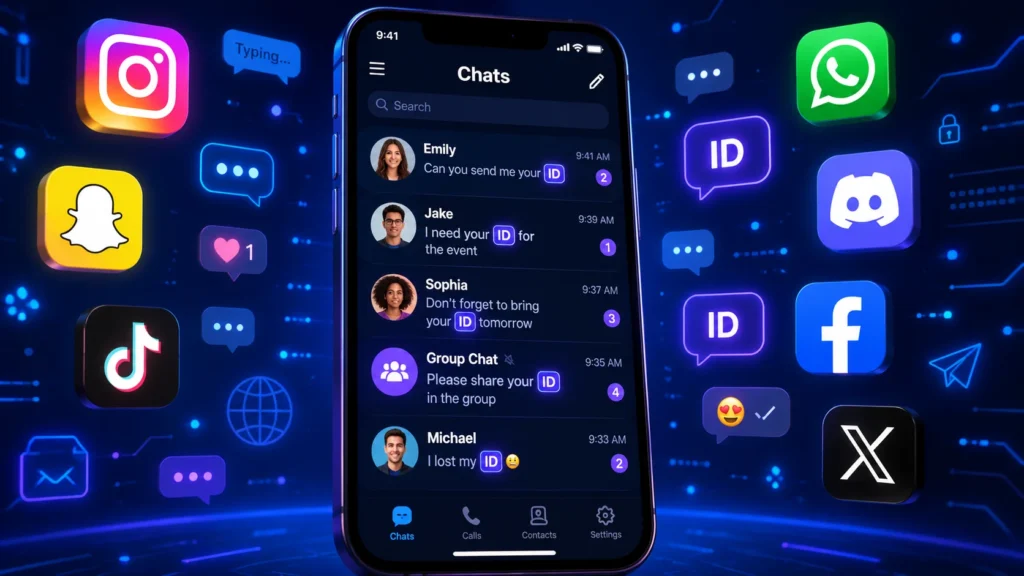

ID meaning in text refers to Identification or Identity. In text messages, chats, and social media, people commonly use ID to refer to a person’s identification, username, account ID, or another unique identifier, depending on the context.
If you’ve ever received a message saying “Send me your ID,” “What’s your Discord ID?” or “Can you share your player ID?”, you may have wondered what ID meaning in text actually is.
Unlike many internet abbreviations that change meaning depending on the conversation, ID usually has a straightforward definition. In most cases, it stands for Identification or Identity. However, the exact meaning still depends on the context. Someone asking for your ID in a gaming chat usually wants your player identification, while a business representative asking for your ID may be referring to a government-issued identification document.
Today, the abbreviation appears everywhere. You can find it in text messages, social media conversations, online games, messaging apps, banking apps, customer support chats, and business communications. Because digital conversations happen so quickly, people often shorten common words. ID has become one of the most widely recognized abbreviations in online communication.
This guide explains everything you need to know about ID meaning in text, including its definition, common uses, examples, platform-specific meanings, and the difference between ID and similar abbreviations.
What Does ID Mean in Text?
The ID meaning in text is usually Identification.
People use it when talking about identifying a person, an account, a document, or a unique number assigned to someone or something. Instead of typing the entire word “identification,” they simply write ID because it’s shorter and universally understood.
For example:
“Can you send me your ID?”
This sentence usually means the sender wants some form of identification. Depending on the situation, that could be:
- A driver’s license
- A student ID
- An employee ID
- A passport
- A user account ID
- A gaming ID
The surrounding conversation tells you which meaning is correct.
Quick Meaning Table
| Abbreviation | Meaning | Common Context |
|---|---|---|
| ID | Identification | General texting |
| ID | Identity | Online accounts |
| ID | User ID | Websites and apps |
| ID | Player ID | Online games |
| ID | Account ID | Social media platforms |
| ID | Identification document | Verification processes |
Although people often classify ID as texting slang, it isn’t slang in the traditional sense. It’s simply a shortened form of a commonly used word.
ID Meaning Explained in Simple Words
Think of ID as a label that helps identify someone or something.
Every day, people use different types of identification without even thinking about it.
For example:
- Your school gives you a student ID.
- Your employer provides an employee ID.
- Social media platforms assign account IDs.
- Online games generate player IDs.
- Banks create customer IDs.
- Government agencies issue identification cards.
Instead of saying “identification number” every time, people simply say ID.
It’s a small abbreviation that saves time while remaining easy to understand.
Why Do People Use ID in Text Messages?
Text messaging is built around speed.
People naturally shorten words that everyone already recognizes. Just as someone writes:
- LOL
- BRB
- FYI
- IDK
they also write ID instead of Identification.
The abbreviation works well because it’s short, familiar, and rarely causes confusion.
Here are several reasons why people prefer using ID in messages.
Faster Typing
Typing two letters takes much less time than writing an entire word.
Instead of writing:
“Please send your identification.”
Most people simply write:
“Send your ID.”
The meaning stays exactly the same while the message becomes quicker to type.
Universal Recognition
Unlike newer internet slang, ID has existed for decades.
People of different age groups understand it because they encounter it in schools, workplaces, government documents, banking systems, and online platforms.
Fits Every Digital Platform
You’re chatting on a phone or using a desktop computer, ID fits naturally into short conversations.
Examples include:
- Customer support chats
- Gaming communities
- Workplace messaging
- Social media
- SMS
- Business apps
ID Meaning in Chat
When someone uses ID during a chat conversation, they usually refer to some type of identifier.
The identifier changes depending on the discussion.
Imagine a few different conversations.
Example One
Alex: What’s your Discord ID?
Ryan: I’ll send it now.
In this conversation, ID refers to Ryan’s Discord account identifier.
Example Two
Customer Support: Please provide your order ID.
Customer: Sure, it’s 875431.
Here, ID means the order identification number.
Example Three
Friend: What’s your player ID?
You: It’s 90873452.
Now, ID represents a gaming account.
These examples show why context matters. The abbreviation itself doesn’t change. Only the object being identified changes.
ID Meaning in Messaging
The ID meaning in messaging remains almost identical across different communication platforms.
Messaging apps allow users to exchange information quickly. Because of that, abbreviations become part of everyday communication.
Here are the most common situations where people mention ID in messages.
Account Verification
Businesses often ask customers for an account ID before providing assistance.
Example:
“Please enter your customer ID.”
Online Shopping
E-commerce companies use order IDs to track purchases.
Example:
“Your order ID has been generated successfully.”
Banking
Banks assign customer IDs to every account holder.
Example:
“Enter your Customer ID before logging in.”
Gaming
Most multiplayer games assign a unique player ID.
Example:
“Share your Player ID so I can add you.”
Educational Platforms
Schools and universities assign student IDs.
Example:
“Please enter your Student ID to access your grades.”
Common Types of ID Used in Digital Communication
Not every ID refers to the same thing.
Here are some of the most common types you may encounter online.
| Type of ID | Purpose |
|---|---|
| User ID | Identifies an online account |
| Customer ID | Identifies a customer |
| Student ID | Identifies a student |
| Employee ID | Identifies an employee |
| Order ID | Tracks purchases |
| Transaction ID | Confirms payments |
| Player ID | Identifies gaming accounts |
| Profile ID | Identifies social media profiles |
| Device ID | Identifies electronic devices |
| Session ID | Tracks website sessions |
Every one of these IDs serves the same basic purpose: uniquely identifying something.
ID Meaning on Social Media
The ID meaning on social media generally stays consistent across platforms.
Instead of referring to an identification document, it usually points to an account, username, profile, or unique identification number assigned by the platform.
Although every social network has its own system, the purpose remains the same.
The ID helps distinguish one account from millions of others.
Let’s look at how different platforms use the abbreviation.
ID Meaning on Snapchat
On Snapchat, ID often refers to a user’s account identification.
Someone may ask:
“What’s your Snapchat ID?”
In everyday conversation, this usually means your username or the unique account you use to log into Snapchat.
Some developers and advanced users also refer to internal account identifiers, but regular users simply mean the username.
Example conversation:
Emma: Send me your Snapchat ID.
Jake: It’s JakeTravels22.
ID Meaning on TikTok
TikTok users commonly mention ID when talking about profiles.
For example:
“What’s your TikTok ID?”
Most people simply mean your TikTok username.
Businesses, advertisers, and developers may also refer to creator IDs or account identifiers used inside TikTok’s platform.
For everyday users, however, the meaning stays simple.
It identifies the account.
ID Meaning on Instagram
Instagram users frequently exchange IDs when connecting with friends.
Someone might say:
“Share your Instagram ID.”
In casual conversations, this usually means:
- Your username
- Your profile name
- Your account identifier
Businesses sometimes use Instagram account IDs for advertising tools, analytics, and integrations, although regular users rarely encounter those technical identifiers.
ID Meaning on WhatsApp
WhatsApp doesn’t encourage people to exchange usernames because accounts are primarily linked to phone numbers.
Still, the abbreviation ID appears in several situations.
People may refer to:
- Business account ID
- WhatsApp account identification
- Device identification
- Verification requests
For example:
“The support team asked for my business ID.”
In this case, the ID helps identify a specific business account rather than a personal conversation.
ID Meaning on Discord
Discord uses several different IDs behind the scenes.
Regular users usually mean their username when they mention their Discord ID.
However, developers often refer to:
- User ID
- Server ID
- Channel ID
- Message ID
- Role ID
These unique numbers help Discord identify every object within its system.
For most conversations, though, asking for a Discord ID simply means asking how to find or add someone’s account.
ID Meaning on Facebook
Facebook uses several types of IDs to identify users, pages, groups, events, and business assets. Although most people interact with profile names instead of numeric IDs, every account has a unique identifier behind the scenes.
In everyday conversations, someone asking for your Facebook ID usually wants one of two things:
- Your Facebook profile
- Your profile username or account identifier
Businesses and developers may also use Facebook IDs when managing advertising campaigns, business pages, or software integrations.
Example Conversation
Mark: What’s your Facebook ID?
Emma: I’ll send you my profile.
In casual messaging, “Facebook ID” almost always refers to the person’s Facebook account.
ID Meaning on X
On X, formerly known as Twitter, the abbreviation ID usually refers to an account or profile identifier.
Most users simply exchange usernames.
For example:
“Send me your X ID so I can follow you.”
Developers may work with numeric account IDs through software tools, but everyday users rarely see them.
Someone says X ID, Twitter ID, or profile ID, they’re generally talking about the account that identifies a specific user.
What Does ID Stand For?
The most common full form of ID is Identification.
The word comes from the idea of recognizing or verifying a person, object, document, or account. It has been part of everyday language for decades and appears in schools, businesses, healthcare, banking, government services, and nearly every online platform.
Depending on the conversation, ID may also represent Identity or describe a unique identifier assigned to an account.
Common Meanings of ID
| ID Stands For | Where You’ll See It |
|---|---|
| Identification | Everyday communication |
| Identity | Online profiles and security |
| User ID | Websites and apps |
| Account ID | Social media and business platforms |
| Customer ID | Banks and service providers |
| Employee ID | Companies and workplaces |
| Student ID | Schools and universities |
| Player ID | Video games |
| Transaction ID | Online payments |
| Order ID | Shopping websites |
Although the wording changes, the purpose stays the same.
Every ID exists to identify something uniquely.
Is ID Slang?
Many people search for ID slang meaning, but the answer is surprisingly simple.
ID is not actually slang.
Instead, it’s an abbreviation that people use because it’s shorter than writing the full word.
Unlike expressions such as:
- LOL
- SMH
- TBH
- FR
- NGL
ID doesn’t express emotion, opinion, or internet culture. It simply replaces a longer word.
That’s why you’ll see it just as often in professional emails as in casual text messages.
Why People Mistake ID for Internet Slang
There are several reasons people assume ID belongs to internet slang.
First, it appears frequently in texting.
Second, search engines often group all abbreviations together, they’re slang or not.
Finally, many messaging apps encourage users to shorten words whenever possible.
As a result, ID appears beside common chat abbreviations even though it isn’t slang itself.
Think of it this way.
Every slang term may be an abbreviation, but not every abbreviation is slang.
ID falls into the second category.
ID Abbreviation Meaning
The ID abbreviation meaning is straightforward.
It’s the shortened form of the word Identification.
Abbreviations make communication quicker without changing the original meaning.
For example:
| Full Word | Abbreviation |
|---|---|
| Identification | ID |
| Information | Info |
| Department | Dept. |
| Avenue | Ave. |
| Street | St. |
People naturally shorten familiar words because readers already understand them.
That’s exactly why ID has become so common.
ID Abbreviation in Everyday Life
Even outside texting, you’ll see ID almost everywhere.
Examples include:
- School ID
- Employee ID
- Military ID
- National ID
- Medical ID
- Visitor ID
- Hotel ID
- Security ID
- Driver’s ID
- Membership ID
These aren’t internet terms.
They’ve been part of everyday communication for generations.
Digital messaging simply carried the abbreviation into online conversations.
Is ID an Acronym or an Initialism?
This question often causes confusion.
Although many people call every shortened word an acronym, that’s not technically correct.
Here’s the difference.
| Type | Definition | Does ID Fit? |
|---|---|---|
| Acronym | Pronounced like a word | No |
| Initialism | Pronounced letter by letter | Yes |
| Abbreviation | Any shortened word | Yes |
When you say ID, you pronounce each letter individually.
You say:
“Eye Dee”
You don’t pronounce it as one word.
That makes it an initialism.
Since it’s also a shortened version of a longer word, it’s also an abbreviation.
Acronym vs. Initialism vs. Abbreviation
Understanding these three terms helps avoid confusion.
Abbreviation
An abbreviation is any shortened form of a word.
Examples include:
- ID
- Dept.
- Ave.
- Jan.
- Inc.
Initialism
An initialism uses the first letters of words, and you pronounce each letter separately.
Examples include:
- ID
- FBI
- CIA
- BBC
- USB
Acronym
An acronym forms a new word from the first letters.
Examples include:
- NASA
- LASER
- UNICEF
- SCUBA
- RADAR
So, when someone searches for ID acronym meaning, the technically accurate answer is that ID is an initialism and an abbreviation, not an acronym.
How People Use ID in Everyday Texting
One reason ID meaning in messaging remains popular is its flexibility.
The abbreviation fits almost every type of digital conversation.
Let’s explore the most common situations.
Asking for Identification
Sometimes people genuinely need proof of identity.
Example:
Friend: Don’t forget to bring your ID.
Here, the message refers to an identification card.
Sharing a User ID
Many apps create unique account identifiers.
Example:
Chris: What’s your game ID?
Alex: I’ll send it now.
Customer Support
Support agents frequently ask for account IDs.
Example:
Please enter your customer ID before we continue.
This helps them locate the correct account.
Banking Conversations
Banks use customer IDs for secure access.
Example:
Enter your Customer ID and password.
The ID identifies the account owner before login.
Gaming Communities
Online games almost always assign every player a unique identifier.
Example:
Lucas: What’s your Player ID?
Ryan: 483726194.
Now Ryan can receive a friend request without sharing personal information.
Workplace Communication
Companies assign employee IDs for internal systems.
Example:
Please include your employee ID in the request.
The number identifies the employee inside the organization’s records.
Why IDs Matter in Digital Communication
The internet connects billions of people.
Without unique identifiers, websites couldn’t distinguish one account from another.
Imagine a social media platform with one million users named “John.”
A unique ID prevents confusion.
It ensures every account stays separate even if users share identical names.
That’s why almost every online service creates some form of identification.
Examples include:
- Banking apps
- Online stores
- Schools
- Government portals
- Streaming services
- Gaming platforms
- Social networks
- Customer support systems
Each one relies on IDs to organize information accurately.
ID in Professional Messages vs. Casual Texts
The meaning rarely changes, but the tone does.
| Professional Message | Casual Text |
|---|---|
| Please provide your Customer ID. | Send me your ID. |
| Enter your Employee ID. | What’s your game ID? |
| Verify your Account ID. | What’s your Discord ID? |
| Include your Order ID. | Share your TikTok ID. |
Professional conversations sound more formal.
Casual chats keep things short and relaxed.
Despite the difference in tone, ID still refers to identification in both situations.
Examples of ID in Text Messages
Learning through examples makes it much easier to understand how people use ID in real conversations. Although the abbreviation stays the same, its meaning changes slightly depending on what people are discussing.
The examples below show how ID appears in everyday texting, online messaging, gaming, customer support, and social media.
| Text Message | Meaning |
|---|---|
| Can you send me your ID? | Identification document |
| What’s your Discord ID? | Discord account identifier |
| I forgot my Player ID. | Gaming account number |
| Please enter your Customer ID. | Customer account identifier |
| Send your Employee ID before noon. | Company identification number |
| What’s your TikTok ID? | TikTok username or account |
| I need your Order ID. | Purchase reference number |
| Share your Instagram ID. | Instagram account |
| I found your User ID. | Online account identifier |
| Enter your Student ID to continue. | School identification number |
These examples highlight an important point. The abbreviation doesn’t change. Instead, the type of identification changes with the situation.
Real-Life Conversation Examples Using ID
Here are a few realistic conversations that show how naturally people use ID in digital communication.
Example: Friends Chatting
Emma: What’s your Instagram ID?
Sophia: It’s @SophiaTravels.
Here, ID refers to the Instagram account.
Example: Gaming Chat
David: Send me your Player ID so I can invite you.
Lucas: Sure. It’s 945672381.
In this conversation, ID identifies a gaming profile.
Example: Customer Support
Agent: Could you provide your Order ID?
Customer: Yes, it’s 5629147.
The order ID helps the company locate the purchase quickly.
Example: Workplace Conversation
Manager: Please include your Employee ID in the report.
Employee: I’ll update it right away.
The employee ID identifies the staff member within the company.
Example: School Message
Teacher: Don’t forget your Student ID tomorrow.
Student: I’ll bring it.
This example refers to a school-issued identification card.
ID vs. I’d: What’s the Difference?
One of the biggest sources of confusion is the difference between ID and I’d.
Although they look similar, they have completely different meanings.
| ID | I’d |
|---|---|
| Stands for Identification | Means I would or I had |
| Abbreviation | Contraction |
| Usually written in capital letters | Includes an apostrophe |
| Refers to identity or identification | Refers to the speaker |
| Used as a noun | Used as part of a sentence |
The apostrophe makes all the difference.
Examples
ID
Please show your ID.
Meaning: Show your identification.
I’d
I’d love to help.
Meaning: I would love to help.
ID
What’s your User ID?
Meaning: What is your account identifier?
I’d
I’d already finished.
Meaning: I had already finished.
When writing, always pay attention to capitalization and punctuation. They completely change the meaning.
Common Places You May See ID
Because identification plays such an important role in modern life, you’ll find ID almost everywhere.
Here are some of the most common places where people use this abbreviation.
Text Messages
Friends often ask for usernames, player IDs, or account details through text.
Example:
Send me your Game ID.
Social Media
People exchange IDs when they want to connect online.
Examples include:
- Instagram ID
- Facebook ID
- TikTok ID
- Discord ID
Online Shopping
Every purchase receives an Order ID.
This number helps customers and businesses track purchases.
Banking
Banks assign customer IDs for secure account access.
Instead of searching by name, banking systems use these unique identifiers.
Schools and Universities
Students receive identification numbers that appear on:
- Student cards
- Exam records
- Attendance systems
- Library accounts
Government Services
Government agencies issue several forms of identification.
Examples include:
- National ID
- Driver’s license
- Passport
- Voter ID
These documents verify a person’s identity.
Healthcare
Hospitals use patient IDs to organize medical records.
This reduces errors and helps doctors access the correct information quickly.
Businesses
Companies assign employee IDs to manage payroll, attendance, and internal systems.
Instead of relying on names alone, organizations use unique numbers for every employee.
Online Games
Nearly every multiplayer game creates a Player ID.
Examples include:
- Team-based games
- Battle royale games
- Strategy games
- Sports games
- Mobile games
Sharing a Player ID allows friends to connect without revealing personal information.
Why Context Matters When Interpreting ID
Although ID usually means Identification, context determines exactly what is being identified.
Consider these examples.
Bring your ID tomorrow.
This probably means an identification card.
Now compare it with:
Send your Discord ID.
This clearly refers to a Discord account.
Here’s another example.
Enter your Customer ID.
Now the abbreviation refers to a customer account.
The letters never change. The surrounding conversation provides the meaning.
Whenever you’re unsure, read the sentences before and after the abbreviation. They’ll almost always reveal the intended meaning.
Common Mistakes People Make With ID
Even though ID is one of the simplest abbreviations, people still misunderstand it from time to time.
Here are the most common mistakes.
Assuming ID Always Means a Government Document
Many people immediately think of a driver’s license or passport.
In reality, ID can refer to almost any unique identifier.
Confusing ID With I’d
This happens frequently because both look similar at first glance.
Remember:
- ID = Identification
- I’d = I would or I had
Thinking ID Is Internet Slang
While it appears in text messages, ID isn’t a slang term.
It’s simply a widely accepted abbreviation.
Assuming Every Platform Uses the Same Type of ID
Every website creates its own identifiers.
For example:
- A banking customer ID differs from a gaming player ID.
- A Discord ID differs from an Instagram username.
- An order ID differs from a transaction ID.
Understanding the context prevents confusion.
Related Texting Abbreviations
If you’re learning about ID meaning in text, it’s helpful to understand other common abbreviations that appear in online conversations.
| Abbreviation | Meaning |
|---|---|
| IDK | I Don’t Know |
| IMO | In My Opinion |
| IMHO | In My Humble Opinion |
| BRB | Be Right Back |
| TBH | To Be Honest |
| FYI | For Your Information |
| DM | Direct Message |
| PM | Private Message |
| AFK | Away From Keyboard |
| IRL | In Real Life |
| NGL | Not Gonna Lie |
| TTYL | Talk To You Later |
| SMH | Shaking My Head |
| GTG | Got To Go |
| BFF | Best Friends Forever |
These abbreviations appear regularly in texting, gaming, forums, and social media. Learning them makes online conversations much easier to understand.
ID Compared With Other Common Types of Identification
The table below shows how different IDs serve different purposes while sharing the same basic goal of identifying a person, account, or transaction.
| Type of ID | Used For | Example |
|---|---|---|
| User ID | Website accounts | Login credentials |
| Customer ID | Banks and businesses | Customer records |
| Student ID | Schools and colleges | Academic services |
| Employee ID | Workplaces | Payroll and attendance |
| Player ID | Online gaming | Friend requests |
| Order ID | Shopping websites | Purchase tracking |
| Transaction ID | Online payments | Payment confirmation |
| Profile ID | Social media | User identification |
| Device ID | Smartphones and computers | Device management |
| Session ID | Websites | Secure browsing sessions |
No matter which type you encounter, the purpose remains the same: to uniquely identify something within a specific system.
FAQs
What does ID mean in text?
ID usually stands for Identification. In texting, it can refer to a person’s identification, a user account, a player ID, or another unique identifier depending on the conversation.
What does ID stand for?
The most common full form of ID is Identification. In some contexts, it may also refer to Identity or a unique account identifier assigned by a website or application.
What is ID meaning in chat?
In chat conversations, ID generally refers to an account, profile, username, or identification number. The exact meaning depends on what people are discussing.
Is ID a slang word?
No. ID is an abbreviation and an initialism rather than internet slang. People use it in both casual and professional communication because it’s shorter than writing “Identification.”
What does ID mean on Snapchat?
On Snapchat, ID usually refers to a user’s account or username. People commonly ask for someone’s Snapchat ID when they want to add them.
What does ID mean on Instagram?
On Instagram, ID generally means a profile or username. Businesses and developers may also use internal account identifiers for technical purposes.
What does ID mean on TikTok?
Most TikTok users use ID to mean a username or account. It helps identify a specific profile among millions of users.
What does ID mean on WhatsApp?
On WhatsApp, ID may refer to a business account, account identification, or another identifier used during verification or customer support.
What does ID mean on Discord?
Discord users often use ID to describe a username or account. Developers may also refer to unique user, server, channel, or message IDs.
Is ID the same as I’d?
No. ID means Identification, while I’d is a contraction for I would or I had. The apostrophe changes the meaning completely.
Is ID an acronym?
Technically, no. ID is an initialism because you pronounce each letter separately. It is also an abbreviation because it shortens the word “Identification.”
Why do people say ID in messages?
People use ID because it’s short, familiar, and easy to understand. It saves time while clearly referring to identification, account details, or unique identifiers in digital communication.
Conclusion
The ID meaning in text is simple once you understand the context. In most conversations, ID stands for Identification, although it may refer to an identity, account, username, customer number, player ID, or another unique identifier.
You’re chatting with friends, contacting customer support, joining an online game, or using social media, the abbreviation serves the same purpose: identifying a specific person, account, or item. By paying attention to the surrounding conversation, you can quickly determine the exact meaning and use ID confidently in any text, message, or online discussion.
Discover More Related Articles:
- “Mhm” Slang Meaning : What It Really Means in Texting In 2026
- “LMS” Mean in Text: Internet Slang and Everyday Usage In 2026
- “NGL” Meaning in Chat: What People Actually Mean When They Say It In 2026