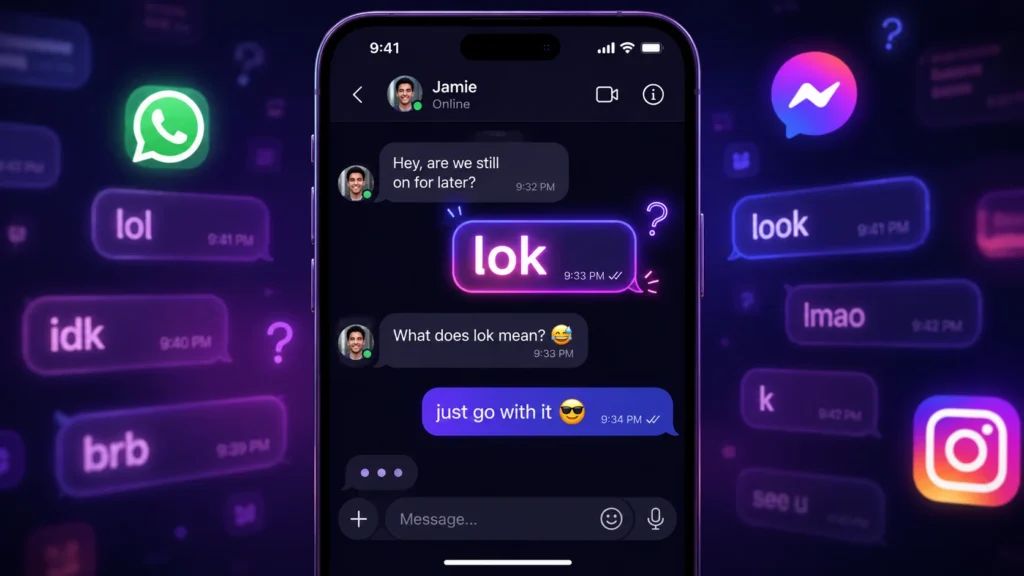

Lok meaning in text: “Lok” is usually an informal misspelling or shorthand of “look” used in fast texting or chat conversations. It has no fixed slang meaning and its sense depends on the context of the message.
You see “lok” in a message and pause for a second. It feels familiar but unclear. Is it slang? A typo? Or something deeper?
Here’s the truth right away. “lok” does not have a fixed meaning in modern texting or internet slang. Most of the time, it shows up due to typing speed, context shortcuts, or simple mistakes.
But that’s only the surface. Once you dig deeper, you’ll see that “lok meaning in text” depends heavily on how people use language in fast digital conversations.
Let’s break it down in a simple, real-world way so you never get confused again.
What Does Lok Mean in Text? Core Explanation
When people search what does lok mean in text, they usually expect a single definition. But digital language rarely works like a dictionary.
In real usage, “lok” mainly appears in three ways:
- A misspelling of the word “look”
- A fast typing shortcut in informal chats
- A context-based fragment that only makes sense in a full sentence
So instead of one meaning, “lok” behaves more like a flexible placeholder in conversation.
Think of it like hearing a half-word in a noisy room. You guess the meaning based on what you already know.
Most Common Lok Meaning in Chat Messages
Let’s get practical. If you see “lok” in WhatsApp or Instagram messages, this is almost always what it means:
Lok as “Look” (Most Common Usage)
This is the dominant interpretation.
People type “lok” instead of “look” when they:
- Type too fast
- Miss the second “o”
- Use predictive text that skips letters
- Don’t bother correcting casual messages
Example:
- “lok at this video” → “look at this video”
- “lok here” → “look here”
This is not slang. It is simply a typing shortcut error pattern.
Lok as a Phonetic Shortcut in Texting
Sometimes “lok” appears intentionally in very informal conversations.
People shorten words when:
- They want faster typing
- They chat during gaming
- They use slang-heavy group chats
In these cases, “lok” becomes a phonetic shortcut of “look.”
It’s similar to how people type:
- “kno” instead of “know”
- “gud” instead of “good”
- “u” instead of “you”
This is part of the broader internet habit of reducing typing effort.
Context-Based Meaning of Lok in Conversations
Here’s where things get interesting.
“Lok” doesn’t stand alone. It depends on the sentence around it.
Example Breakdown
- “lok this meme”
- Meaning: Look at this meme
- “don’t lok at me like that”
- Meaning: Don’t look at me like that
- “I lok tired today”
- Meaning: I look tired today
Notice something? The brain automatically fills in the missing letters.
That’s how contextual interpretation works in digital communication.
Is Lok a Real Slang Word?
No widely accepted slang dictionary includes “lok” as a standalone slang term.
Unlike:
- LOL (laugh out loud)
- IDK (I don’t know)
- BRB (be right back)
“lok” does not have a fixed global meaning.
Instead, it falls into this category:
Informal text variation of an existing English word
So you should not treat it like official internet slang.
Lok Meaning on Social Media Platforms
Social media changes how people type.
On platforms like Instagram, Snapchat, and TikTok:
- People prioritize speed over spelling
- Captions often include informal typing
- Comments are short and rushed
So “lok” appears mostly in:
- Comments
- Replies
- Chat messages under posts
But you won’t usually see it in polished captions or professional posts.
For example:
- “lok at this edit 🔥”
- “lok what I found”
It stays within casual digital interaction only.
Lok Meaning on WhatsApp Chats
WhatsApp is where “lok” shows up the most.
Why?
Because WhatsApp conversations are:
- Fast
- Private
- Informal
- Filled with shorthand typing
Common WhatsApp usage examples:
- “lok this pic”
- “lok bro”
- “lok here fast”
In all cases, the meaning resolves to “look.”
There is no separate WhatsApp-specific definition.
Why People Get Confused by Lok
At first glance, “lok” looks like it should mean something official.
But confusion happens because:
- It resembles real English structure
- It looks like an acronym
- It appears in short messages without context
From an NLP (Natural Language Processing) perspective, systems also struggle with it because:
- It is not a standardized token
- It overlaps with valid word fragments
- It lacks semantic consistency
So both humans and machines rely heavily on context.
How to Understand Lok Correctly in Any Message
You don’t need to guess blindly. Use a simple decoding method.
Step-by-step approach:
- Read the full sentence
- Replace “lok” with “look”
- Re-read the sentence
- Check if meaning becomes clear
Example:
Message: “lok at this crazy video”
Step 1: Replace → “look at this crazy video”
Step 2: Meaning becomes obvious
This method works almost every time.
Related Chat Slang That Confuses People With Lok
Many users confuse “lok” with other short forms.
Here are similar confusing patterns:
| Term | Real Meaning | Why It Confuses |
|---|---|---|
| lol | laugh out loud | similar shape |
| lk | like | short form overlap |
| lok | look (usually) | missing letter pattern |
| ok | okay | similar structure |
These small variations are part of messaging shorthand evolution.
Common Misinterpretations of Lok
People often assume “lok” is something bigger than it really is.
Here are common wrong assumptions:
It is a Gen Z acronym
No evidence supports this.
It has hidden meaning in gaming or coding
No standard usage exists.
It is a coded slang word
It is not used as coded slang in mainstream communication.
Most of the time, it is simply:
A missing letter version of “look”
NLP Perspective | How Machines Interpret Lok
Now let’s go a bit technical but keep it simple.
When AI or text systems see “lok,” they analyze it through:
Tokenization
The system breaks “lok” into a token but finds no dictionary match.
Word sense disambiguation
The system tries to match meaning based on nearby words.
Abbreviation detection
It flags it as non-standard or likely misspelled word.
Contextual prediction
It guesses “look” based on sentence structure.
So machines don’t “understand” it directly. They infer meaning.
Why Lok Exists in Digital Language
Language evolves in messy, human ways.
“Lok” exists because:
- People type fast
- Mobile keyboards skip letters
- Autocorrect sometimes fails
- Informal chat removes spelling pressure
Think of it like handwriting shortcuts in digital form.
People don’t aim for correctness in casual chat. They aim for speed.
How Lok Fits Into Internet Slang Evolution
Internet slang follows a pattern:
- Full words → abbreviations → shortened forms → fragmented typing
Examples:
- “because” → “bcoz”
- “you” → “u”
- “look” → “lok”
“lok” sits at the fragmented stage where spelling gets partially dropped.
It shows how language adapts to digital speed.
Summary: What Lok Really Means in Text
Let’s make it simple.
- “lok” usually means look
- It is not official slang
- It has no fixed acronym meaning
- It depends heavily on context
- It appears mostly in casual chats and WhatsApp messages
So the next time you see it, don’t overthink it.
Just read it as “look” in most cases.
FAQs
What does lok mean in text messages?
“Lok” usually means “look” and appears due to typing shortcuts or mistakes. It does not have an official slang definition.
Is lok a real slang word?
No, “lok” is not a recognized slang word. It is mostly an informal variation of the word “look” used in casual texting.
What does lok mean on WhatsApp?
On WhatsApp, “lok” almost always means “look.” People type it quickly in informal conversations without correcting spelling.
Is LOK an acronym in texting?
No standard texting acronym uses “LOK.” Any uppercase usage depends on specific group context, not global slang.
Why do people type lok instead of look?
People type “lok” due to fast typing, missing letters, or autocorrect issues. It is usually unintentional rather than a coded meaning.
Conclusion
“Lok” in text usually doesn’t carry any special or hidden meaning. Most of the time, people simply use it as a quick or accidental version of the word “look.” It shows up in casual chats where speed matters more than perfect spelling.
In real conversations, you should always read the full sentence before deciding its meaning. Once you replace “lok” with “look,” the message usually becomes clear and easy to understand.
So, instead of treating it as a new slang term, think of it as a small typing shortcut. Context is what gives it meaning, not the word itself.
Discover More Related Articles:
- “RS” Mean in Text: You’ve Seen It Everywhere In 2026
- “ION” Mean in Text: Don’t Misunderstand This Slang In 2026
- “Chuzz” Meaning in Social Media: Why People Are Using It In 2026