
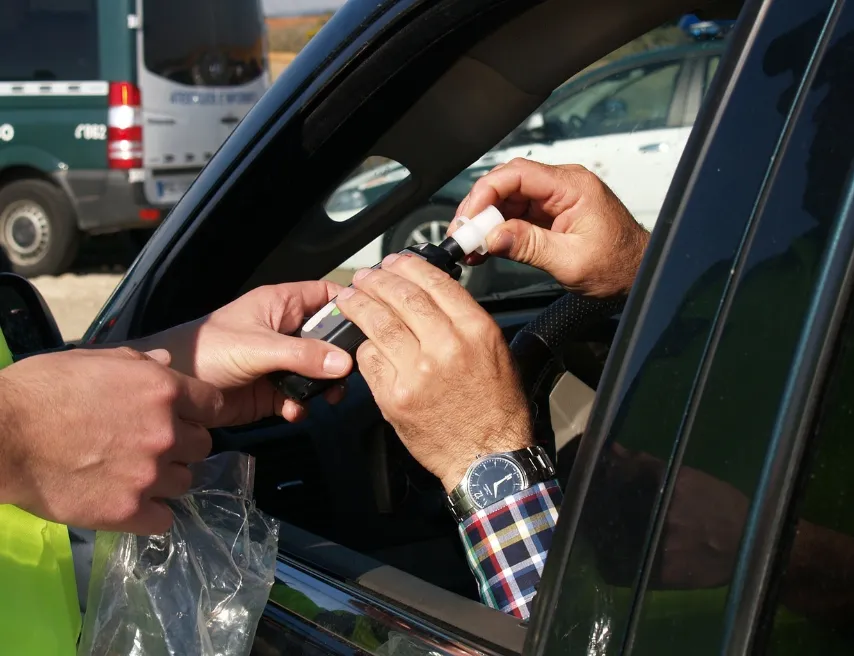

My friend had the worst assumption of what IID installation would be like for her car. She received her IID requirements in the mail about a week before the scheduled appointment for the car breathalyzer and her worst fears were confirmed. In her mind she had made a cartoonish drawing of how the technician would pull apart the dashboard of her car and have wires sprawled all over the place in order to install her IID. What a relief she was not aware of how IID installation worked and how long it would take for her car breathalyzer installation. In reality it only took less than an hour to install her IID and the device is nearly invisible in her car under her dashboard.
A car breathalyzer, or car ignition interlock device, is often referred to as an IID or car breath tester. An IID is a small, compact breath testing machine that is hardwired into your car’s ignition system. Once installed by a certified IID technician, the IID is a hand held tube that must be blown into by the driver prior to starting the vehicle. The vehicle will only start if the driver’s breath sample contains an adequate amount of alcohol at or below a predetermined threshold. When installed in a vehicle, the ignition interlock device is an active part of starting your car. While often referred to simply as a breath tester for cars, the terms “car breath tester” or “breath tester for cars” don’t fully explain the many variables to consider when it comes to car breathalyzer installation.
Before you show up at the service center
The first step of the interlock installation process that consistently causes stress and anxiety among individuals with an IID requirement that they were not made aware of prior to their appointment is verification of information and production of required documentation for the installation of an IID in their vehicle. Some examples of the items that typically need to be verified by the individual are:
- Your state-issued IID requirement paperwork is ready (the provider will ask for it, no exceptions)
- You know which vehicles fall under the requirement, which isn’t always obvious if you own more than one
- You’ve chosen an approved, state-certified provider, because plenty of shops do electronics work but don’t qualify for IID programs
- You understand the ongoing monitoring fees, billed monthly and separate from what you pay at installation
Make sure you bring all of the required paperwork to install the IID to the service center to verify your requirements to install an IID to install the car breathalyzer. Without proper documentation to verify your requirements to install an IID, you will not be able to complete the appointment for the installation of your IID and the loss of time will be a negative in your compliance window that the licensing authority will not find endearing.
What actually happens during the appointment
The installation of the IID is approximately 45 minutes to two hours, depending on the type of vehicle that you have. Many people have older model pick-up trucks, and also many people have the current model hybrid cars. So, the technicians are able to handle and service all of the different makes and models of vehicles, and they are able to deal with any kind of problem that your vehicle may have.
Here’s the rough sequence:
- The technician reviews your vehicle’s make, model, and year to confirm compatibility with the device
- The handset, the part you breathe into, gets mounted somewhere accessible, typically near the steering column or center console
- The control unit is wired into the ignition circuit, usually by tapping existing wiring rather than cutting or permanently altering anything structural
- If your state requires a camera (and several do), it gets positioned to capture a clear, unambiguous image of your face during each test
- The technician calibrates the device, confirms it’s communicating correctly with your ignition system, and runs test readings to verify everything
- You get a hands-on walkthrough of proper technique before you leave
The last step in the installation of an IID is very important. If one does not blow hard enough, pauses in the middle of a breath test, or does not sustain a blow for a sufficient amount of time, the IID will register a failed test. The technician can discuss all of these points with you and explain how your actions could result in a failed test being recorded on your IID record.
The Device
The main part of the IID that is mounted in the vehicle is the control unit. Most IIDs are roughly the size of a TV remote control and do not pull a lot of power from the vehicle’s battery when the vehicle is off. Some IIDs are equipped with a detachable mouthpiece which can be replaced if needed. There are some IIDs on the market that have cameras and can take the photo of the driver for proof of testing. Some IIDs can also be equipped with GPS tracking. However, most states do not require these extra features of car breathalyzer installation. In fact, most states require only the most basic model of IID to meet the requirements for car breathalyzer installation.
| Component | What it does | Visible to driver? |
| Handset / breath tube | Collects breath sample before ignition | Yes |
| Control unit | Processes sample, communicates with ignition | Partially (usually under dash) |
| Camera module | Confirms driver identity during test | Yes, if required |
| Data logger | Records all test results for monitoring authority | No |
Rolling Re-Tests
These tests can occur while you are driving and you will be pulled over to the side of the road until the test is completed. After the test you can continue on your way. If you fail or refuse a rolling retest then a violation will be logged on your record. As mentioned before the ignition interlock device does not shut off your car while it is in motion. Shutting off a moving car could cause an accident and that would be worse than drinking and driving.
One last item of note in terms of how the IID will operate in an attempt to prevent a person from driving while intoxicated. It will NOT disable the ignition of a moving vehicle. Such an action would be far worse than allowing a person to potentially drive while intoxicated and cause serious harm or even death to other people on the road.
When seeking a car breathalyzer installation in Charlottesville for a Virginia resident, a local company such as car breathalyzer installation Charlottesville can be of service. First, call the company to confirm that all of your requirements can be met.
Recalibration: the ongoing commitment nobody quite prepares for
After the installation of your IID it needs to be recalibrated from time to time and the data from the IID logged and sent to your monitoring authority. The frequency for these procedures is typically between 30 and 60 days and the service provider will complete these tasks for you. As a result of these procedures the installation of an IID is not a single event, but rather a service that is provided on a subscription basis while you are complying with your terms and conditions of your program.
Understanding recurring service expenses and following reliable business and financial insights can help drivers plan for long-term monitoring costs without unexpected budget surprises.
Calibration is a serious part of the monitoring of your compliance with the terms of your sentence. Missing a scheduled calibration will result in a serious violation of your sentence and could result in additional time on your sentence as well as other serious consequences. According to law, only a certified installer is permitted to remove an IID from a vehicle.
Installation of a car breathalyzer is not that difficult of a process. Some cars require more work under the hood than others. A good technician can usually install a car breathalyzer in about 45 minutes to 2 hours. There is also usually paperwork to complete as well as tutorial to explain how the device works. But after the car breathalyzer is installed, the real test begins – months and months of constant monitoring while you are driving. One failed test can affect the entire program. It is very important to remain compliant throughout the monitoring period.