
Definition
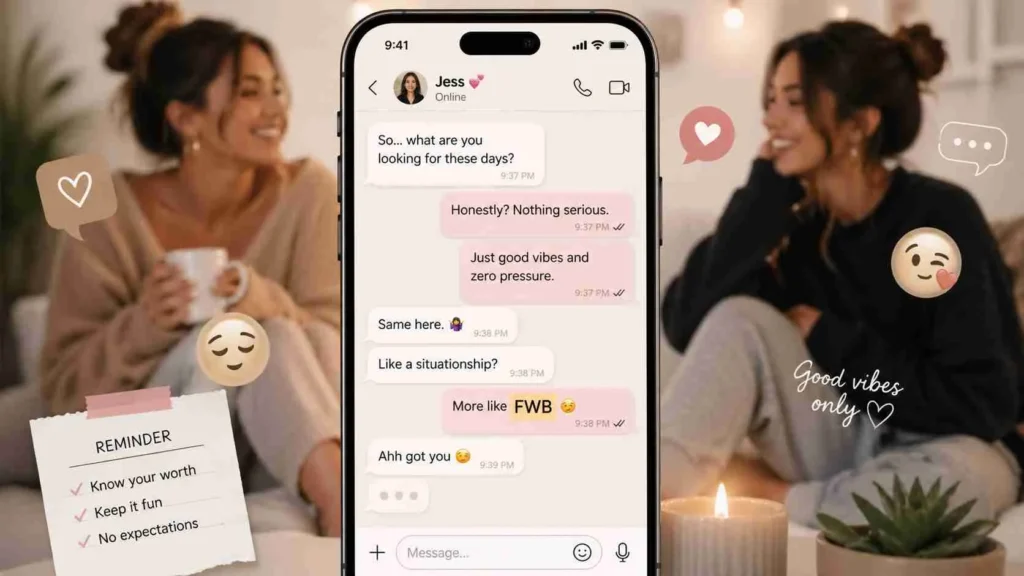
FWB (Friends With Benefits) means a relationship where two people are friends but also engage in a physical or intimate connection without a committed romantic relationship. It typically involves mutual agreement, clear boundaries, and no expectations of long-term emotional commitment.
You’ve probably seen “FWB” pop up in texts, dating apps, memes, or social media captions. Maybe someone casually dropped it into a conversation, and you wondered what exactly does that mean? Is it just casual dating? Is it something more complicated?
In today’s fast-paced digital world, relationship terms evolve quickly, and FWB (Friends With Benefits) has become one of the most widely used abbreviations in modern communication. It reflects shifting attitudes toward relationships, boundaries, and personal freedom.
But here’s the thing FWB isn’t as simple as it sounds.
This guide breaks it all down in a clear, friendly, and practical way so you fully understand what FWB meaning in chat , how people use it, and what to watch out for.
What Does FWB Mean? (In Simple Terms)
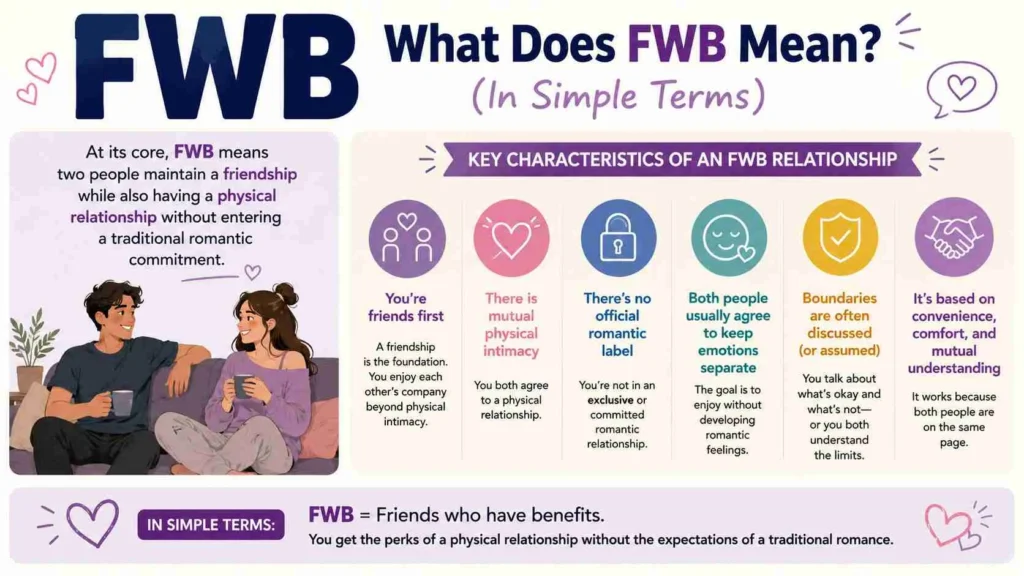
At its core, FWB means two people maintain a friendship while also having a physical relationship without entering a traditional romantic commitment.
Key Characteristics of an FWB Relationship:
- You’re friends first
- There is mutual physical intimacy
- There’s no official romantic label
- Both people usually agree to keep emotions separate
- Boundaries are often discussed (or assumed)
It’s a setup based on convenience, comfort, and mutual understanding.
Origin and Rise in Popularity
The idea of “friends with benefits” isn’t new, but the abbreviation FWB gained popularity with:
- Text messaging culture
- Online dating apps
- Social media platforms
- Pop culture references (movies, TV shows)
The phrase became especially mainstream in the 2000s, as casual dating became more socially accepted and openly discussed.
Why It Became Popular:
- People wanted less pressure than traditional relationships
- More focus on personal freedom and flexibility
- Easier communication through abbreviations in texting
- Changing attitudes toward modern dating norms
Today, FWB is widely understood across different age groups, especially among younger adults.
How FWB Is Used in Real Life
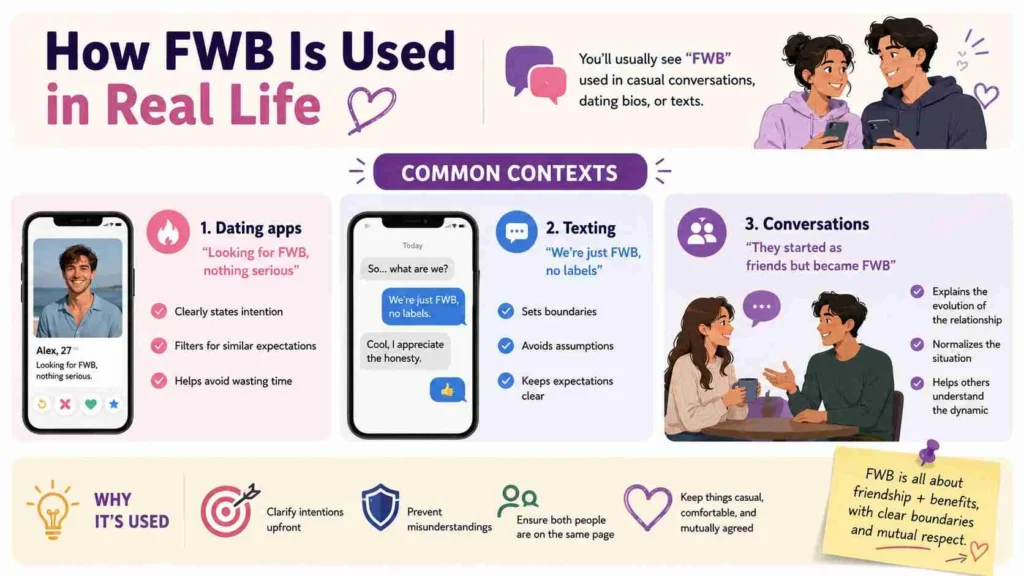
You’ll usually see “FWB” used in casual conversations, dating bios, or texts.
Common Contexts:
- Dating apps: “Looking for FWB, nothing serious”
- Texting: “We’re just FWB, no labels”
- Conversations: “They started as friends but became FWB”
It’s often used to clarify intentions and avoid misunderstandings.
Examples of FWB in Sentences (With Tone)
Understanding tone is important because the meaning can feel different depending on context.
Friendly / Casual Tone 😊
- “We’re just FWB no drama, just vibes.”
- “Honestly, FWB works for us right now.”
👉 This tone suggests comfort, mutual agreement, and ease.
Neutral Tone 😐
- “They agreed to be FWB after their breakup.”
- “FWB relationships aren’t for everyone.”
👉 Straightforward, descriptive, no emotional bias.
Negative or Complicated Tone 😕
- “FWB sounded simple… until feelings got involved.”
- “Being FWB ruined our friendship.”
👉 Highlights potential downsides or emotional challenges.
FWB vs Similar Relationship Terms
FWB is often confused with other dating terms. Let’s clear that up.
Comparison Table
| Term | Meaning | Emotional Involvement | Commitment Level |
|---|---|---|---|
| FWB | Friends + physical relationship | Usually low (but can vary) | No commitment |
| Casual Dating | Dating without seriousness | Moderate | Flexible |
| Hookup | One-time or short-term encounter | Very low | None |
| Situationship | Undefined relationship | Often confusing | Unclear |
| Dating | Romantic involvement | Higher | Possible commitment |
FWB vs Situationship: Key Difference
- FWB: Clear agreement, defined boundaries
- Situationship: Undefined, often confusing, emotional gray area
👉 If there’s clarity, it’s likely FWB.
👉 If there’s confusion, it’s probably a situationship.
Alternate Meanings of FWB
While “Friends With Benefits” is the most common meaning, FWB can sometimes stand for other things depending on context:
- Full Weight Bearing (medical term)
- Free Wheelin’ Bob Dylan (rare slang reference)
- Family Welfare Board (organizational use)
👉 However, in casual texting and social media, FWB almost always means Friends With Benefits.
Pros and Cons of FWB Relationships
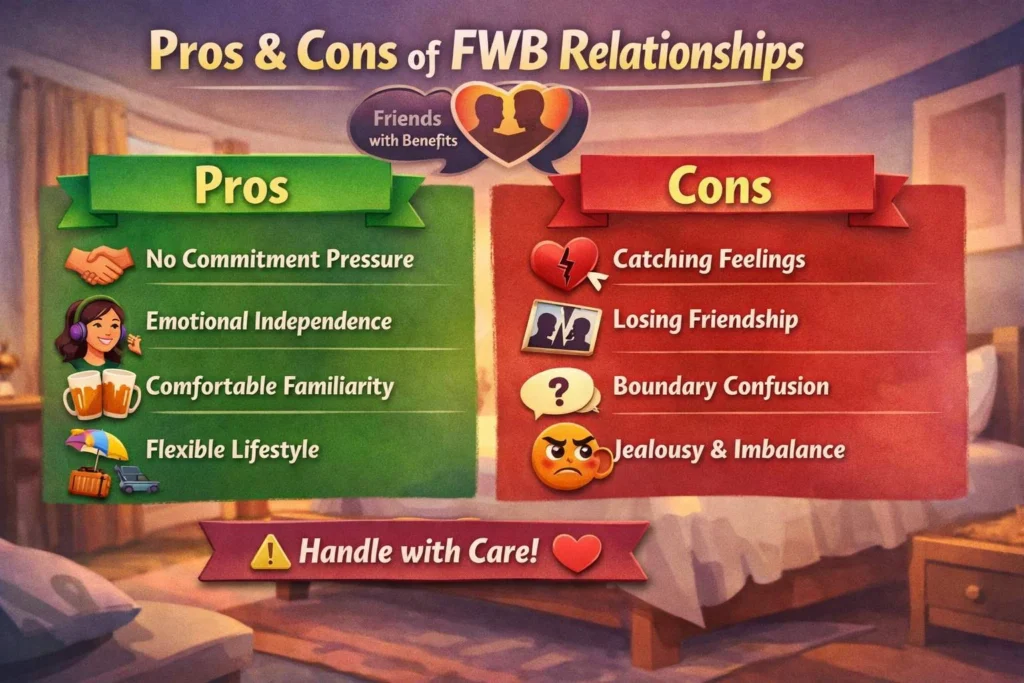
Pros
- No pressure of commitment
- Emotional independence
- Comfortable familiarity (since you’re already friends)
- Flexibility in lifestyle
Cons
- Risk of developing feelings
- Potential loss of friendship
- Miscommunication about boundaries
- Jealousy or imbalance
Tips for Navigating an FWB Relationship
If you’re dealing with an FWB meaning in text situation, clarity is everything.
Helpful Tips
- Communicate expectations early
- Set clear boundaries
- Be honest about feelings
- Check in regularly
- Be prepared for possible changes
👉 The biggest mistake people make is assuming both sides feel the same way.
Polite or Professional Alternatives to “FWB”
In some contexts (like formal conversations), you may want softer or more neutral wording.
Alternatives:
- “Casual relationship”
- “Non-committed arrangement”
- “Informal dating”
- “Close friends with mutual understanding”
👉 These sound more professional and less slang-heavy.
Example Scenarios Table
| Situation | Is FWB Appropriate? | Explanation |
|---|---|---|
| Dating app bio | Yes | Common and widely understood |
| Workplace conversation | No | Too informal or personal |
| Text with friends | Yes | Casual and acceptable |
| Formal writing | No | Use alternatives instead |
FAQs
1. What does FWB mean in texting?
FWB in texting usually stands for “Friends With Benefits,” meaning two people are friends who also share a physical relationship without being romantically committed. It’s commonly used to quickly explain relationship dynamics without going into detail.
2. Is FWB the same as a relationship?
No, FWB is not considered a traditional relationship because it lacks emotional commitment and long-term expectations. While there may be closeness, it doesn’t typically include exclusivity or romantic obligations.
3. Can FWB turn into a serious relationship?
Yes, sometimes FWB arrangements evolve into romantic relationships if both people develop feelings. However, this can also create complications if the feelings are not mutual.
4. Is FWB a good idea?
It depends on the individuals involved. FWB can work well when both people communicate clearly and share the same expectations, but it can lead to emotional challenges if boundaries are unclear.
5. What are the rules of an FWB relationship?
There are no universal rules, but common guidelines include honesty, mutual respect, clear boundaries, and regular communication about expectations and feelings.
6. Does FWB involve emotions?
Ideally, FWB is meant to avoid deep emotional involvement, but in reality, emotions can develop over time, making the situation more complex.
7. How is FWB different from hooking up?
Hooking up is usually a one-time or short-term encounter, while FWB involves an ongoing friendship combined with physical intimacy.
8. Why do people choose FWB instead of dating?
People may choose FWB for flexibility, less pressure, independence, or because they are not ready for a committed relationship but still want companionship.
Conclusion:
FWB, or Friends With Benefits, is more than just a trendy abbreviation it reflects how modern relationships are evolving.
However, the simplicity of the term can be misleading. The success of an FWB relationship depends heavily on clear communication, emotional awareness, and mutual respect. Without those, things can quickly become confusing or even hurtful.
If you’re navigating or considering an FWB situation, the most important thing is honesty with yourself and with the other person. In the end, FWB works well for some people and not for others and that’s perfectly okay.
Discover More Related Articles:
- “Pookie” Meaning: How It Is Used in Chat & Social Media In 2026
- “FAFO” Meaning: In TikTok & Social Media Messages In 2026
- “Wyll” Meaning: How It Is Used in Online Conversations In 2026