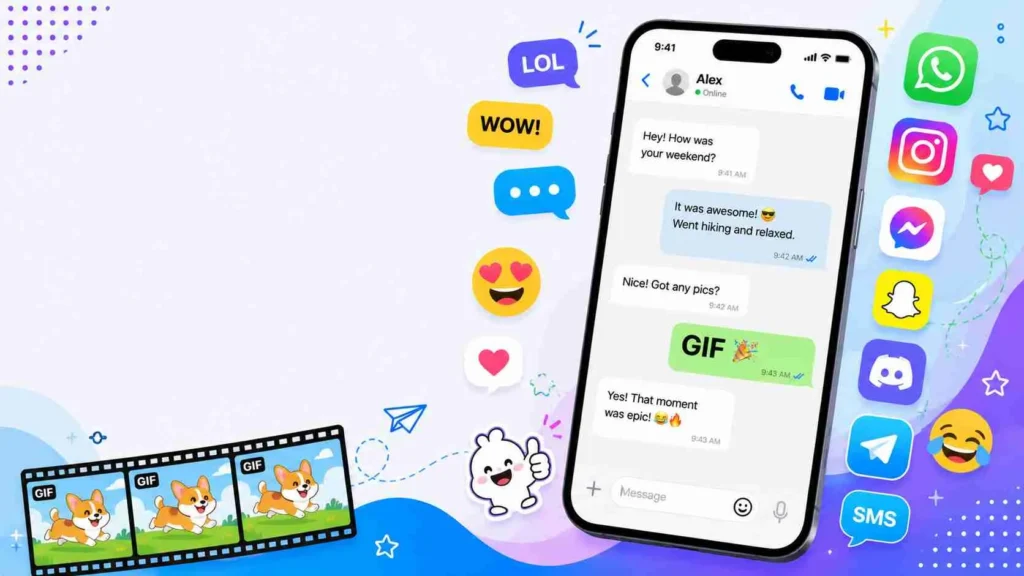

GIF meaning in text refers to a short, looping animated image that people send in chats and messages to express emotions, reactions, or humor. Instead of typing a long response, a GIF quickly communicates feelings like laughter, excitement, surprise, or celebration in a fun and visual way.
If you’ve ever received a message that says, “Send a GIF,” or watched someone reply with a funny animated image instead of typing a sentence, you might have wondered what it actually means. While GIFs have existed for decades, they remain one of the most popular ways to communicate online. They appear in text messages, social media comments, workplace chats, gaming communities, and almost every major messaging app.
Unlike plain text, a GIF captures emotion, humor, sarcasm, excitement, or surprise in just a few seconds. Sometimes a single animated image says more than an entire paragraph. That’s why millions of people use GIFs every day to make conversations more expressive and entertaining.
In texting, the word GIF doesn’t usually function as slang or an abbreviation like LOL or BRB. Instead, it refers to a short animated image that people send to react, joke, celebrate, or express feelings without typing everything out.
You’re new to texting culture or simply curious about internet terminology, this guide explains everything you need to know. You’ll learn the GIF meaning in text, where the format came from, how people use it across messaging apps, how it differs from emojis and memes, and why it continues to play such an important role in digital communication.
Quick Answer: In texting, GIF refers to a short looping animated image that people use to express emotions, reactions, humor, or ideas during conversations.
GIF Meaning in Text
The GIF meaning in text is surprisingly simple. When someone mentions a GIF in a conversation, they’re almost always talking about a short animated image rather than a static picture.
Instead of writing a long explanation like:
“I’m so excited about this!”
someone might simply send a dancing celebration GIF.
Likewise, instead of saying:
“I can’t believe that happened.”
they might reply with a shocked facial reaction from a popular movie or television show.
A GIF helps communicate emotion instantly. It adds personality to a conversation without requiring many words.
Unlike videos, GIFs play automatically and usually repeat in an endless loop. They don’t require the recipient to press play, making them perfect for quick conversations.
Simple Definition
A GIF in texting is:
- A looping animated image
- A visual reaction
- A digital expression
- A way to replace or enhance written messages
- A common feature in messaging apps and social media
People often use GIFs when words don’t fully capture how they feel.
For example:
| Text Message | Meaning |
|---|---|
| “Good morning!” + sunrise GIF | Friendly greeting |
| Laughing GIF | That’s hilarious |
| Eye-roll GIF | Mild annoyance or sarcasm |
| Applause GIF | Congratulations |
| Facepalm GIF | That was embarrassing |
These visual responses often make conversations feel more natural and engaging.
What Does GIF Mean in Text Messages?
When someone writes:
- “Send me a GIF.”
- “That’s the perfect GIF.”
- “I replied with a GIF.”
they’re referring to an animated image rather than the letters themselves.
The actual file format is rarely the focus during everyday conversations. Instead, people simply think of GIFs as funny or expressive animations.
For example:
Friend: I finally passed my driving test.
You: (sends cheering celebration GIF)
The GIF communicates excitement instantly.
Another example:
Friend: I accidentally emailed my boss the wrong file.
You: (sends dramatic facepalm GIF)
No lengthy explanation is necessary because the animation expresses the emotion perfectly.
Is GIF a Texting Abbreviation?
This question confuses many people.
Technically, GIF is not a texting abbreviation like:
- LOL
- BRB
- IMO
- TTYL
- IDK
Those abbreviations replace words or phrases.
GIF is different.
It refers to a specific image format that became widely used in online conversations.
Although people type the word “GIF,” they usually mean the animation itself rather than an acronym used as shorthand.
Here’s a quick comparison.
| Internet Term | Purpose |
|---|---|
| LOL | Express laughter |
| BRB | Tell someone you’ll return |
| OMG | Express surprise |
| GIF | Refers to an animated image |
| Emoji | Small digital icon |
| Meme | Humorous image or concept |
So while GIF appears in conversations alongside internet slang, it belongs to a different category.
What Does GIF Stand For?
The full form of GIF is Graphics Interchange Format.
The format was introduced in 1987 as a way to display digital images efficiently while keeping file sizes relatively small. At the time, internet connections were much slower than they are today, so smaller image files loaded much faster.
Although the technology is decades old, GIFs remain incredibly popular because they’re simple, lightweight, and universally supported.
Originally, GIFs weren’t designed for reaction images or internet humor.
They were created to display graphics like:
- Company logos
- Website icons
- Digital artwork
- Simple illustrations
Over time, people discovered that GIFs could also display multiple frames in sequence, creating short looping animations.
That discovery changed internet culture forever.
Why the GIF Format Became So Popular
Several features helped GIFs become a staple of online communication.
Small File Sizes
Compared to traditional videos, GIFs are compact and easy to share.
Automatic Playback
Users don’t need to press play.
The animation starts immediately.
Infinite Looping
Most GIFs repeat continuously until the viewer scrolls away.
Universal Compatibility
Nearly every browser, smartphone, messaging app, and social platform supports GIFs.
Easy to Understand
A few seconds of animation often communicate emotions faster than text.
Because of these advantages, GIFs quickly spread across forums, blogs, social media, and messaging apps.
How GIFs Work in Texting
One reason GIFs remain popular is their simplicity.
They’re quick to send, easy to understand, and capable of expressing emotions that might otherwise require several sentences.
Imagine someone texts:
“I got promoted!”
You could respond with:
- Congratulations!
- That’s amazing!
- I’m proud of you!
Or you could send an animated standing ovation.
The reaction feels immediate and emotionally expressive.
That’s the power of visual communication.
What Makes a GIF Different From a Photo?
Photos capture a single moment.
GIFs capture several moments that play repeatedly.
Here’s an easy comparison.
| Photo | GIF |
|---|---|
| One image | Multiple frames |
| Doesn’t move | Animated |
| Static | Loops continuously |
| Shows one moment | Shows an action |
| Limited expression | More emotional and engaging |
Even subtle movement makes a GIF feel more alive than a still picture.
For example:
A smiling photo shows happiness.
A GIF of someone jumping with excitement shows celebration much more effectively.
Movement adds emotion.
Why People Prefer GIFs Over Plain Text
Digital conversations often lack facial expressions, tone of voice, and body language.
GIFs help restore those missing elements.
Instead of wondering someone is joking, excited, embarrassed, or sarcastic, the animation provides context immediately.
People commonly send GIFs to express:
- Excitement
- Happiness
- Laughter
- Gratitude
- Frustration
- Shock
- Confusion
- Celebration
- Love
- Surprise
- Sarcasm
- Approval
A single animation can communicate an emotion more naturally than several sentences.
That’s one reason GIFs continue to thrive even as new communication tools appear.
Why GIFs Matter in Modern Digital Communication
The way people communicate online has changed dramatically over the last two decades.
Text messages used to rely almost entirely on words.
Today, conversations blend:
- Text
- Emojis
- Stickers
- Voice notes
- Photos
- Videos
- GIFs
Each format adds a different layer of meaning.
GIFs occupy a unique space because they combine movement, facial expressions, humor, and cultural references in one compact animation.
Instead of typing:
“That meeting could have been an email.”
Someone might send a famous reaction GIF showing exaggerated boredom.
The message becomes funnier and often easier to understand.
This combination of speed and emotion explains why GIFs remain one of the internet’s favorite communication tools.
Fun Fact: Billions of GIFs are shared every year across messaging apps and social media platforms, making them one of the most recognizable forms of visual communication online.
GIF Meaning in Chat
The GIF meaning in chat is virtually identical to its meaning in text messages, but chats often encourage even more visual communication.
In group chats, gaming communities, and social platforms, people frequently respond with GIFs instead of typing full replies. A well-chosen reaction GIF can acknowledge a joke, celebrate someone’s success, or playfully tease a friend in seconds.
Because chats move quickly, GIFs help keep conversations lively without interrupting the flow. They act as visual shorthand, allowing participants to react instantly while adding personality to the discussion.
For example:
| Chat Situation | Typical GIF Response |
|---|---|
| Someone shares exciting news | Celebratory dancing GIF |
| A friend tells a funny story | Laughing reaction GIF |
| Someone makes an unbelievable claim | Shocked reaction GIF |
| A game ends in victory | Victory celebration GIF |
| An awkward moment occurs | Cringing or facepalm GIF |
These reactions feel natural because they mirror facial expressions and body language that people would use in face-to-face conversations.
As a result, GIFs have become an essential part of modern chat language, helping people communicate emotions clearly even when they’re miles apart.
GIF Meaning in Messaging Apps
One reason GIFs remain so popular is that nearly every messaging platform supports them in some form. While the purpose stays the same across apps, the way you find, send, or receive GIFs may vary slightly.
No matter which platform you use, a GIF serves one main purpose: to make conversations more expressive and engaging.
Let’s look at how GIFs fit into today’s most popular messaging apps.
GIF Meaning in WhatsApp
WhatsApp includes a built-in GIF search feature, making it easy to send animated reactions without leaving the conversation.
People commonly use GIFs to:
- Celebrate birthdays
- Say good morning
- Congratulate friends
- React to jokes
- Express excitement
- Show sympathy in a lighthearted way
Instead of typing:
“Congratulations on your new job!”
Many users simply send a clapping or celebration GIF.
Because WhatsApp supports both individual and group chats, GIFs help messages feel warmer and more personal.
GIF Meaning on Instagram
Instagram uses GIFs in several ways.
You’ll often see them in:
- Direct Messages (DMs)
- Stories
- Story stickers
- Replies
- Comments in some features
On Instagram, GIFs usually add humor, excitement, or emphasis.
For example, someone replying to a travel photo might send an animated applause or heart-themed GIF instead of writing a long compliment.
Content creators also use animated stickers and GIFs to make Stories more eye-catching.
GIF Meaning on Facebook Messenger
Facebook Messenger helped popularize reaction GIFs long before many other messaging apps embraced them.
Users frequently reply with GIFs when they want to:
- Laugh at a joke
- Celebrate good news
- Express surprise
- Respond dramatically
- Make conversations more entertaining
Messenger includes an integrated GIF library, allowing users to search for reactions using simple words like:
- Happy
- Excited
- Crying
- Dancing
- Wow
- Love
This makes GIFs accessible even for people who have never downloaded one before.
GIF Meaning on Snapchat
Snapchat focuses on quick, visual communication, making GIFs a natural fit.
Users often include GIFs in:
- Snaps
- Stories
- Chat messages
Unlike traditional texting, Snapchat encourages playful conversations.
Adding a GIF can make a photo or message feel more energetic without requiring additional text.
GIF Meaning on Discord
Discord communities rely heavily on GIFs.
People are discussing games, movies, sports, or hobbies, reaction GIFs help members communicate emotions instantly.
Common Discord uses include:
- Celebrating victories
- Reacting to announcements
- Responding during live events
- Showing excitement during game launches
- Sharing inside jokes
Because Discord conversations move quickly, GIFs provide fast visual responses that everyone immediately understands.
GIF Meaning on Telegram
Telegram users frequently exchange GIFs during both casual and professional conversations.
The app includes searchable GIF libraries and supports animated media smoothly.
People often use GIFs to:
- Break the ice
- Lighten serious conversations
- Celebrate milestones
- Replace repetitive text replies
- Keep group chats entertaining
Telegram’s speed and media support have made GIF sharing almost effortless.
GIF Meaning in SMS and iMessage
Traditional SMS wasn’t originally designed for animated media.
However, modern smartphones often convert GIFs into multimedia messages (MMS) or support them directly through messaging apps.
Apple’s iMessage includes a built-in GIF search feature, allowing users to insert animations into conversations in seconds.
As a result, GIFs have become just as common in personal text messages as they are on social media.
Examples of GIF Meaning in Conversations
Understanding how people actually use GIFs makes their purpose much clearer.
Here are several realistic examples.
| Conversation | GIF Meaning |
|---|---|
| “I finally graduated!” | Celebration and congratulations |
| “That movie was incredible.” | Excitement and approval |
| “Monday morning again…” | Exhausted reaction |
| “I spilled coffee on myself.” | Embarrassment or facepalm |
| “Guess who got engaged!” | Happy cheering reaction |
| “You won’t believe what happened.” | Shock or suspense |
Notice that the GIF doesn’t replace communication.
Instead, it enhances the message.
Example Conversation One
Alex: I got tickets to the concert!
Taylor: (Sends dancing celebration GIF.)
The GIF communicates excitement instantly.
Example Conversation Two
Chris: I accidentally sent my mom a meme meant for my friends.
Jordan: (Sends laughing GIF.)
Rather than typing “That’s hilarious,” the GIF makes the reaction feel more genuine.
Example Conversation Three
Emma: I passed my final exam!
Ryan: (Sends standing ovation GIF.)
The animation emphasizes congratulations in a fun, memorable way.
Common Types of GIFs
Not every GIF serves the same purpose.
Some are funny while others communicate emotions or highlight memorable moments from pop culture.
Understanding these categories helps you choose the right GIF for any conversation.
Reaction GIFs
Reaction GIFs are the most common type used in texting.
They express emotions that would normally appear through facial expressions or body language.
Popular reactions include:
- Laughing
- Clapping
- Crying
- Celebrating
- Eye rolling
- Facepalming
- Shock
- Confusion
- Approval
- Disappointment
Reaction GIFs work because they’re instantly recognizable.
People don’t need to explain the emotion.
The animation says it for them.
Funny GIFs
Funny GIFs exist purely for entertainment.
These animations often feature:
- Unexpected moments
- Animals
- Children
- Comedy scenes
- Viral internet clips
- Silly accidents
- Physical humor
They’re commonly shared in group chats where everyone enjoys the joke together.
Movie and TV GIFs
Many of today’s most recognizable GIFs come from films and television.
People use scenes featuring exaggerated facial expressions because they’re easy to understand even without sound.
Examples include:
- Slow applause
- Dramatic applause
- Confused looks
- Happy dancing
- Shocked reactions
- Awkward silence
These GIFs often become part of internet culture because they perfectly capture everyday emotions.
Celebrity GIFs
Celebrities frequently appear in GIF libraries.
Award shows, interviews, sporting events, and television appearances produce countless memorable reactions.
People enjoy using celebrity GIFs because familiar faces make emotions easier to recognize.
A surprised celebrity reaction often communicates more effectively than plain text.
Meme GIFs
Some internet memes evolve into animated GIFs.
Unlike static memes, meme GIFs add movement that makes the joke even stronger.
These often spread rapidly across social media before becoming part of everyday conversations.
Animated Sticker-Style GIFs
Many messaging platforms blur the line between stickers and GIFs.
These animations are typically:
- Colorful
- Cartoon-like
- Short
- Cheerful
- Designed specifically for messaging
Although they resemble stickers, they’re technically animated images.
Why GIFs Are So Popular
GIFs have survived decades of changing technology.
That isn’t an accident.
They solve a communication problem that plain text cannot.
They Add Emotion
Written messages sometimes feel cold because readers can’t hear tone of voice.
GIFs restore emotional context.
A smiling animation feels warmer than simply writing:
“Thanks.”
They Save Time
Rather than typing three sentences, one animation often communicates everything.
Consider these examples.
Instead of writing:
“I’m laughing so hard I can’t stop.”
Someone simply sends a laughing GIF.
The result is faster and often funnier.
They’re Easy to Understand
Even if two people speak different languages, many GIFs remain universally recognizable.
A celebration.
A hug.
A facepalm.
A surprised expression.
These emotions cross language barriers.
They Encourage Engagement
Visual content naturally attracts attention.
In busy group chats, GIFs often stand out more than plain text.
That’s one reason brands, creators, and everyday users continue sharing them.
They Fit Internet Culture
Modern online communication values speed.
People scroll quickly.
They respond quickly.
GIFs fit perfectly into this environment because they deliver emotion within seconds.
GIF vs Emoji
Many people assume GIFs and emojis serve the same purpose.
They don’t.
Although both communicate emotions, they do so differently.
| Feature | GIF | Emoji |
|---|---|---|
| Animation | Usually animated | Usually static |
| Movement | Yes | No |
| Real people | Often | No |
| Facial expressions | Highly detailed | Simplified |
| Humor | Strong | Moderate |
| File type | Image format | Unicode character |
| Best use | Detailed reactions | Quick emotions |
When Should You Use a GIF?
A GIF works best when:
- You want dramatic reactions.
- You want humor.
- You want storytelling.
- You want stronger emotional impact.
When Should You Use an Emoji?
Emojis work better when:
- Sending quick replies.
- Writing professional messages.
- Keeping conversations simple.
- Saving space.
Many people actually combine both.
For example:
“Congratulations! 🎉”
followed by
a celebration GIF.
The emoji introduces the emotion while the GIF amplifies it.
GIF vs Meme
Another common misunderstanding involves memes.
Although GIFs and memes often overlap, they aren’t the same thing.
| GIF | Meme |
|---|---|
| Animated | Often static |
| Loops continuously | Usually single image |
| Designed for reactions | Designed for jokes or commentary |
| Can tell a short story | Usually delivers one punchline |
| Image format | Content category |
A meme is an idea or joke that spreads across the internet.
A GIF is simply one format that can deliver that joke.
Some memes become GIFs.
Some GIFs become memes.
Many never do either.
Understanding this difference helps explain why people often search for “GIF vs meme.”
The terms are related but not interchangeable.
How to Use GIFs in Text Conversations
Knowing the GIF meaning in text is only part of the story. The real value comes from understanding when and how to use GIFs effectively. A well-timed GIF can make a conversation more engaging, strengthen relationships, and add personality to your messages. On the other hand, using the wrong GIF at the wrong time can create confusion or even send the wrong message.
The best GIFs feel natural. They complement your words instead of replacing them entirely. Think of a GIF as the digital equivalent of a smile, a laugh, or a surprised expression. It adds emotional context that plain text often lacks.
Match the GIF to the Conversation
Always choose a GIF that fits the mood of the discussion.
For example, if your friend announces a promotion, a celebration GIF feels appropriate. If someone shares disappointing news, sending a laughing GIF would seem insensitive.
Consider the emotional tone before selecting an animation.
| Conversation | Good GIF Choice | Poor GIF Choice |
|---|---|---|
| Birthday wishes | Celebration or confetti | Angry reaction |
| Friend passes an exam | Standing ovation | Sleeping GIF |
| Someone tells a joke | Laughing reaction | Crying dramatically |
| Team wins a game | Victory dance | Sad reaction |
| Friend shares bad news | Supportive hug | Party celebration |
Taking a few extra seconds to choose the right reaction shows thoughtfulness and helps avoid misunderstandings.
Don’t Let GIFs Replace Every Message
GIFs work best when they enhance communication rather than dominate it.
Imagine having a conversation where every reply is an animated image. While it might seem funny at first, it quickly becomes difficult to understand the discussion.
Balance visual responses with actual conversation.
Instead of replying only with a GIF, consider combining it with text.
For example:
- “That’s amazing!” followed by a celebration GIF.
- “I can’t stop laughing.” followed by a laughing GIF.
- “Congratulations—you earned it!” followed by an applause GIF.
This approach keeps your message clear while adding personality.
Think About Your Audience
Not everyone uses GIFs the same way.
Close friends may appreciate humorous or exaggerated reactions, while coworkers or clients may expect a more professional tone.
Before sending a GIF, ask yourself:
- Does this person regularly use GIFs?
- Will they understand the reference?
- Is the conversation casual or formal?
- Could the animation be misunderstood?
Choosing the right style for the audience makes communication smoother.
Keep GIFs Relevant
A random animation can interrupt the flow of a conversation instead of improving it.
Suppose someone asks:
“What time is the meeting?”
Sending a dancing cat GIF probably won’t help.
Instead, answer the question first. If the situation calls for humor afterward, then a GIF may add a lighthearted touch.
Relevant GIFs support the conversation rather than distract from it.
Use GIFs to Show Emotion
One of the biggest strengths of GIFs is emotional expression.
People commonly send GIFs to communicate:
- Excitement
- Gratitude
- Pride
- Surprise
- Happiness
- Nervousness
- Relief
- Disbelief
- Celebration
- Encouragement
These emotions are often easier to recognize through movement than through words alone.
GIF Etiquette
Like every form of communication, GIFs come with unwritten social rules. Following basic etiquette helps ensure your messages remain respectful, appropriate, and enjoyable.
Avoid Overusing GIFs
GIFs are most effective when used occasionally.
If every message contains an animation, the novelty wears off quickly. Conversations can also become slower because recipients need to watch each GIF before responding.
Mix text, emojis, and GIFs naturally.
Variety keeps conversations interesting.
Respect Serious Conversations
Not every discussion benefits from humor.
Avoid sending GIFs during conversations involving:
- Illness
- Family emergencies
- Job loss
- Financial hardship
- Sensitive personal topics
- Condolences
In these situations, sincere words communicate empathy far better than animated reactions.
Avoid Offensive Content
Many GIF libraries include humorous clips, but humor is subjective.
Before sending a GIF, make sure it doesn’t contain:
- Offensive language
- Inappropriate gestures
- Insensitive jokes
- Cultural stereotypes
- Graphic imagery
If you’re unsure how someone might interpret an animation, choose a simpler reaction instead.
Don’t Flood Group Chats
Group conversations already move quickly.
Sending multiple GIFs back-to-back can overwhelm the chat and make it harder for others to follow the discussion.
One thoughtful reaction usually has more impact than several unrelated animations.
Be Mindful in Professional Settings
Many workplaces now use messaging platforms such as Slack or Microsoft Teams. While some teams encourage casual communication, others maintain a more formal culture.
Before sending a GIF at work, consider:
- Company culture
- Your relationship with coworkers
- The topic being discussed
- the GIF adds value
A brief celebration GIF after completing a successful project may be welcomed. A sarcastic reaction during a client discussion probably won’t be.
When You Should Avoid Sending GIFs
GIFs make conversations more expressive, but there are times when plain language works better.
During Serious Discussions
Some conversations deserve thoughtful, direct communication.
For example:
- Expressing sympathy
- Offering condolences
- Discussing health concerns
- Addressing workplace conflicts
- Talking about legal or financial matters
Words provide clarity and compassion that GIFs often cannot.
In Formal Business Communication
Professional emails, official announcements, and client correspondence usually benefit from a clean, text-based approach.
Unless your workplace specifically encourages casual messaging, save GIFs for informal conversations.
When the Other Person May Not Understand the Reference
Many popular GIFs come from movies, television shows, or internet trends.
If the recipient doesn’t recognize the reference, the intended meaning may be lost.
Simple reactions often communicate more effectively than niche internet jokes.
When Internet Connections Are Limited
Although GIFs are relatively small compared to videos, they still require more data than plain text.
In areas with slow internet or limited mobile data, messages containing several GIFs may take longer to load.
When Accessibility Matters
Not everyone experiences digital media in the same way.
Rapid animations can distract some users or create challenges for people who rely on assistive technologies.
When communicating with diverse audiences, clear text remains the most accessible option.
How to Find and Send GIFs
Modern smartphones and messaging apps make sharing GIFs incredibly simple.
Most users never need to download a separate application because GIF search is built directly into many platforms.
Use Built-in GIF Search
Many messaging apps include a search button labeled GIF.
Tap it, type a keyword, and browse hundreds of animated reactions.
Popular searches include:
- Happy
- Thank you
- Congratulations
- Wow
- Funny
- Excited
- Good morning
- Love
- Applause
- Birthday
Within seconds, you’ll find animations that match your conversation.
Use a GIF Keyboard
Many smartphones include GIF keyboards that integrate directly into the messaging app.
Instead of leaving the conversation, you can:
- Open the keyboard.
- Tap the GIF icon.
- Search for a keyword.
- Select the animation.
- Send it instantly.
This seamless process explains why GIF usage has grown so rapidly.
Save Your Favorite GIFs
If you frequently use the same reactions, consider saving them.
Favorites help you respond faster and maintain consistency.
Many messaging apps automatically remember recently used GIFs for easy access.
Popular Situations for Sending GIFs
People use GIFs every day for countless reasons.
Some of the most common include:
- Congratulating friends
- Wishing someone happy birthday
- Reacting to breaking news
- Celebrating sports victories
- Responding to funny stories
- Saying good morning
- Welcoming new coworkers
- Sharing excitement before vacations
- Reacting to television finales
- Expressing disbelief
Because these situations occur regularly, GIFs have become part of everyday online communication.
How Do You Pronounce GIF?
One of the internet’s longest-running debates centers on a surprisingly simple question:
Should GIF be pronounced with a hard G or a soft G?
You’ll hear both versions.
Some people pronounce it like “gift” without the final “t.”
Others pronounce it like “jif.”
The debate has continued for years because neither pronunciation has completely replaced the other in everyday speech.
The Soft G Argument
Supporters of the soft G pronunciation point out that the creator of the GIF format pronounced it like “jif.”
This view gained attention after interviews and public discussions about the file format.
The Hard G Argument
Others believe the pronunciation should match the word graphics, which begins with a hard G.
Since GIF stands for Graphics Interchange Format, they argue the first letter should keep the same sound.
Which Pronunciation Is Correct?
In everyday conversation, both pronunciations are widely understood.
No matter which version you use, people almost always know you’re referring to the familiar animated image format.
The debate has become part of internet culture itself, often inspiring jokes, memes, and even GIFs about GIFs.
Common Misunderstandings About GIFs
Although GIFs are incredibly popular, several misconceptions continue to circulate online.
Myth: Every Animated Image Is a GIF
Many people use the word “GIF” to describe any short animation.
In reality, modern messaging apps may display animations using different file formats while still calling them GIFs for simplicity.
Myth: GIFs Always Have Sound
GIFs are silent.
If you hear audio while viewing an animation online, it’s likely a short video rather than a true GIF.
Myth: GIFs Are Only for Young People
People of all ages use GIFs.
Businesses, educators, sports teams, news organizations, and professionals regularly include GIFs in digital communication.
Their broad appeal comes from their ability to express emotion quickly and clearly.
Myth: GIFs Are Outdated
Despite newer technologies such as animated stickers and short-form videos, GIFs remain widely used.
Their simplicity, compatibility, and ease of sharing continue to make them a favorite across messaging apps and social media platforms.
Remember: A great GIF doesn’t replace your message. It strengthens it. The best conversations combine thoughtful words with expressive visuals, creating communication that feels both personal and engaging.
FAQs
What does GIF mean in text?
When people ask about the GIF meaning in text, they’re usually referring to the animated images shared during conversations rather than the technical file format.
What is a GIF in texting?
A GIF in texting is a short animated image that plays automatically and repeats in a continuous loop. Unlike a photograph, which captures only a single moment, a GIF shows movement, making reactions feel more expressive and natural.
Does GIF mean the same thing on every messaging app?
Yes. you’re chatting through WhatsApp, Instagram, Facebook Messenger, Discord, Telegram, Snapchat, or iMessage, the meaning stays the same.
Is GIF considered internet slang?
Not exactly. Although people often discuss GIFs alongside internet slang and texting abbreviations, a GIF is not slang in the traditional sense. Slang words replace or shorten phrases, such as “LOL” for “laugh out loud” or “BRB” for “be right back.
What does GIF stand for?
GIF stands for Graphics Interchange Format, a digital image format introduced in 1987. It was originally designed to display images efficiently while keeping file sizes small enough for slower internet connections.
Why do people send GIFs instead of typing?
People often choose GIFs because they communicate emotions faster than words alone. A single animated reaction can express excitement, laughter, frustration, surprise, or encouragement almost instantly.
Are GIFs the same as emojis?
Although GIFs and emojis both help express emotions, they work differently. Emojis are small digital symbols built into modern keyboards, while GIFs are animated images that often feature real people, movie scenes, television clips, or custom artwork.
What’s the difference between a GIF and a meme?
A GIF and a meme aren’t the same thing, even though they often overlap. A GIF is a file format capable of displaying looping animations, while a meme is a piece of internet culture that spreads through humor, commentary, or shared experiences.
Can you send GIFs through regular text messages?
Yes, although the experience depends on your device and mobile carrier. Many smartphones automatically convert GIFs into multimedia messages (MMS) when sending them through traditional text messaging.
Are GIFs still popular today?
Absolutely. Even with the rise of animated stickers, short-form videos, and other visual communication tools, GIFs remain a staple of online conversations. Social media platforms, messaging apps, workplaces, gaming communities.
Conclusion
Understanding the GIF meaning in text goes far beyond knowing what the letters stand for. In everyday conversations, a GIF represents a fast, visual, and expressive way to communicate emotions that plain text often struggles to capture. You’re celebrating good news, reacting to a funny story, expressing surprise, or simply making a chat more entertaining, GIFs bring movement and personality to digital conversations.
Their popularity isn’t based on novelty alone. GIFs solve a real communication challenge by adding facial expressions, gestures, and emotion to text-based messaging. That’s why they’ve become a standard feature across nearly every major messaging app and social media platform.
While it’s important to use GIFs thoughtfully and match them to the tone of the conversation, they remain one of the simplest ways to create more engaging and memorable interactions online. Combined with clear writing and good judgment, a well-chosen GIF can strengthen conversations, build connections, and make everyday messaging feel more human.
Discover More Related Articles:
- “A Burger and a Grape Snow Cone” Mean: in Social Media Slang Guide In 2026
- “Diddy” Meaning in Texting: When & How It’s Used In 2026
- “SMH” Mean in Text: Don’t Misuse This Acronym In 2026