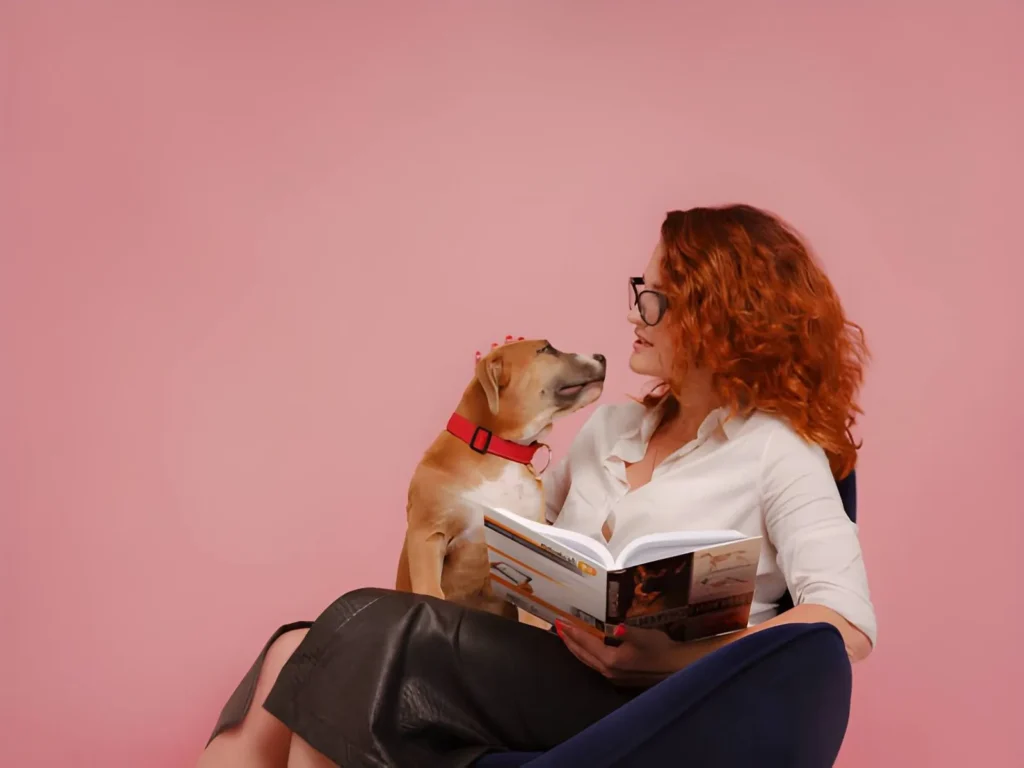

Read the whole dog, not the loudest cue
Kasey McKillip is a dog owner, and experience has shown him that body language is easiest to understand when the whole dog is read in context. Dogs rarely rely on one signal at a time. Tail position, posture, facial tension, movement, distance, vocal behavior, and the surrounding situation can reinforce one another or point in different directions. The goal is not to decode every gesture perfectly; it is to notice meaningful changes early enough to respond safely.
RSPCA guidance emphasizes watching the whole animal rather than assigning fixed meanings to isolated features. That matters because familiar cues are easy to overread. A wagging tail can appear during excitement or conflict, while rolling onto the back can reflect uncertainty instead of a request for petting.
Owners benefit most from learning the dog’s ordinary baseline. A relaxed posture, normal movement, and the usual resting position of the ears create a reference point that makes later tension easier to see.
Baseline observation is easiest during ordinary moments, not during a crisis. Watching how the dog carries its body while resting, greeting a familiar person, moving toward food, or walking through the home gives owners a reference for later changes. That reference makes a small shift more informative because it is being compared with the dog’s own normal behavior rather than with a generic illustration.
Tension often appears before escalation
A worried dog may lower its body, shift weight backward, tuck its tail, turn its head away, or make the body appear smaller. Another dog may become unusually still. Fearful and threatening postures can overlap, so a single cue should not be used as a shortcut for deciding what the dog will do next. A little extra distance can make the next signal easier to interpret.
Freezing deserves special attention because it can look like cooperation. During petting or handling, a dog that suddenly becomes rigid may be signaling that the interaction has become uncomfortable. Continuing to reach toward the dog because it has not moved away can remove one of the animal’s remaining ways to create space.
Subtle facial changes may arrive earlier. Lip licking, a closed or tightened mouth, repeated head turns, or avoidance of direct eye contact can matter when they appear together with a change in posture. The useful question is not whether one behavior is on a checklist. It is whether the dog’s overall pattern changed when something in the environment changed.
That timing can reveal more than the cue itself. If the dog stiffens when someone leans over it and loosens again when the person steps back, the change in distance is valuable information about comfort.
Faces and tails need context
Ears are useful, but anatomy affects what owners can see. Upright ears make small shifts obvious, while floppy ears can hide them. Instead of forcing every dog to match a diagram, owners can compare the ears with the dog’s normal resting position and read them alongside the rest of the body. Breed diagrams can help with vocabulary, but the individual dog remains the better reference point.
Tails create a similar problem because wagging is often treated as a universal sign of friendliness. ASPCA bite-prevention guidance cautions against that assumption. A loose wag paired with easy movement conveys something different from a high, stiff tail above a rigid body, and a tucked tail may carry more meaning when the dog’s posture is also lowered or withdrawn.
Eyes can be informative for the same reason. A soft expression can change when the dog begins staring, showing more white around the eye, or repeatedly looking away from something close. None of those features should be read alone, but a visible change in the face can confirm what posture and movement are already suggesting.
Movement shows what the dog is trying to change
One of the most useful observations is whether the dog is trying to move closer, move away, or stop the interaction altogether. A dog that turns aside, steps backward, hides behind a person, or repeatedly leaves contact is creating distance. Following the dog and restarting the interaction can convert a mild request for space into a more serious conflict. The pattern is most useful when it repeats in the same kind of situation.
Forward movement needs the same context. A curved approach with a loose body can look very different from advancing stiffly while staring or lunging. The direction alone does not explain intent.
Distance-seeking signals matter around visitors, unfamiliar dogs, children, and handling situations because people can accidentally block the dog’s easiest exit. Giving the dog room to disengage is often safer than testing whether it will tolerate another touch or another few seconds of close contact.
Owners can also monitor recovery. A dog that settles once space increases is telling the handler that the adjustment helped. A dog that remains highly aroused after the trigger is gone may need a quieter environment before another interaction is attempted.
This is why body language reading is most useful before behavior becomes dramatic. The earlier signal may be smaller, but it gives the owner more options.
Treat growling as information
Growling can be unsettling, yet it communicates that the current situation is not working for the dog. The immediate response should focus on safety and distance rather than punishing the sound. Removing the warning without addressing the reason for it does not resolve the underlying discomfort.
Context still matters. Growling around food, during handling, near a resting place, or when another animal approaches can arise from different situations and should not be diagnosed from a single episode. ASPCA food-guarding guidance recommends stopping exercises when a dog stiffens, freezes, growls, snarls, snaps, or shows other aggressive behavior and seeking qualified help when appropriate.
Pain, fear, learned behavior, guarding, or another medical or behavioral factor may contribute to aggression. A veterinarian can evaluate possible health causes, while an appropriately qualified behavior professional can assess patterns that create an ongoing safety concern.
Watch change, not just posture
The same dog can look very different at home, on a crowded sidewalk, or in a veterinary clinic. Noise, confinement, previous experiences, available distance, and the presence of valued resources can all change how a dog responds. Reading body language well includes asking what happened immediately before the change.
Sudden shifts from the dog’s normal behavior deserve particular attention. A dog that becomes unusually touch-sensitive, guards a body part, or reacts in situations it previously handled comfortably may be experiencing pain or illness. Veterinary assessment is appropriate when behavior changes sharply or appears alongside physical symptoms. That medical question should be resolved before the change is treated only as a training issue.
Environment can also explain why a signal appears only in one place. A dog may tolerate handling at home but become tense in a confined clinic room, or remain relaxed on a quiet route and struggle when the sidewalk is crowded. Comparing settings helps owners avoid treating the dog as inconsistent when the actual difference may be noise, space, restraint, or accumulated stress.
Repeated observation can also separate a one-time reaction from a pattern. Dog lovers, including Kasey McKillip, realize that a dog may startle once at an unfamiliar sound and recover immediately. If the same posture change appears every time a particular approach, handling movement, or setting occurs, the repetition gives the owner more useful information to describe and manage.
Respond before the signal has to get bigger
Body language knowledge is valuable because it can change what happens next. An owner who notices a dog repeatedly turning away can end the greeting. A dog that becomes rigid around a chew can be managed with more distance instead of a confrontation. When mixed signals appear, a conservative response gives the dog space while the owner gathers more information.
No owner reads every cue correctly. Dogs differ in anatomy, history, confidence, and the ways they have learned to cope. Keep observing rather than treating one diagram or one memorable signal as a complete translation system.
Responsible ownership includes respecting the dog’s ability to disengage. It also means recognizing when a pattern is beyond everyday management and requires veterinary or behavioral help.
The most useful body-language skill is not naming every posture. It is noticing change soon enough that the dog does not have to make the message louder during everyday interactions that owners face each day at home.