
Your outdoor condenser is corroding right now. Not because it’s old or poorly installed, but because you live near the water. Every breeze off the harbor carries chloride particles that land on aluminum fins, copper coils, and steel fasteners, and they don’t just sit there. They pull electrons out of the metal the moment moisture is present. The damage is invisible for the first year or two, then suddenly your system is struggling to hold temperature, your energy bills creep up, and a technician tells you the coil is shot. That’s salt air corrosion doing exactly what it always does.
If you own a home on the Massachusetts South Shore or anywhere within a mile of open water, this article will help you understand the actual mechanism, how to read the warning signs early, and what a smart protection plan looks like before you need a full replacement.
What Salt Air Actually Does to the Metal in Your AC
The condenser unit sitting outside your house is a collection of dissimilar metals: aluminum fins wrapped around copper tubing, mounted in a steel cabinet, held together with galvanized and zinc-coated fasteners. Each one of those material boundaries is a potential galvanic corrosion site the moment a salt-laden electrolyte bridges them, which is exactly what a coastal salt mist does.
Chloride ions are the culprit. They break down the thin oxide layer that normally protects aluminum and steel, exposing fresh metal to continued attack. On the condenser coil, pitting forms first along the fins. That pitting reduces the surface area available for heat exchange, so the compressor has to work longer to shed the same amount of heat. Longer runtime equals more wear, higher electricity consumption, and accelerated bearing and capacitor failure elsewhere in the system.
The electrical side of the outdoor unit suffers just as badly. Contactors, capacitor terminals, and disconnect blocks develop surface oxidation that increases resistance at connections. You might see voltage drop, nuisance trips, or a compressor that’s slow to start. Homeowners usually blame the compressor. The actual cause is a corroded contact point that costs twelve dollars to replace, but by the time anyone finds it the compressor has taken the heat and worn early.
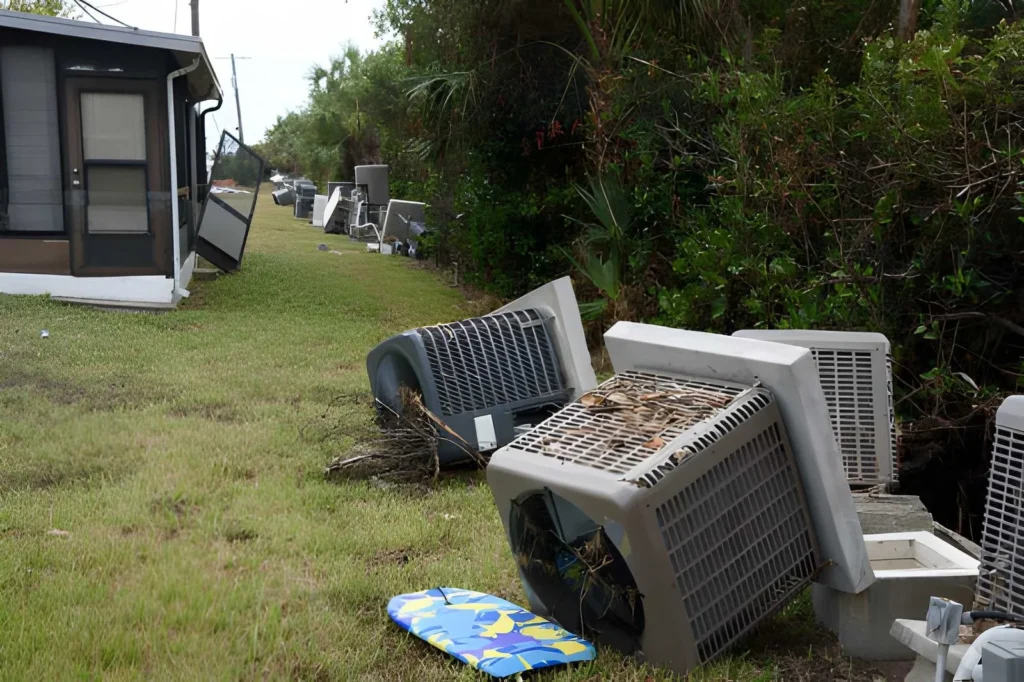
Steel cabinet panels and mounting hardware fare even worse than the electrical components in many cases. Corrosion is most aggressive within the first few hundred feet of the ocean and remains significant for roughly a mile, with salt-accelerated wear documented several miles inland. If your home sits anywhere in that band, which describes most of Cohasset, Scituate, and the surrounding South Shore towns, your equipment is running in a corrosive environment every single day of its life.
The Lifespan Math That Hurts
Here’s the part that makes the replacement conversation sting. ASHRAE, the standards body that sets performance guidelines for the HVAC industry, publishes a median lifespan of 15 years for a residential split or package air conditioner under normal operating conditions. That figure assumes average climate, average maintenance, and no extraordinary corrosive exposure. A coastal property is not average, and the gap between ASHRAE’s median and what actually happens at the shore is significant.
| Installation Type | Typical Lifespan | Notes |
| Standard unit, inland home | 13–15 years | ASHRAE median; average maintenance assumed |
| Standard unit, coastal home (within 1 mile) | 7–10 years | Salt exposure without protection measures |
| Coastal-rated unit, properly sited and maintained | 12–15 years | Coated coils, corrosion-resistant hardware, rinsing schedule |
That middle row is where most coastal homeowners live, and it represents a replacement cycle that can cost thousands of dollars sooner than anyone planned. The good news is the bottom row is achievable without exotic equipment or a large budget. It just requires knowing what to specify from day one.
The broader corrosion picture reinforces how serious the chemistry is. The National Association of Corrosion Engineers estimated the global cost of corrosion at around $2.5 trillion in their 2016 IMPACT study, which equals approximately 3.4% of world GDP. Residential HVAC losses are a slice of that figure, but they’re a painful one because the failure lands directly on the homeowner with no insurance backstop and no depreciation benefit.
A Concrete Cohasset Scenario
Picture a home on Jerusalem Road with the back of the property facing open water. The prevailing southwest wind in summer carries salt spray directly onto the condenser sitting on the south side of the house. The previous owner installed a standard mid-grade central AC system eight years ago. The cabinet is visibly rusting, the fins are bridged with white oxidation deposits, and last summer the system ran almost continuously to hold 74 degrees on a day that was only 88 outside. A technician checks the coil and finds it’s operating at roughly 60% of its original heat-transfer efficiency because the fins have corroded and blocked airflow between them.
This is not an unusual case. It’s the most common story that ac repair cohasset calls tell. The fix at this stage is almost always replacement rather than repair, because a corroded coil in a salt environment will continue deteriorating even after cleaning. The money goes further starting fresh with a coated coil and a plan.
Your Coastal AC Triage Matrix
When a coastal AC system starts underperforming, the decision to repair or replace isn’t always obvious. Use this framework before committing to either:
| Condition | Likely Move | Why |
| Unit under 7 years, no visible coil pitting | Repair and protect | Salt damage is surface-level; a coil coating and rinsing schedule extend life meaningfully |
| Unit 7–10 years, visible fin bridging or pitting | Get a replacement quote alongside repair quote | Repair costs stack fast once coil integrity is compromised; compare 5-year total cost of each path |
| Unit over 10 years, coastal exposure, efficiency drop over 20% | Replace with coastal-rated equipment | Continued repairs on a corroded chassis return diminishing value; spec coated coils this time |
| Any age, corroded electrical contacts causing nuisance trips | Repair the contacts first | Cheap fix that prevents compressor damage; buys time for a planned replacement decision |
The point of this matrix is not to push you toward replacement. It’s to help you see that the age of the cabinet matters less than the condition of the coil and the cost trajectory of continued repairs. Some 9-year-old coastal units are worth protecting. Some 6-year-old ones in direct spray positions are already past the point of reasonable rescue.
What Protection Actually Looks Like
Specify the right equipment upfront and the maintenance list becomes short. Coastal-rated condensers arrive from the factory with epoxy or phenolic coil coatings that prevent chloride from reaching the base metal. Stainless or coated fasteners replace the standard galvanized hardware that develops rust streaks within two or three seasons at the shore. Unit placement matters almost as much as the equipment itself: a condenser tucked behind a knee-wall or positioned out of direct prevailing-wind spray can see dramatically lower salt deposition than one sitting fully exposed.
The maintenance side has three real items. Rinse the outdoor unit with a low-pressure fresh-water hose every four to six weeks through the warm season. Schedule an annual professional inspection that specifically checks coil condition and electrical connections for oxidation, not just a generic tune-up. And watch your energy bills month over month. A quiet efficiency decline of 10–15% over a single summer is usually your first readable signal that the coil is losing ground.
“Maintenance quality, installation practices, and environment including salt air and humidity strongly influence lifespan,” according to a 2025 equipment lifecycle analysis by EGIA Contractor University, drawing on data from Pacific Northwest National Laboratory, NREL, and ASHRAE’s published service-life standards.
Research published in 2022 in Cleaner Engineering and Technology via ScienceDirect modeled corrosion rate changes across 223 coastal counties and found that increased temperature and humidity in those environments promote steel corrosion, with projected decreases in the useful life of steel structures ranging from several percent to over 15% depending on climate trajectory. That’s academic language for what coastal homeowners already know intuitively: the ocean is patient and it always wins unless you give your equipment a fighting chance.
Making the Right Call Before Your Next Summer
The worst time to figure out your coastal AC situation is the first week of July when every HVAC technician in the area is booked two weeks out. Schedule a corrosion-focused inspection now, confirm whether your coil coating is intact, and if you’re approaching that 7-to-10-year window on a unit that’s never had coastal-specific care, get a replacement quote while you have time to evaluate it calmly.
Salt air is not a reason to panic. It’s a reason to plan earlier than inland homeowners do, spec smarter equipment when you replace, and build a simple maintenance rhythm that takes about thirty minutes a month. Do those three things and you shift from the 7-year replacement cycle into the 12-to-15-year window. That’s a real difference in what coastal homeownership costs you over time.