

Definition
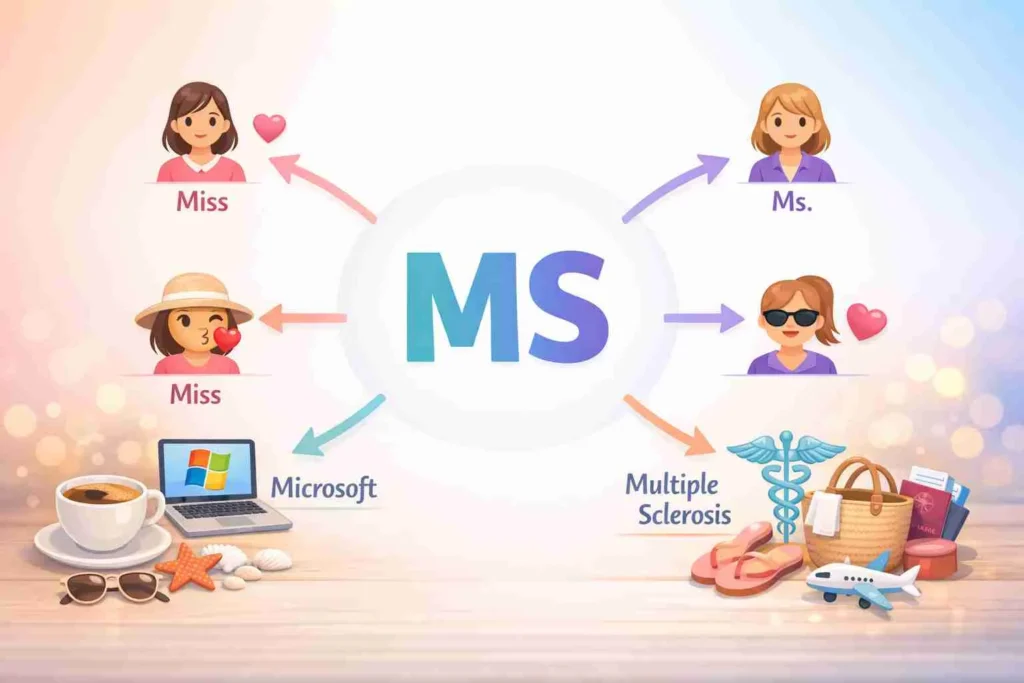
“MS” is a widely used abbreviation with multiple meanings depending on context. Most commonly, it stands for “Miss” (a title for an unmarried woman), “Microsoft” (the global technology company), or “Multiple Sclerosis” (a medical condition).
Ever come across “MS” in a message, email, or social media post and paused for a second wondering what it actually means? You’re not alone.
Unlike slang terms with a single meaning, “MS” is one of those abbreviations that changes its identity depending on where and how it’s used. It can sound formal in an email, casual in a chat, or serious in a medical discussion. Ms meaning.
That’s exactly why understanding context is key.
In this guide, we’ll break down everything you need to know about “MS” from its origins and meanings to real-life examples, tone variations, comparisons, and even polite alternatives you can use in professional settings.
What Does MS Mean in Different Contexts?
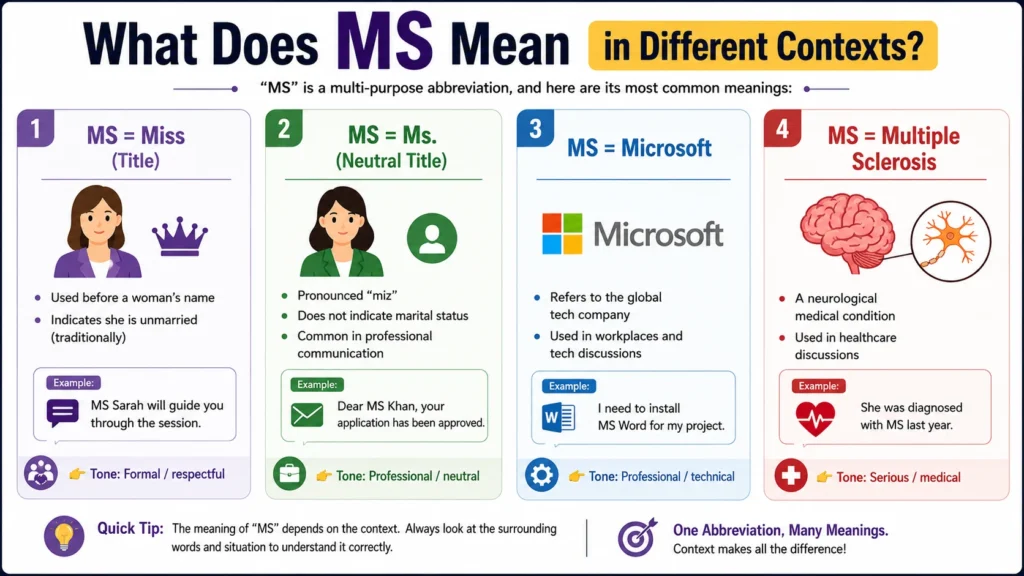
“MS” is a multi-purpose abbreviation, and here are its most common meanings:
1. MS = Miss (Title)
- Used before a woman’s name
- Indicates she is unmarried (traditionally)
Example:
- MS Sarah will guide you through the session.
👉 Tone: Formal / respectful
2. MS = Ms. (Neutral Title)
- Pronounced “miz”
- Does not indicate marital status
- Common in professional communication
Example:
- Dear MS Khan, your application has been approved.
👉 Tone: Professional / neutral
3. MS = Microsoft
- Refers to the global tech company
- Used in workplaces and tech discussions
Example:
- I need to install MS Word for my project.
👉 Tone: Professional / technical
4. MS = Multiple Sclerosis
- A neurological medical condition
- Used in healthcare discussions
Example:
- She was diagnosed with MS last year.
👉 Tone: Serious / medical
5. MS = Manuscript
- Used in writing and publishing
- Refers to a draft or document
Example:
- The author submitted the MS to the editor.
👉 Tone: Professional / literary
Origin and Evolution of “MS”
The abbreviation “MS” has evolved over time, gaining different meanings across industries.
Historical Background:
- “Miss” and “Mrs.” were traditionally used to identify women based on marital status
- “Ms.” emerged in the 20th century as a neutral alternative
- Became popular during the women’s rights movement
Why “Ms.” Became Popular:
- Removes focus from marital status
- Promotes equality and professionalism
- Widely adopted in business and official communication
How “MS” Is Used Today
Today, “MS” is used across multiple areas:
In Texting & Social Media:
- Rarely used as slang
- Mostly appears in formal or contextual references
In Professional Emails:
- Used as a respectful title
- Especially when marital status is unknown
And in Tech & Workplaces:
- Commonly refers to Microsoft products
(MS Excel, MS Word, MS Teams)
In Medical Context:
- Refers to Multiple Sclerosis
- Often used in awareness and healthcare discussions
Real-Life Examples of “MS” in Context
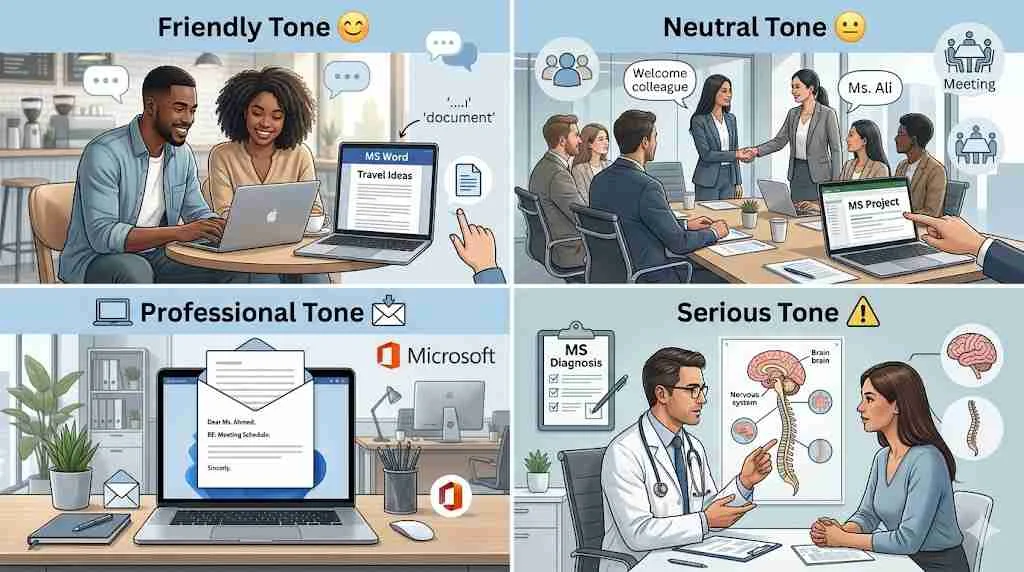
Understanding tone is crucial, so here are examples across different situations:
Friendly Tone 😊
- Hey, did you finish that MS Word file?
- I saw a documentary about MS, it was really informative.
Neutral Tone 😐
- MS Ali will be joining the meeting today.
- Please send the MS by tomorrow.
Professional Tone 📩
- Dear MS Ahmed, thank you for your inquiry.
- The MS Office suite has been updated.
Serious Tone ⚠️
- MS is a condition that affects the nervous system.
- Raising awareness about MS is important.
Example Table | Meanings of “MS” by Context
| Context | Meaning | Example Sentence | Tone |
|---|---|---|---|
| Formal Title | Miss / Ms. | MS Fatima will lead the meeting | Professional |
| Technology | Microsoft | Install MS Excel | Technical |
| Medical | Multiple Sclerosis | He is living with MS | Serious |
| Writing | Manuscript | Submit your MS to the editor | Professional |
MS Abbreviation Meaning
MS is a common abbreviation with several meanings depending on the context. In everyday communication, Ms. is a title used before a woman’s name without indicating her marital status. In technology, MS often stands for Microsoft or Microsoft Office.
In medicine, it commonly refers to Multiple Sclerosis, a disease that affects the central nervous system. In education, MS can also mean Master of Science, a postgraduate academic degree. The intended meaning depends on the situation in which the abbreviation is used.
MS vs Similar Terms
Many people confuse “MS” with similar abbreviations. Here’s a simple comparison:
MS vs Mrs.
- MS → Neutral, doesn’t indicate marital status
- Mrs. → Used for married women
👉 Example:
- MS Khan (unknown status)
- Mrs. Khan (married)
MS vs Miss
- Miss → Unmarried woman
- MS → Neutral, more modern
👉 Tip: Use “MS” in professional settings
MS vs Mr.
- MS → For women
- Mr. → For men
MS vs MRS vs MX
- MS → Neutral
- MRS → Married
- MX → Gender-neutral title
Alternate Meaning of MS
Although less common, “MS” can also mean:
- Master of Science (Academic degree)
- Milliseconds (Time measurement)
- Managed Services (Business/IT term)
- Morphine Sulfate (Medical abbreviation)
👉 Always rely on context to understand the correct meaning.
When to Use “MS” (Best Practices)
Use “MS” when:
- You don’t know a woman’s marital status
- You want to stay professional
- You’re writing formal emails or documents
Avoid using “MS” when:
- The person prefers another title
- You’re in a casual conversation where titles aren’t needed
Polite and Professional Alternatives
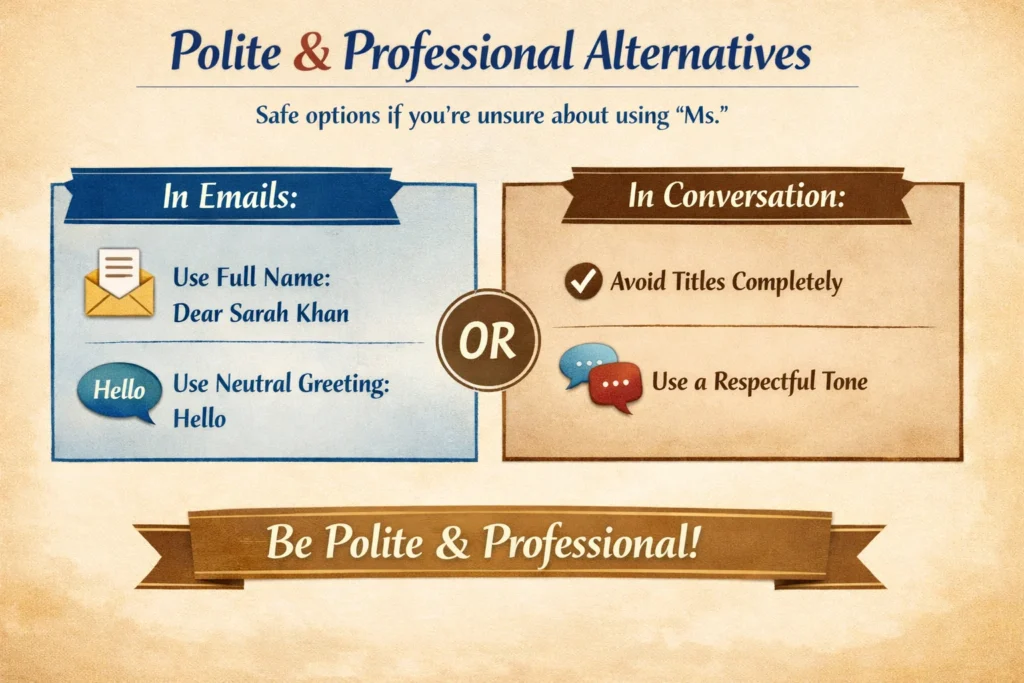
If you’re unsure about using “MS,” here are some safe alternatives:
In Emails:
- Use full name: Dear Sarah Khan
- Use neutral greeting: Hello
In Conversation:
- Avoid titles completely
- Use respectful tone instead
FAQs
What does MS mean in texting?
In texting, MS usually does not have a slang meaning. It often refers to Microsoft, a title like Ms., or depends on the context of the conversation.
Is MS the same as Miss?
Not exactly. Miss refers to an unmarried woman, while MS is a neutral title that does not indicate marital status.
What does MS mean in school or education?
In education, MS can stand for Master of Science, which is a postgraduate academic degree.
Can MS be used for any woman?
Yes, MS can be used for any woman regardless of marital status, making it a safe and respectful option.
What does MS mean in medical terms?
In medical contexts, MS stands for Multiple Sclerosis, a condition affecting the brain and spinal cord.
Is it rude to use MS instead of Mrs.?
No, it is not rude. In fact, MS is often preferred in professional settings because it is neutral and respectful.
How do you pronounce MS as a title?
It is pronounced as “miz,” not “miss.”
What does MS mean in business emails?
In business emails, MS is used as a formal title before a woman’s name when her marital status is unknown or irrelevant.
What does MS stand for?
MS can stand for several things depending on the context, including Ms. (a title for a woman), Microsoft, Multiple Sclerosis, or Master of Science. The correct meaning depends on where and how the abbreviation is used.
What does “Ms.” mean?
Ms. is a respectful title used before a woman’s last name regardless of her marital status. Unlike Mrs. (married) or Miss (traditionally unmarried), Ms. does not indicate whether a woman is married.
Conclusion
“MS” might look like a simple two-letter abbreviation, but it carries a surprising amount of versatility. From formal titles and tech references to medical terminology, its meaning shifts based on context, making it essential to read between the lines.
In modern communication, especially in professional settings, “MS” is widely preferred because it is respectful, neutral, and inclusive. When in doubt, using “MS” or avoiding titles altogether can help you maintain clarity and professionalism without making assumptions.
The key is simple: understand the situation, match the tone, and choose the meaning that fits naturally.
Discover More Related Articles:
- 380 Comebacks to “What Do You Want From Me”: That Keep It Light in 2026
- 478 Reply to “You Have Big Shoes to Fill”: In Leadership Roles in 2026