
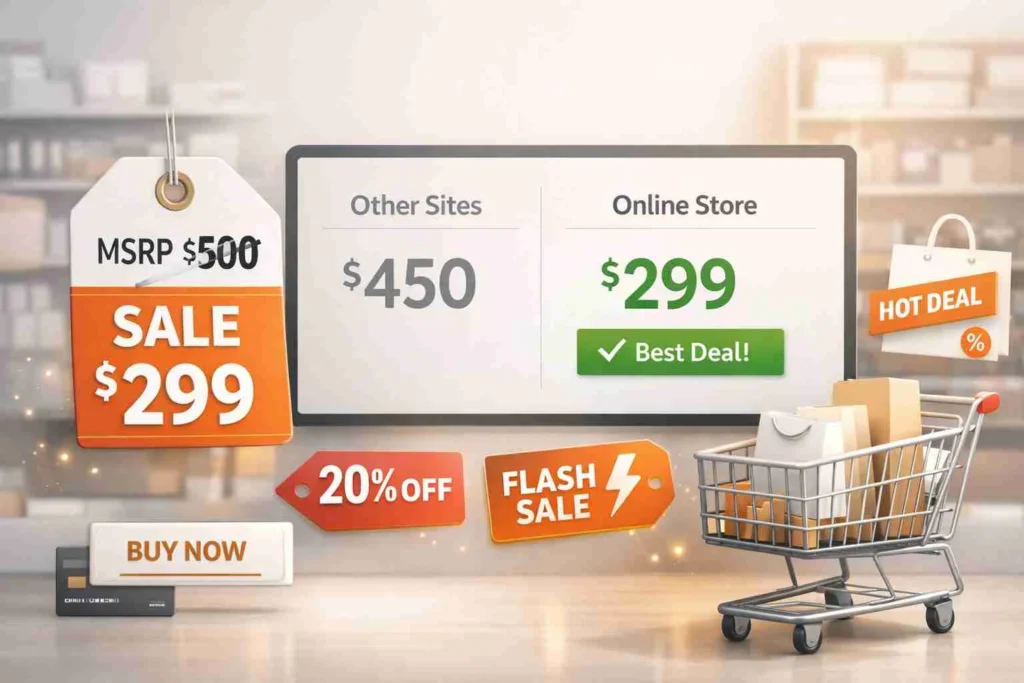

Definition
MSRP (Manufacturer’s Suggested Retail Price) is the price that a manufacturer recommends retailers charge customers for a product. It serves as a guideline rather than a fixed rule, meaning stores can sell the product above or below the MSRP depending on demand, competition, and other factors.
If you’ve ever shopped for a car, electronics, or even clothing, chances are you’ve come across the term MSRP. At first glance, it might seem like just another pricing label but it actually plays a crucial role in how products are priced, marketed, and sold.
Understanding what MSRP means can help you become a smarter shopper. It gives you a reference point, helps you spot real discounts, and prevents you from overpaying. You’re buying a smartphone, negotiating a car deal, or browsing online sales, knowing how MSRP works puts you in control.
In this detailed guide, we’ll break down everything you need to know about MSRP from its origin and real-world use to comparisons, examples, and practical tips you can apply instantly.
What Does MSRP Mean in Simple Terms?
MSRP stands for:
- M – Manufacturer
- S – Suggested
- R – Retail
- P – Price
In simple terms, it is the recommended selling price set by the manufacturer for retailers to follow.
However, here’s the key point:
👉 MSRP is not mandatory. Retailers can adjust prices based on:
- Market demand
- Competition
- Location
- Inventory levels
Origin and Evolution of MSRP
The concept of MSRP began as a way for manufacturers to maintain pricing consistency across different retailers.
Why was MSRP introduced?
Before MSRP, pricing was chaotic:
- Retailers charged vastly different prices for the same product
- Customers had no idea what a “fair price” looked like
- Price wars could damage brand reputation
To solve this, manufacturers introduced MSRP to:
- Create a standard reference price
- Build trust with customers
- Protect brand value
- Help retailers position products correctly
Modern-Day Popularity
Today, MSRP is widely used in industries such as:
- Automobiles 🚗
- Electronics 📱
- Appliances 🏠
- Fashion 👕
It has become especially important in online shopping, where customers compare prices across multiple platforms instantly.
How MSRP Works in Real Life
MSRP acts as a baseline price, but the final selling price can vary.
Example Scenario
Let’s say a smartphone has an MSRP of $1,000.
- Retailer A sells it for $950 (discounted)
- Retailer B sells it for $1,000 (standard)
- Retailer C sells it for $1,050 (premium market)
All are valid because MSRP is only a suggestion.
MSRP Example Table (Pricing Variations)
| Product | MSRP Price | Retail Price | Difference | Reason |
|---|---|---|---|---|
| Smartphone | $1,000 | $950 | -$50 | Discount sale |
| Laptop | $1,500 | $1,450 | -$50 | Competitive pricing |
| Car | $25,000 | $27,000 | +$2,000 | High demand |
| Sneakers | $120 | $100 | -$20 | Clearance |
| Gaming Console | $500 | $600 | +$100 | Limited stock |
Where You Commonly See MSRP
You’ll notice MSRP in many everyday shopping situations:
- Car dealerships (often called “sticker price”)
- Online stores (shown as “original price”)
- Retail shops (printed on packaging or labels)
Important Tip
If you see something labeled as “20% off MSRP,” it means the discount is based on the original suggested price not necessarily the market price.
Tone and Usage of MSRP in Conversations
MSRP is usually used in a neutral or professional tone, but depending on context, it can take on different meanings.
Neutral Tone
- “The MSRP for this laptop is $1,200.”
Friendly Tone 😊
- “That’s a great deal it’s way below MSRP!”
Skeptical or Negative Tone 🤨
- “They’re charging above MSRP? That’s not worth it.”
MSRP vs Other Pricing Terms (Comparison)
Understanding MSRP becomes easier when you compare it with similar pricing terms.
Comparison Table: MSRP vs Other Pricing Terms
| Term | Meaning | Key Difference from MSRP |
|---|---|---|
| MSRP | Suggested price by manufacturer | Not mandatory |
| Retail Price | Actual selling price | Set by retailer |
| Invoice Price | Price retailer pays manufacturer | Lower than MSRP |
| Market Price | Price based on demand/supply | Fluctuates often |
| Sale Price | Discounted price | Temporary reduction |
MSRP vs Invoice Price (Important for Buyers)
Especially in car buying, understanding this difference is powerful:
- MSRP = What the manufacturer suggests
- Invoice Price = What the dealer actually pays
👉 This gap is where negotiation happens.
Real-Life Examples of MSRP Usage
Here are some practical scenarios:
1. Buying a Car
You see a car with:
- MSRP: $30,000
- Dealer offer: $28,500
✔ You’re getting a discount below MSRP.
2. Shopping Online
A jacket shows:
- MSRP: $150
- Sale price: $90
✔ That’s a marketing strategy highlighting savings.
3. Limited Edition Products
- MSRP: $400
- Market price: $700
❗ Happens due to high demand (e.g., gaming consoles)
Usage Examples Table (With Context & Tone)
| Situation | Sentence Example | Tone |
|---|---|---|
| Shopping | “This is below MSRP, so it’s a good deal.” | Friendly |
| Negotiation | “Can you go lower than MSRP?” | Neutral |
| Complaint | “Why is it priced above MSRP?” | Negative |
| Advice | “Always compare with MSRP before buying.” | Informative |
Why MSRP Is Important for Buyers
Understanding MSRP gives you a major advantage:
Key Benefits
- Helps you identify real discounts
- Prevents overpaying
- Acts as a price benchmark
- Useful for negotiation
Why MSRP Matters for Sellers
Retailers also rely on MSRP:
- Ensures pricing consistency
- Maintains brand perception
- Helps marketing (discount claims)
- Guides inventory strategy
Common Misconceptions About MSRP
1. MSRP is the final price ❌
Not true it’s just a suggestion.
2. Lower than MSRP always means a good deal ❌
Sometimes retailers inflate MSRP artificially.
3. MSRP is fixed worldwide ❌
Prices may vary by region and taxes.
Alternate Meanings of MSRP
While rare, MSRP can sometimes mean different things depending on context:
- Minimum Suggested Retail Price (informal variation)
- Internal business terms (rare usage)
However, in almost all consumer contexts, MSRP refers to Manufacturer’s Suggested Retail Price.
Polite or Professional Alternatives to MSRP
In formal or business writing, you might see:
- Suggested retail price
- Recommended selling price
- List price
- Base price
These terms are often used interchangeably, though slight differences may exist.
Practical Tips for Using MSRP Smartly
Before Buying
- Always compare MSRP with multiple retailers
- Check historical pricing (not just discounts)
- Be cautious of “fake discounts”
During Negotiation
- Use MSRP as a starting point
- Aim closer to invoice price (for cars)
- Ask for additional perks if price won’t drop
Advanced Insight: MSRP and Marketing Psychology
MSRP is also a powerful marketing tool.
How it influences buyers
- Creates a perception of value
- Highlights discounts clearly
- Anchors customer expectations
For example:
- Seeing “Was $200, Now $120” feels like a big win even if the actual value is subjective.
FAQs
What does MSRP mean in simple words?
MSRP means the price a manufacturer recommends retailers charge for a product, but stores can sell it for more or less depending on various factors.
Is MSRP the same as the selling price?
No, MSRP is only a suggested price. The actual selling price is decided by the retailer and may differ.
Why do retailers sell above MSRP?
Retailers may charge more than MSRP due to high demand, limited supply, or market trends.
Can you negotiate below MSRP?
Yes, especially for big purchases like cars. Many retailers are open to negotiation below MSRP.
Is MSRP always accurate?
Not always. Some companies set higher MSRP to make discounts look bigger.
What is the difference between MSRP and invoice price?
MSRP is the suggested selling price, while invoice price is what the retailer pays the manufacturer.
Why is MSRP important for buyers?
It helps buyers understand they’re getting a fair deal or overpaying.
Do all products have an MSRP?
Most branded products do, but some items especially handmade or local goods may not have a defined MSRP.
Conclusion
MSRP is more than just a number on a price tag it’s a powerful reference point that shapes how products are priced, marketed, and perceived. While it represents the manufacturer’s recommended price, the actual amount you pay can vary widely depending on demand, competition, and timing.
For buyers, MSRP is a tool for smarter shopping. It helps you recognize genuine discounts, negotiate confidently, and avoid overpaying. For sellers, it acts as a pricing guide that maintains consistency and brand value.
The key is not to treat MSRP as a fixed rule, but as a starting point for evaluating value. When used correctly, it becomes one of the most useful concepts in everyday purchasing decisions.
Discover More Related Articles:
- “RS” Mean in Text: You’ve Seen It Everywhere In 2026
- “ION” Mean in Text: Don’t Misunderstand This Slang In 2026
- “Chuzz” Meaning in Social Media: Why People Are Using It In 2026