


A concubine is a woman in a recognized, long-term partnership with a man of higher social status but she has no legal rights as a wife. Unlike a mistress, her role is semi-formal and often public; unlike a wife, her children inherit less or nothing at all.
What exactly is a concubine?
And no, it’s not just a fancy word for a mistress.
You’ve probably heard the term in movies, history books, or even the Bible. But most people get the concubine meaning wrong. They confuse her with a wife. Or worse, they dismiss her as just a secret lover.
Here’s the truth.
A concubine held a real, recognized place in many ancient societies. She wasn’t a wife, but she also wasn’t hidden away. Her children could become kings. Her influence could topple empires. Think of Yang Guifei in Tang Dynasty China. Or Hürrem Sultan in the Ottoman Empire. These women started as concubines and reshaped history.
By the end of this guide, you’ll know the concubine definition inside and out. You’ll understand how it differs from a wife or mistress. You’ll see real historical examples. And you’ll never misuse the word again.
Let’s kill the biggest confusion first.
A Simple Concubine Definition

Let’s start with the most direct concubines meaning.
A concubine is a woman who lives in a recognized, often long-term sexual and domestic partnership with a man of higher social rank. But she does not have full marital status. concubines definition. define concubine.
That’s it in a nutshell.
The meaning of concubine changes slightly depending on the culture and time period. But the core idea stays the same: she’s a secondary partner with fewer legal rights than a wife.
Here’s what the concubine definition includes:
- A formal or semi-formal arrangement, not a secret affair.
- Cohabitation with the man, often in his household.
- Recognized by the community, even if not fully by law.
- Her children may inherit, but usually less than a wife’s children.
And here’s what it does not include:
- Legal marriage.
- Full inheritance rights.
- Equal social status to a wife.
- Protection under marriage laws.
So when someone asks, “what is a concubine?” the short answer is: a recognized but legally inferior partner.
Now let’s break that down further.
Royal Concubine Meaning
A royal concubine was a woman who had an officially recognized relationship with a king, emperor, sultan, or other ruler but was not his legal wife or queen. In many historical societies, royal concubines lived within the royal household and could hold significant influence, although their status was usually lower than that of the ruler’s wife.
Some royal concubines gained wealth, political power, or special privileges, and their children were sometimes eligible for succession depending on local laws and traditions. Examples of royal concubines can be found in the courts of ancient China, the Ottoman Empire, Egypt, and other monarchies throughout history.
Concubine in English| How to Say It and Use It
First, the concubine pronunciation.
Say it like this: KONG-kyoo-bine
- KONG rhymes with “long”
- kyoo sounds like the letter Q
- bine rhymes with “vine”
Three syllables. Stress the first one. KONG-kyoo-bine.
Now, how do you use concubine in English sentences today?
You mostly see it in historical or biblical contexts. It’s not a common everyday word. But when you do use it, be precise.
Correct examples:
- “In ancient China, the emperor had one wife and hundreds of concubines.”
- “The Bible describes Hagar as a concubine of Abraham.”
- “A concubine’s children could inherit if the wife had no sons.”
Incorrect examples (common mistakes):
- “He introduced his concubine at the company party.” (No. That’s not how it works today.)
- “She’s basically his concubine.” (Unless you’re in an ancient royal court, no she isn’t.)
The concubine meaning in simple words is: a long-term female partner who isn’t a wife but has a recognized place in the man’s household.
That’s clear enough for any student or curious reader.
Concubine Synonym and Antonym | A Handy Table
No single word perfectly matches the concubine synonym list. But some come close. Others are outright opposites.
Here’s a quick reference table for concubine synonyms and antonyms.
| Synonyms (close but not exact) | Antonyms (opposite roles) |
|---|---|
| Consort (royal) | Wife (legal spouse) |
| Secondary wife (in polygamous cultures) | Husband |
| Court companion | Unmarried person |
| Kept woman (derogatory) | Single woman |
| Paramour (more secretive) | Legal spouse |
Let’s clarify the confusion.
A consort is usually a wife or husband of a monarch. A concubine is not a wife, so “consort” isn’t quite right.
A mistress is often a secret lover supported financially. A concubine lives in the household openly. Different animals entirely.
So when you search for a concubine synonym, remember: nothing fits perfectly. That’s because the role itself was unique.
The best short synonym? Secondary wife. But only in cultures where polygamy existed.
What Is a Concubine? Real Historical Examples
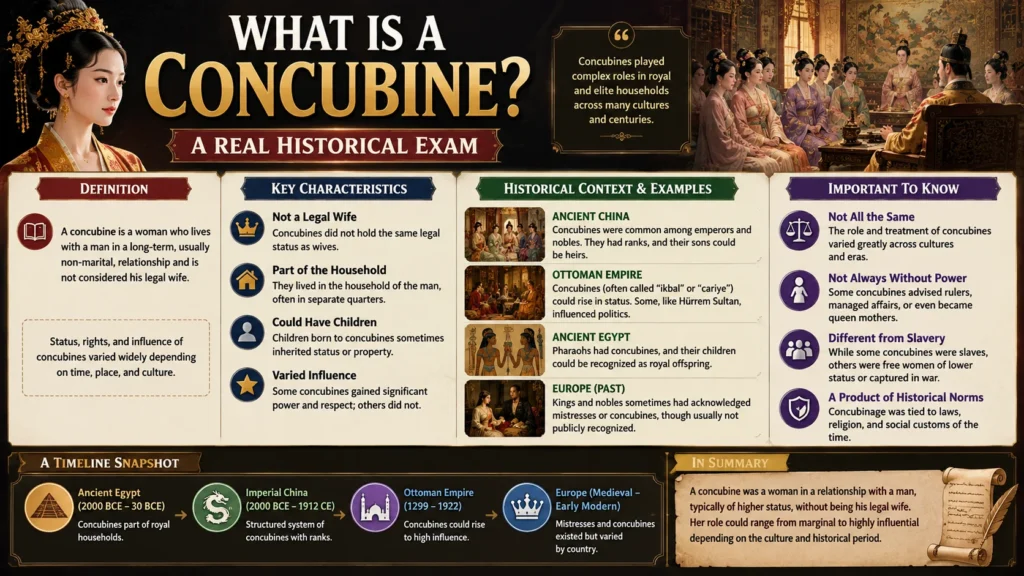
To truly understand the concubine meaning, you need stories. Real people. Real palaces. And real politics.
Let’s look at three major civilizations where concubines shaped history.
Ancient China and the Imperial Harem
China’s emperors took concubinage to an extreme.
The emperor had one legal wife: the Empress. But he could have thousands of concubines. Yes, thousands. The Forbidden City in Beijing housed entire palaces just for them.
These women lived in a strict hierarchy. At the top: the Empress. Below her: consorts, concubines, and servants. Each rank had different privileges, salaries, and living quarters.
Why did Chinese emperors have so many concubines?
- To guarantee male heirs. A single wife might only have daughters or no children at all.
- To show off wealth and power. More concubines meant more status.
- To secure political alliances. Families sent their daughters to become concubines, hoping for favor.
Famous example: Yang Guifei
Yang Guifei started as a concubine of Emperor Xuanzong of Tang. She became his absolute favorite. The emperor neglected state affairs for her. It led to a massive rebellion. She was eventually forced to commit suicide. Her story appears in poems, plays, and films for over a thousand years.
Another example: Wu Zetian
Wu Zetian entered the emperor’s court as a low-ranking concubine. She worked her way up. Then she became the emperor’s wife. And then? She became the only female emperor in Chinese history. A concubine turned supreme ruler. That’s power.
The Ottoman Empire and the Harem System
The Ottoman Empire had a different system. Their concubines were often slaves from non-Muslim countries. But here’s the twist: those concubines could rise higher than almost any woman in Europe at the time.
The Ottoman harem wasn’t just a pleasure palace. It was a political training ground. Mothers of sultans wielded enormous influence. Some ruled the empire through their young sons.
Famous example: Hürrem Sultan
Hürrem Sultan started as a slave and concubine. She caught the eye of Suleiman the Magnificent. He broke every tradition by marrying her. She became his legal wife and one of the most powerful women in Ottoman history. She corresponded with foreign kings, built charitable foundations, and advised her husband on state matters.”
The Bible: Concubine Meaning in Scripture
The concubine meaning in the Bible is slightly different. Biblical concubines had recognized status but still weren’t full wives.
Examples of concubines in the Bible:
- Hagar (Genesis 16): Sarah gave Hagar to Abraham as a concubine to bear a child. After Hagar became pregnant, tension exploded. Hagar and her son Ishmael were eventually sent away.
- Bilhah and Zilpah (Genesis 30): Rachel and Leah, wives of Jacob, gave their maidservants to him as concubines. Those concubines bore four of Jacob’s twelve sons.
- The Levite’s concubine (Judges 19): A tragic story. The Levite’s concubine ran away. He brought her back. She was brutally abused and died. The story led to a civil war in Israel.
**Key takeaway about concubine meaning in the Bible : The Bible doesn’t endorse concubinage. It simply records it as a historical reality, like polygamy or slavery. The laws around concubines in the Old Testament gave them some protection but never equal status to wives.
So what is a concubine in biblical terms? A secondary female partner recognized by custom but not given full marital rights.
Concubine vs Wife | Key Differences
This is the most common question people ask. What is the difference between a wife and a concubine?
Let’s make it crystal clear.
| Factor | Wife | Concubine |
|---|---|---|
| Legal status | Protected by formal marriage laws | Protected by custom, not law |
| Social standing | High. Invited to official events. | Lower. Often seated separately. |
| Children’s inheritance | Full inheritance rights. Primary heirs. | Limited rights. Could inherit if no wife’s sons existed. |
| Ability to leave | Could divorce or seek legal separation. | Could be dismissed without recourse. |
| Ceremony | Formal wedding. Religious or legal vows. | Simple or no ceremony. Sometimes a contract. |
| Recognition | Public. Everyone knows her as the wife. | Semi-public. Known within the household but not always outside. |
Now, here’s where nuance matters.
Some concubines lived better than poor wives. A concubine of a wealthy noble might have silk clothes, servants, and fine food. Meanwhile, a farmer’s wife worked the fields.
But the legal difference was brutal.
If the man died, the wife inherited his estate and managed the household. The concubine could be thrown out the next day. No protection. No safety net.
That’s the real difference between concubine and wife. It was never about love or affection. It was about legal power.
Why Did Kings Have Concubines? The Real Reasons

Let’s bust a myth right now.
Kings didn’t have concubines just for pleasure. That’s a Hollywood fantasy. The real reasons were cold, practical, and political.
1. Heirs, Heirs, Heirs
Royal succession depended on healthy sons. A single wife might have ten daughters and no sons. Or she might die in childbirth. Or become infertile.
Concubines provided a backup system. More women meant more chances for a male heir. Dynasties didn’t survive without sons. Concubines helped them survive.
2. Political Alliances
A king couldn’t marry every nobleman’s daughter. Marriage was too serious. It created legal ties, inheritance claims, and political expectations.
But taking a daughter as a concubine? That still honored her family. It created an alliance. But it didn’t give her father a claim to the throne.
Smart politics.
3. Prestige and Wealth
In many cultures, a man’s status was measured by his household. More women meant more wealth. More workers. And more children.
When a king had hundreds of concubines, everyone knew he was powerful. It was a flex. A brutal, expensive flex.
4. Care for Women
This one sounds strange to modern ears. But in some ancient societies, being a concubine was better than available alternatives.
A widow with no male relatives? She might starve. A woman from a poor family? She might become a servant or a prostitute.
Becoming a concubine offered food, shelter, and protection. It wasn’t freedom. But it was survival.
So when someone asks why did kings have concubines, don’t just say “for sex.” Say: for heirs, alliances, prestige, and sometimes even charity. The truth is more interesting than the myth.
Is a Concubine the Same as a Mistress?
No. Absolutely not.
This confusion drives historians crazy. Let’s settle it once and for all.
| Factor | Concubine | Mistress |
|---|---|---|
| Recognition | Recognized openly by the man and community. | Usually secret. Hidden from the wife. |
| Living arrangement | Lives in the man’s household. | Lives separately. The man visits her. |
| Status | Has a defined rank (low, but defined). | No official rank. Socially shameful. |
| Children | Children are recognized, even if limited. | Children are often illegitimate. No rights. |
| Historical context | Formal role in many ancient societies. | Existed in most societies but was taboo. |
Think of it this way.
A concubine is like a junior partner with a title. She’s on the org chart. Her role exists.
A mistress is an off-the-books contractor. No title. No recognition. And o protection.
So is a concubine the same as a mistress? Only if you ignore every historical and legal detail.
What Is Concubinage? The System Explained
Concubinage is the practice or system of keeping concubines. It’s the noun for the entire arrangement.
Concubinage existed on nearly every continent. It appeared in:
- Ancient China, Japan, Korea
- The Ottoman Empire and Islamic caliphates
- Ancient Egypt, Rome, Greece
- Pre-colonial Africa (many kingdoms had secondary wives)
- The Bible lands (Israel, Canaan, Mesopotamia)
Each culture had its own rules. But most shared common features:
- The concubine’s children had fewer inheritance rights.
- The concubine herself had no legal claim to the man’s property.
- The arrangement could end at any time, usually by the man’s choice.
- The concubine’s family often received payment or gifts.
Concubinage wasn’t marriage. But it also wasn’t casual. It occupied a strange middle ground that modern English doesn’t have a perfect word for.
Are Concubines Still Common Today?
The short answer is no – legally speaking.
Most countries abolished concubinage over the last two centuries. Modern marriage laws, women’s rights movements, and economic changes made the system obsolete.
But.
Unofficial arrangements still exist. They just use different names.
In parts of West Africa, some wealthy men maintain multiple female partners in a way that resembles historical concubinage. In Southeast Asia and the Middle East, “temporary marriages” or unregistered partnerships sometimes fill a similar role.
Even in the West, you might hear people compare “baby mama” situations to concubinage. Economically dependent. Children involved. No legal marriage. The comparison isn’t perfect, but the echoes are there.
However, what is a concubine in modern legal terms? Nothing. The word is almost always historical now. You won’t find legal concubines in the United States, Europe, or most of Asia.
So if someone today calls a woman a concubine, they’re either:
- Speaking historically (“she was a concubine in ancient China”)
- Speaking biblically (“Hagar was a concubine”)
- Or using the word as an insult (don’t do this)
Concubine Etymology | Where the Word Comes From

Words have histories. And the concubine etymology is surprisingly straightforward.
The word comes from Latin.
- Con- meaning “with” or “together”
- -cumbere meaning “to lie down”
Literally: “to lie with.”
The Romans used concubina for a woman who lived with a man without being his wife. It wasn’t a compliment, but it also wasn’t the worst insult.
From Latin, the word moved into Old French as concubin. Then into Middle English around the 13th century.
The meaning of concubine hasn’t changed much in 800 years. It’s always meant: a recognized female partner who isn’t a wife.
That’s rare. Most words drift over time. This one stayed remarkably stable.
FAQs
What does concubine mean in simple words?
A woman in a long-term, recognized relationship with a powerful man. But she’s not his wife.
What is concubinage?
The system or practice of keeping concubines.
Were concubines legally married?
No. That’s the entire point of the distinction.
What was the role of a concubine?
To provide companionship. Bear children. Cement political alliances. And rarely, to seize power and become ruler.
Concubine meaning in Urdu?
لونڈی (Laundi) or رکھیل (Rakhel). Both carry negative tones. Use carefully.
Concubine meaning in Hindi?
रखैल (Rakhel) or उपपत्नी (Upapatni). Again, not polite terms.
What does concubine mean in the Bible?
A secondary female partner recognized by custom but not given full marital rights. Examples include Hagar, Bilhah, and Zilpah.
Difference between concubine and wife?
A wife has legal status, full inheritance rights for her children, and social recognition. A concubine has none of these.
What is a concubine in history?
A semi-formal partner in ancient royal courts and households. Often a political tool for producing heirs and forging alliances.
Conclusion
You might wonder: why bother learning about concubines?
Fair question.
The concubine meaning matters because it shows us how differently societies organized family, power, and gender. It reminds us that “marriage” wasn’t always the only option. And it forces us to ask uncomfortable questions about women’s rights, then and now.
A concubine was not a wife. But she wasn’t nothing, either.
She occupied a strange middle space. Recognized but not protected. Valued but not equal. Close to power but never fully safe.
That’s the real concubine definition. Not just a historical footnote. But a mirror reflecting older, harsher ideas about women, status, and survival.
Got more questions? Keep reading. Keep learning. History has plenty of strange stories left to tell.
Discover More Related Articles:
- “Glaze” Meaning Slang: What It Really Means in Internet Conversations In 2026
- “67” Meaning Slang: How It’s Used in Online Conversations In 2026
- “Cap” Slang Meaning: From Street Language to Social Media in 2026