
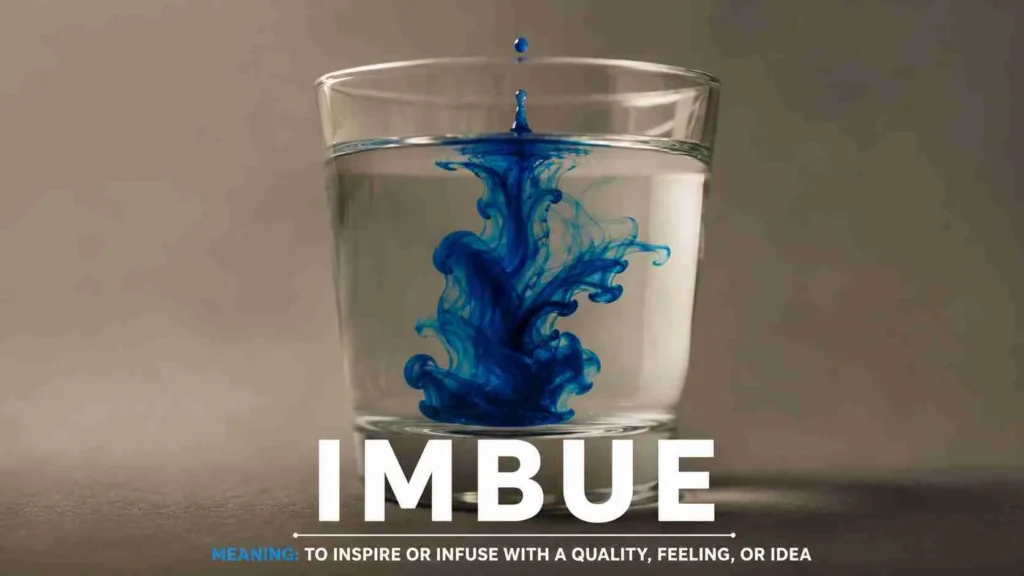

Imbue means to fill someone or something completely with a specific quality, emotion, or idea so thoroughly that the quality becomes part of that person or thing. You always imbue someone or something with a trait, like a mentor imbuing a student with confidence or a ritual imbuing an object with sacred meaning.
You’ve seen a parent kneel down and whisper something to a terrified child before a school play. A moment later, that kid walks on stage like a tiny warrior.
What happened there?
The parent didn’t just say “good luck.” They poured courage into that child. They filled a small, scared person with a quality that didn’t exist a second before.
That exact act has a name. It’s called imbue.
Here’s what you’ll learn in this guide. We’ll cover the clear definition, the right pronunciation, where the word came from, and every synonym worth knowing. You’ll get real sentence examples. You’ll understand how imbue differs from infuse and instill. And you’ll even learn the Urdu and Hindi meanings plus how the Bible uses this powerful verb.
No fluff. Just useful knowledge you can use today.
A Clear Definition of Imbue
Let’s start with the core imbue definition.
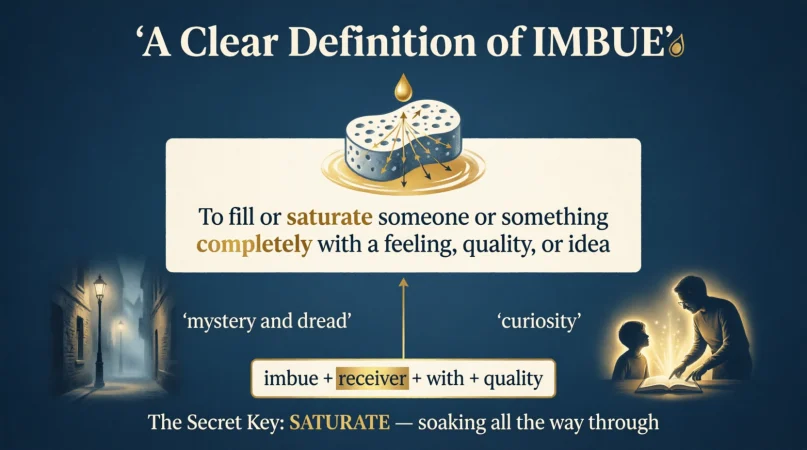
Imbue (verb) : To fill or saturate someone or something completely with a feeling, quality, or idea.
Notice the word “saturate.” That’s important. Imbue isn’t about adding a thin layer. It’s about soaking all the way through.
Think of a sponge dropped into a bucket of water. The sponge doesn’t just get wet on the outside. Water reaches every pocket, every corner, every tiny hole. That’s imbuing.
Here are two quick examples to lock it in:
- A great novelist can imbue a boring street corner with mystery and dread.
- A kind teacher can imbue a struggling student with genuine curiosity.
The verb meaning stays consistent every time. You imbue someone or something with a quality. You never “imbue to” or “imbue at.” The grammar is simple: imbue + receiver + with + quality.
So when you search for imbue dictionary meaning, remember that word “saturate.” It’s the secret key.
How to Pronounce Imbue & Why People Get It Wrong
Let’s clear this up right now. The imbue pronunciation is:
/ɪmˈbjuː/
Say it like this: im-BYOO
- First syllable: “im” (like the word “him” without the H)
- Second syllable: “BYOO” (rhymes with “you” but starts with a B)
Here’s a trick. Say “I’m blue” quickly. Now change the L to a B. “I’m byoo.” That’s almost it. Just blend the two syllables tighter.
The most common mistake? People say “im-BOO” with a long OO sound like “boo” from a ghost. That’s wrong. It’s BYOO with a Y sound in the middle.
Practice out loud three times.
Im-BYOO. Im-BYOO. And Im-BYOO.
Got it? Good. Now no one will correct you again.
Where Did Imbue Come From?
The imbue origin goes back to Latin. The root word is imbuere. That Latin verb means “to wet, to moisten, or to steep.”
Let that sink in. For the Romans, imbuere described what happens when you dip cloth into dye. The liquid doesn’t just touch the surface. It seeps into every fiber. The cloth becomes the color.
Later, Old French picked it up as embu(u)er, meaning “to soak in.” Then Middle English borrowed the word, and over time, “imbue” shifted from physical soaking to emotional and spiritual filling.
The imbue etymology explains everything. You’re not just giving someone confidence. You’re steeping them in it like a tea bag in hot water.
That’s why you can’t half-imbue something. Either the quality saturates the person or object or it doesn’t. There’s no middle ground.
Imbue Synonyms
Most people just grab the first synonym they find. That’s a mistake. Here are the real imbue synonyms with their specific flavors.
| Synonym | Best used when… | Example sentence |
|---|---|---|
| infuse | You add a quality gradually, like steeping tea | He infused the meeting with playful energy |
| instill | You plant an idea in someone’s mind over time | She instilled a lifelong love of reading |
| permeate | The quality spreads throughout every part | Panic permeated the crowd |
| saturate | You fill something completely, sometimes too much | Ads saturate every inch of the website |
| inspire with | You spark a creative or emotional feeling | The speech inspired them with hope |
| endow with | You give a natural, often permanent quality | Genetics endowed her with perfect pitch |
| suffuse | Light, color, or emotion spreads softly across | Sunlight suffused the morning room |
| implant | You fix an idea firmly into someone’s mind | The camp implanted a sense of discipline |
So which synonym should you use?
Use infuse when the quality blends into something like sugar into iced tea.
Use instill when you repeat a lesson until it sticks.
And use permeate when the quality spreads on its own without anyone actively putting it there.
Use imbue when you want the strongest, most complete version of filling something up.
Here’s a simple test. If you can replace the word with “soaked,” pick imbue. If you can replace it with “mixed in,” pick infuse. And if you can replace it with “taught slowly,” pick instill.
Imbue Antonyms
You can’t understand a word fully until you know its opposite. Here are the clean imbue antonyms.
| Antonym | Meaning | Example |
|---|---|---|
| strip of | Remove a quality completely | The scandal stripped him of dignity |
| drain from | Pull a quality out like liquid | The long war drained hope from the nation |
| deprive of | Keep someone from having a quality | Poverty deprived them of opportunity |
| empty of | Take everything out until nothing remains | Criticism emptied the room of joy |
| eradicate from | Wipe out a quality entirely | The new policy eradicated trust from the team |
| withdraw | Take back a quality you gave | She withdrew her emotional support |
Notice the pattern. All antonyms involve removal or absence. Imbue adds. Antonyms subtract.
If a leader imbues a team with confidence, that team feels bold and capable. If the same leader later drains confidence from the team, those same people feel small and doubtful.
That’s the power of the word. It works in both directions.
Imbue Used in a Sentence
Theory is fine. Examples are better. Here are imbue used in a sentence across different contexts. Read each one out loud. Feel how the word works.
Emotions and Confidence
- A single text from her mother could imbue the nervous bride with instant calm.
- The coach didn’t teach new skills. He just imbued the benchwarmers with a belief they could win.
- That old photograph imbues me with an unexplainable sadness every time I see it.
Values and Beliefs
- Religious rituals often aim to imbue followers with humility and gratitude.
- His grandfather imbued him with a stubborn sense of fairness that never faded.
Art, Literature, and Meaning
- In The Great Gatsby, Fitzgerald imbues the green light with desperate longing and impossible dreams.
- The director used silence to imbue every frame with creeping dread.
- A simple clay pot becomes priceless when a culture imbues it with ancestral meaning.
Purpose and Knowledge
- The best history teachers don’t just recite dates. They imbue each war and treaty with human consequence.
- Years of failure finally imbued her with the wisdom that success never promised.
One more for the road.
That tiny coffee shop imbues even its paper cups with a sense of belonging.
See how the word carries weight? You wouldn’t say “imbue” for a minor feeling like mild annoyance. You save it for deep, total filling.
Imbue vs Infuse vs Instill
This confuses almost everyone. Let’s kill the confusion forever.
Imbue means to fill something so completely that the quality becomes part of its identity. The receiver is often passive. The quality saturates it from the outside in.
The ritual imbued the necklace with protective power.
Infuse means to introduce a quality into something, often gradually. The focus is on the act of adding. The final result is a blend, not a takeover.
He infused the soup with garlic and rosemary.
Instill means to put an idea or habit into someone’s mind through repeated effort over time. You can only instill into people, not objects.
She instilled punctuality in her children by requiring them to be early every single day.
Here’s a table to make it crystal clear.
| Word | Best for | Receiver type | Speed | Final state |
|---|---|---|---|---|
| imbue | Complete saturation | People or things | Instant or fast | The receiver becomes the quality |
| infuse | Blending a quality in | Things or situations | Gradual | The quality mixes with what’s already there |
| instill | Planting a habit or idea | People only | Slow, over time | The idea takes root in the mind |
Still not sure? Try this trick.
If you’re describing a one-time event that transforms something, use imbue.
Her hug imbued me with strength.
If you’re describing a process that adds flavor or energy, use infuse.
His jokes infused the party with laughter.
If you’re describing repeated lessons that shape behavior, use instill.
My father instilled respect for hard work.
Now you know. Use each word with precision.
How to Use Imbue Naturally in Your Own Writing
You don’t want to sound like a dictionary. You want to sound like a human who knows their words. Here’s how.
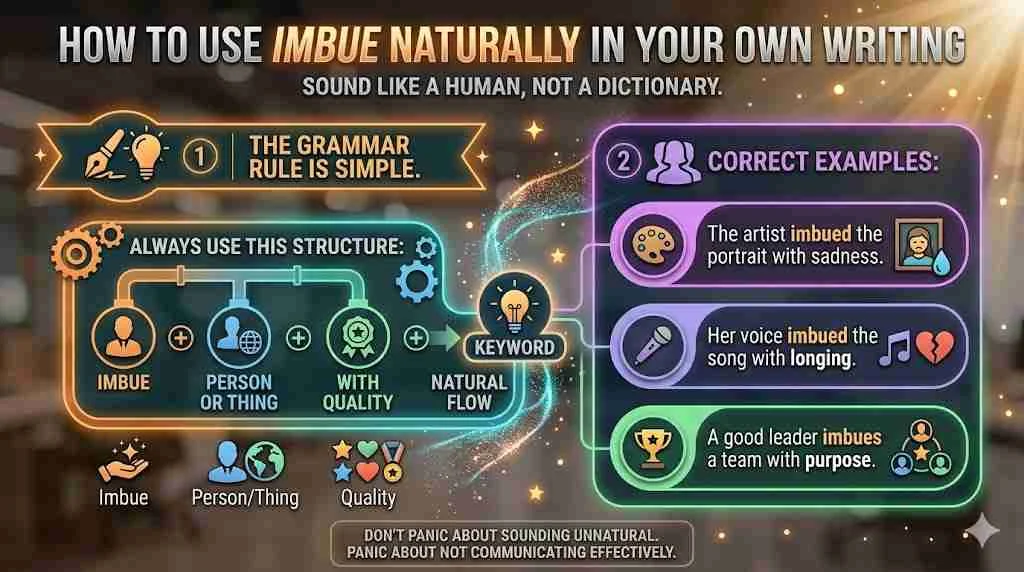
The grammar rule is simple.
Always use this structure:
Imbue + person or thing + with + quality
Correct examples:
- The artist imbued the portrait with sadness.
- Her voice imbued the song with longing.
- A good leader imbues a team with purpose.
Incorrect examples:
- The artist imbued sadness to the portrait. (Wrong preposition)
- The artist imbued the portrait by sadness. (Wrong preposition)
- The artist imbued the portrait sadness. (Missing “with”)
Just remember the phrase “fill with.” You fill a glass with water. You imbue a person with courage. Same pattern.
How often should you use imbue?
Don’t overdo it. Imbue is a strong verb. It hits hard. Once every 500 to 800 words is plenty. If you use it twice on the same page, the second use loses its punch.
When should you use the passive form?
Sometimes passive is fine. Say you want the focus on the person receiving the quality, not the giver.
- Passive: She was imbued with a quiet sense of justice.
- Active: Her father imbued her with a quiet sense of justice.
Both work. Choose active when you want energy. Choose passive when you want the spotlight on the receiver.
For students and easy definition seekers.
Here’s the simplest version you can share with a child or an English learner.
Imbue means to fill something so full of a feeling that the feeling becomes part of it.
That’s it. No fancy words. No Latin roots. Just a clean easy definition of imbue.
Imbue Meaning in Urdu, Hindi and the Bible
Language learners search for translations constantly. Here’s what they need to know.
Imbue meaning in Urdu
The closest Urdu equivalents are:
- متاثر کرنا (mutasir karna) – to affect deeply
- لبریز کرنا (labrez karna) – to fill to the brim
If you say usne bachay mein himmat bhhar di, you’re saying “he imbued the child with courage.” The idea of “filling to the brim” is baked into Urdu’s verb bharna.
Imbue meaning in Hindi
Hindi speakers use similar concepts:
- भर देना (bhar dena) – to fill completely
- डालना (daalna) – to put or instill
A common Hindi sentence: Guru ne shishya mein gyaan bhar diya. That means “The teacher imbued the student with knowledge.”
Imbue meaning in the Bible
The Bible doesn’t use the word “imbue” directly in most translations. But the concept appears constantly.
Colossians 3:16 says, “Let the word of Christ dwell in you richly.” That’s imbuing. The message doesn’t just touch the believer. It takes up residence.
Old Testament prophets often described God “pouring out” His spirit. That’s the same idea. The spirit saturates the person so completely that they act differently, speak differently, and think differently.
So when someone asks for imbue meaning in the Bible, tell them this: It’s the difference between hearing a rule and becoming the kind of person who lives that rule without thinking.
What Does Imbue Mean in Literature?

Writers love this word. For good reason.
When an author imbues an object, character, or setting with meaning, that element stops being ordinary. It becomes a symbol.
Think about the green light in The Great Gatsby. On the surface, it’s just a light at the end of a dock. But Fitzgerald imbues that light with Gatsby’s longing for Daisy, his dream of the past, and the painful distance between who he is and who he wants to be.
That’s the magic. A simple object suddenly carries the whole weight of the novel’s theme.
Here’s how modern writers use imbue in literature today.
- The author imbues the abandoned house with the ghost of every argument that happened inside it.
- She imbues each minor character with a secret desire you only discover pages later.
- The poet imbues a rainy bus stop with the loneliness of an entire city.
If you write fiction or creative nonfiction, learn this word. It names exactly what you’re trying to do when you make ordinary things matter.
Imbued vs Imbues
You’ll see both forms. Here’s when to use each.
Imbued is the past tense and the past participle.
Past tense example: Her speech imbued the team with energy yesterday.
Past participle example: The team was imbued with energy after her speech.
Imbues is the third-person present tense. Use it for he, she, it, or any single thing.
Example: His presence imbues the room with calm.
Example: This ritual imbues the marriage with sacred meaning.
Imbue is the base form for everything else.
Example: They want to imbue the new building with history.
That’s it. No hidden traps. Just pick the right time frame and match the subject.
A Short Guide for Students
If you’re a student or you’re teaching one, here’s the fastest way to learn imbue.
Easy definition for students:
Imbue means to fill something so full of a feeling that the feeling becomes a part of it.
Memory trick one (visual):
Picture a white T-shirt falling into a bucket of blue dye. The shirt comes out completely blue. That’s imbuing. The blue became the shirt.
Memory trick two (sound):
Say “I’m blue” when you’re sad. But with a B: “I’m byoo.” When you feel a feeling that deep, you’re imbued with it.
Memory trick three (opposite):
If you empty a glass, you drained it. If you fill a glass to the very top, you imbued it with water.
Simple fill-in-the-blank practice:
- A good coach can ______ a shy player with confidence. (imbue)
- The old house was ______ with decades of family memories. (imbued)
- Her kindness ______ every conversation with warmth. (imbues)
Answers: imbue, imbued, imbues.
Why This Word Matters
You might think this is just vocabulary trivia. It’s not.
The words you use shape how you see the world. If you don’t have the word “imbue,” you might say “add” or “give” when you really mean “saturate completely.” You lose precision. You lose power.
When you know imbue meaning, you can describe exactly what happens when a mentor changes a student forever. You can name what art does to a blank canvas. You can explain why certain traditions feel heavy with meaning while others feel hollow.
That’s not pretentious. That’s useful.
A parent who knows this word can look at their child and think: I want to imbue you with kindness, not just tell you to be nice. That thought changes how they act.
A leader who knows this word doesn’t just assign tasks. They ask: How do I imbue this project with purpose? That question changes the outcome.
So learn the word. Practice the word. Then use the word when it matters most.
Quick Reference Table
| Term | Answer |
|---|---|
| Part of speech | Verb |
| Pronunciation | im-BYOO |
| Origin | Latin imbuere (to wet, steep) |
| Definition | Fill completely with a quality |
| Grammar pattern | Imbue + receiver + with + quality |
| Top synonyms | Infuse, instill, permeate, saturate |
| Top antonyms | Strip, drain, deprive, empty |
| Past tense | Imbued |
| Present tense (he/she/it) | Imbues |
| Urdu | متاثر کرنا / لبریز کرنا |
| Hindi | भर देना / डालना |
| Common mistake | Saying “imbue to” instead of “imbue with” |
FAQs
What does imbue mean?
To fill someone or something completely with a quality, feeling, or idea so it becomes part of them.
How do you use imbue in a sentence?
Always follow the pattern: imbue + receiver + with + quality. Example: His speech imbued the crowd with urgency.
What is the definition of imbue?
A verb meaning to saturate or inspire deeply with a particular trait or emotion.
What are synonyms of imbue?
Infuse, instill, permeate, saturate, endow, suffuse, inspire.
What is the opposite of imbue?
Strip, drain, deprive, empty, eradicate, withdraw.
Is imbue a positive word?
Mostly yes. It implies enrichment or deepening. But you can imbue something with negative qualities too, like imbued with bitterness.
What does imbue with confidence mean?
To fill someone so completely with confidence that they act boldly without hesitation.
What does imbue with meaning mean?
To give ordinary things or actions a deeper significance. A handshake becomes a promise. A meal becomes a memory.
How is imbue different from infuse?
Imbue saturates completely. Infuse blends in gradually. Imbue changes identity. Infuse changes flavor.
What is the Urdu meaning of imbue?
متاثر کرنا (mutasir karna) or لبریز کرنا (labrez karna).
What is the Hindi meaning of imbue?
भर देना (bhar dena) or डालना (daalna).
Can you give examples of imbue in a sentence?
Yes. She imbued her apology with genuine regret. The old oak tree imbued the yard with a sense of permanence. His letters imbued ordinary words with love.
Conclusion
You don’t need to memorize every synonym or recite the Latin root at parties. Just hold onto this: To imbue is to soak something through with a feeling or quality until it becomes part of that thing.
Use the word when you mean deep, total, irreversible filling. Practice with one sentence today. Write it down. Say it out loud. Then you’ve imbued the word with your own understanding. And that’s the whole point.
Discover More Related Articles:
- “Glaze” Meaning Slang: What It Really Means in Internet Conversations In 2026
- “67” Meaning Slang: How It’s Used in Online Conversations In 2026
- “Cap” Slang Meaning: From Street Language to Social Media in 2026