


Ad hoc means creating something for one specific purpose or situation only. It’s temporary, not part of your regular routine, and once it solves the problem, you usually never use it again.
You get an email that says, “Please prepare an ad hoc report by 2 PM.” Or your boss calls an “ad hoc meeting” for three people. Or someone mentions an “ad hoc committee” that will meet once and disappear.
What does that actually mean?
Let’s cut through the confusion.
Ad hoc meaning in plain English: something created for one specific purpose. It’s temporary. It’s not part of your regular routine. And once it solves the problem, you usually never see it again.
Think of it like a spare key you cut for a single lock. You open that door. You throw the key away. No fuss. No permanent hardware.
That’s ad hoc.
In this guide, you’ll learn the real ad hoc meaning. You’ll see examples from business, project management, networking, and daily life. You’ll stop wondering and start using the term correctly. No fluff. No filler.
What Does Ad Hoc Mean?

Ad hoc comes from Latin. “Ad” means “to” or “for.” “Hoc” means “this.” Put them together: for this.
That’s it.
When you call something ad hoc, you mean it exists for this specific situation and nothing else.
Here’s the difference between ad hoc and permanent:
- Permanent: Your weekly team meeting happens every Monday at 10 AM. It’s on the calendar. You prepare for it.
- Ad hoc: Your server crashes on a Wednesday. You grab two people and fix it in 20 minutes. No calendar. No recurring invite. Done.
See the difference?
One runs on a schedule. The other shows up only when needed.
Active example: “I built an ad hoc spreadsheet to track one client’s refunds. After I sent the final report, I deleted the file. I’ll never use that sheet again.”
No passive voice. No “was built by me.” Just clear action.
Short version for memory: Ad hoc = temporary + specific + single use.
Where Did Ad Hoc Come From?
You don’t need a history lesson. But a tiny bit of background helps you remember the ad hoc meaning forever.
Latin speakers used “ad hoc” in legal and philosophical writing back in the 1600s. A lawyer would say, “This argument applies ad hoc to this case only.” He meant: don’t try this argument in another trial. It won’t work.
English borrowed the phrase because no single English word captured “purpose-built for one situation.” We had words like “temporary” and “specific.” But we didn’t have a tight two-word phrase that means “made for this and nothing else.”
So we stole it from Latin. Smart move.
One historical example: Roman courts sometimes formed ad hoc tribunals for unusual crimes. A man stole a pig in a way the law didn’t cover. So a judge picked three citizens on the spot. They heard the case once. Then they left. No permanent pig court.
That’s ad hoc in action.
Now you know. Let’s move to real life.
How to Use Ad Hoc in Real Life
Examples beat definitions every time. Here’s how people actually use ad hoc meaning across different situations.
Table: Ad Hoc vs Permanent by Context
| Context | Ad Hoc Example | Permanent Example |
|---|---|---|
| Work meeting | “We held an ad hoc meeting to fix the billing error.” | Weekly department sync |
| Data report | “My manager wanted an ad hoc sales report for Q3 only.” | Automated monthly dashboard |
| Committee | “The board formed an ad hoc ethics committee for one case.” | Standing finance committee |
| Network | “Two laptops connected via ad hoc network without a router.” | Office Wi-Fi with access points |
| Decision | “That was an ad hoc choice. Don’t expect it again.” | Company policy written in the handbook |
| Project | “We ran an ad hoc project to clean up customer addresses.” | Ongoing product development |
| Team | “I pulled an ad hoc team of three people for the audit.” | Permanent marketing department |
Everyday Sentences Using Ad Hoc Meaning
You don’t need to work in an office to use this term. Here are real sentences anyone would say:
- “I made an ad hoc grocery run for the barbecue. We ran out of buns.”
- “The teacher formed an ad hoc study group for the final exam. After the test, the group stopped meeting.”
- “We used an ad hoc translation tool for one client document. I found a free web tool and never opened it again.”
- “My neighbor organized an ad hoc carpool for the school field trip. Just that one day.”
- “I wrote an ad hoc script to rename 200 photos. It worked once. I deleted it afterward.”
Notice something? Each sentence uses active voice. Each example is specific. And each one shows a temporary solution that disappears after use.
Bold takeaway: If you reuse the same “ad hoc” solution three times, it’s not ad hoc anymore. It’s a process. Name it. Document it. Make it permanent.
Ad Hoc Meaning in Business
People ask “what does ad hoc mean in business” more than any other variation. Let’s answer that clearly.
In business, ad hoc means short-term resources, temporary teams, or one-off tasks that don’t fit your normal workflow.
You don’t plan ad hoc work. You respond to it.
Real Business Scenario
Your company processes 500 customer support tickets per week through a standard system. That’s permanent.
Then a bug hits. Fifty customers report the same weird error. Your normal system can’t handle this specific issue. What do you do?
You form an ad hoc team.
- One developer writes a quick script.
- Two support agents manually email those fifty customers.
- One manager tracks the responses on a shared doc.
The bug gets fixed in four hours. The ad hoc team disbands. Everyone goes back to their regular jobs.
That’s ad hoc problem solving in action.
What Ad Hoc Is NOT in Business
Don’t confuse ad hoc with sloppy or unprepared. Ad hoc work is intentional. You choose to create a temporary solution because a permanent solution costs too much or takes too long.
Bad ad hoc: “We have no process. We just make everything up as we go.” That’s chaos. Not ad hoc.
Good ad hoc: “We have a strong process for 95% of our work. For the weird 5% that shows up once a year, we handle it ad hoc. Then we go back to our process.”
Why Businesses Love Ad Hoc
Three reasons:
- Low overhead. You don’t build a permanent department for a one-time problem.
- Speed. No approvals. No committees. Just solve it.
- Flexibility. You can pivot instantly when something unexpected happens.
The Risk of Too Much Ad Hoc
Here’s the warning.
If your business solves everything ad hoc, you have no process. Nothing repeats. Nothing scales. Your best people burn out because they’re constantly fighting fires.
Real failure example: A small marketing agency tried to handle every client request ad hoc. No templates. No systems. Each project felt like starting from scratch. Within eight months, two senior hires quit. The owner worked 70-hour weeks. The agency nearly closed.
The fix? Identify which tasks repeat. Turn those into permanent processes. Leave ad hoc only for true outliers.
Rule of thumb: If the same “ad hoc” request happens three times, build a system for it.
Ad Hoc Meaning in Project Management
Project managers live and die by structure. So when something goes ad hoc, it breaks the usual rules.
What Is an Ad Hoc Project?
An ad hoc project has three traits:
- No start date in the original plan. Someone just created it.
- No recurring budget. You pull money from a contingency fund.
- No permanent team. You borrow people from other projects.
Example: You’re building a mobile app. Halfway through, a major client asks for a custom integration. That wasn’t in your scope. You create an ad hoc project to deliver just that integration. Once you deliver it, the project ends. You return to the main app.
Ad Hoc Task vs Routine Task
| Feature | Ad Hoc Task | Routine Task |
|---|---|---|
| Appears in weekly plan? | No | Yes |
| Assigned to a specific person? | Usually yes, quickly | Yes, regularly |
| Has a repeatable checklist? | Rarely | Almost always |
| Shows up in metrics or KPIs? | No | Yes |
| Team knows how to do it without asking? | No | Yes |
Quote worth remembering: “Every project starts as ad hoc. But only the bad ones stay that way.”
How to Handle Ad Hoc Requests Without Losing Your Mind
You can’t stop ad hoc requests. But you can manage them.
List of four practical tactics:
- Create an “ad hoc bucket.” Reserve 10-20% of each week’s capacity for unexpected tasks. When an ad hoc request comes in, it goes into the bucket. No disruption to planned work.
- Use a one-line document. For any ad hoc task lasting more than two hours, write one sentence: what, who, why, done by when. That’s it. No formal project charter.
- Set a decision rule. Ask: “Will this ad hoc task happen again?” If yes, build a lightweight process now. If no, just do it and move on.
- Track ad hoc work for one month. You’ll spot patterns. Three ad hoc data requests about the same customer segment? That’s not ad hoc. That’s a missing report. Build it once.
Ad Hoc Committee Meaning

You hear “ad hoc committee” in news about governments, universities, and corporate boards. What does that mean?
An ad hoc committee is a temporary group formed to solve one specific problem or study one specific question. When the committee delivers its answer or recommendation, it dissolves.
Real Examples of Ad Hoc Committees
- School board: Forms an ad hoc committee to review a single principal’s contract. Three members serve for six weeks. They issue a recommendation. The committee ends.
- City council: Creates an ad hoc committee to study one proposed traffic law. The committee holds two public hearings. It writes a report. Then it disappears.
- Corporate board: Forms an ad hoc ethics committee to investigate one executive’s conduct. The committee meets five times. It submits findings. It never meets again.
Ad Hoc Committee vs Standing Committee
| Ad Hoc Committee | Standing Committee | |
|---|---|---|
| Duration | Temporary | Permanent |
| Purpose | One specific question | Ongoing oversight |
| Meeting frequency | Irregular, as needed | Regular (monthly, quarterly) |
| Example | “2023 Parking Fine Review Committee” | “Finance and Audit Committee” |
| Disbands after? | Yes, after delivering findings | No, continues year after year |
Bold fact: The US Congress uses ad hoc committees for special investigations. The famous “Church Committee” in 1975 investigated intelligence agency abuses. It was ad hoc. After releasing its final report, the committee closed. But its work led to permanent oversight rules.
Why Use an Ad Hoc Committee Instead of a Standing One?
Two reasons:
- Speed. A standing committee has a full agenda. Adding a new topic takes months. An ad hoc committee focuses only on your question.
- Expertise. You can pull in specific people not normally on the standing committee. A finance expert for a budget question. A lawyer for a legal question. Then they leave.
Ad Hoc Meeting Meaning
You’ll probably attend an ad hoc meeting this week. Maybe today.
Ad hoc meeting definition: A meeting called for one specific purpose with a small group of people. It doesn’t repeat. You don’t put it on a recurring calendar.
Signs You’re in an Ad Hoc Meeting
- No agenda was sent more than 24 hours in advance.
- Only three to five people attend.
- Someone says, “Let’s grab 15 minutes to solve this.”
- You don’t take formal minutes.
- The meeting has no end date or series.
Ad Hoc Meeting vs Regular Meeting
| Ad Hoc Meeting | Regular Meeting | |
|---|---|---|
| Schedule | Called same day or day before | Fixed day and time weekly/monthly |
| Attendees | Small, specific to the problem | Larger, often includes roles not topic-relevant |
| Duration | Short, usually under 30 minutes | 30-90 minutes typically |
| Follow-up action | One task, then done | Multiple action items carried forward |
| Preparation | Minimal or none | Pre-read materials expected |
When to Call an Ad Hoc Meeting
Good reasons to call one:
- A production bug affects only your team
- Two people disagree on a single deliverable
- You need a quick approval to unblock a task
- A client asks an unexpected question that requires a real-time answer
Bad reasons to call one:
- You forgot to read an email (read it first)
- You want to “touch base” with no clear goal (that’s a social chat, not a meeting)
- The same issue keeps coming up (create a standing meeting or a written process)
Rule: If you can solve it with a 3-sentence email or a 2-minute phone call, don’t hold an ad hoc meeting.
Ad Hoc Report Meaning
Data analysts see “ad hoc report” requests daily. Here’s what that means.
An ad hoc report is a one-off data pull created for a single question. You run it once. You share the results. And you don’t automate it.
Real Ad Hoc Report Example
Your sales director asks: “Can you pull me the average deal size for customers in Texas who bought in Q2 of last year?”
That’s specific. That’s one-time.And tThat’s ad hoc.
You write a SQL query. You export to Excel. And you close the query. You’ll probably never run that exact filter again.
Ad Hoc Report vs Automated Dashboard
| Ad Hoc Report | Automated Dashboard | |
|---|---|---|
| Created for | One specific question | Ongoing monitoring |
| Runs on | Demand, manually | Schedule (daily, weekly) |
| User | Usually one person or small team | Many people across organization |
| Changes | Different every time | Fixed metrics and filters |
| Documentation | Optional | Required |
| Refresh cost | Low (just your time) | Higher (engineering to maintain) |
How Companies Use Ad Hoc Reports
Three common scenarios:
- Executive asks a one-time question. “What was our revenue in Poland last March?” You run the report. You answer. You move on.
- Investigating an anomaly. Your dashboard shows a spike in refunds yesterday. You run ad hoc reports by product, region, and customer type to find the cause.
- Testing a hypothesis. “I think our mobile users buy more than desktop users. Can you pull one report to check?” You run it once. If the hypothesis holds, you build a permanent dashboard.
Bold tip: If you run the same ad hoc report three times in two months, automate it. Name it. Put it on a shared drive. Save your future self two hours.
Ad Hoc Request Meaning
You send and receive ad hoc requests constantly. You just don’t call them that.
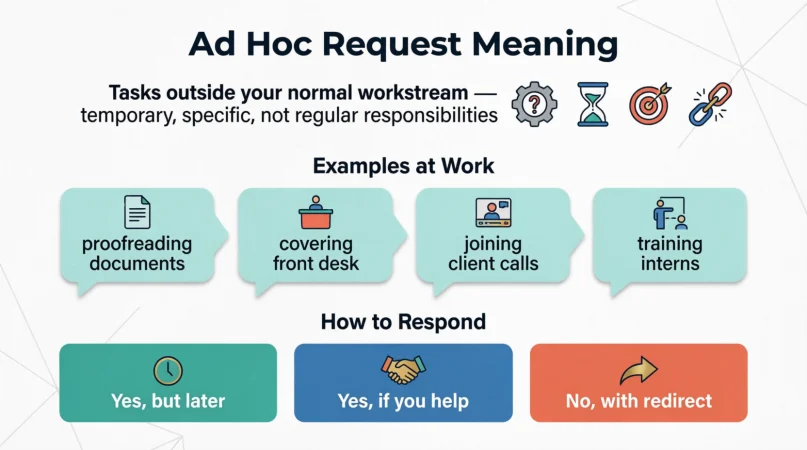
An ad hoc request is any task that falls outside your normal workstream. Someone asks you to do something not in your job description or weekly plan.
Examples of Ad Hoc Requests at Work
- “Can you proofread this one-page doc? It’s not your job but you’re good at grammar.”
- “I need you to cover the front desk for 30 minutes while Sarah is out.”
- “Would you sit in on a client call just to answer technical questions?”
- “Can you show the intern how to use our expense system? Just this once.”
Each request is temporary. Each is specific. And each is not your regular responsibility.
How to Say Yes (or No) to Ad Hoc Requests
You can’t say yes to everything. You’ll drown. But you can’t say no to everything either. You’ll seem unhelpful.
List of three response templates:
- Yes, but later: “I can handle that ad hoc request tomorrow morning. My plate is full until then.”
- Yes, if you help: “I can do that ad hoc analysis if you pull the raw data first.”
- No, with a redirect: “I can’t take that on right now. Talk to Jamie in operations. She handles similar requests.”
Fact from workplace studies: The average knowledge worker receives 15-20 ad hoc requests per week. That’s three to four per day. Most take less than 15 minutes. But they add up to nearly five hours of unplanned work weekly.
Ad Hoc Analysis Meaning
Data scientists and analysts use “ad hoc analysis” almost daily. It means exploring data without a pre-written query or predefined dashboard.
Ad hoc analysis definition: A manual, exploratory look at data to answer a new question that no one has asked before.
Real Ad Hoc Analysis Example
Your company launches a new feature. One week later, someone asks: “Are users over 50 using the feature differently than users under 30?”
No dashboard tracks that. No recurring report exists.
So you open a notebook. You write queries. You filter. And you find the answer in two hours. Then you close the notebook. That’s ad hoc analysis.
Ad Hoc Analysis vs Production Analysis
| Ad Hoc Analysis | Production Analysis | |
|---|---|---|
| Purpose | Answer a new, one-time question | Power a recurring dashboard or report |
| Code quality | Good enough for today’s answer | Production-ready, documented, tested |
| Run frequency | Once | Many times (daily, weekly, on demand) |
| User | Usually just the analyst | Broad team or external customers |
| Time invested | Hours | Days or weeks |
Bold truth: Most data teams spend 40-60% of their time on ad hoc analysis requests. That leaves less time for building permanent data products. The best teams track ad hoc requests and systematically convert repeat ones into automated reports.
Ad Hoc Network Meaning
This one confuses people because “ad hoc” means something slightly different in networking.
An ad hoc network is a temporary connection between two or more devices without using a router or access point.
Think peer-to-peer, not hub-and-spoke.
Real Ad Hoc Network Example
You’re in a conference room with no Wi-Fi. You have a laptop. Your colleague has a laptop. You need to share a 2GB file.
You create an ad hoc Wi-Fi network directly between the two laptops. No router. No internet. Just the two machines talking to each other. You transfer the file. You disconnect the network. Done.
Ad Hoc Network vs Infrastructure Network
| Ad Hoc Network | Infrastructure Network | |
|---|---|---|
| Central device | No router or access point | Yes, router or switch |
| Setup time | Minutes | Hours to configure |
| Range | Short (usually under 100 feet) | Longer (router dependent) |
| Security | Basic (WEP or WPA if configured) | Advanced (WPA2, WPA3, enterprise auth) |
| Use case | Temporary, small groups | Permanent, large groups |
| Example | Two laptops sharing a file on a plane | Office Wi-Fi with 100 users |
Modern Relevance of Ad Hoc Networks
You don’t see ad hoc networks often today. Why? Because most devices now use:
- Wi-Fi Direct (printers, phones sharing files)
- AirDrop (Apple devices)
- Bluetooth (headsets, speakers)
These technologies do the same thing as old-school ad hoc networks but with easier setup. The underlying concept remains temporary device-to-device communication.
Fact: The original Wi-Fi standard (802.11) included ad hoc mode as a core feature. Later versions still support it. But most users never touch it because modern OS interfaces hide the option.
Ad Hoc Basis Meaning
You’ll see “on an ad hoc basis” in employment contracts, service agreements, and internal policies.
On an ad hoc basis means: we’ll do this only when needed, not on a regular schedule.
Examples in the Wild
- “The consultant will provide additional support on an ad hoc basis for up to 10 hours per quarter.”
- “Managers may approve overtime on an ad hoc basis during peak seasons.”
- “The IT team handles password resets on an ad hoc basis. No SLA guaranteed.”
Ad Hoc Basis vs Scheduled Basis
| On an Ad Hoc Basis | On a Scheduled Basis | |
|---|---|---|
| Frequency | As needed, irregular | Fixed intervals (daily, weekly, monthly) |
| Expectation | May happen zero times | Will definitely happen |
| Budget | Often separate contingency | Built into regular operating budget |
| Communication | Request-driven | Calendar-driven |
Bold tip for managers: Don’t put recurring work “on an ad hoc basis.” That’s a trap. You’ll constantly remind people to do the same tasks. Instead, schedule it. Even if it’s monthly or quarterly, put it on a calendar.
Quick Reference | Ad Hoc Meaning Cheat Sheet
Print this in your brain.
| Question | Answer |
|---|---|
| Definition | For this specific purpose only |
| Duration | Temporary |
| Repeats? | No, one-time or rare |
| Opposite | Permanent, standing, ongoing |
| Part of regular process? | No |
| Needs documentation? | Optional for small tasks, smart for larger ones |
| Pronunciation | ADD HOCK |
| Latin origin | Ad (to/for) + hoc (this) |
Bold one-sentence takeaway: Ad hoc means you built a solution for one problem, and you’ll probably never build it again.
When to Avoid Using “Ad Hoc”
You now know the ad hoc meaning well. But knowing when not to use it matters just as much.
Don’t use ad hoc when:
The same problem keeps happening.
If your team fixes the same server issue ad hoc every two weeks, you don’t have an ad hoc problem. You have a missing permanent fix. Stop calling it ad hoc. Build a real solution.
You’re trying to sound smart.
Just say “temporary” or “one-time” if your audience doesn’t know Latin phrases. Clear beats fancy every time.
You need accountability.
“We’ll handle it ad hoc” sounds flexible. But it also means “no one owns this.” For anything critical, assign a person, a date, and a process.
Real Failure Example
A startup handled all customer onboarding ad hoc. Each new client got a custom spreadsheet, a manual email sequence, and a one-off call schedule. The founders thought this was agile.
It wasn’t.
By client 20, they spent 10 hours per new customer on manual work. They missed deadlines. Clients got inconsistent experiences. Two customers complained directly to the CEO.
The fix? They built a standard onboarding checklist, automated emails, and a shared project template. Onboarding dropped to 3 hours per client. Ad hoc moved to the exceptions only.
Lesson: Ad hoc works for outliers. Process works for everything else.
FAQs
Is ad hoc temporary?
Yes. Always. If something repeats on a schedule, it’s not ad hoc. Call it standing, ongoing, or recurring instead.
What’s the opposite of ad hoc?
Several words work:
- Permanent
- Standing
- Ongoing
- Fixed
- Regular
- Scheduled
- Institutionalized
Example: “The finance committee is a standing committee, not an ad hoc committee.”
Why is it called ad hoc?
atin: “ad” (to/for) + “hoc” (this). So “for this” specific situation. No deeper meaning.
How do you use ad hoc in a sentence without sounding stiff?
Natural examples:
- “We fixed that problem ad hoc. Don’t expect a repeat.”
- “I’m setting up an ad hoc meeting with just you and me. 15 minutes.”
- “That report was totally ad hoc. I’ll never run it again.”
Avoid: “An ad hoc arrangement was implemented by the team.” Too passive. Too stiff. Just say “We handled it ad hoc.”
What does ad hoc mean in business?
Short-term, temporary solutions for one-off problems. Not part of regular operations. See Section V above for full details.
What does ad hoc mean in chat or text messaging?
Same as everywhere else. “Let’s make an ad hoc plan for Saturday” means a loose plan created quickly for just that Saturday. No repeating.
Is ad hoc a bad thing?
No. Ad hoc solutions are often smart and efficient. The problem appears when you use ad hoc for everything. Balance temporary solutions with permanent processes.
What does ad hoc mean in law?
Legal ad hoc refers to arguments, rulings, or tribunals that apply only to the specific case at hand. A judge might say, “This ruling applies ad hoc to these facts only.” That means another case with slightly different facts could get a different ruling.
How do you pronounce ad hoc?
“ADD HOCK.”
Not “add HOKE.” Not “ADJ hoc.” Two clear syllables. Stress the first syllable slightly more.
Conclusion
Ad hoc isn’t some fancy Latin trick. It’s just a practical way to say “we built this for one problem, and that’s it.” You’ll find it everywhere temporary teams, one-off reports, quick meetings, even device-to-device Wi-Fi. The key is knowing when to use it (true outliers) and when to stop using it (repeating problems that need a real process).
**So next time someone asks for an ad hoc report or calls an ad hoc meeting, you won’t freeze. You’ll know exactly what they mean. Now go use the term once today. Just don’t overdo it. Nobody likes the person who says “ad hoc” six times in one conversation.
Discover More Related Articles:
- “POV” Meaning: How to Use It & Why It’s Everywhere Online In 2026
- “FWIW” Meaning: What It Means, How to Use It & When It Sounds Right In 2026
- “Solfege” Meaning: Improves Pitch & Ear Training Skills In 2026