


Definition
Solfege (also spelled solfège or solfeggio) is a music education method that assigns specific syllables Do, Re, Mi, Fa, Sol, La, Ti to the notes of a musical scale to help singers and musicians read, understand, and perform pitch accurately.
If you’ve ever heard someone singing “Do-Re-Mi” and wondered what it actually means, you’ve already stepped into the world of solfege. It’s one of the most powerful tools in music learning, helping beginners and professionals train their ears, improve pitch accuracy, and understand musical structure in a simple, memorable way.
In this article, we’ll break down everything about solfege meaning, including its origin, real-world use, comparisons, examples, and practical tips you can actually apply. Solfege Definition: Meaning, Music Notes, and How Beginners Use Do-Re-Mi Explained
What is Solfege Meaning in Music?
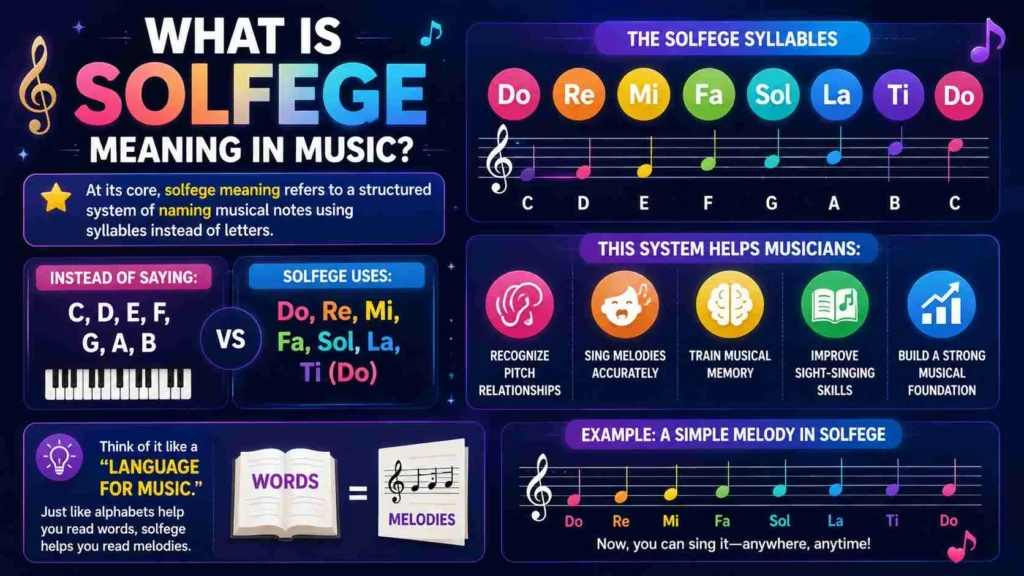
At its core, solfege meaning refers to a structured system of naming musical notes using syllables instead of letters.
Instead of saying:
- C, D, E, F, G, A, B
Solfege uses:
- Do, Re, Mi, Fa, Sol, La, Ti (Do)
This system helps musicians:
- Recognize pitch relationships
- Sing melodies accurately
- Train musical memory
- Improve sight-singing skills
Think of it like a “language for music.” Just like alphabets help you read words, solfege helps you read melodies.
Origin of Solfege – Where Did It Come From?
The origin of solfege dates back to the Middle Ages in Europe, particularly in Gregorian chant traditions.
A monk named Guido of Arezzo (11th century) is widely credited with developing the early solfege system. He used a hymn where each line started with a higher pitch:
- “Ut queant laxis…”
Each line’s first syllable became the basis of musical notes.
Later, “Ut” evolved into “Do,” making the modern system easier to sing.
Key historical points:
- Developed for teaching church chants
- Evolved in Western classical music education
- Became standardized in modern music theory
Today, solfege is used worldwide in music schools, choirs, and vocal training programs.
Why Solfege is So Popular in Music Learning
Solfege remains popular because it simplifies something complex music theory.
Here’s why musicians love it:
- Helps beginners understand pitch easily
- Strengthens ear training skills
- Improves sight-reading ability
- Makes learning songs faster
- Builds strong musical memory
- Works across instruments and vocals
Instead of memorizing abstract notes, learners feel music through sound patterns.
How Solfege Works (Simple Explanation)
Solfege assigns a syllable to each note in a scale:
| Musical Note | Solfege Syllable |
|---|---|
| C | Do |
| D | Re |
| E | Mi |
| F | Fa |
| G | Sol |
| A | La |
| B | Ti |
| C (octave) | Do |
This pattern repeats in every octave.
So when someone sings:
Do–Re–Mi–Fa–Sol, they are actually singing a rising musical scale.
Types of Solfege Systems
There are two main types of solfege used in music education:
1. Fixed Do System
In this system:
- Do = C always
- Re = D always
- Mi = E always
Common in:
- France
- Spain
- Italy
2. Movable Do System
In this system:
- Do is the root note of the scale
- It changes depending on the key
Example:
- In C major: Do = C
- In G major: Do = G
Common in:
- United States
- United Kingdom (in many schools)
Real-Life Usage of Solfege
Solfege is not just theory it is actively used in real musical settings.
Common uses include:
- Choir training
- Vocal warm-ups
- Ear training exercises
- Music classrooms
- Professional singer coaching
- Instrument practice (piano, violin, guitar)
For example, a choir director might say:
“Sing this line using Do-Re-Mi first before adding lyrics.”
This helps singers understand pitch before focusing on words.
Solfege in Daily Music Practice (Examples)
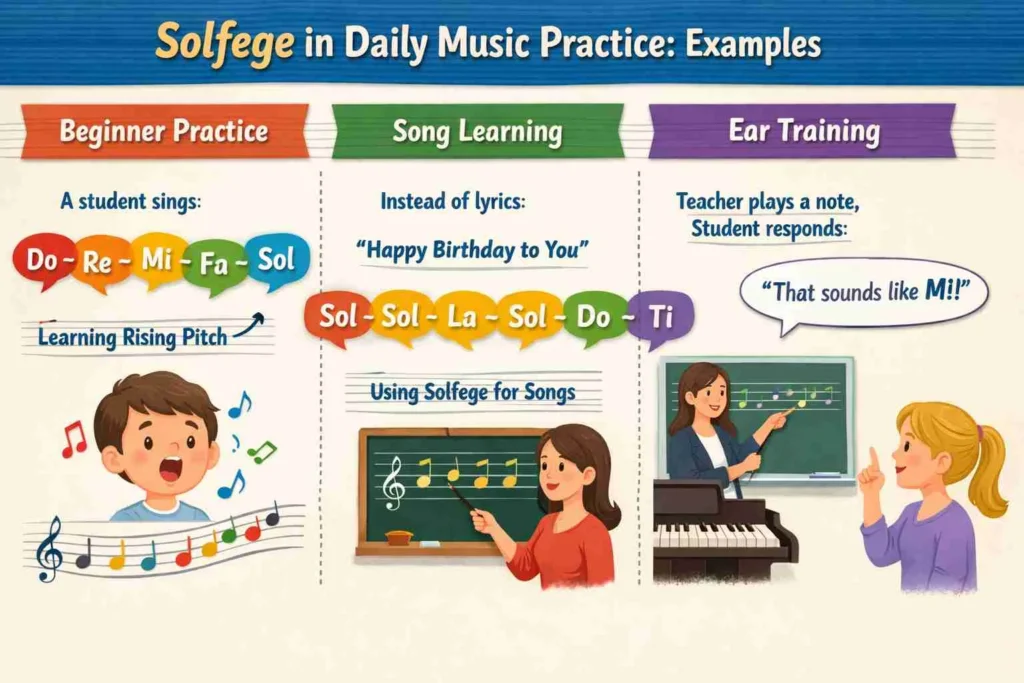
Let’s understand how solfege works in real situations:
Example 1: Beginner Practice
A student sings:
- Do – Re – Mi – Fa – Sol
This helps them understand rising pitch.
Example 2: Song Learning
Instead of lyrics:
- “Happy Birthday to You”
A teacher might break it into:
- Sol – Sol – La – Sol – Do – Ti
Example 3: Ear Training
Teacher plays a note, student responds:
- “That sounds like Mi!”
Emotional Tone and Learning Experience
Solfege is often described as:
- Friendly 😊
- Structured 📊
- Musical 🎶
- Educational 📚
It removes confusion from music learning and replaces it with a clear pattern.
Beginners often feel:
- More confident
- Less overwhelmed
- More connected to sound
Professionals use it to sharpen precision and timing.
Solfege vs Related Music Terms
To fully understand solfege meaning, it helps to compare it with similar concepts:
| Term | Meaning | Difference |
|---|---|---|
| Solfege | Syllable-based note system | Focuses on singing pitch |
| Musical Notes | C, D, E system | Letter-based notation |
| Sight-singing | Singing written music | Uses solfege for training |
| Ear Training | Identifying sound pitches | Solfege is a tool for it |
| Scales | Ordered notes | Solfege names those notes |
Solfege is essentially the bridge between theory and practical singing.
Alternate Names and Variations
Solfege may also appear as:
- Solfège (French spelling)
- Solfeggio (Italian term)
- Do-Re-Mi system (informal name)
All refer to the same core idea of musical syllables used for pitch training.
Practical Benefits of Learning Solfege
Learning solfege gives musicians several long-term advantages:
1. Better Pitch Accuracy
You can sing notes correctly without instruments.
2. Faster Music Learning
Songs become easier to memorize.
3. Strong Ear Development
You can recognize notes instantly.
4. Improved Creativity
Helps in composing melodies.
5. Professional Skill Building
Used in auditions and choir performances.
Common Mistakes Beginners Make
Even though solfege is simple, learners often struggle with:
- Mixing fixed and movable Do systems
- Ignoring rhythm while focusing only on pitch
- Rushing through exercises
- Not practicing regularly
- Confusing similar-sounding notes
Consistency is key in mastering solfege.
Tips to Learn Solfege Effectively
Here are some easy tips:
- Practice daily for 10–15 minutes
- Start with simple scales
- Use a piano or keyboard for reference
- Sing slowly before increasing speed
- Record your voice to check accuracy
- Learn in small steps, not everything at once
Solfege in Modern Music Education
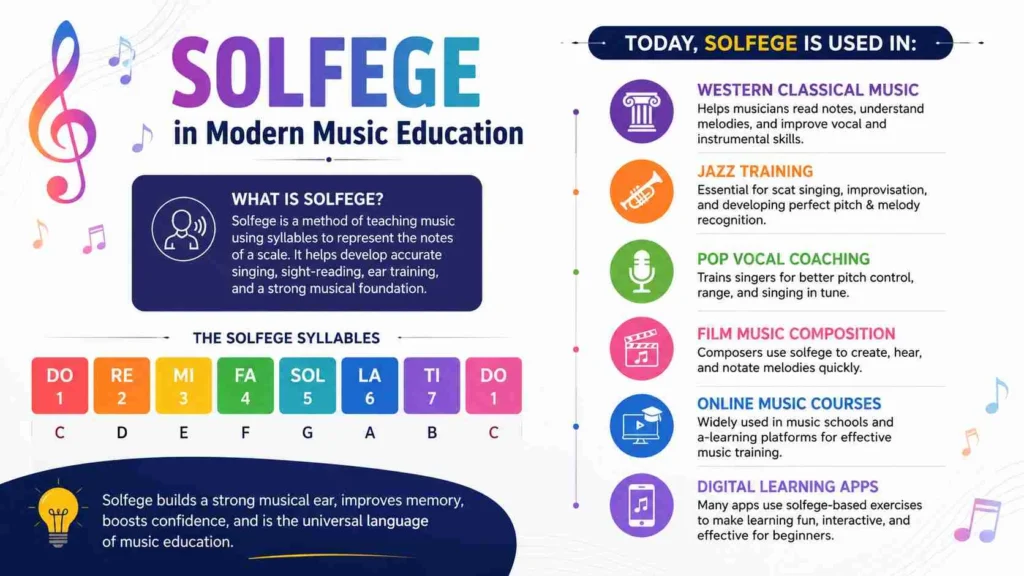
Today, solfege is used in:
- Western classical music
- Jazz training
- Pop vocal coaching
- Film music composition
- Online music courses
Even digital learning apps use solfege-based exercises to train beginners.
FAQs
What is solfege meaning in simple words?
Solfege meaning refers to a musical system where notes are sung using syllables like Do, Re, Mi instead of letter names, helping learners understand pitch and melody easily.
Why do singers use solfege?
Singers use solfege to train their voice, improve pitch accuracy, and learn songs faster by understanding musical patterns rather than memorizing lyrics alone.
Is solfege necessary for beginners?
Solfege is not mandatory, but it is highly recommended because it builds strong music foundations and makes learning instruments or singing much easier.
What is the difference between solfege and notes?
Solfege uses syllables like Do-Re-Mi, while musical notes use letters like C-D-E. Solfege focuses on singing and ear training, while notes are written symbols.
Can I learn solfege without a teacher?
Yes, solfege can be self-taught using online resources, apps, and practice exercises, although a teacher can help correct mistakes faster.
Is solfege used in all music genres?
Yes, solfege is used across classical, pop, jazz, and even film music because it is a universal tool for understanding pitch.
What is movable Do in solfege?
Movable Do means the syllable “Do” changes depending on the key of the music, helping singers understand relative pitch instead of fixed notes.
How long does it take to learn solfege?
Basic solfege can be learned in a few weeks, but mastering it for professional use may take months of consistent practice.
Conclusion
Solfege meaning goes far beyond just singing Do-Re-Mi it is a powerful foundation of music education that helps learners understand pitch, rhythm, and melody in a structured and simple way.
From ancient church chants to modern music classrooms, solfege has remained a timeless tool for musicians of all levels. You are a beginner trying to learn your first song or a professional improving your vocal precision, solfege can dramatically improve your musical understanding.
The key is consistent practice, patience, and active listening, because over time, your ears begin to recognize music naturally without effort. solfeggio meaning.
Discover More Related Articles:
- Namaste Meaning: Cultural & Spiritual Significance In 2026
- “Gyatt” Meaning: What It Stands For & How It’s Used In 2026
- “Habibi” Meaning: What It Really Means & How to Use It In 2026