
Definition
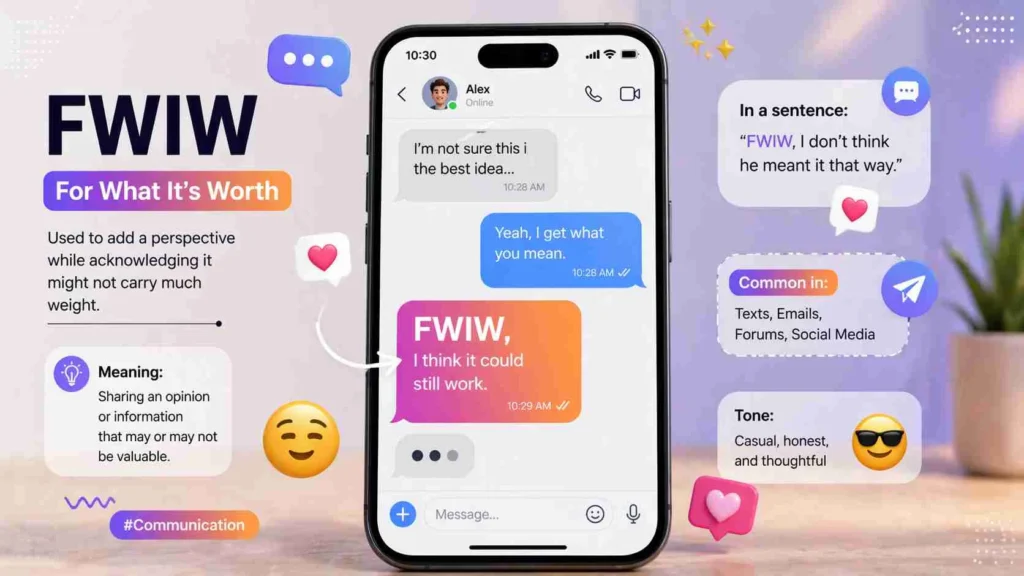
FWIW stands for “For What It’s Worth.” It’s a casual abbreviation used in texts, emails and online conversations to share an opinion, suggestion, or piece of information often while signaling that it may or may not be valuable to the listener
You’ve probably seen “FWIW” pop up in a text message, Reddit thread, or even a work email and wondered what tone it carries. Is it helpful? Passive-aggressive? Neutral? The truth is, FWIW meaning depends heavily on context, which is exactly why it’s such an interesting and widely used fwiw abbreviation.
From friendly advice to subtle disclaimers, “FWIW” plays multiple roles in modern communication. In this guide, we’ll break down everything you need to know from its origin and tone to real-world usage examples and professional alternatives so you can use it confidently and interpret it correctly when others do.
Define FWIW
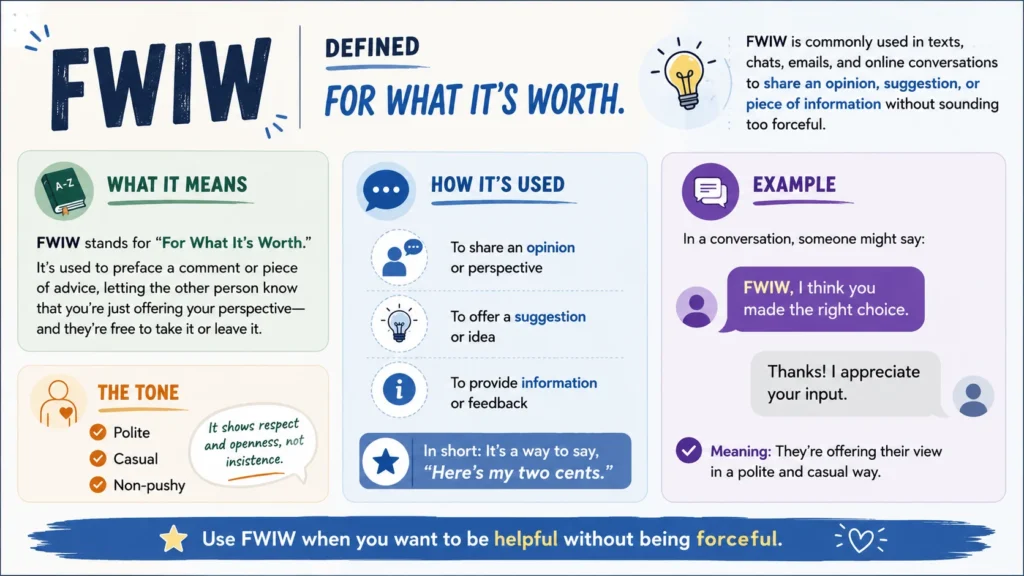
FWIW stands for “For What It’s Worth.” It’s commonly used in texts, chats, emails, and online conversations to share an opinion, suggestion, or piece of information without sounding too forceful. For example, someone might say, “FWIW, I think you made the right choice,” meaning they’re offering their view in a polite and casual way.
What Does FWIW Mean?
At its core, FWIW = “For What It’s Worth.”
It’s used to:
- Offer an opinion without forcing it
- Share information humbly
- Soften a statement that might be unsolicited
- Add a disclaimer to advice
Simple Explanation:
“Here’s my input but take it however you want.”
Origin and Evolution of FWIW
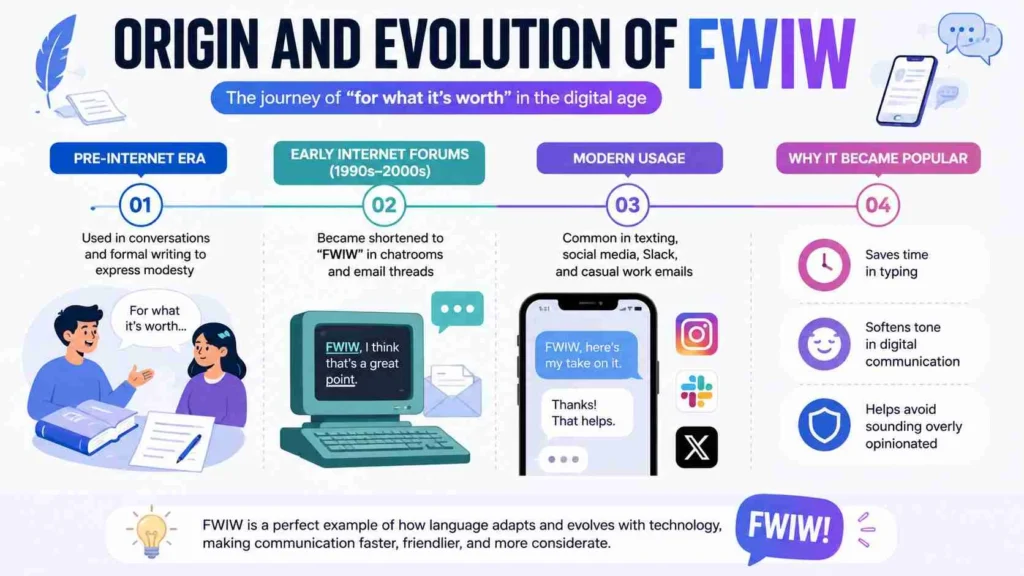
The phrase “for what it’s worth” existed long before the internet. It was traditionally used in spoken English as a polite way to present thoughts without sounding pushy.
How it evolved:
- Pre-internet era: Used in conversations and formal writing to express modesty
- Early internet forums (1990s–2000s): Became shortened to “FWIW” in chatrooms and email threads
- Modern usage: Common in texting, social media, Slack, and casual work emails
Why it became popular:
- Saves time in typing
- Softens tone in digital communication
- Helps avoid sounding overly opinionated
Today, it’s part of everyday internet slang alongside terms like “IMO” and “TBH.”
How to Use FWIW in Real Conversations
“FWIW” is incredibly flexible. It can fit into casual chats, online discussions, and even semi-professional settings.
Common Situations:
- Giving advice
- Sharing personal experience
- Offering feedback
- Adding a disclaimer
Examples of FWIW in Different Tones
The tone of “FWIW” can change depending on how it’s used. Let’s break it down.
1. Friendly / Helpful Tone 😊
Used to offer advice without sounding bossy.
- “FWIW, I tried that restaurant last week and it was amazing.”
- “FWIW, studying in the morning helped me focus better.”
👉 Feels supportive and casual.
2. Neutral / Informational Tone 📌
Used to add information without emotional weight.
- “FWIW, the meeting was rescheduled to 3 PM.”
- “FWIW, this phone model has better battery life.”
👉 Straightforward and matter-of-fact.
3. Dismissive or Passive-Aggressive Tone 😬
Sometimes it can come off slightly sharp or defensive.
- “FWIW, I already told you about that yesterday.”
- “FWIW, I didn’t think it was a good idea from the start.”
👉 Tone depends heavily on context and punctuation.
Example Table| FWIW in Context
| Situation | Example Sentence | Tone | Meaning Interpretation |
|---|---|---|---|
| Giving advice | FWIW, you should double-check the report | Helpful | Suggestion without pressure |
| Sharing experience | FWIW, I’ve used this app before | Neutral | Personal input |
| Defending yourself | FWIW, I wasn’t involved in that decision | Slightly defensive | Clarification or distancing |
| Casual conversation | FWIW, that movie was overrated | Opinionated | Personal view |
| Workplace email | FWIW, the client seemed satisfied with the proposal | Professional-neutral | Informational update |
When Should You Use FWIW?
Good Times to Use It:
- When offering optional advice
- When sharing personal opinions
- When you don’t want to sound forceful
- When adding context to a discussion
Avoid Using It When:
- You need to sound authoritative
- Giving formal or official instructions
- Communicating in highly professional or sensitive situations
FWIW vs Similar Abbreviations
“FWIW” is often confused with other abbreviations. Here’s how it compares:
| Abbreviation | Full Form | Meaning | Tone |
|---|---|---|---|
| FWIW | For What It’s Worth | Optional opinion or info | Neutral to soft |
| IMO | In My Opinion | Personal viewpoint | Direct |
| IMHO | In My Humble Opinion | Opinion with modest tone | Polite |
| TBH | To Be Honest | Honest or blunt statement | Casual / sometimes blunt |
| FYI | For Your Information | Sharing info (no opinion needed) | Informational |
Key Difference:
- FWIW softens your opinion
- IMO states your opinion directly
- FYI shares facts, not opinions
Tone Tips | How FWIW Can Be Misinterpreted
Because text lacks vocal tone, “FWIW” can sometimes be misunderstood.
To Keep It Positive:
- Pair it with friendly language “FWIW, I think you did a great job!”
- Avoid using it in arguments Might sound defensive or dismissive
- Be mindful of punctuation “FWIW…” can sound softer than “FWIW.”
Professional Alternatives to FWIW
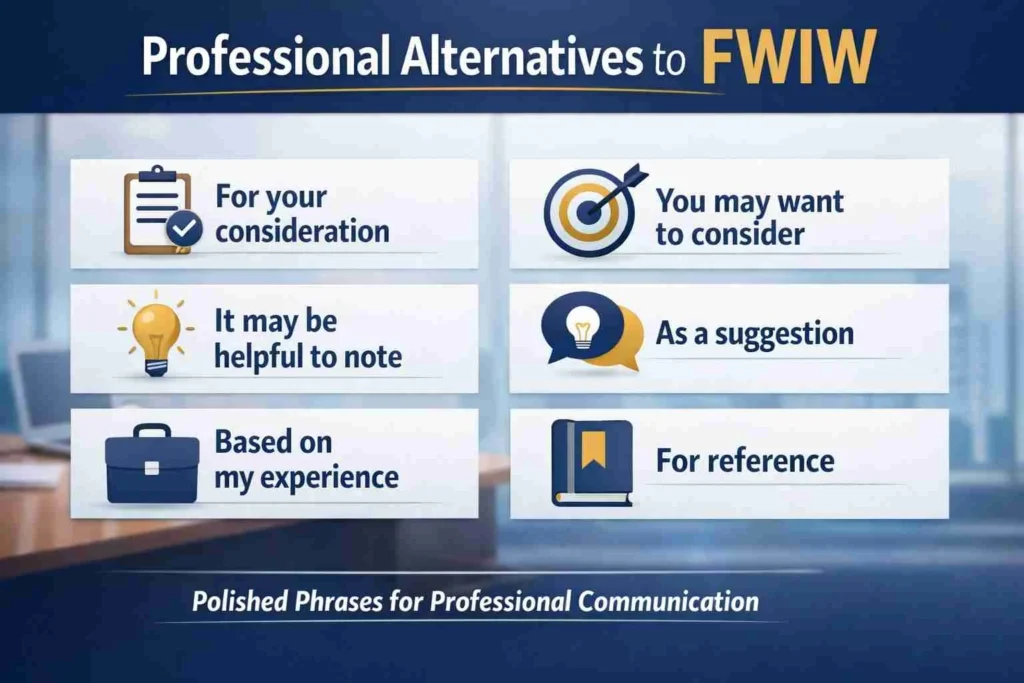
In formal settings, you might want to replace “FWIW” with clearer, more polished phrases.
Alternatives:
- “For your consideration”
- “It may be helpful to note”
- “Based on my experience”
- “You may want to consider”
- “As a suggestion”
- “For reference”
Example:
Instead of:
“FWIW, this strategy didn’t work last time.”
Use:
“For your consideration, this strategy did not yield results previously.”
Alternate Meanings of FWIW
While rare, “FWIW” can occasionally have other meanings depending on context:
- Finance/Trading: “For What It’s Worth” (same meaning, but used in analysis)
- Forums/Online communities: Still primarily the same meaning
Real-World Usage Social Media & Messaging
“FWIW” appears frequently across platforms like:
- WhatsApp chats
- Twitter/X threads
- Reddit discussions
- Email conversations
- Workplace tools like Slack
Example:
“FWIW, this trend will probably fade in a few months.”
It helps people share thoughts casually without sounding overly confident.
FAQs
Is FWIW rude or polite?
FWIW is generally polite, but it can sound slightly dismissive or passive-aggressive depending on tone, wording, and context.
When should I use FWIW? You should use FWIW when offering advice, sharing opinions, or adding helpful information in a casual or semi-formal conversation.
Can FWIW be used in professional emails?
Yes, but sparingly. It’s better suited for informal or semi-professional emails rather than highly formal communication.
What is the difference between FWIW and IMO?
FWIW softens your opinion and makes it optional, while IMO directly states your opinion without softening it.
Does FWIW means the same as FYI?
Not exactly. FYI shares information, while FWIW introduces an opinion or suggestion with a softer tone.
Is FWIW commonly used today?
Yes, it remains widely used in texting, online forums, and casual digital communication.
Can FWIW sound passive-aggressive?
Yes, especially if used in arguments or paired with critical statements, it can come across as defensive or dismissive.
Conclusion
FWIW is one of those small abbreviations that carries a lot of subtle meaning. It allows you to share opinions without pressure, offer advice without sounding bossy, and communicate thoughtfully in digital conversations. While it’s mostly neutral or helpful, tone and context can shift its meaning so it’s worth using carefully. fwiw acronym.
In everyday use, it’s perfect for casual chats, online discussions, and even light workplace communication. But in formal settings, swapping it for more polished phrases can make your message clearer and more professional. What is fwiw.
Ultimately, understanding how and when to use FWIW gives you an edge in modern communication helping you sound both confident and considerate at the same time. fwiw full form.
Discover More Related Articles:
- “Gyatt” Meaning: What It Stands For & How It’s Used In 2026
- “Habibi” Meaning: What It Really Means & How to Use It In 2026
- Namaste Meaning: Cultural & Spiritual Significance In 2026