

Definition
Ennui is a noun that refers to a deep feeling of weariness, boredom, or dissatisfaction often caused by a lack of excitement, purpose, or stimulation in life. Unlike simple boredom, ennui carries a heavier, more existential tone, suggesting emotional fatigue or a sense of emptiness.
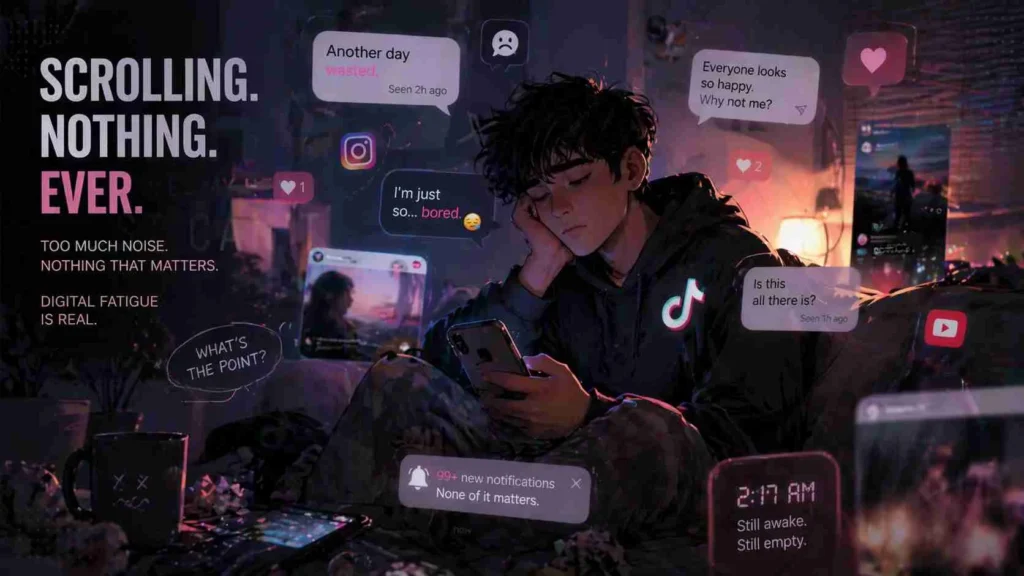
Ever had one of those days where nothing feels exciting even the things you usually enjoy? You scroll endlessly, switch between apps, maybe even start something new… but still feel oddly drained and uninterested. That’s not just boredom that’s ennui.
In today’s fast-paced, hyper-connected world, ennui has become surprisingly common. Despite constant entertainment and stimulation, many people experience a lingering sense of dissatisfaction or emotional dullness. Understanding the meaning of “ennui” can help you recognize these feelings, articulate them better, and even find ways to overcome them.
This guide breaks down everything you need to know about ennui its meaning, origins, usage, examples, and how it compares to similar emotions.
Origin of the Word “Ennui”

The word ennui comes from the French language, where it originally meant “annoyance” or “boredom.” It traces back even further to the Latin word inodiare, meaning “to make hateful.”
Historical Evolution:
- Latin Roots: Inodiare (to make loathsome)
- Old French: Enui (annoyance, trouble)
- Modern French: Ennui (boredom, weariness)
- English Usage: Adopted in the 18th century to describe a more refined or intellectual kind of boredom
Over time, the meaning evolved from simple irritation to a more complex emotional state involving existential dissatisfaction.
Why “Ennui” Is So Popular Today
The concept of ennui has gained popularity in modern conversations, especially in discussions about mental health, burnout, and digital fatigue.
Reasons for its growing relevance:
- Digital overload: Constant exposure to content can make everything feel repetitive
- Lack of purpose: Many people struggle with meaning in work or daily life
- Social comparison: Seeing curated lives online can create dissatisfaction
- Routine fatigue: Repetitive schedules can lead to emotional numbness
In short, ennui reflects a modern emotional paradox having access to everything, yet feeling uninspired.
Real-World Usage of “Ennui”
“Ennui” is typically used in more thoughtful or descriptive conversations rather than casual slang. It appears often in writing, psychology discussions, and artistic expression.
Common contexts:
- Literature and poetry
- Mental health discussions
- Social commentary
- Personal reflection
Examples of “Ennui” in Different Tones
| Context | Example Sentence | Tone |
|---|---|---|
| Friendly | “I think I’m just feeling a bit of ennui lately maybe I need a break 😊” | Light, self-aware |
| Neutral | “He experienced a sense of ennui after years in the same routine.” | Informative |
| Negative | “Her constant complaints felt less like stress and more like pure ennui.” | Slightly dismissive |
| Reflective | “The quiet moments made her confront an underlying ennui she couldn’t ignore.” | Thoughtful |
| Creative | “A fog of ennui settled over the city, dulling its once vibrant charm.” | Artistic |
How to Use “Ennui” Correctly
Using “ennui” properly can make your communication more expressive and nuanced.
Tips for usage:
- Use it when describing deep or persistent boredom, not momentary boredom
- Works well in formal or semi-formal contexts
- Often paired with reflective or emotional language
Example sentences:
- “There’s a strange ennui that comes with doing the same thing every day.”
- “Despite his success, he couldn’t shake off a lingering ennui.”
- “Travel helped her escape the ennui of her routine life.”
Ennui vs Similar Terms: What’s the Difference?
Although ennui is often confused with other emotions, it has its own unique nuance.
| Term | Meaning | Key Difference |
|---|---|---|
| Boredom | Lack of interest or stimulation | More temporary and surface-level |
| Burnout | Emotional exhaustion from stress | Caused by overwork, not lack of stimulation |
| Apathy | Lack of feeling or interest | More emotional detachment than dissatisfaction |
| Depression | Persistent sadness and low mood | Clinical condition, more severe than ennui |
| Restlessness | Inability to relax | More physical/mental agitation than emptiness |
Key takeaway:
Ennui = existential boredom + emotional dissatisfaction
Alternate Meanings (If Any)
While “ennui” primarily refers to a deep sense of boredom or dissatisfaction, it can sometimes be used more loosely to describe:
- General fatigue with life
- Lack of motivation
- Emotional monotony
However, its core meaning remains consistent a lingering sense of emptiness or weariness.
Polite or Professional Alternatives to “Ennui”
If you’re writing in a professional or sensitive context, you might want alternatives that feel more accessible.
Alternatives:
- “A sense of disengagement”
- “Emotional fatigue”
- “Lack of stimulation”
- “Feeling unfulfilled”
- “Diminished motivation”
Example:
Instead of: “The team is experiencing ennui”
Say: “The team seems to be experiencing a lack of engagement and motivation.”
Practical Ways to Overcome Ennui
Understanding ennui is helpful but dealing with it is even more important.
Effective strategies:
- Change your routine: Even small changes can refresh your mindset
- Try something new: Learning or exploring can break monotony
- Limit screen time: Reduce digital overload
- Set meaningful goals: Purpose reduces feelings of emptiness
- Connect with others: Social interaction can bring energy back
FAQs
What is the meaning of ennui in simple terms?
Ennui means a deep feeling of boredom or dissatisfaction, often caused by a lack of excitement or purpose in life. It goes beyond normal boredom and reflects emotional weariness.
Is ennui the same as boredom?
Not exactly. While boredom is temporary and mild, ennui is deeper and more persistent, often tied to a sense of emptiness or lack of meaning.
How do you pronounce ennui?
Ennui is pronounced as “ahn-wee,” with a soft, French-style sound.
Can ennui be a sign of depression?
Sometimes ennui can overlap with depressive feelings, but it is not the same as clinical depression. If it becomes persistent and severe, it may be worth seeking professional advice.
Why do people feel ennui in modern life?
Modern lifestyles often involve routine, digital overload, and lack of meaningful engagement, all of which can contribute to feelings of ennui.
Is ennui a negative emotion?
It can feel negative, but it can also serve as a signal that something in your life needs change or improvement.
How can I use ennui in a sentence?
You can say, “She felt a sense of ennui after repeating the same routine every day.”
What is the difference between ennui and apathy?
Ennui involves dissatisfaction and boredom, while apathy is more about emotional indifference or lack of feeling altogether.
Conclusion
Ennui is more than just boredom it’s a deeper emotional state that reflects dissatisfaction, monotony, and a lack of purpose. In today’s world, where constant stimulation ironically leads to emotional fatigue, recognizing ennui is the first step toward overcoming it.
By understanding its meaning, origins, and real-world usage, you can better identify when you or others are experiencing it. More importantly, you can take practical steps to break free from it, by changing routines, seeking new experiences, or reconnecting with what truly matters. What is ennui.
Ultimately, ennui isn’t just a problem it’s also a signal. And if you listen closely, it might guide you toward a more fulfilling and meaningful life. Define Ennui: Ennui is a feeling of boredom, weariness, or dissatisfaction caused by a lack of excitement or purpose.
Discover More Related Articles:
- “Gyatt” Meaning: What It Stands For & How It’s Used In 2026
- “Habibi” Meaning: What It Really Means & How to Use It In 2026
- Namaste Meaning: Cultural & Spiritual Significance In 2026