

Antebellum means “before the war,” from Latin ante (before) + bellum (war). In American history, it refers specifically to the period before the Civil War (roughly 1815–1861), especially in the Southern states where slavery, cotton plantations, and a rigid social hierarchy defined daily life.
You have seen the word antebellum before. Maybe on a historic home tour. Maybe in a news story about a band changing its name. Or perhaps in a history textbook you barely skimmed.
But what does antebellum actually mean?
Here is the short answer. Antebellum comes from two Latin words. Ante means “before.” Bellum means “war.” Put them together and you get “before the war.”
Which war? In American history, almost always the Civil War (1861–1865).
But the short answer does not tell the whole story. The antebellum period in the United States specifically the American South was a time of stunning wealth, brutal slavery, political explosions, and a cultural myth that still confuses people today.
This guide walks you through everything. You will learn the antebellum definition, how to pronounce it, key historical facts, social structure, economic realities, architecture, and why some people now call the word problematic.
No fluff. Just clear, useful history.
What Does Antebellum Mean?
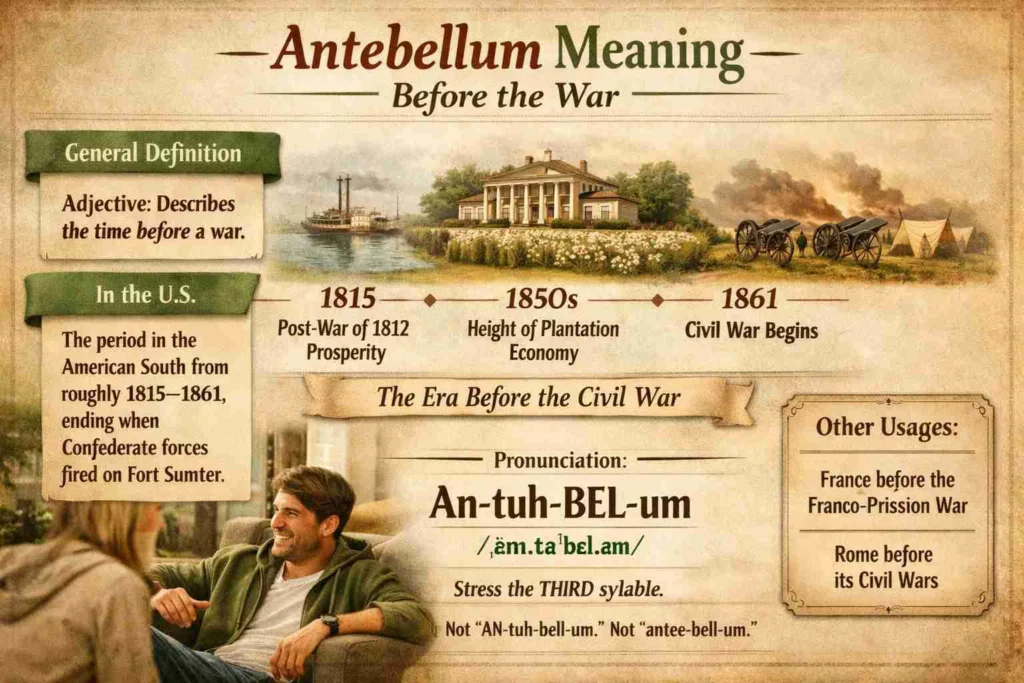
Let us start with the simplest antebellum meaning. The word is an adjective. It describes the time before a war.
In general history writing, any country can have an antebellum period. France had one before the Franco-Prussian War (1870). Rome had one before its many civil wars.
But in everyday American English, antebellum points directly to one thing: the years before the U.S. Civil War.
Antebellum simple definition: The period in the American South from roughly 1815 to 1861, ending when Confederate forces fired on Fort Sumter.
Antebellum pronunciation: An-tuh-BEL-um. Say it with the stress on the third syllable. Not “AN-tuh-bell-um.” Not “antee-bell-um.” An-tuh-BEL-um.
Part of speech: Adjective. You use it to modify a noun. Antebellum architecture. Antebellum economy. Antebellum society.
Example sentence: “The antebellum South produced more cotton than any other region on earth, but that production relied entirely on enslaved labor.”
Antebellum synonym: Pre-war, pre-Civil War.
Antebellum antonym: Postbellum (after the war).
Now that you have the basic meaning of antebellum, let us drop it into real historical context.
When Exactly Was the Antebellum Period?
Dates matter. Historians do not all agree on the exact start of the antebellum era. But they generally place it between two major bookends.
Start date (disputed): Some say 1783 the end of the American Revolution. Others say 1793 the invention of the cotton gin. Most settle on 1815, right after the War of 1812.
Why 1815? Because that is when the United States truly stabilized. The British were no longer a serious threat. American manufacturing began growing in the North. And the South started doubling down on cotton.
End date (clear): 1861. The Civil War begins. The antebellum period ends the moment shells hit Fort Sumter in Charleston Harbor on April 12.
Length of the antebellum period: Approximately 46 years (1815–1861). That is roughly two generations. Short enough for one person to remember the start and live through the end.
Key Years in the Antebellum Timeline
| Year | Event | Significance |
|---|---|---|
| 1793 | Cotton gin invented | Made cleaning cotton fast. Increased demand for enslaved labor instead of reducing it. |
| 1815 | End of War of 1812 | America turns inward. The South expands west. |
| 1820 | Missouri Compromise | Drew a line across former Louisiana Territory. Slavery legal south of the line. Illegal north of it. |
| 1831 | Nat Turner’s rebellion | Enslaved preacher leads uprising in Virginia. Kills about 60 white people. White militias kill 200 Black people in retaliation. |
| 1845 | Texas annexed | Adds another huge slave state to the Union. |
| 1846–1848 | Mexican-American War | U.S. gains California and the Southwest. Debate over slavery in new territories explodes. |
| 1850 | Compromise of 1850 | California joins as a free state. Tougher Fugitive Slave Act forces Northerners to return escapees. |
| 1854 | Kansas-Nebraska Act | Lets territories vote on slavery. Leads to “Bleeding Kansas” a small civil war before the big one. |
| 1857 | Dred Scott decision | Supreme Court rules Black people cannot be U.S. citizens. Congress cannot ban slavery in territories. |
| 1859 | John Brown’s raid | Abolitionist tries to start slave rebellion at Harpers Ferry. Fails. Hanged. Southerners see him as proof the North wants to destroy them. |
| 1860 | Abraham Lincoln elected | Southern states begin seceding. |
| 1861 | Fort Sumter attacked | Civil War begins. Antebellum period ends. |
That timeline shows the truth. The antebellum period was not peaceful or sleepy. It was a high-pressure cooker. Every decade brought a new crisis over slavery.
The Antebellum South| More Than Just Pretty Mansions
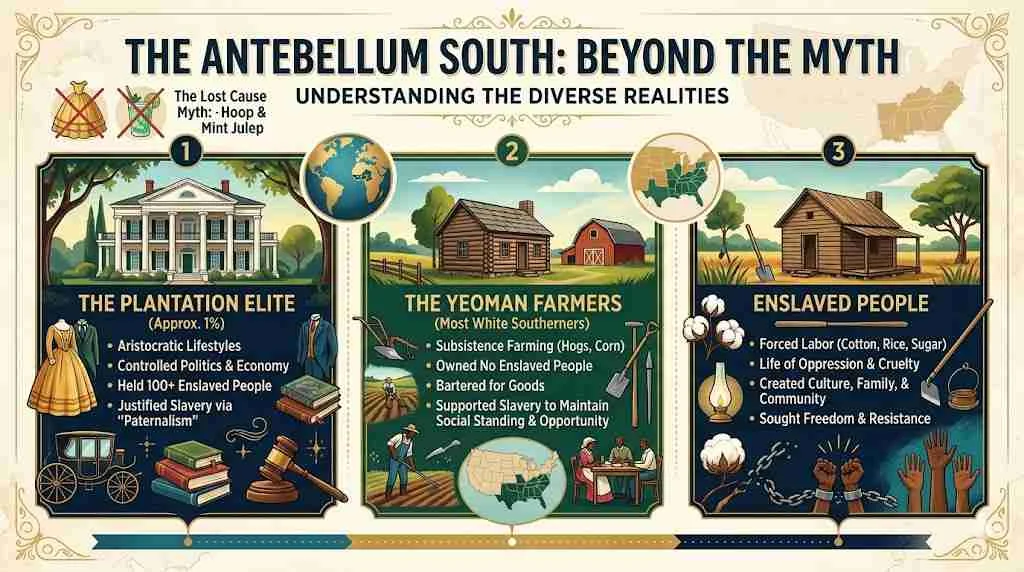
Pop culture loves to show the antebellum South as a land of hoop skirts, mint juleps, and genteel manners. That image comes from a lie called the Lost Cause a myth white Southerners invented after the Civil War to make themselves look noble.
The real antebellum South looked very different depending on who you were.
For the Wealthy Plantation Elite
About 1 in 3 Southern white families owned any enslaved people at all. But only about 1% owned more than 100 enslaved people. Those were the true elites the planter aristocracy.
Here is what their lives looked like:
- Lived in grand Greek Revival mansions with columns.
- Sent sons to schools like the University of Virginia or West Point.
- Controlled state legislatures and the U.S. Congress (thanks to the Three-Fifths Compromise, which counted enslaved people for representation even though they could not vote).
- Claimed to practice a noble “paternalism” the idea they were taking care of enslaved people like children. It was a justification for evil, not reality.
Famous antebellum elite families: The Lees of Virginia, the Calhouns of South Carolina, the Davis family of Mississippi (Jefferson Davis later became Confederate president).
For the Yeoman Farmers (Most White Southerners)
Most white Southerners owned zero enslaved people. They lived on small farms 50 to 200 acres and grew corn, raised hogs, and maybe grew a little cotton.
- Often lived in log cabins or simple wooden homes.
- Worked alongside their own families in the fields.
- Rarely saw cash money. Bartered for goods.
- Still supported slavery. Why? Several reasons. They feared freed Black people competing for land. They hoped to buy an enslaved person someday. And they took pride in being “free” meaning above enslaved people on the social ladder.
Quote from a yeoman farmer’s letter (paraphrased from historical records): “I aint rich. But I aint a slave neither. And that counts for something.”
For Enslaved People
This is the hardest part of the antebellum meaning. The era cannot be understood without facing slavery head‑on.
By 1860, nearly 4 million Black people were enslaved in the United States. Most lived in the South. About 55% worked on cotton plantations. The rest worked on tobacco, rice, sugar, or hemp farms or as domestic servants, blacksmiths, carpenters, or field hands.
Conditions were brutal:
- Workday often lasted 14 to 16 hours during harvest season.
- Whippings were routine. Planters called them “discipline.”
- Families were split apart at auction blocks. A child could be sold away from a mother with no warning.
- Marriage was not legally recognized. Enslaved people created their own rituals, but owners could ignore them anytime.
- Reading and writing were illegal in most Southern states for enslaved people. Punishment could include losing a finger or being hanged.
Resistance happened every single day. Not just big rebellions like Nat Turner’s. Small acts too. Working slowly. Breaking a plow on purpose. Pretending to be sick. Running away for a week then coming back. Singing coded songs about escape.
Famous words from Frederick Douglass (who escaped slavery in 1838): “I have no accurate knowledge of my age, never having seen any authentic record containing it. By far the larger part of the slaves know as little of their ages as horses know of theirs.”
That quote alone shatters the “kind master” myth. Enslaved people were denied even the basic fact of their own birthdays.
The Antebellum Economy | King Cotton Rules Everything
You cannot understand the antebellum period definition without looking at money. The Southern economy ran on one crop: cotton.
Here is a staggering fact. In 1790, the United States produced about 1.5 million pounds of cotton per year. By 1860, that number hit 2.3 billion pounds per year.
What changed? Two things. The cotton gin (1793) made cleaning cotton fast. And the Industrial Revolution in England and New England created endless demand for raw cotton.
The math of King Cotton (1860):
| Statistic | Number |
|---|---|
| U.S. cotton production | 2.3 billion pounds |
| South’s share of U.S. cotton | Nearly 100% |
| Share of world cotton from U.S. South | 75% |
| Value of cotton exports | $192 million |
| Share of all U.S. exports | 60% |
That last line is crucial. In 1860, cotton alone paid for 60 cents of every dollar the United States earned from selling goods to other countries. The entire national economy Northern banks, British textile mills, New York shipping companies profited from enslaved cotton labor.
The plantation system worked like this:
- A planter bought land in Alabama, Mississippi, or Louisiana.
- He bought enslaved people (average price in 1860: $800 for a field hand, which is about $30,000 today).
- He planted cotton.
- Enslaved people harvested it.
- The planter sold the cotton to a factor (a kind of middleman/banker).
- The factor sold it to a textile mill in England or Massachusetts.
- The planter bought more land and more enslaved people.
Repeat for 40 years. That was the antebellum economy in a nutshell.
Why did the South not industrialize? Because cotton was so profitable that everything else seemed like a waste of time. Southerners put their money into land and enslaved people, not factories or railroads. By 1860, the North had 20,000 miles of railroad tracks. The South had 9,000. That imbalance helped the Union win the Civil War.
Antebellum Social Structure | A Pyramid of Power
Think of antebellum society as a steep pyramid. Everyone knew their place. The law enforced it.
Top (1% of free people): The planter elite. Owned 100+ enslaved people. Controlled politics, law, and culture.
Second tier (10% of free people): Small planters and professionals. Owned 5 to 99 enslaved people. Lawyers, doctors, merchants. Aspired to join the top tier.
Third tier (30% of free people): Yeoman farmers. Owned 0 to 4 enslaved people. Lived modestly. Supported the system anyway.
Fourth tier (20% of free people): Poor whites. Owned no enslaved people. Lived on marginal land. Often worked as overseers or day laborers. Still considered “superior” to anyone Black.
Bottom tier (40% of total population in the Deep South): Enslaved Black people. Zero legal rights. Could be sold, whipped, or killed with little consequence. The entire pyramid rested on their unpaid labor.
Outside the pyramid completely (but present): Free Black people. About 250,000 lived in the South by 1860. They could own property and sometimes marry. But they could not vote, serve on juries, or testify against white people. And they always lived one bad accusation away from being enslaved again (kidnapping was real).
This structure created a world of immense fear. Poor whites feared falling lower. Planters feared rebellion. Enslaved people feared the whip, the auction block, and family separation. Everyone lived on edge.
Antebellum Architecture | Beauty With a Brutal Backstory
Antebellum architecture is gorgeous. No denying it. Those tall white columns, sweeping double staircases, and huge wrap‑around porches look stunning in photographs.
But who built them? Enslaved laborers. Who paid for them? Cotton profits soaked in blood. Who designed them? Often European-trained architects, but also skilled enslaved craftsmen whose names history erased.
Common features of antebellum homes:
- Greek Revival style (imitating ancient Greek temples meant to symbolize democracy, which is ironic given slavery)
- Massive columns (usually Doric, Ionic, or Corinthian)
- Large central hallway (for air flow in the sticky Southern heat)
- Second‑floor ballrooms
- Formal gardens
- Separate quarters for enslaved people (often called “slave cabins” small, uninsulated, crowded)
Famous antebellum homes you can still visit:
- Oak Alley Plantation (Louisiana). Known for its row of 28 oak trees planted in the early 1700s. The “Big House” is gorgeous. The reconstructed slave cabins tell a different story.
- Boone Hall (South Carolina). One of the oldest working plantations. Its “Slave Street” includes nine original brick cabins where enslaved families lived.
- Nottoway Plantation (Louisiana). The largest remaining antebellum mansion in the South. 53,000 square feet. Has its own ballroom, billiards room, and a floating staircase.
Important fact: Most enslaved people did not live in big house photos. They lived in small cabins near the fields. Often one room for a whole family. Dirt floors. No glass windows just wooden shutters. Chimneys made of sticks and mud.
What to look for today: The best historic plantations now center enslaved people’s stories. If a tour only talks about the “charm” and skips slavery, walk out. That is bad history.
Antebellum vs Postbellum | What Changed After the War
The Civil War destroyed the antebellum world. But replacing it took a long time. Here is the difference between antebellum and postbellum.
Postbellum meaning: After the war. In U.S. history, it usually refers to Reconstruction (1865–1877) and the decades that followed.
| Feature | Antebellum (Before 1861) | Postbellum (After 1865) |
|---|---|---|
| Legal status of enslaved people | Enslaved (property) | Free (13th Amendment, 1865) |
| Labor system | Slavery | Sharecropping + convict leasing |
| Who worked the land | Enslaved people forced to work | Freed people and poor whites working for a share of the crop (usually a bad deal) |
| Political power of Black people | None | Briefly: voting, office-holding during Reconstruction (1867–1877) |
| Southern economy | Cotton monoculture | Still cotton-heavy, but some diversification (tobacco, rice, lumber) |
| Social structure | Openly hierarchical by race | Jim Crow laws re‑establish racial hierarchy by 1900 |
| Federal government role | Weak in the South | U.S. Army occupies parts of the South during Reconstruction |
The big takeaway: The antebellum period legally ended in 1865. But the spirit of white supremacy survived. It just changed clothes. Sharecropping trapped many freed people in endless debt. Convict leasing re‑enslaved Black men for minor crimes like vagrancy. And Jim Crow laws segregated every public space from water fountains to schools.
So when someone says “the Old South is gone,” they are only partly right. The fancy columns remain. So do many of the racial hierarchies. The names just changed.
Is the Word Antebellum Offensive?
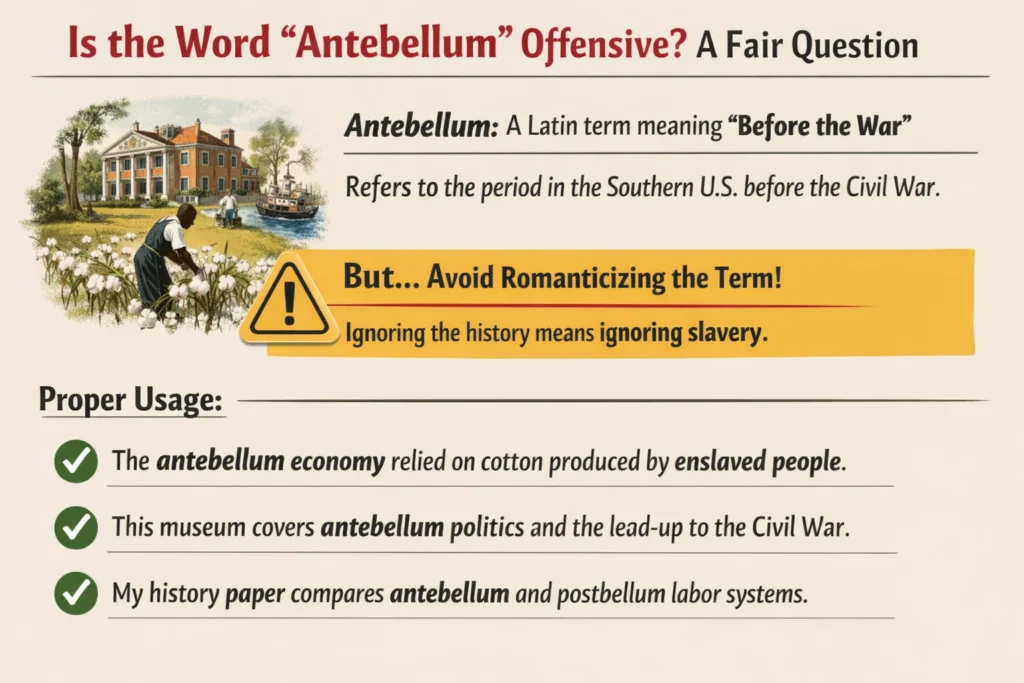
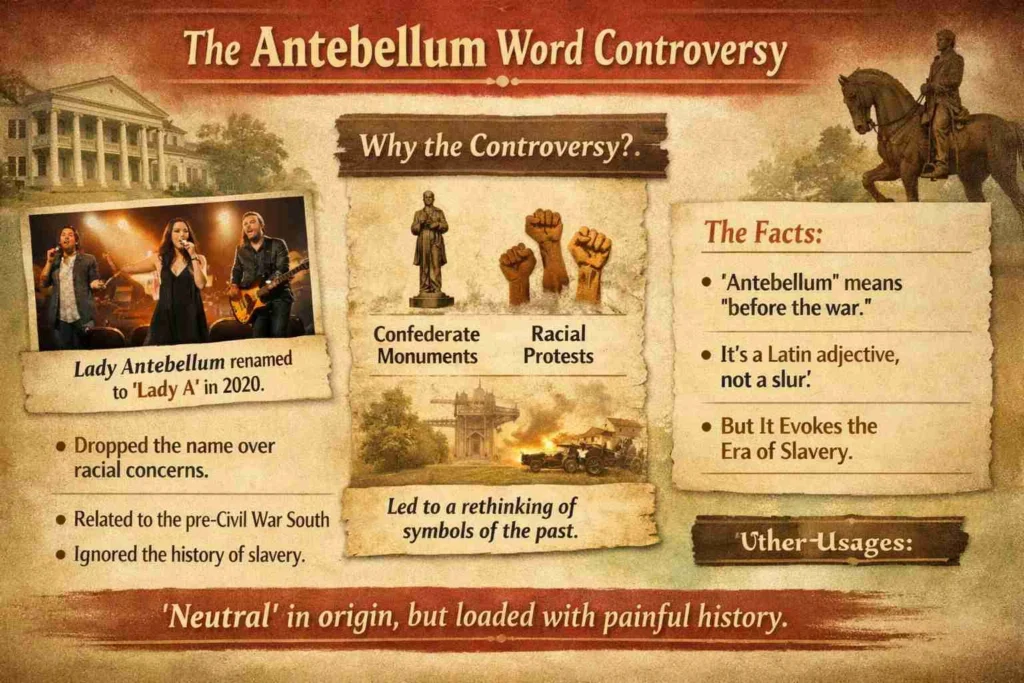
You might have noticed the band Lady Antebellum changed its name to Lady A in 2020. Why?
Because the word antebellum became politically charged. The band members admitted they did not think deeply about the name when they chose it in 2006. They liked how it sounded “Southern” and “classic.” But by 2020, after nationwide protests over police brutality and Confederate monuments, they realized the term ignored slavery.
Here is the honest answer: The word antebellum itself is not a slur. It is a Latin adjective. It describes a time period.
But and this is a big but using antebellum without mentioning slavery is like describing a car crash by complimenting the paint job. The word carries historical weight. If you use it just for “pretty Southern vibes,” you are romanticizing a slave society.
Examples of okay usage:
- “The antebellum economy relied on cotton produced by enslaved people.”
- “This museum covers antebellum politics and the lead-up to the Civil War.”
- “My history paper compares antebellum and postbellum labor systems.”
Examples of questionable usage:
- “Let’s have an antebellum‑themed wedding with hoop skirts and mint juleps.” (Yikes. That is cosplaying slavery.)
- “This bed and breakfast has so much antebellum charm.” (What charm? The architecture? Say that instead. Or better yet, name the enslaved builders.)
- “She’s going for an antebellum aesthetic in her living room.” (Please do not. Just say “Greek Revival” or “19th‑century Southern.”)
Final verdict: Use the word. But use it carefully. Pair it with historical honesty. If you see a tour guide or a brand using antebellum like a decoration, ask what they are leaving out.
Etymology | Where the Word Antebellum Really Comes From
This section is for word nerds. The antebellum origin is clean and logical.
Ante – Latin prefix meaning “before.” You see it in words like antecedent (going before), antedate (to come before in time), and antenatal (before birth).
Bellum – Latin noun meaning “war.” You see it in belligerent (warlike or hostile), rebel (from bellum via Latin rebellis), and bellicose (eager to fight).
Put together: Antebellum = before war.
First known use in English: Around the 1840s. Early uses appeared in letters and legal documents referring to “the antebellum condition” of property or land.
Why did English borrow it from Latin instead of using “prewar”? Two reasons. First, Latin sounded educated and authoritative in the 19th century. Second, “prewar” was too vague. Prewar what? Antebellum, in American context, points specifically to the Civil War. That specificity became useful after 1865, when writers needed one word to describe everything before the rebellion.
Related words in modern English:
- Postbellum – after the war
- Interbellum – between wars (usually World War I and World War II)
- Bellicose – aggressively hostile
- Rebel – from bellum through Latin rebellis (one who makes war again)
So when you say antebellum, you are speaking 2,000‑year‑old Latin. That is kind of cool. Just remember what it describes.
Antebellum in Literature and Pop Culture
The antebellum in literature shows up everywhere. Some books romanticize it. Others tear it apart.
Famous antebellum novels (written during or shortly after the era):
- Uncle Tom’s Cabin (1852) by Harriet Beecher Stowe. This book sold 300,000 copies in its first year. It made millions of Northerners hate slavery. Abraham Lincoln reportedly called Stowe “the little woman who wrote the book that made this great war.”
- The Narrative of the Life of Frederick Douglass (1845). Douglass wrote his own story of escaping slavery. It remains one of the most powerful American memoirs ever written.
- Gone with the Wind (1936) written long after the antebellum period but set during it. This novel (and the 1939 film) created the modern myth of the “gracious Old South.” It downplays slavery’s brutality. It also won the Pulitzer Prize. Complicated legacy.
Modern books that handle the antebellum period honestly:
- Kindred (1979) by Octavia Butler. A Black woman from 1976 travels back to an antebellum plantation. Brutal. Brilliant.
- The Known World (2003) by Edward P. Jones. A novel about Black slave owners in antebellum Virginia. Based on real historical records. Won the Pulitzer Prize.
- Twelve Years a Slave (1853) by Solomon Northup. A free Black man from New York gets kidnapped and sold into slavery in Louisiana. The 2013 film adaptation won Best Picture.
Pop culture references: The band Antebellum (later Lady A) created the most famous modern use. But you also hear the word in documentaries (The Civil War by Ken Burns), history podcasts, and museum labels.
If you want to understand the antebellum historical meaning beyond this article, start with the books above. They will stick with you.
Quick Reference| Antebellum Facts at a Glance
Use this table for a fast refresher.
| Category | Detail |
|---|---|
| Word origin | Latin ante (before) + bellum (war) |
| Pronunciation | An-tuh-BEL-um |
| Time period | ~1815 to 1861 |
| Ending event | Confederate attack on Fort Sumter, April 12, 1861 |
| Primary region | Southern United States |
| Population of enslaved people in 1860 | Nearly 4 million |
| Cotton share of U.S. exports (1860) | 60% |
| Percent of white families owning slaves | About 33% in the South (less than 5% owned more than 20) |
| Architectural style | Greek Revival, Federal, Georgian |
| Opposite term | Postbellum |
| Modern controversy | Romanticizes slavery if used without historical context |
FAQs
What does antebellum mean in American history?
The period just before the Civil War (1861–1865). It refers almost exclusively to the South.
What is the antebellum period known for?
Cotton plantations, enslaved labor, political fights over slavery’s expansion, and grand architecture built by enslaved craftsmen.
When was the antebellum period?
Roughly 1815 to 1861. Different historians quibble over the exact start year, but the end is clear: Fort Sumter.
What states were considered antebellum states?
Any slave state before the Civil War. That includes:
- Deep South: South Carolina, Georgia, Alabama, Mississippi, Louisiana, Texas, Florida
- Upper South: Virginia, North Carolina, Tennessee, Arkansas
- Border states (slavery legal but stayed in the Union): Kentucky, Missouri, Maryland, Delaware
What is antebellum architecture?
Lavish Southern homes built before 1861. Greek Revival style with tall columns, large porches, and grand staircases. Built by enslaved laborers.
How do you pronounce antebellum?
An-tuh-BEL-um. Stress the third syllable.
Is antebellum the same as pre-Civil War?
Yes. They are synonyms in American English.
What is the difference between antebellum and postbellum?
Antebellum means before the Civil War. Postbellum means after the Civil War (usually Reconstruction, 1865–1877).
Why did Lady Antebellum change its name?
Because the band realized the word glosses over slavery. They changed to Lady A in 2020.
What happened during the antebellum era?
The cotton economy exploded. Slavery expanded west. Political crises like the Missouri Compromise, the Compromise of 1850, and the Dred Scott decision pushed the nation closer to civil war.
What ended the antebellum period?
The Civil War. Specifically, the Confederate attack on Fort Sumter on April 12, 1861.
Was the antebellum period only in the South?
In American history, yes. Other countries had their own antebellum periods. But when Americans say “antebellum,” they mean the Southern pre-Civil War years.
What is a simple definition of antebellum for students?
“Antebellum” means “before the war.” In U.S. history class, it means the time before the Civil War when the South had slavery and cotton plantations.
Conclusion
You now know the antebellum meaning inside and out. You know it comes from Latin. And you know it describes the years before the Civil War. And you know about King Cotton, the plantation elite, the brutal lives of enslaved people, and the beautiful homes that still draw tourists.
But here is the most important thing to remember. Words are not neutral. Antebellum sounds old and fancy. But it describes a time when one human being could legally own another. When families were torn apart for profit. When a Black person’s life was worth less than a mule.
That does not mean you should never use the word. History needs precise language. Antebellum is precise.
But when you use it or see it on a sign, a tour, or a product ask the follow‑up question. Antebellum for whom? The planter? The enslaved person? The poor white farmer?
The honest answer changes everything.
So go ahead. Use the word. Pronounce it correctly (an-tuh-BEL-um). Drop it into conversations about 19th-century America. Impress your friends with Latin roots. But do not forget the weight it carries. That weight is real. And understanding it makes you not just smarter, but more human.
Discover More Related Articles:
- “POV” Meaning: How to Use It & Why It’s Everywhere Online In 2026
- “FWIW” Meaning: What It Means, How to Use It & When It Sounds Right In 2026
- “Solfege” Meaning: Improves Pitch & Ear Training Skills In 2026