


Agnostic means a person who does not claim to know whether a god exists. It’s a position on knowledge (not belief), so an agnostic can still have faith or doubt but refuses to pretend certainty about the divine.
Most people get the agnostic meaning wrong.
They think an agnostic person is someone who can’t make up their mind. A waffler. Someone who sits awkwardly between belief and atheism because they’re too scared to choose.
That’s not even close.
In fact, that misunderstanding annoys actual agnostics more than almost anything else.
So let’s clear it up. No philosophy degree required. No religious baggage. Just the real agnostic definition, how it works, and why millions of smart people proudly call themselves agnostic.
The Real Agnostic Meaning in Simple Terms
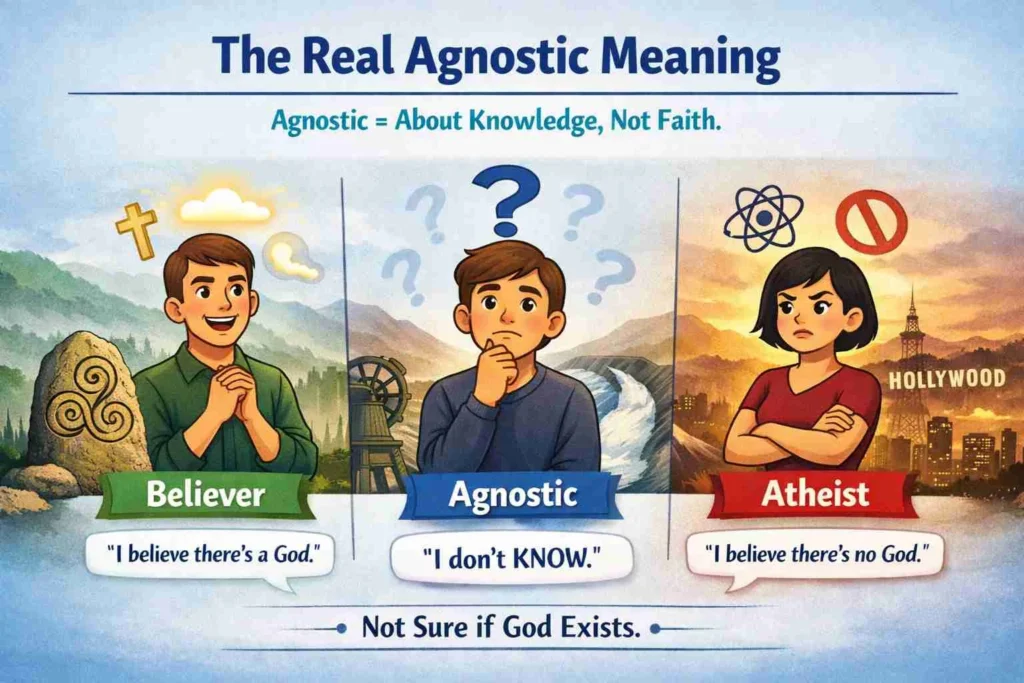
Let’s start with the simplest agnostic explanation you’ll find anywhere.
Agnostic meaning: A person who says “I don’t know whether a god exists.”
Notice the word know. Not believe. Know.
That’s the entire game right there.
An agnostic person isn’t claiming there’s no God. They’re also not claiming there is one. They’re making a statement about knowledge, not about faith.
Think of it this way:
- Belief lives in your gut.
- Knowledge lives in your head.
- Agnosticism lives in the honest gap between the two.
You can feel something strongly. That doesn’t mean you know it. And agnostics refuse to pretend otherwise.
A Quick Story to Lock In the Agnostic Definition
Imagine you’re walking through a dense forest at night.
Someone says, “There’s a cabin two miles north.”
Someone else says, “No there isn’t. That’s a lie.”
You look around. You see nothing but trees and darkness.
What do you say?
If you’re honest, you say: “I don’t know. I can’t see that far. I’ll need more evidence.”
Congratulations. You just took an agnostic stance.
You didn’t deny the cabin exists. You didn’t confirm it either. You simply admitted your current lack of knowledge.
That’s the entire agnostic worldview in one dark forest walk.
Why the Agnostic Belief System Confuses People
Here’s where most articles mess up.
They try to make agnosticism sound like a third religion. Or a halfway house between Christianity and atheism.
It’s neither.
The agnostic philosophy doesn’t give you rules to follow. No holy book. No prayers. No afterlife promises.
Instead, it gives you one thing: permission to say “I don’t know” without shame.
That sounds small. But for many people, it’s life-changing.
Growing up religious? You learned that doubt was dangerous.
Growing up atheist? You learned that uncertainty was weakness.
Agnosticism rejects both pressures. Doubt isn’t dangerous. It’s honest. Uncertainty isn’t weakness. It’s the starting point of real thinking.
The Man Who Invented “Agnostic” And Why He Did It
You can’t talk about agnostic meaning without mentioning Thomas Henry Huxley.
- England. Darwin’s theory of evolution had just blown a hole through traditional Christianity.
Huxley was Darwin’s bulldog – a fierce defender of science. But he wasn’t your typical angry atheist. He had a different problem.
He looked at religious people claiming certain knowledge about God. Then he looked at atheists claiming certain knowledge that no God exists.
Both groups seemed equally arrogant to him.
So he coined a new word: agnostic. From Greek *a-* (without) + gnosis (knowledge).
His point? Stop pretending you know things you don’t.
Huxley didn’t say God doesn’t exist. He said: “I don’t have enough evidence to be sure one way or the other. And neither do you.”
That’s the original agnostic meaning. It’s still the best one.
Agnostic vs Atheist vs Theist | The Simple Chart Everyone Needs
Let’s settle this confusion once and for all.
Here’s the breakdown of agnostic vs atheist vs theist in plain language.
| Term | Focus | What They Say |
|---|---|---|
| Theist | Belief | “I believe God exists.” |
| Atheist | Belief | “I do not believe God exists.” |
| Agnostic | Knowledge | “I don’t know if God exists.” |
See the difference?
Atheism and theism argue about belief. Agnosticism steps back and argues about knowledge.
You can combine them too. That’s where things get interesting.
The Four Positions Almost Nobody Talks About
Most people think you’re either:
- Religious (theist)
- Atheist
- Agnostic
But that’s too simple. Real life has four main positions.
1. Gnostic Theist
Believes in God and claims to know for sure.
Example: “I don’t just believe Jesus rose from the dead. I know he did.”
2. Agnostic Theist
Believes in God but admits they could be wrong.
Example: “I have faith in God, but I can’t prove it. I might be mistaken.”
3. Gnostic Atheist
Claims to know no god exists.
Example: “There’s definitely no God. I’m 100% certain.”
4. Agnostic Atheist
Doesn’t believe in God but doesn’t claim certainty.
Example: “I see no evidence for God, so I don’t believe. But I won’t say I know for sure.”
Most self-described agnostics fall into category 2 or 4. Some fall right in the middle – caring less about belief and more about staying humble.
What Do Agnostics Actually Believe?
This question comes up constantly. “What are agnostic beliefs?”
The honest answer? It varies.
Agnosticism isn’t a belief system. It’s a stance on knowledge. So two agnostics can believe totally different things and still both be agnostic.
However, most agnostics share a few common threads.
Common agnostic attitudes:
- Certainty about God is impossible for humans.
- Faith without evidence is risky.
- Doubt is intellectually honest, not a failure.
- No religion has proven its case beyond doubt.
- It’s okay to live with unanswered questions.
What agnostics usually don’t have:
- A holy book
- A central leader
- Required rituals
- Dogma about the afterlife
- Conversion ceremonies
You won’t find an “agnostic church.” But you will find millions of people quietly living with humility about the biggest questions.
Can You Believe in God and Be Agnostic?
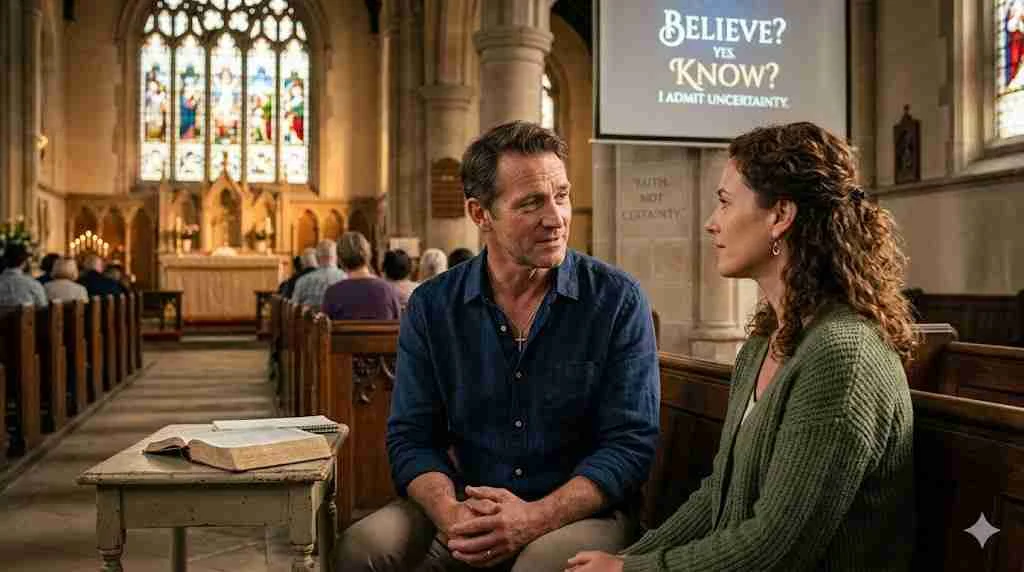
Yes. Absolutely.
This surprises many people. They think “agnostic” means “no God.” That’s wrong.
Remember the four positions above. An agnostic theist believes in God but admits they don’t know for certain.
Real-world example:
Someone prays every Sunday. They love their religious community. They feel a deep sense of the divine.
But ask them “Do you know God exists?” and they pause.
“I believe,” they say. “But know? No. I can’t prove it. I have faith, not certainty.”
That person is an agnostic theist. They’re religious and agnostic at the same time.
This is more common than you think. Many religious people privately admit uncertainty. They just don’t say it out loud in church.
Is Agnosticism a Religion?
Short answer: No.
Longer answer: Still no, but let me explain why people get confused.
A religion typically includes:
- Belief in something supernatural
- Sacred texts
- Rituals (prayer, meditation, holidays)
- Moral codes
- Community structures
- Often a clergy or leadership
Agnosticism has none of these.
You can’t “practice” agnosticism like you practice Buddhism or Christianity. You can’t marry someone in an agnostic ceremony. There’s no agnostic confession or agnostic baptism.
What agnosticism offers instead is a framework for approaching religious questions. It’s a tool, not a temple.
Calling agnosticism a religion is like calling “skepticism” a religion. It misses the point entirely.
Religious Agnostic | Is That a Real Thing?
Yes, and it’s fascinating.
A religious agnostic participates in a religion but holds agnostic views about knowledge.
Examples:
- A Christian who says “I follow Jesus, but I can’t be 100% sure about the resurrection.”
- A Jew who keeps kosher and celebrates holidays but admits “I don’t know if God gave the Torah at Sinai.”
- A Muslim who prays five times daily yet says “I have faith, but I won’t claim certain knowledge of Allah’s nature.”
Some religious traditions even welcome agnosticism.
Reform Judaism has a long history of embracing doubt. Certain Buddhist schools focus more on practice than belief. Even some Quaker meetings include agnostics and atheists.
So yes. Religious agnostic is real. It’s not a contradiction. It’s humility inside a tradition.
Spiritual But Agnostic | What That Looks Like
You’ve heard “spiritual but not religious” a million times.
Some of those people are actually spiritual but agnostic.
What does that mean?
They feel something larger than themselves. Maybe nature. Maybe love. Maybe mystery itself.
They meditate. They practice gratitude. They feel awe looking at the stars.
But ask them “Is that God?” and they shrug.
“I don’t know what it is,” they say. “But it’s real to me. I just won’t pretend I understand it.”
That’s spiritual agnosticism. No doctrine. No claims of knowledge. Just openness to wonder without attaching certainty to it.
Famous Agnostics You’ve Heard Of
You’re in good company if this agnostic meaning resonates with you.
Charles Darwin – Believed in God earlier in life. Later called himself an agnostic. Never became a hard atheist.
Carl Sagan – Famous astronomer. Wrote “The cosmos is within us. We are made of star-stuff.” Called himself agnostic. Said extraordinary claims need extraordinary evidence.
Albert Einstein – People still argue about his beliefs. But he rejected atheism and traditional religion. Called himself agnostic or “pantheistic” (seeing God in nature’s laws).
Margaret Atwood – Author of The Handmaid’s Tale. Openly agnostic. Says she’s “interested in belief” but doesn’t claim knowledge.
Neil deGrasse Tyson – Popular scientist. Says “I’m an agnostic. I don’t know. And I’m okay with that.”
These aren’t wishy-washy people. They’re some of the sharpest minds in history. They chose agnosticism not from laziness but from intellectual rigor.
Signs You Might Be Agnostic
You don’t have to call yourself anything. But these signs might ring a bell.
- You often say “I’m not sure what I believe.”
- You think every religion has some truth but none has all the truth.
- You respect people of faith but can’t force yourself to share their certainty.
- You dislike when either atheists or believers claim to know things they can’t prove.
- You’ve stopped telling people you’re “spiritual” because that word feels too vague.
- You’re comfortable saying “I don’t know” about life’s biggest questions.
- You think faith is fine. Pretending faith is knowledge is not.
If you nodded at several of these, you might already hold an agnostic mindset. You just didn’t have the word for it.
Agnostic vs Atheist | The Debate That Never Ends
Let me clear up the most common fight online.
Atheists often say: “Agnosticism isn’t a separate thing. Everyone is either a theist or atheist. ‘Agnostic’ just describes how sure you are.”
That’s a popular view. It’s called the “spectrum” view.
But many agnostics disagree. They say: “No. I reject the whole belief/knowledge merger. My agnosticism isn’t about degree of certainty. It’s a different question entirely.”
Who’s right?
Both have good points.
The atheist’s argument:
“Belief is binary. You either believe a god exists or you don’t. There’s no third option. ‘I don’t know’ still means you don’t actively believe. So you’re an atheist.”
The agnostic’s counter:
“That flattens real human experience. I don’t want to say ‘I believe’ or ‘I don’t believe.’ Both feel false. My honest position is ‘I withhold judgment until I have evidence.’ That’s distinct from atheism.”
Reasonable people disagree here. The best answer? Respect how someone identifies. If they call themselves agnostic, don’t force “atheist” on them. And vice versa.
What Does Agnostic Mean in Religion Specifically?
When people ask “what does agnostic mean in religion” they usually want the practical answer.
Here it is:
An agnostic in a religious context doesn’t claim to know if God exists. They might attend services. They might pray. They might not. But they won’t say “I know God exists” or “I know God doesn’t exist.”
That’s it.
No drama. No rebellion. Just honesty about the limits of human knowledge.
Some agnostics avoid religion entirely. Others participate fully while holding their uncertainty privately. Both are valid expressions of the agnostic meaning.
The Agnostic Mindset as a Daily Tool

You don’t have to care about God to benefit from agnostic thinking.
The agnostic attitude works for everything from politics to parenting to work decisions.
How?
- When someone claims absolute certainty, you pause.
- When evidence conflicts, you admit you don’t know.
- When pressure mounts to pick a side, you ask “What do I actually know for sure?”
- You tolerate ambiguity better than most people.
This isn’t weakness. In a world full of loud, certain voices, the quiet agnostic stance is a superpower.
You stop pretending. You stop performing certainty. You just think clearly and admit what you don’t know.
Try it for a week. It’s liberating.
The Difference Between Agnostic and Theist | One Clear Example
Let me give you a conversation that shows the difference.
Theist: “I believe God created the universe. I know this because scripture tells me so.”
Agnostic: “I’m open to that idea. But I don’t know that scripture is correct. I wasn’t there at creation. So I’ll keep looking at evidence and stay humble about what I can’t verify.”
See the difference?
The theist moves from belief to knowledge. The agnostic stays in the realm of “I don’t know.”
Neither is necessarily wrong. They just operate on different standards.
A Table of Agnostic vs Gnostic vs Atheist vs Theist
Here’s everything in one clean table for quick reference.
| Position | Belief Claim | Knowledge Claim | Example Statement |
|---|---|---|---|
| Gnostic Theist | God exists | I know God exists | “I know Jesus rose from the dead.” |
| Agnostic Theist | God exists | I don’t know for sure | “I have faith but can’t prove it.” |
| Gnostic Atheist | No god exists | I know no god exists | “I am 100% certain there’s no God.” |
| Agnostic Atheist | No god exists | I don’t know for sure | “I see no evidence so I don’t believe. But I could be wrong.” |
| Pure Agnostic | No clear belief | I don’t know either way | “I’m not making any claim. I just don’t know.” |
Most people who say “I’m agnostic” fall into the last two rows. But now you know the full range.
Why Certainty Is Overrated
Here’s something agnostics understand deeply.
Certainty feels good. It removes anxiety. It gives you answers.
But feeling good isn’t the same as being right.
History is full of people who were absolutely certain about things they were dead wrong about.
- Certain that the Earth was flat.
- Certain that bloodletting cured disease.
- Certain that slavery was morally correct.
- Certain that women couldn’t vote or think as clearly as men.
Certainty, without evidence, is dangerous.
The agnostic stance doesn’t say “never be certain.” It says “be certain only when you have good reason.”
And for questions about God? Most agnostics argue we don’t have good reason for certainty. So we stop pretending we do.
That’s not weakness. That’s intellectual maturity.
Real-Life Agnostic Examples You Might Recognize
Let’s move beyond famous names to everyday situations.
Example 1: The Quiet Scientist
Dr. Chen studies astrophysics. She sees immense order in the universe. That feels spiritual to her. But ask “Did God create that order?” and she says “I don’t know. I study physics, not metaphysics.”
Example 2: The Honest Pastor
Mark leads a small Protestant church. He preaches every Sunday. But privately, he admits “I believe in God. But I don’t know. Sometimes my faith feels strong. Other times I’m full of doubt. I tell my congregation the same.”
Example 3: The Raised-Religious Now Unsure
Leah grew up Catholic. She stopped attending in college. Now she says “I don’t know what I believe. I pray sometimes because it comforts me. But I won’t pretend God answered. Maybe he does. Maybe he doesn’t. I just don’t know.”
None of these people are lazy thinkers. They’re honest ones.
Agnostic Meaning for Beginners | A One-Paragraph Summary
If someone asks you for the agnostic meaning for beginners, say this:
“An agnostic is someone who doesn’t claim to know whether God exists. They might believe or not believe. They might pray or not pray. But they won’t say they know for sure. Because they don’t. And they think it’s more honest to admit that than to pretend.”
That’s it. That’s the whole thing.
The Emotional Side of Agnosticism
We’ve talked a lot about definitions and philosophy. But there’s an emotional reality too.
Many agnostics feel lonely.
Religious people think they’re atheists. Atheists think they’re religious-light. Both sides sometimes pressure them to pick a team.
But the agnostic person isn’t refusing to pick. They’re refusing to lie.
That takes guts. Especially in cultures where “I don’t know” is treated as a failure.
If you’re agnostic, you’re not broken. You’re not confused. You’re not lazy.
You’re just someone who values honesty over comfort. That’s rare. And it’s valuable.
Why “Agnostic” Might Be the Most Honest Position
Let me leave you with a question.
If you had to bet your life on whether God exists, could you be 100% sure?
Most people would pause.
They’d say “I believe strongly. But 100% sure? No. I can’t prove it.”
That pause is agnosticism.
It’s not anti-religion. It’s not pro-atheism. It’s pro-honesty.
And honesty about the limits of human knowledge? That’s not a weakness. That’s wisdom dressed in humility.
FAQs
Q: What does agnostic mean in simple words?
A: “I don’t know if God exists.”
Q: Is an agnostic person the same as an atheist?
A: No. Atheism is about belief. Agnosticism is about knowledge. You can be both or just one.
Q: Can an agnostic believe in God?
A: Yes. That’s an agnostic theist. They have faith but no certainty.
Q: Do agnostics pray?
A: Some do. Some don’t. Agnosticism doesn’t forbid or require anything.
Q: Is agnosticism a lack of faith?
A: Not exactly. It’s a lack of knowledge claims. Faith can still exist alongside it.
Q: What’s the opposite of agnostic?
A: Gnostic – someone who claims certain knowledge about God.
Q: Are agnostics spiritual?
A: Many are. They just don’t frame spirituality as certain knowledge.
Q: Why would someone choose agnostic over atheist?
A: Atheist sounds too certain to them. Agnostic feels more honest about their uncertainty.
Q: Do agnostics go to hell?
A: That depends entirely on which religion (if any) turns out to be true. Most agnostics would say “I don’t know, and neither do you.”
Q: Is agnosticism growing?
A: Yes. In the US, the “nones” (no religious affiliation) now make up about 30% of adults. Many within that group hold agnostic views.
Q: What is agnostic religion?
A: Agnostic religion refers to a belief approach where a person believes that the existence of a god, gods, or a higher power is unknown or impossible to prove with certainty.
Conclusion
The world rewards certainty. Loud answers. Firm declarations. Agnosticism quietly says no thank you.
You don’t need to know everything. You don’t need to pretend. You can live a good, meaningful, ethical life without claiming certainty about God.
Millions of agnostics do it every day. They love their families. They create art. They help strangers. They wonder about the stars.
And when someone asks “Do you believe in God?” They smile and say “I don’t know. And I’m okay with that.” That’s the real agnostic meaning. Not indecision. Honesty.
Discover More Related Articles:
- “RS” Mean in Text: You’ve Seen It Everywhere In 2026
- “ION” Mean in Text: Don’t Misunderstand This Slang In 2026
- “Chuzz” Meaning in Social Media: Why People Are Using It In 2026