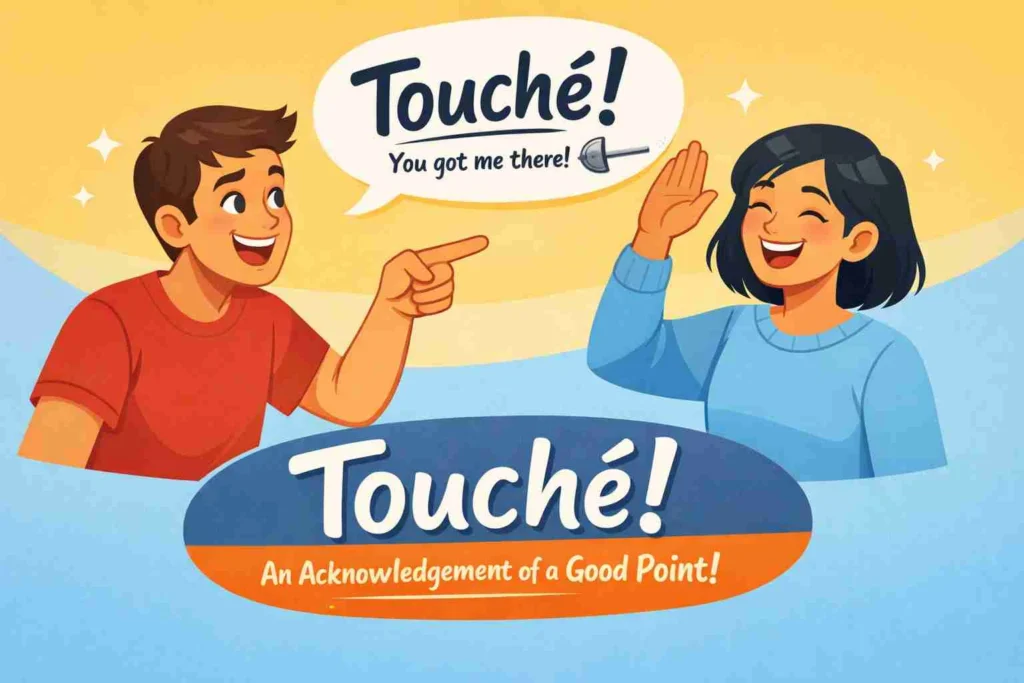

Touché means acknowledging that someone just made a clever point often by turning your own words or logic back against you. You say it to show respect for their verbal hit, just like fencers do when they get touched by a blade.
You’re in the middle of a heated but friendly debate.
Maybe it’s about who’s the worst driver. Or why pineapple belongs on pizza. Your friend just fired back a comeback so sharp, so perfectly aimed, that you have nothing left to say.
You pause. You smirk. And you say one word: Touché.
Feels good, right?
But here’s the thing. Most people use touché without really understanding its touché meaning. They think it just means “good point” or “you got me.” That’s close. But it’s not the whole story.
This guide will give you the real touché definition. You’ll learn its French fencing roots. You’ll see exactly when to say it, when to stay quiet, and how to pronounce it so you don’t sound like a tourist.
Plus, you’ll get real texting examples, debate etiquette, and the one mistake that makes touché sound mean instead of clever.
Let’s dive in.
Touché Definition | What Does Touché Actually Mean?
Let’s start simple.
Touché meaning in plain English:
You acknowledge that someone just made a clever or effective point. Often, that point turns your own argument back against you.
You’re not saying “you’re right about everything.” You’re saying “that was a good hit.”
Think of it like a verbal nod. You lose a small battle. But you win respect.
The One-Sentence Takeaway
Touché is how smart people say “I see what you did there” without sounding childish.
Real Example
You say: “You’re always on your phone.”
Your friend says: “You just checked yours three times while saying that.”
You: “Touché.”
Notice what happened. You didn’t get angry. You didn’t deny it. You just acknowledged the hit. That’s classy.
What Touché Is NOT
- An apology
- A full surrender
- Sarcasm (unless you want to start a real fight)
- A way to say “that’s funny”
Keep these distinctions in mind. They matter more than you think.
How to Pronounce Touché | Two Syllables, Zero Embarrassment
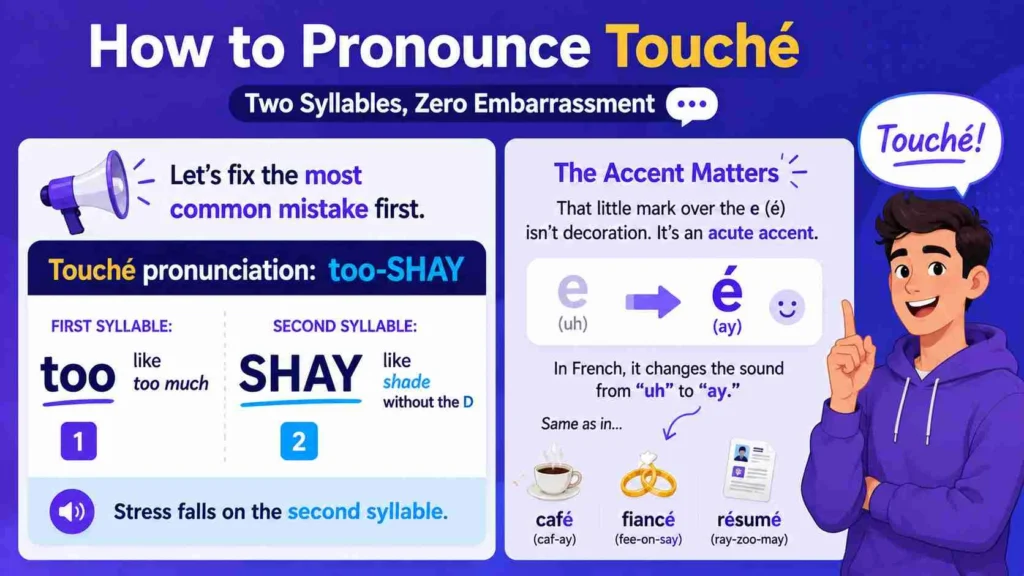
Let’s fix the most common mistake first.
Touché pronunciation: too-SHAY
- First syllable: “too” like too much
- Second syllable: “SHAY” like shade without the D
- Stress falls on the second syllable
The Accent Matters
That little mark over the *e* (é) isn’t decoration. It’s an acute accent. In French, it changes the sound from “uh” to “ay.” Same as in café, fiancé, or résumé.
Common Wrong Pronunciations
| Wrong Way | Why It’s Wrong |
|---|---|
| “touch-ee” | Ignores the accent completely |
| “tooch” | Missing the second syllable |
| “touched” | That’s a different word entirely |
| “too-shay” with flat tone | You need the rising stress on “SHAY” |
Quick Test
Say this out loud: “Too much shade.”
Now drop the “much” and “de.”
“Too… SHAY.”
That’s it. You’ve got it.
Touché Origin | From Fencing to Friendly Roasts
Where did this word come from?
The touché origin story starts in France. Not in living rooms or coffee shops. In fencing salons.
The French Root
Touché is the past participle of the French verb toucher. That verb means “to touch” or “to hit.”
In fencing, when one fencer landed a valid hit on their opponent, they’d say “Touché!” The meaning? “You touched me. You landed a hit. I acknowledge it.”
The Shift to Conversation
At some point in the 20th century, English speakers borrowed the word for verbal sparring.
Think about it. A debate is like a fencing match. You make an argument. Your opponent parries. Then they land a rhetorical hit. Saying “touché” is like raising your hand and admitting they scored.
Interesting Cultural Twist
Here’s something most people don’t know.
In French fencing, the person who gets hit says “Touché.” In English conversation, the person who receives the clever comeback says “Touché.” Same word. Different speaker.
That’s why the touché meaning in English is slightly different from its original French use. We adapted it. And that’s fine. That’s how language works.
Touché Meaning in Conversation | Real Scenarios You’ll Recognize
Theory is boring. Let’s see touché in action.
Scenario 1: The Work Debate
You: “We don’t need meetings every morning. They waste time.”
Coworker: “You’re the one who asked for a recap meeting last week because you missed the memo.”
You: “…Touché.”
Why this works: You didn’t get defensive. You acknowledged the point. Now the conversation can move forward.
Scenario 2: The Friendly Roast
You: “You’re the messiest person I know.”
Friend: “Your car has three empty coffee cups and a sock in the backseat.”
You: “Touché.”
Why this works: It keeps things playful. No one gets hurt. Everyone laughs.
Scenario 3: The Argument That Almost Got Heated
You: “You never listen to me.”
Partner: “You just interrupted me twice while I was trying to listen.”
You: “Okay. Touché.”
Why this works: You de-escalate. Instead of doubling down, you admit the hit. That’s emotional intelligence.
Scenario 4: Texting
Friend: “You always leave me on read.”
You: “You left me on delivered for three days last week.”
Friend: “Touché 😂”
Why this works: It’s fast. It’s funny. It ends the mini-argument without anyone feeling attacked.
Touché Meaning in Texting and Chat | Short, Sweet and Sarcasm-Free
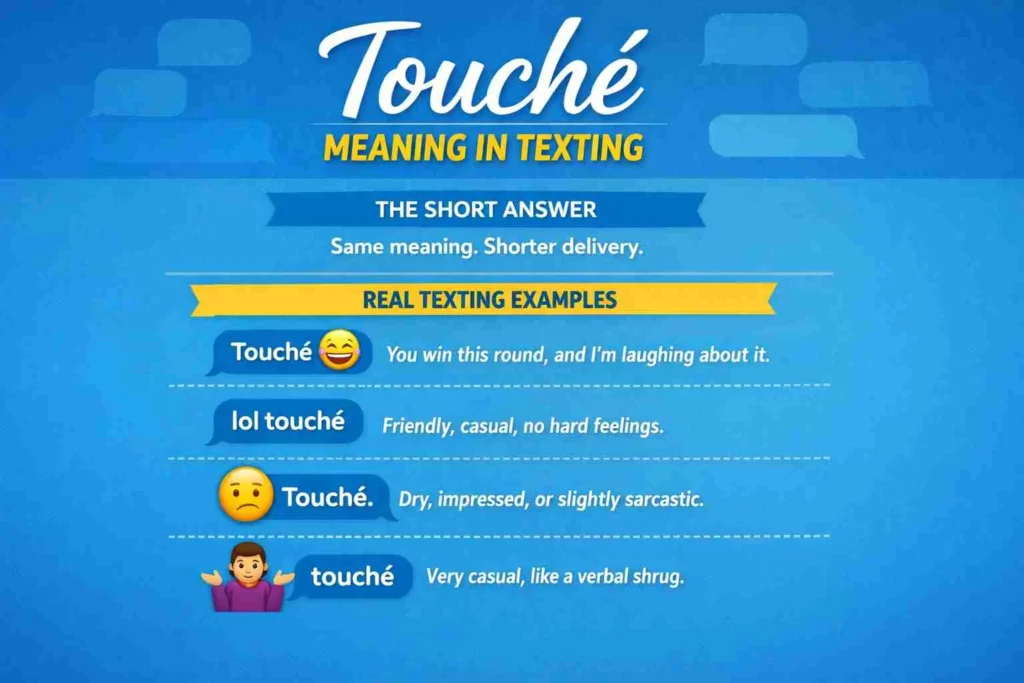
Texting changes everything. No tone of voice. No facial expression. Just words on a screen.
So how does touché work in chat?
The Short Answer
Same meaning. Just shorter delivery.
Real Texting Examples
- “Touché 😅” – you win this round, and I’m laughing about it
- “lol touché” – friendly, casual, no hard feelings
- “Touché.” with a period – dry, impressed, or slightly sarcastic (use carefully)
- “touché” all lowercase – very casual, almost like a verbal shrug
Emojis That Pair Well With Touché
| Emoji | Vibe |
|---|---|
| 🎯 | “You hit the target” |
| 🤺 | “Fencing reference, nice” |
| 🙌 | “High five for that comeback” |
| 🫡 | “I salute your cleverness” |
| 😂 | “You got me and it’s funny” |
What Touché Does NOT Mean in Text
- “I’m angry”
- “Stop talking”
- “You’re wrong”
If you mean any of those things, don’t say touché. Say what you actually mean.
Touché Slang Meaning | What People Think It Means vs. What It Really Means
Slang drifts. Words change. But touché has stayed surprisingly stable.
The Common Misunderstanding
Many people think touché simply means “good point.”
That’s not wrong. But it’s incomplete.
The Real Slang Meaning
Touché means “you made a good point that specifically turns my own words or logic against me.”
The “turning against me” part is crucial.
Touché vs. “Gotcha”
| Term | Meaning | Tone |
|---|---|---|
| Gotcha | I caught your mistake or contradiction | Can be smug or playful |
| Touché | I acknowledge your clever hit | Respectful, rarely smug |
Example difference:
Someone says “Gotcha!” after you slip up on a fact. That can feel like they’re gloating.
Someone says “Touché” after you turn their argument around. That feels like respect.
Touché vs. “Fair Point”
| Term | Meaning | Best For |
|---|---|---|
| Fair point | I agree with your reasoning | Calm, neutral discussions |
| Touché | Your comeback was clever | Quick, witty exchanges |
Example difference:
In a work meeting: “Fair point, let’s adjust the timeline.”
At a bar with friends: “Touché. I walked right into that.”
When to Use Touché | The Etiquette You Actually Need
Knowing the touché meaning is one thing. Knowing when to say it is another.
Do Say Touché When
- Someone uses your own logic against you
- You want to acknowledge wit without losing your cool
- The comeback is clever, not just mean
- You’re in a friendly debate or roast
- You want to de-escalate a tense moment
Don’t Say Touché When
- You’re genuinely angry (it’ll sound sarcastic and petty)
- The point is obvious or boring
- Example: “Water is wet.” “Touché.” (No. Just no.)
- You’re in a formal debate with judges
- Just say “I concede that point” instead
- Someone made a hurtful personal attack
- That’s not clever. That’s just rude. Don’t reward it.
- You’ve already said it twice in the same conversation
- Once is witty. Twice is a tic. Three times is annoying.
The Golden Rule of Touché Etiquette
Only say touché if you’d smile while saying it.
If you wouldn’t smile? Don’t say it. Say something else or stay quiet.
Pro Tip: Read the Room
Touché works great with friends, close coworkers, or anyone who enjoys verbal sparring.
It works poorly with:
- Your boss (depends on culture, but risky)
- A stranger who’s already annoyed
- Someone who doesn’t know the word (they’ll just look confused)
Touché Examples in Sentences | Real Life, Real Talk
Let’s make this sticky. Here are touché examples you might actually say.
Everyday Conversation
- “You said I never help with dishes. But I washed everything last night while you watched TV.”
Touché. - “You make fun of my coffee addiction. You drink three energy drinks before noon.”
Okay. Touché. - “You’re late again.” – “You were late yesterday.” – Touché.
At Work (Casual Environments)
- “You said we need better documentation. You haven’t updated the wiki in six months.”
Touché. I’ll do it today. - “You always interrupt me in meetings.” “You just interrupted me to say that.” Touché.
Texting Exchanges
Person A: “You never text back fast.”
Person B: “Says the person who took six hours to say ‘k.’”
Person A: “Touché 😂”
Person A: “You’re addicted to your phone.”
Person B: “You’re reading this on yours right now.”
Person A: “…touché.”
With Kids (Simplified)
Kid: “You said no cookies before dinner. But you just ate a donut.”
Parent: “Touché. You got me. One cookie.”
Kid: “You always say patience is important. But you yelled at the GPS.”
Parent: “Alright. Touché. I’ll try harder.”
Touché vs Checkmate | A Confusion Worth Clearing Up
People mix these up. Let’s fix that permanently.
The Core Difference
| Term | Meaning | Finality | Tone |
|---|---|---|---|
| Touché | You made a good point this round | Low debate continues | Respectful, playful |
| Checkmate | I’ve won completely. No moves left. | Total game over | Dominant, final |
When to Use Each
Touché:
“You said I’m bad with money. But you just bought a $100 candle.”
Touché. The conversation can keep going.
Checkmate:
In chess only. Or as a dramatic joke.
“You forgot your own birthday? Checkmate.” (That’s a joke. Don’t actually say this.)
Why You Should Never Say Checkmate in Casual Chat
It sounds like you think you’re a movie villain. It’s too final. Too aggressive. Too weird.
Stick with touché. It’s classier.
Touché Meaning for Kids | The Simple Version
Sometimes you need to explain the touché meaning to a child. Or to an adult who’s new to the word.
The Kid-Friendly Definition
Touché means “good one” when someone makes a smart comeback.
A Story They’ll Remember
A dad tells his daughter, “No candy before dinner.”
The daughter points at the dad’s hand. He’s holding a chocolate bar.
She says, “You’re eating candy right now.”
The dad smiles. “Touché. You got me.”
Why Kids Love This Word
It makes them feel smart. It turns a potential argument into a game. And it teaches them to acknowledge when someone else makes a good point.
That’s a life skill.
Touché Synonyms and Antonyms | Expand Your Vocabulary
Sometimes you don’t want to say touché. Here are your options.
Synonyms for Touché
| Word or Phrase | When to Use It |
|---|---|
| Fair point | Neutral, calm, professional |
| You got me | Friendly, casual, humble |
| Well played | Slightly competitive, respectful |
| I stand corrected | Formal, humble, no wit intended |
| Point taken | Neutral, slightly cold but polite |
| Touche (without accent) | Acceptable in casual English writing |
Antonyms for Touché
| Word or Phrase | Meaning |
|---|---|
| That doesn’t follow | Their logic is flawed |
| Irrelevant | Their point doesn’t matter |
| Nice try but no | You reject the point without respect |
| So? | Dismissive, rude |
| You’re still wrong | Denying the hit entirely |
Pro Tip
If you never say touché, people won’t notice. If you say “nice try but no” too often, people will think you’re a jerk.
Choose wisely.
Common Touché Mistakes | And How to Avoid Them
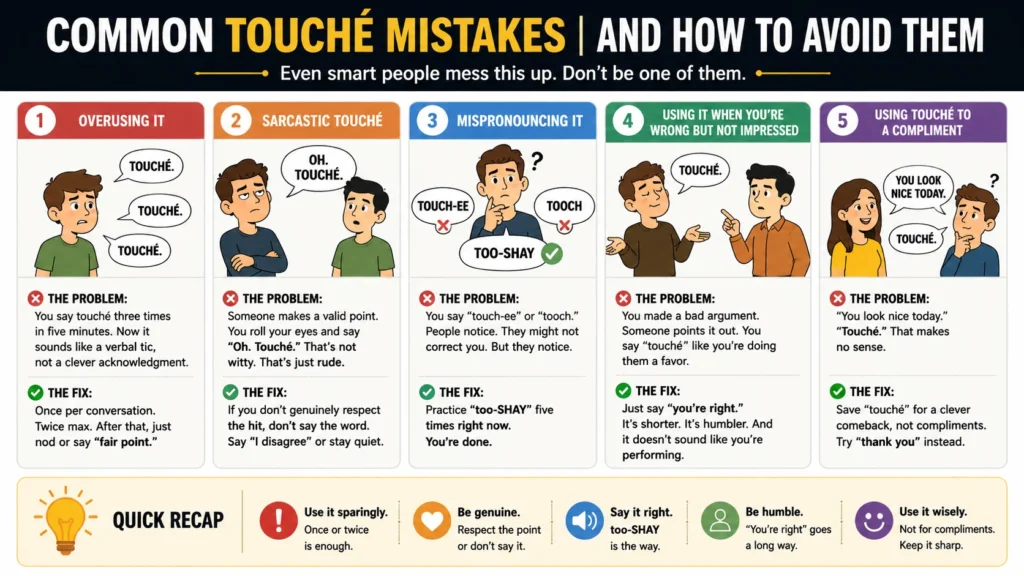
Even smart people mess this up. Don’t be one of them.
Mistake 1: Overusing It
The problem: You say touché three times in five minutes. Now it sounds like a verbal tic, not a clever acknowledgment.
The fix: Once per conversation. Twice max. After that, just nod or say “fair point.”
Mistake 2: Sarcastic Touché
The problem: Someone makes a valid point. You roll your eyes and say “Oh. Touché.” That’s not witty. That’s just rude.
The fix: If you don’t genuinely respect the hit, don’t say the word. Say “I disagree” or stay quiet.
Mistake 3: Mispronouncing It
The problem: You say “touch-ee” or “tooch.” People notice. They might not correct you. But they notice.
The fix: Practice “too-SHAY” five times right now. You’re done.
Mistake 4: Using It When You’re Wrong But Not Impressed
The problem: You made a bad argument. Someone points it out. You say “touché” like you’re doing them a favor.
The fix: Just say “you’re right.” It’s shorter. It’s humbler. And it doesn’t sound like you’re performing.
Mistake 5: Using Touché to a Compliment
The problem: “You look nice today.” “Touché.” That makes no sense.
The fix: Say “thank you” like a normal human.
Touché in Pop Culture and Memes | Why the Word Sticks Around
Some words fade. Touché has staying power. Here’s why.
The Office (US)
Jim and Dwight spar constantly. In one episode, Dwight actually makes a solid point. Jim pauses. Smiles. Says “Touché.” It’s a rare moment of respect between rivals.
That scene works because everyone understands the touché meaning. No explanation needed.
Social Media Meme Format
Meme template: Two people arguing in text messages.
Person A: “You always interrupt.”
Person B: “You just interrupted me to say that.”
Meme caption: And then they said touché.
Millions of shares. Why? Because the format is recognizable. The word is short. And everyone has been in that situation.
Why Touché Works in Memes
- Short word (fits in tiny text)
- Recognizable meaning
- Perfect for verbal sparring screenshots
- Sounds smarter than “haha true”
Touché Etiquette Around the World | Does It Translate?
You’re traveling. You make a clever point to a French speaker. You wait for them to say touché.
They don’t.
What happened?
In France
French people know the word. But they use it less often in casual conversation than English speakers do. And remember: in original French fencing, the person receiving the hit says “Touché.” Not the person throwing the punch.
So a French person might hear your clever comeback and think “that was a good hit… on me.” They might not say touché back. They might just nod.
In the UK
Touché is common but slightly upper-middle-class. Some Brits find it a bit pretentious. Others use it all the time. Know your audience.
In Canada (Quebec)
French-Canadians use touché more like the English version. Friendly. Playful. Common in banter.
In Non-English Speaking Countries
Don’t assume people know the word. In many places, saying “touché” will just get you blank stares. Stick with “good point” or a local equivalent.
The Psychology of Touché | Why This Word Feels So Good
Let’s get a little deeper. Why does saying touché feel satisfying?
It Signals Confidence
Weak people can’t admit when someone makes a good point. Strong people can. Saying touché shows you’re secure enough to lose a small battle.
It Ends the Escalation
Without touché, a friendly debate can turn into a real argument. You both keep trying to “win.” With touché, you stop. You acknowledge the hit. The tension dissolves.
It Gives the Other Person a Win
Everyone likes feeling clever. When you say touché, you’re giving the other person a small victory. That builds goodwill. That makes them like you more.
It’s More Elegant Than “You’re Right”
“You’re right” can feel like surrender. Touché feels like respect. Same acknowledgment. Different flavor.
How to Teach Someone the Touché Meaning
You have a friend. They keep using touché wrong. How do you fix them?
The Gentle Correction Method
Wait for them to misuse it. Then say:
“You know, touché actually works best when someone turns your own point against you. Like in fencing. It’s a hit acknowledgment.”
Then give a quick example. Keep it light. Don’t lecture.
The Funny Method
Next time they misuse it, say “That was a touché attempt. Solid B minus. Want the real definition?”
If they laugh? Teach them. If they look annoyed? Drop it. touche meaning slang.
The Lead-by-Example Method
Use touché correctly around them. Often. They’ll pick it up naturally. lol touche meaning.
Touché Meaning | A Quick Reference Table
| Question | Answer |
|---|---|
| What does touché mean? | Acknowledgment of a clever point, often turning your own words against you |
| How do you pronounce touché? | too-SHAY |
| Where does touché come from? | French fencing |
| Can you use touché in texting? | Yes. Very common. |
| Is touché rude? | No. But sarcastic touché is rude. |
| What’s better: touché or fair point? | Touché for witty banter. Fair point for calm discussions. |
| Can kids say touché? | Yes. Teach them the simple definition. |
| Does touché mean “you win”? | No. It means “you won that exchange.” Not the whole argument. |
FAQs
Is touché only for arguments?
No. Works for banter, texts, friendly roasts, even work chat if the culture is casual. Just don’t use it in serious conflicts.
Do French people say touché the same way we do?
Almost. The meaning overlaps a lot. But French speakers use it less often. And they originally used it from the receiving end of a hit.
Can I say touché to a compliment?
No. That’s weird. Say “thank you” instead.
Is touché rude?
Not if you say it with a smile. Without a smile? Yes. It sounds sarcastic and petty.
Can women say touché?
Yes. It’s not gendered. Anyone can use it.
Is touché outdated?
No. It’s actually becoming more common in texting and memes. The word is alive and well.
What’s the difference between touché and touché with an accent?
Nothing. The accent just shows pronunciation. In English writing, many people drop the accent. That’s fine. But using the accent (é) looks more polished.
Can you say touché in a professional email?
Rarely. Only if you have a very casual relationship with the person. Otherwise it’s too informal.
How do you spell “touché”?
A: The correct spelling is touché—T-O-U-C-H-É. The word comes from French, and the acute accent (é) is part of the original spelling. While you’ll sometimes see touche without the accent in informal English, touché is the preferred and most accurate spelling.
What does “tooshay” mean?
A: “Tooshay” is a phonetic spelling of touché, a French word used to mean “good point,” “you got me,” or “well played” after someone makes a clever or valid remark.
Conclusion
You made it to the end. That means you now know more about touché meaning than 99% of people. Let’s recap the essentials.
Touché definition: Acknowledgment of a clever point that often turns your own logic against you.
Touché pronunciation: too-SHAY. Never “touch-ee.”
Touché origin: French fencing. You acknowledge a hit.
When to use it: Friendly debates, witty roasts, playful texts, de-escalation moments.
When not to use it: Sarcastically, repeatedly, or when you’re genuinely angry.
The golden rule: Only say it if you’d smile while saying it.
Now here’s your challenge. Next time someone makes a sharp comeback, don’t get defensive. Don’t ignore it. Don’t try to one-up them. Just smile. Nod. And say “Touché.”
You’ll look confident. You’ll sound smart. And you’ll keep the conversation fun instead of turning it into a fight. That’s the real power of this little French word. Now go use it.
Discover More Related Articles:
- “RS” Mean in Text: You’ve Seen It Everywhere In 2026
- “ION” Mean in Text: Don’t Misunderstand This Slang In 2026
- “Chuzz” Meaning in Social Media: Why People Are Using It In 2026