
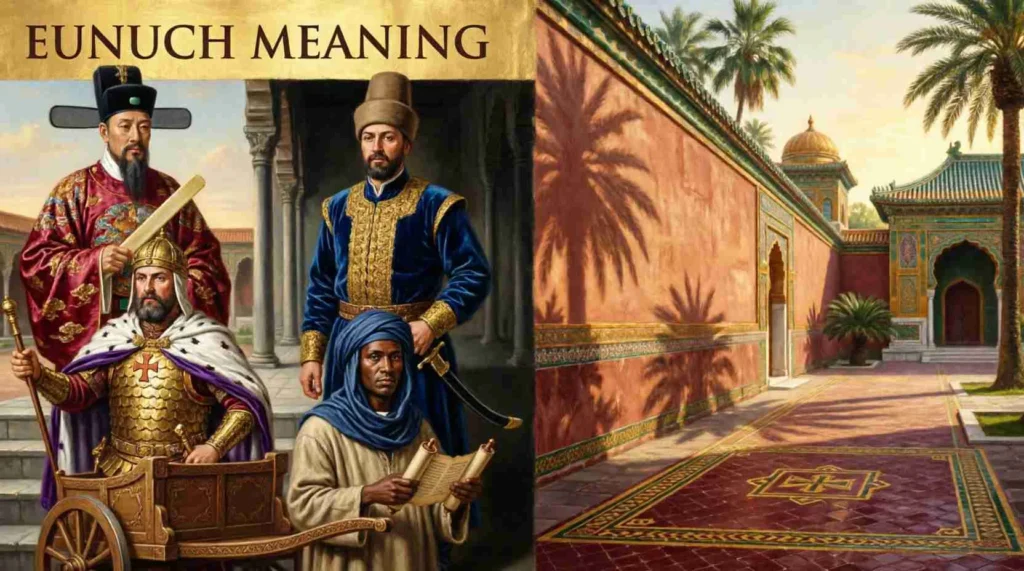

A eunuch is a castrated male, typically one who lost his testicles before puberty. Historically, eunuchs served as trusted royal court officials, harem guardians, or palace administrators because they couldn’t father children or start rival dynasties.
You know the word. But do you really know what it means?
Let’s clear this up right now.
A eunuch is a castrated male. That’s the core eunuch meaning in simple English. But here’s where it gets interesting. Most people don’t realize that eunuchs weren’t just servants. They ran empires. They commanded armies. They advised kings. And in some places, they held more power than anyone except the ruler himself.
So what is a eunuch exactly? A man who lost his testicles (and sometimes the penis too) usually before puberty. The definition of eunuch varies slightly by culture and time period. But the constant is castration. Everything else changes based on where and when you look.
This guide gives you the full picture. You’ll learn the eunuch origin, the eunuch pronunciation (it’s YOO-nuk), the brutal ways someone became one, and why powerful empires trusted them completely. You’ll also see the eunuch meaning in the Bible, the eunuch meaning in history, and how modern communities like the hijras connect to this ancient term.
No academic fluff. Just real answers.
What Does Eunuch Mean? The Straight Definition
Let’s start with the eunuch word meaning itself.
Eunuch (noun): A castrated male human. Historically, castration removed the testicles. Sometimes it also removed the penis. The result meant no male sex hormones (testosterone) from the testicles. That changed the body. No facial hair. Higher voice. No sperm production. No biological children.
The eunuch definition includes one more critical piece: social role. Not every castrated man was a eunuch in the historical sense. The title meant you served a royal court or a religious institution. You worked inside the palace. You guarded private chambers. You managed the treasury. You advised the emperor.
So the meaning of eunuch combines two things:
- Physical castration
- Palace or religious service
Without both, the term doesn’t quite fit.
Quick Reference Table: Eunuch Meaning at a Glance
| Term | Definition |
|---|---|
| Eunuch | Castrated male serving a royal court or religious body |
| Castration | Surgical removal of testicles (sometimes penis) |
| Chamberlain | A senior eunuch who managed royal household affairs |
| Hijra | South Asian third-gender community; some but not all are castrated |
| Khwaja Sira | Pakistani third-gender identity with historical Mughal court ties |
Where the Word Comes From
The eunuch origin story starts with Greek.
Ancient Greek gave us eunoukhos. Break it down:
So a eunuch meaning in Greek was literally “bedroom guard.”
Why that name? Because eunuchs guarded royal bedrooms and harems. No other man could enter those spaces. A castrated male posed no sexual threat to the king’s wives or concubines. So he could stand watch inside the most private rooms of the palace.
The word traveled into Latin as eunuchus. Then into Old French as eunuque. Then into Middle English as eunuch around the 14th century.
Eunuch pronunciation: YOO-nuk (IPA: /ˈjuː.nək/)
Say it out loud. YOO like “you.” Nuk like “nuck” in “nuclear” but shorter. Two syllables. Stress on the first.
Eunuch synonym examples:
- Chamberlain (specific rank)
- Castrato (musical term for castrated male singers)
- Palace official
- Royal attendant
- Court servant
Eunuch translation examples across languages:
| Language | Word | Notes |
|---|---|---|
| Arabic | خصي (khasī) | Also refers to castrated animals |
| Hindi | हिजड़ा (hijra) | Cultural term, not exact match |
| Urdu | خواجہ سرا (khwaja sira) | “Lord of the house” |
| Chinese | 太监 (tàijiàn) | Senior imperial eunuch |
| Turkish | Hadım | Simple castrated male |
| Persian | خواجه (khwajeh) | Also means “wealthy lord” |
How Someone Became a Eunuch
The definition of eunuch starts with castration. But how did it actually happen?
History records three main pathways.
Method One: Pre-pubescent Castration
Most palace eunuchs lost their testicles between ages 6 and 12. Why that age range? Survival.
Castration before puberty meant the urethra (urine tube) was still small and soft. Less scar tissue. Lower chance of fatal infection. Higher survival rate overall.
The methods varied by culture:
- China: A special knife called a “eunuch knife.” The boy drank pepper tea as anesthesia (barely worked). The cut removed both testicles and sometimes the penis. A tin plug went into the wound to keep the urethra open. The boy then walked for three days to help drainage.
- Ottoman Empire: African slave traders performed castration on boys as young as eight. They used a hot iron or a tight cord. Survival rate was terrible. About 90% died from infection or bleeding. The 10% who lived became the most valuable servants in the empire.
- Byzantine Empire: Less brutal records exist. Some sources suggest they used a crushing method rather than cutting. This caused less bleeding but more long-term damage.
Method Two: Punishment or Slavery
Many eunuchs didn’t choose their fate. They lost everything as war captives or criminals.
The Persians castrated prisoners of war. The Romans punished certain crimes with castration. And in some African kingdoms, slave traders castrated boys specifically to sell to Ottoman markets.
These adult eunuchs had lower survival rates. More bleeding. More infection. But those who lived still found powerful positions. A castrated slave was worth ten times more than an ordinary one.
Method Three: Religious Self-Castration
Rare but real. Some men castrated themselves for God.
The most famous example? Origen of Alexandria (184–253 AD). This early Christian theologian read Matthew 19:12 – “There are eunuchs who have made themselves eunuchs for the kingdom of heaven.” So he took a knife and did it himself.
Church leaders were horrified. But Origen still became one of Christianity’s most influential thinkers.
Other examples appear in medieval Christian sects. The Skoptsy in 18th-century Russia castrated themselves as a path to holiness. They believed the genitals were the source of original sin. Cut them off, cut out sin.
“There are eunuchs who were born that way, and there are eunuchs who have been made eunuchs by others and there are those who choose to live like eunuchs for the sake of the kingdom of heaven.” Matthew 19:12
Why Empires Used Eunuchs
You might wonder: why go through all this? Why castrate healthy boys when you could just hire regular servants?
Four big reasons explain the eunuch significance in history.
Reason One: No Dynastic Threat
A eunuch cannot father children. That’s the whole point.
Think like a paranoid emperor. You put a normal man in charge of your household. He sleeps with your concubines. He has a son. That son could claim to be yours. Suddenly you have a civil war over who’s the real heir.
A eunuch removes that risk completely. No children. No family. No rival dynasty.
Reason Two: Total Access
Eunuchs went where other men couldn’t.
The royal harem was forbidden territory for any male except the king himself. But someone had to deliver messages. Someone had to guard the doors. Someone had to manage supplies and servants.
Eunuchs solved that problem. They walked freely in female quarters. They handled intimate tasks. They heard private conversations. No other male had that privilege.
Reason Three: No Competing Loyalties
A normal man has a wife. He has children. He has in-laws and cousins and family obligations.
Those ties split his loyalty. He might betray the king to help his son. He might leak secrets to his brother-in-law.
Eunuchs had none of that. No wife. No children. No extended family. The king became their only family. Their loyalty had nowhere else to go. That made them incredibly valuable.
Reason Four: Administrative Skill
Here’s the ironic part.
Many eunuchs were the most educated people in the palace. They learned to read and write. They managed budgets and supplies. They understood law and protocol.
Why? Because castration often happened to boys from conquered territories. Those boys came from noble families. They had education before they lost everything. And after castration, they had no other career path except palace service. So they became the best administrators in the empire.
Major Historical Empires That Used Eunuchs
Let’s travel through time and place. Each empire used eunuchs differently. But every single one relied on them heavily.
Ancient China (1600 BCE – 1912 CE)
China had the longest continuous eunuch tradition in history. Over 3,000 years.
The Chinese imperial court employed thousands of eunuchs. At its peak under the Ming dynasty (1368–1644), over 100,000 eunuchs served the emperor.
Roles of Chinese eunuchs:
- Managed the imperial household
- Supervised tax collection
- Controlled palace security
- Delivered official messages
- Served as personal secretaries
- Commanded armies (yes, armies)
Famous example: Zheng He (1371–1433)
Zheng He was a Muslim eunuch from Yunnan province. The Ming emperor captured him as a boy, castrated him, and brought him to court. Zheng He rose through the ranks. Eventually he commanded the largest fleet the world had ever seen.
His treasure ships sailed from China to Southeast Asia, India, Arabia, and East Africa. Each voyage carried 20,000 to 30,000 men. The ships were five times longer than Columbus’s Santa Maria.
Zheng He brought back giraffes, zebras, and ambassadors from 30 different kingdoms. Not bad for a “bedroom guard.”
The dark side of Chinese eunuchs:
Some eunuchs became corrupt. Really corrupt.
The Ten Eunuchs of the Han dynasty (189 CE) murdered the top general and held the emperor hostage. The Wei Zhongxian of the Ming dynasty (1620s) practically ruled China while the emperor ignored his duties.
These abuses led to backlash. Later dynasties tried to limit eunuch power. But they never eliminated the system entirely. The last Chinese eunuch, Sun Yaoting, died in 1996. Yes, 1996. He served the last emperor, Puyi, until the Qing dynasty fell in 1912.
Ottoman Empire (1299–1922)
The Ottomans took eunuchs to another level. They split them into two distinct groups: white and black.
White eunuchs: Came from Europe (mostly the Balkans and Caucasus). Castrated as boys and sold to the Ottoman court. Served in administrative roles. Held positions like Chief Treasurer or Grand Vizier’s assistant.
Black eunuchs: Came from Africa (mostly Ethiopia and Sudan). Castrated using the brutal hot iron method. Only 10% survived. But those who lived served in the most sensitive position of all: guardian of the harem and the Valide Sultan (the sultan’s mother).
The Chief Black Eunuch (Kızlar Ağası):
This man ranked among the most powerful officials in the entire Ottoman Empire. He controlled access to the harem. He delivered messages between the sultan and his mother. He managed the palace school. He supervised charitable foundations.
By the 17th century, the Chief Black Eunuch ranked third in the empire. Only the Grand Vizier and the Chief Religious Judge outranked him.
What life looked like for Ottoman eunuchs:
They lived in their own quarters inside the Topkapi Palace. They married women (though obviously could not consummate). They adopted children. They amassed personal wealth. Some became legendary for their political cunning.
The Ottoman eunuch system lasted over 600 years. It ended only when the empire collapsed after World War I.
Byzantine Empire (330–1453 AD)
The Byzantines did something strange. They let eunuchs lead armies.
Narses (478–573 AD) is the best example. He was a eunuch who served Emperor Justinian I. Narses commanded Byzantine forces against the Ostrogoths in Italy. He won. Then he served as governor of Italy for 15 years. A eunuch general. Imagine that.
Why Byzantines trusted eunuchs with military command:
Same logic as China. A eunuch general couldn’t start his own dynasty. No children meant no succession claim. So emperors could give them massive armies without worrying about rebellion.
Other famous Byzantine eunuchs:
- Eusebius – Chief minister under Emperor Constantius II
- Chrysaphius – Advisor to Emperor Theodosius II, known for political scheming
- Samonas – A former Arab slave who became chief minister of the Byzantine Empire
The Byzantine court had specific ranks for eunuchs. The highest was Parakoimomenos (literally “one who sleeps beside”). This official had private access to the emperor’s bedroom. He controlled the emperor’s schedule and secrets.
Ancient Persia and Egypt
Persia (550–330 BCE):
The Persian king Cyrus the Great employed eunuchs as royal advisors. The Greek historian Xenophon wrote that eunuchs were “trustworthy because they had no families to favor.” Persian eunuchs managed the royal treasury and supervised the education of young princes.
Egypt (uncertain dates):
Evidence is thinner here. Some tomb paintings show castrated males in palace scenes. The word “eunuch” appears in Egyptian administrative papyri. But Egypt never developed a large-scale eunuch system like China or the Ottomans.
Eunuch Meaning in the Bible
Many people encounter the word “eunuch” for the first time while reading the Bible. And they often get confused.
Let’s clarify the biblical eunuch meaning.
Old Testament References
Isaiah 56:3-5
“Let no foreigner who is bound to the Lord say, ‘The Lord will surely exclude me from his people.’ And let no eunuch complain, ‘I am only a dry tree.’ For this is what the Lord says: ‘To the eunuchs who keep my Sabbaths, who choose what pleases me and hold fast to my covenant to them I will give within my temple and its walls a memorial and a name better than sons and daughters. I will give them an everlasting name that will not be cut off.’”
This verse is revolutionary for its time. Eunuchs were often excluded from religious ceremonies. But Isaiah says God welcomes them. Not just tolerates welcomes. And promises them a “name better than sons.”
New Testament References
Matthew 19:12
“For there are eunuchs who were born that way, and there are eunuchs who have been made eunuchs by others and there are those who choose to live like eunuchs for the sake of the kingdom of heaven. The one who can accept this should accept it.”
Jesus describes three types:
| Type | Meaning |
|---|---|
| Born eunuchs | Possibly men with ambiguous genitalia or natural infertility |
| Made by others | Castrated males (historical eunuchs) |
| Choose celibacy | Those who give up marriage for religious devotion |
Jesus doesn’t condemn any of them. He simply states the categories.
Acts 8:26-40 The Ethiopian Eunuch
This is the most famous biblical eunuch meaning story.
An Ethiopian court official, a eunuch, travels in a chariot. He reads the prophet Isaiah but doesn’t understand it. Philip the evangelist runs up to the chariot, explains the passage, and tells him about Jesus.
They come to some water. The eunuch says, “Look, here is water. What can stand in the way of my being baptized?”
Philip baptizes him. Then the eunuch goes on his way rejoicing.
Why this story matters:
The Ethiopian eunuch is a foreigner, a castrated male, and a high-ranking official. He ticks every box of “outsider” in first-century Judaism. Yet he becomes one of the first recorded converts to Christianity. The early church welcomed him fully. No second-class status.
So the eunuch meaning in the Bible isn’t negative. It’s inclusive. Eunuchs appear as faithful servants of God, not as outcasts.
Modern Meaning: Hijras, Khwaja Sira and Third Gender
Here’s where people get confused.
Many readers assume historical eunuchs and modern hijras are the same thing. They are not. But they do overlap.
Who Are the Hijras?
Hijras are a third-gender community in South Asia, especially India, Pakistan, and Bangladesh. Some hijras undergo castration (called nirvan). Many do not.
Hijras have their own culture, language, and religious practices. They traditionally performed blessings at weddings and births. They also faced severe discrimination. In 2014, the Indian Supreme Court recognized hijras as a third gender legally.
Key difference from historical eunuchs:
- Historical eunuchs were forced into castration (mostly) and forced into service
- Hijras choose their identity (some choose castration, some don’t)
Who Are the Khwaja Sira?
In Pakistan, the term khwaja sira (Persian for “lord of the house”) is preferred over hijra. The khwaja sira community traces its roots to the Mughal Empire, where eunuchs served in royal courts.
Like hijras, khwaja sira identify as a third gender. Pakistan’s parliament passed the Transgender Persons (Protection of Rights) Act in 2018. It legally recognizes khwaja sira and transgender individuals.
Why the Distinction Matters
Conflating historical eunuchs with modern third-gender communities erases both histories.
Historical eunuchs didn’t choose castration. They were victims of war, slavery, or political ambition. Many lived privileged lives inside palaces. But they started as captives.
Modern hijras and khwaja sira navigate a different reality. They fight for legal recognition, employment, and dignity. Castration, when it happens, is often self-inflicted as part of religious ritual. Not forced by an emperor.
Respect both histories by keeping them clear.
Common Myths About Eunuchs
Let’s kill some bad information.
Myth 1: All eunuchs were weak or feminine
Truth: Chinese eunuchs commanded fleets. Byzantine eunuchs led armies. Ottoman eunuchs ran the empire’s finances. Some developed deep voices and kept their muscle mass if castrated after puberty. The “weak eunuch” stereotype comes from Hollywood, not history.
Myth 2: Eunuchs only guarded harems
Truth: Harem guarding was one job among dozens. Eunuchs served as treasurers, tax collectors, royal secretaries, palace architects, judges, and diplomats. The Ethiopian eunuch in Acts was a treasury official. Zheng He was an admiral. Narses was a general.
Myth 3: Castration always happened in childhood
Truth: Many eunuchs were castrated as adults. Prisoners of war. Punished criminals. Religious devotees like the Skoptsy. Adult castration had lower survival rates, but it happened regularly.
Myth 4: No eunuchs exist today
Truth: Medical castration still occurs for testicular cancer and prostate cancer. Some men choose chemical castration for severe paraphilias. And the hijra/khwaja sira communities include castrated members. The historical palace eunuch is gone. But castrated males still exist.
Physical and Social Effects of Castration
Let’s get specific about the body.
If castration happened before puberty:
- No facial or body hair (or very thin)
- Voice stays high (like a boy’s)
- No Adam’s apple development
- Long limbs compared to torso
- No sperm production (infertile)
- No male pattern baldness
- Some breast tissue growth (gynecomastia)
If castration happened after puberty:
- Facial hair remains (stops growing new hair)
- Voice stays deep (already changed)
- Muscle mass decreases over time
- Testicles shrink (obviously)
- Sex drive drops significantly
- Still infertile
Social effects in palace settings:
- Wore special clothing (often silk robes in China)
- Lived in separate quarters
- Addressed by special titles
- Could not marry (officially)
- Could not adopt legally (though many did unofficially)
Timeline of Eunuch History
| Time Period | Region | Key Development |
|---|---|---|
| 1600 BCE | China | Earliest records of eunuchs in Shang dynasty |
| 800 BCE | Assyria | Eunuchs serve as palace officials |
| 550 BCE | Persia | Cyrus the Great employs eunuch advisors |
| 330 BCE | Greece | Alexander the Great brings Persian eunuchs into his court |
| 30 BCE | Rome | Roman emperors adopt eunuch servants from the east |
| 330 CE | Byzantium | Emperor Constantine uses eunuchs in his new capital |
| 800 CE | Abbasid Caliphate | Islamic courts formalize eunuch roles |
| 1405 CE | China | Zheng He begins his first voyage |
| 1453 CE | Ottoman | Ottomans capture Constantinople, expand eunuch system |
| 1912 CE | China | Last Qing emperor abdicates, ending imperial eunuchs |
| 1922 CE | Turkey | Ottoman Empire dissolves, eunuch system ends |
| 1996 CE | China | Last Chinese eunuch, Sun Yaoting, dies |
| 2014 CE | India | Supreme Court recognizes hijras as third gender |
Why Understanding Eunuchs Still Matters Today
You might think this is just old history. Irrelevant to modern life.
But three reasons make the eunuch meaning relevant right now.
Reason One: Power Structures
Eunuchs show how power really works. Not through official titles alone. But through access and trust. A eunuch had no official rank sometimes. Yet he controlled who saw the emperor. That’s real power.
Modern politics works the same way. Executive assistants. Personal secretaries. Bodyguards. These people have no elected office. But they control access. Eunuchs invented that playbook.
Reason Two: Gender Complexity
The existence of eunuchs complicates simple male/female categories. History has always acknowledged people outside the binary. Eunuchs weren’t considered fully male. They weren’t female. They occupied a third space.
This connects directly to modern conversations about gender identity. The words change. But the reality of human variation does not.
Reason Three: Bible Interpretation
Millions of people read the Bible every day. Many stumble over “eunuch” passages. Understanding the eunuch meaning in the Bible unlocks those verses. You see God including outsiders. You see the early church baptizing a castrated foreigner. That changes how you read the whole text.
FAQs
Q: What does eunuch mean in simple words?
A: A castrated male who served a royal court or religious institution.
Q: What is a eunuch in ancient times?
A: A palace official who lost his testicles, usually before puberty, and gained trusted access to the king’s private chambers.
Q: What is the eunuch meaning in the Bible?
A: Two main meanings: (1) literal castrated males, and (2) celibate men who choose not to marry for religious reasons.
Q: Are there eunuchs today?
A: Medical castration exists. Historical palace eunuchs do not. Some hijra and khwaja sira communities include castrated members.
Q: Why were eunuchs used in royal courts?
A: No family meant no dynastic threat. Castration allowed access to harems. No competing loyalties. Plus they were highly educated administrators.
Q: What is a eunuch synonym?
A: Chamberlain, castrato, palace official, royal attendant.
Q: Did eunuchs have high status?
A: Some did. The Chief Black Eunuch of the Ottoman Empire ranked third in the government. Chinese eunuchs like Zheng He commanded entire fleets. But lower-ranking eunuchs did manual labor.
Q: What is the eunuch meaning in Urdu?
A: خواجہ سرا (khwaja sira) literally “lord of the house.”
Conclusion
The eunuch meaning is more than a dictionary definition. It’s a window into how human societies organize power, gender, and trust.
You’ve learned the eunuch origin (Greek for “bedroom guard”). You know the eunuch pronunciation (YOO-nuk). You’ve seen the eunuch role in history across China, the Ottoman Empire, Byzantium, and Persia. You’ve read the eunuch meaning in the Bible through Isaiah, Matthew, and the story of the Ethiopian official.
And you understand the difference between historical eunuchs and modern hijras. That distinction matters. Respect the past without erasing the present.
Next time someone asks you, “What is a eunuch?” you won’t stumble. You’ll give them the real answer. Complete. Nuanced. Backed by 3,000 years of history.
And you’ll pronounce it right too. YOO-nuk. Not “yoo-nuch.” Not “eh-nook.” YOO-nuk.
Now go share what you learned.
Discover More Related Articles:
- “A Burger and a Grape Snow Cone” Mean: in Social Media Slang Guide In 2026
- “Diddy” Meaning in Texting: When & How It’s Used In 2026
- “SMH” Mean in Text: Don’t Misuse This Acronym In 2026