
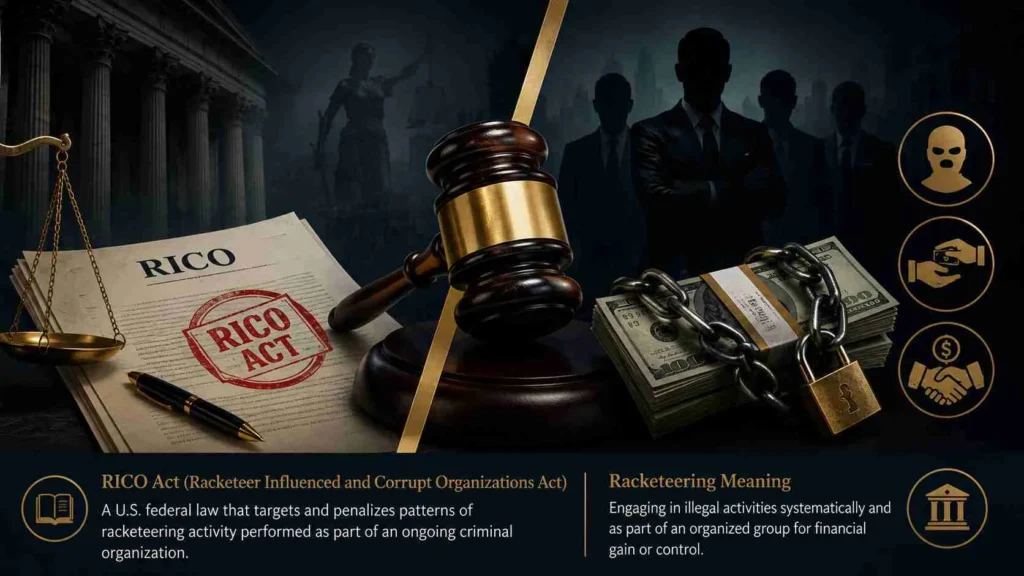

Racketeering means running a criminal enterprise that repeatedly commits illegal acts like fraud, extortion, or bribery. Under federal RICO law, just two connected crimes within ten years can trigger serious penalties including 20 years in prison and asset seizure.
You hear the word “racketeering” in crime dramas. A prosecutor slams a thick folder on the table. Someone whispers about the mob. But what does racketeering meaning actually boil down to in real life?
Simple. Racketeering means running an illegal business. Or using a legal business to commit crimes repeatedly.
Think of it this way. A single stolen car is theft. But stealing cars every month through a fake auto shop? That’s racketeering. The difference isn’t just the crime itself. It’s the pattern and the enterprise behind it.
This guide walks you through everything. You’ll learn the racketeering definition in plain words. You’ll understand how the famous RICO Act works. And you’ll finally know what people mean when they say “racketeering charges.”
Let’s strip away the Hollywood fog.
What Is Racketeering? The Simple Definition
Let’s start with the core. The racketeering meaning breaks into two parts:
- A pattern of illegal acts
- Committed through an enterprise
An enterprise can be anything. A street gang. A Fortune 500 company. A small family restaurant. Even a loose group of people with no formal paperwork.
The illegal acts are called predicate offenses. Federal law lists over 35 of them. Here are the most common:
- Extortion
- Bribery
- Fraud (mail, wire, bank, healthcare)
- Money laundering
- Drug trafficking
- Murder for hire
- Kidnapping
- Arson
- Counterfeiting
- Obstruction of justice
- Witness intimidation
One crime doesn’t make racketeering. You need at least two predicate acts within ten years. Those acts don’t need to end in conviction. A grand jury only needs probable cause that they happened.
Here’s a quick analogy. Imagine you run a landscaping company. You also threaten competitors with violence. You bribe city inspectors to ignore illegal dumping. Now your landscaping business isn’t really a landscaping business. It’s a criminal enterprise wearing a lawn mower disguise.
That’s the meaning of racketeering in a nutshell.
Why the Pattern Matters
The pattern separates racketeering from ordinary crime. A single act of fraud is just fraud. Two acts of fraud, connected in purpose and method, become a pattern. Prosecutors look for:
- Similarity of crimes
- Time between crimes (usually months or years)
- Same victims or methods
- Ongoing criminal purpose
Without a pattern, RICO doesn’t apply. That’s intentional. Congress designed RICO to catch career criminals and organizations, not one-time offenders.
The Legal Engine: RICO Explained
You can’t understand racketeering law without understanding RICO. The Racketeer Influenced and Corrupt Organizations Act passed in 1970. Congress created it to fight the Mafia.
Before RICO, prosecutors could only catch the low-level criminals. The boss gave orders from a safe distance. He never touched the drugs or held the gun. So he walked free.
RICO changed that. Now prosecutors can charge anyone who participates in the enterprise, even if they never personally committed a crime. If you manage the books for a drug ring, you’re on the hook. If you invest illegal money into a legitimate business, you’re on the hook.
The federal racketeering laws under RICO have four main sections:
| RICO Section | What It Prohibits |
|---|---|
| 18 U.S.C. § 1962(a) | Using racketeering income to acquire or run an enterprise |
| 18 U.S.C. § 1962(b) | Acquiring or maintaining an enterprise through racketeering |
| 18 U.S.C. § 1962(c) | Conducting an enterprise through a pattern of racketeering |
| 18 U.S.C. § 1962(d) | Conspiring to do any of the above |
Most cases fall under section (c). That’s the one you see in headlines: “Conducting an enterprise through a pattern of racketeering activity.”
Criminal vs. Civil RICO
Here’s something most people don’t know. RICO has two faces: criminal and civil.
Criminal RICO is what the Department of Justice uses. Conviction brings prison time, fines, and asset forfeiture.
Civil RICO allows private parties to sue. Let’s say a competitor uses extortion to steal your clients. You can sue them under RICO. If you win, you get triple damages (three times your actual losses) plus legal fees.
That’s a powerful weapon. Businesses use civil RICO against fraudsters. Whistleblowers use it against corrupt employers. Even individuals have used it against street gangs that damaged their property.
What Prosecutors Must Prove
To win a racketeering case, the government must prove five things beyond a reasonable doubt:
- An enterprise existed
- The enterprise affected interstate commerce (almost any business does)
- The defendant was associated with or worked for the enterprise
- The defendant committed at least two predicate acts within ten years
- Those acts were connected to the enterprise’s activities
Notice what’s not required. The enterprise doesn’t need a formal name or charter. Two people agreeing to commit crimes can form an enterprise. The defendant doesn’t need to know every member. And the predicate acts don’t need to be successful. Attempted extortion counts.
How Racketeering Charges Actually Work
Let’s walk through a real racketeering investigation from start to finish. This isn’t theoretical. This is how federal agents work.
Step One: Intelligence Gathering
An FBI agent notices a pattern. Three separate informants mention the same auto repair shop. The shop has a reputation for “persuading” tow truck drivers to pay protection money. No one files police reports. Everyone seems scared.
The agent opens a preliminary inquiry. No grand jury yet. Just checking public records, talking to local cops, looking for connections.
Step Two: Grand Jury Investigation
If the preliminary inquiry finds something, prosecutors go to a grand jury. The grand jury issues subpoenas. Bank records, phone logs, business licenses, text messages. Witnesses testify under oath.
Unlike a trial, no defense lawyer sits in the room. The grand jury only hears the government’s side. That’s legal. Grand juries exist to determine probable cause, not guilt.
Step Three: Indictment
If the grand jury agrees there’s probable cause, they return an indictment. The indictment lists:
- The enterprise (name or description)
- The defendant(s)
- Each predicate act (date, location, statute violated)
- The racketeering counts
A single racketeering offense can include fifteen predicate acts. That’s fifteen separate crimes rolled into one charge. If convicted, the defendant faces up to 20 years per count, not per predicate act.
Step Four: Pre-Trial Motions
Defense lawyers fight back. They file motions to dismiss the indictment. They argue the government didn’t prove an enterprise. Or the predicate acts don’t form a pattern. Or the statute of limitations expired (five years for most RICO crimes).
Most motions fail. But they buy time and shape the battlefield.
Step Five: Trial or Plea
Most racketeering cases never reach trial. The evidence is overwhelming. Witness lists run hundreds of pages. And RICO carries severe mandatory minimums. So defendants plead guilty in exchange for reduced sentences.
But trials happen. When they do, juries hear weeks of testimony. The government introduces recordings, financial records, and cooperating witnesses. The defense attacks credibility and argues the acts were isolated, not patterned.
Step Six: Sentencing and Forfeiture
A conviction triggers the racketeering penalties we’ll cover in detail below. But one unique aspect is criminal forfeiture. The government takes:
- All illegal proceeds
- Any property used to commit the crimes
- Any property bought with illegal proceeds
That means cars, houses, boats, bank accounts, even businesses. The government doesn’t need a separate civil case. Forfeiture happens automatically in the criminal judgment.
Real-World Racketeering Examples
Abstract definitions only get you so far. Let’s look at real racketeering examples that made headlines. Each one shows how the law works in practice.
The Traditional Mob Case: Gambino Family (1985)
The case that proved RICO worked. Federal prosecutors indicted Paul Castellano and other Gambino leaders. The predicate acts included murder, extortion, gambling, and labor racketeering. The enterprise was the Gambino organized crime family. The result? The boss went to prison. The family lost control of the New York waterfront.
The Corporate Case: Enron (2006)
Not a single drug or murder. But Enron’s executives ran a massive accounting fraud. They created fake partnerships to hide debt. They inflated stock prices artificially. When it collapsed, thousands lost jobs and pensions. Prosecutors used RICO alongside securities fraud charges. Several executives went to prison for over a decade.
The International Case: FIFA (2015)
Swiss authorities arrested seven FIFA officials in a dawn raid. The US indictment alleged a 24-year scheme of bribery and kickbacks. Sports marketing executives paid millions for broadcasting rights. The enterprise? FIFA itself. Fourteen people eventually pleaded guilty. The racketeering charges stuck because the pattern spanned decades and continents.
The Small Business Case: Detroit Towing (2019)
This one rarely makes national news. A Detroit towing company paid police officers for crash scene referrals. Then they overcharged drivers and threatened anyone who complained. Two predicate acts: bribery and extortion. The enterprise? The towing company operating as a criminal organization. Owners went to federal prison.
The Street Gang Case: El Rukns (1989)
A Chicago street gang ran drug sales, witness intimidation, and murder. But here’s the twist. Prosecutors also showed the gang operated a legitimate security company. They laundered drug money through that company. The enterprise included both the street gang and the security firm. Leaders received life sentences.
Notice a pattern? Racketeering applies to leather jackets and business suits. The law doesn’t care about your image. It cares about your actions.
Penalties and Collateral Damage
The racketeering punishment goes beyond simple numbers. Let’s break it down clearly.
Prison Time
Each RICO count carries up to 20 years. Life imprisonment is possible if any predicate act carries a life sentence (like murder). And multiple counts run consecutively.
A real example: A drug trafficker convicted of RICO with 15 predicate acts might receive 40 years even though each predicate act alone carried only 10 years. The pattern multiplies the sentence.
Fines
Federal RICO fines reach $250,000 per count for individuals. For organizations, fines climb to $500,000 or twice the illegal gain, whichever is larger. Plus the court can order restitution to victims.
Asset Forfeiture
This hurts more than prison for some people. The government seizes:
- All property acquired through racketeering
- All property used to facilitate racketeering
- Any business interest obtained illegally
No exemptions for family homes. No “we bought it before the crimes.” If illegal money touched it, the government wants it.
Collateral Consequences
Even after prison and fines, a racketeering conviction keeps hurting.
- Felons lose the right to vote in many states
- No federal benefits (housing, student loans, food assistance)
- No employment in banking, healthcare, or government contracting
- Professional licenses revoked (law, medicine, real estate)
- Permanent criminal record
- Deportation for non-citizens
One defense attorney told me, “RICO doesn’t just punish you. It removes you from normal life forever.”
Racketeering vs. Other Crimes: A Comparison Table
People often confuse racketeering vs conspiracy or racketeering vs fraud. Here’s a clear breakdown.
| Crime | Definition | Needs an Enterprise? | Needs a Pattern? | Maximum Penalty |
|---|---|---|---|---|
| Racketeering | Pattern of crimes through an enterprise | Yes | Yes (2+ acts) | 20 years per count |
| Conspiracy | Agreement to commit a crime | No | No | Same as target crime |
| Fraud | Deception for financial gain | No | No | 20-30 years depending on type |
| Money Laundering | Hiding illegal funds | No | No (but single act suffices) | 20 years |
| Extortion | Obtaining property through threats | No | No | 20 years |
The biggest difference? Racketeering definition requires both an enterprise and a pattern. The other crimes need neither.
You can conspire to rob a bank without ever robbing one. You commit fraud with one fake invoice. But racketeering demands two crimes and a criminal group.
Famous Racketeering Cases You’ve Heard Of
Some cases become legal landmarks. Let’s look at four that shaped racketeering law.
United States v. Turkette (1981)
The Supreme Court decided a critical question. Does RICO only apply to legitimate businesses turned criminal? Or does it also apply to wholly criminal enterprises like street gangs?
The Court ruled: both. A criminal enterprise doesn’t need a legitimate front. Two drug dealers sharing profits qualify.
Sedima, S.P.R.L. v. Imrex Co. (1985)
This case opened the door to civil RICO. Lower courts had required a prior criminal conviction before civil lawsuits. The Supreme Court said no. Civil plaintiffs can sue even if prosecutors never brought charges.
Result? Thousands of civil RICO cases flooded federal courts. Businesses started suing competitors for fraud and extortion. Some critics said it went too far. But Congress kept the law.
H.J. Inc. v. Northwestern Bell Telephone Co. (1989)
What exactly is a “pattern” of racketeering? The Supreme Court defined it. A pattern requires relationship and continuity.
- Relationship: The crimes share similar purposes, results, methods, victims, or perpetrators.
- Continuity: The crimes stretch over a period (weeks, months, years) or threaten to continue indefinitely.
One isolated bribe isn’t a pattern. Bribes every quarter for three years is a pattern.
Salinas v. United States (1997)
Can you be guilty of RICO conspiracy even if you never personally committed two predicate acts? Yes. The Supreme Court said conspiracy only requires agreeing to participate in the enterprise. Your co-conspirator’s acts count as yours.
That’s huge. A gang leader who never pulls a trigger can still face life in prison. His soldiers’ murders become his murders under RICO.
Can a Business Be Charged with Racketeering?
Yes. And it happens more than you think. The racketeering meaning doesn’t exclude corporations.
In fact, the Justice Department explicitly targets corporate racketeering. A business becomes a criminal enterprise when its leaders use it to commit crimes. The business itself can be charged. And so can its executives.
Real Example: Purdue Pharma
The company behind OxyContin. Prosecutors alleged Purdue Pharma used deceptive marketing to hide addiction risks. The pattern included mail fraud, wire fraud, and conspiracy. The enterprise was the company itself.
Purdue pleaded guilty to three criminal felonies in 2020. They paid $8.3 billion in penalties. Individual executives faced their own RICO charges in related cases.
Warning Signs for Business Owners
Legal trouble doesn’t always arrive with flashing lights. Here are red flags that transform a normal business into a criminal operation:
- Using company funds to bribe officials
- Cooking books to hide revenue from crimes
- Threatening competitors or witnesses through employees
- Structuring transactions to avoid reporting requirements
- Hiring known criminals for “muscle” roles
One bad decision plus one more bad decision plus a corporate structure equals a RICO indictment.
Racketeering Investigation: How Law Enforcement Builds Cases
The FBI leads most racketeering investigations. But they work with DEA, ATF, IRS Criminal Investigation, and Homeland Security. Here’s their playbook.
Covert Methods
Undercover agents pose as criminals. They buy drugs. They accept bribes.
Title III wiretaps record phone calls. A judge must approve, but once approved, agents listen to everything. Many RICO convictions rest on wiretap evidence.
Confidential informants wear wires. They attend meetings. They record conversations. Their testimony carries weight in court, but defense lawyers attack their credibility (often successfully).
Financial Forensics
Most criminal enterprises leave paper trails. Bank deposits just below reporting thresholds ($10,000). Shell companies wiring money overseas. Fake invoices for services never rendered.
IRS forensic accountants trace these flows. They present charts and timelines to juries. A financial trail becomes the backbone of the case.
Cooperating Witnesses
RICO cases fall apart or succeed based on insiders. The first person caught usually cooperates to reduce their sentence. They testify against higher-ups. Their testimony provides the pattern prosecutors need.
That’s why RICO defendants often face a “wall of silence.” Anyone who talks becomes a target. But eventually, someone breaks. And the whole enterprise collapses.
Racketeering vs Organized Crime: Clearing the Confusion
People use these terms interchangeably. They shouldn’t.
Organized crime describes a type of criminal group. The Mafia, cartels, and triad societies are organized crime. They have hierarchies, rituals, and territories.
Racketeering describes a type of criminal behavior. Any group can do it. Organized crime groups do racketeering. But so do corrupt corporations, street gangs, and even police departments (rarely, but it happens).
Think of it this way. All tigers are cats. But not all cats are tigers. Similarly, organized crime groups commit racketeering. But racketeering also happens outside organized crime.
The Future of Racketeering Law
RICO is over 50 years old. But it keeps evolving.
Cyber-Racketeering
Prosecutors now apply RICO to hacking groups. Anonymous and other cyber collectives face RICO charges when they commit fraud or extortion online. The enterprise exists in chat rooms and encrypted apps. The predicate acts happen through keyboards. But the law works the same.
Civil RICO Against Social Media
Victims of online harassment campaigns have sued social media platforms under civil RICO. The argument? The platform operates as an enterprise that facilitates a pattern of stalking or fraud. Most courts have rejected this. But a few cases survived dismissal.
State RICO Expansion
States without RICO laws are adopting them. States with RICO laws are expanding predicate offenses. Expect more state-level racketeering prosecutions for local corruption and gang violence.
A Final Walkthrough: How One Racketeering Case Unfolds
Let’s tie everything together with a fictional but realistic case.
The Setup:
Three people run a used car dealership. They also operate an illegal gambling ring in the back office. Customers who lose money at gambling get pressured to take high-interest car loans. Anyone who complains receives threats.
The Enterprise:
The dealership itself plus the three owners. A single criminal operation.
The Pattern:
- Illegal gambling (twice per week for two years)
- Loan fraud (17 documented victims)
- Extortion (four threats recorded)
The Investigation:
An FBI wiretap catches the owners discussing gambling proceeds. An undercover agent buys a car and records a threat. Financial records show laundered cash.
The Charges:
One count of RICO conspiracy. Plus the underlying predicate acts as separate charges.
The Outcome:
Two owners plead guilty. One goes to trial and loses. Sentences range from 5 to 15 years. The government seizes the dealership building and all bank accounts.
That’s racketeering meaning in action. Not a movie. Not a mobster cliché. Real people. Real prison.
FAQs
What does racketeering mean in simple words?
Running a group that repeatedly commits crimes. That’s it. Two key parts: a group (enterprise) and repeated crimes (pattern).
Is racketeering a felony?
Yes. A federal felony. Conviction means losing voting rights, gun ownership, and most professional licenses.
Can one person be charged with racketeering?
Yes. The enterprise can be one person plus associates. You don’t need 20 people in matching jackets.
How long does a racketeering investigation take?
Typically 12 to 36 months. Complex cases with wiretaps and financial forensics take the longest.
What’s the difference between state and federal racketeering?
Federal RICO applies to crimes affecting interstate commerce (almost everything). Thirty-three states have their own RICO laws for purely local crimes. Florida, New York, and California use state RICO frequently.
Can you go to prison for racketeering without committing a violent crime?
Absolutely. Fraud and bribery alone support racketeering convictions. Violence isn’t required.
What’s the RICO Act maximum sentence?
20 years per count. Life if any predicate act carries life. Counts run consecutively. A person charged with three counts faces up to 60 years.
How often are racketeering cases dismissed?
Less than 10 percent pretrial. Most survive motions to dismiss. Juries convict in about 70 percent of RICO trials.
What does a racketeering charge mean for immigrants?
For non-citizens, a RICO conviction almost guarantees deportation. It’s considered an aggravated felony under immigration law.
Can a victim sue under RICO?
Yes. Civil RICO allows victims to sue for triple damages. You don’t need a criminal conviction first.
Conclusion
You probably aren’t running a criminal enterprise. Most readers aren’t. So why learn racketeering meaning?
Because the word shows up in news about CEOs, politicians, and even your local car mechanic. Because civil RICO could apply if someone defrauds your small business.
Racketeering isn’t ancient history. The FBI investigates dozens of new RICO cases every year. The Department of Justice prioritizes racketeering prosecutions. And the penalties remain brutal.
Now you know what people mean when they say “racketeering charges.” You understand the pattern, the enterprise, and the RICO Act. You’ve seen real examples from street gangs to Fortune 500 companies.
Next time you hear the term, you won’t picture a movie villain. You’ll picture a legal wrecking ball designed to break up criminal groups of any size or shape. And you’ll know exactly how it works.
Discover More Related Articles:
- “STG” Slang Meaning : What It Really Means in Texting In 2026
- “Azizam” Meaning : Why People Use This Romantic Word In 2026
- “IMY” Meaning in Texting: What You Should Know Today In 2026