
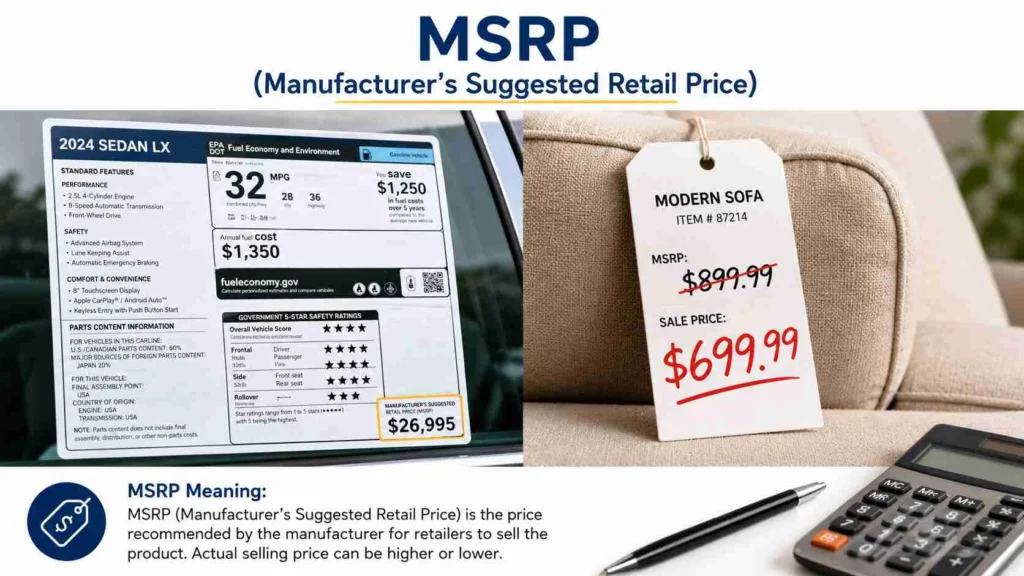

MSRP (Manufacturer’s Suggested Retail Price) is the price a product maker recommends stores charge customers. It’s not a fixed or legal requirement think of it as a starting point for negotiation, not the final word on what you should pay.
Ever walk off a car lot feeling like you just lost a game you didn’t know you were playing? You saw the big number on the window. You paid close to it. Then your cousin calls and says he got the exact same truck for $3,000 less.
That big number on the window? That’s the MSRP. And most people misunderstand what it actually means.
Here’s the truth. MSRP is a suggestion. Not a rule. Not a law. It’s a starting point for a conversation that most buyers don’t realize they’re allowed to have.
Let me show you exactly what MSRP means, how it works, and most importantly, how to use it so you stop overpaying.
What Does MSRP Mean?
MSRP stands for Manufacturer’s Suggested Retail Price.
Break that down word by word:
- Manufacturer – The company that built the product. Toyota. Samsung. Whirlpool. Sony.
- Suggested – A recommendation. Not a requirement. Think of it like a restaurant suggesting a 20% tip. You can leave 10%. Or zero.
- Retail – Selling directly to you, the final customer.
- Price – The dollar amount attached to the product.
So MSRP means: Here’s what we think a store should charge you. But they don’t have to listen.
That last part matters more than anything else on this page.
MSRP Definition: Simple Enough for a Kid, Useful Enough for an Expert
Let me give you three versions of the MSRP definition. Pick the one that sticks.
The kid version: The company that makes a toy puts a price sticker on it. That’s what they hope stores will charge. But the store can charge more or less. No one gets in trouble either way.
The adult version: MSRP is a pricing anchor set by a product’s creator. Retailers can follow it, ignore it, or use it as a baseline for discounts and negotiation.
The car buyer version: That shiny number on the window sticker? It’s the manufacturer’s dream price. The dealer’s actual price is lower. Much lower.
All three mean the same thing. MSRP is not final. MSRP is not fixed.
Where You See MSRP Every Single Day
You probably pass MSRP prices fifty times a week without noticing.
Cars and trucks – This is where MSRP gets the most attention. Every new vehicle has a Monroney sticker (named after the senator who made it law). That sticker shows MSRP plus optional equipment, destination charges, and fuel economy ratings.
Electronics – That $1,200 Sony TV at Best Buy? The $999 iPad on Apple’s website? Both show MSRP. But check Amazon a week later. You’ll often find them $100 to $300 less.
Appliances – Refrigerators. Washing machines. Dishwashers. Home Depot and Lowe’s slap MSRP on every single one. Then they cross it out and write a “sale” price right below it.
Furniture – This is where MSRP gets truly wild. A $3,000 sofa might have an MSRP of $6,000. Then the store “discounts” it 50% every single day of the year. You’re not getting a deal. You’re getting the real price dressed up like a deal.
Mattresses – Oh boy. Mattress MSRP is basically fiction. A $2,000 mattress might actually sell for $800. And it’s still profitable for the store.
Power tools – Walk into Home Depot. Look at a DeWalt drill kit. MSRP says $199. Sale price says $149. That $149 is the real price. The MSRP exists so you feel smart for “saving” $50.
Some clothing brands – Levi’s uses MSRP. Nike uses MSRP on their website. But outlet stores? They show original MSRP crossed out with bright red ink. You’re not saving 40%. You’re paying what the item is actually worth.
Why Manufacturers Invented MSRP in the First Place
Let me take you back to the early 1900s. Car companies had a problem.
Dealers were all over the map on pricing. One Ford dealer charged $500. Another charged $700 for the exact same car. Customers got angry. They felt cheated when they found out their neighbor paid less.
So manufacturers created the MSRP. A single recommended price. A fair starting point.
But here’s what changed. That “fair starting point” slowly became an inflated anchor. Manufacturers realized they could set MSRP high, let dealers “discount” from there, and customers would feel like winners even when they overpaid.
Today, MSRP serves three real purposes:
- Price anchoring – A high MSRP makes a moderate sale price look amazing.
- Brand positioning – Luxury brands set high MSRPs to feel exclusive.
- Dealer protection – MSRP prevents price wars that hurt everyone’s profits.
Notice what’s not on that list? Fairness to you. MSRP was never designed to help the buyer. It’s a tool for sellers.
How MSRP Works: The Step-by-Step Money Trail
Let me walk you through the actual journey of a product from factory to your living room. You’ll see exactly where MSRP enters the picture.
Step 1: Manufacturer builds the product
A company spends money on materials, labor, factory rent, shipping, and design. Let’s say a microwave costs $40 to make.
Step 2: Manufacturer sets wholesale price
The manufacturer needs to make a profit. So they add a markup. That $40 microwave becomes $60 wholesale. That’s what stores pay per unit.
Step 3: Manufacturer sets MSRP
Now the manufacturer adds another markup. This one is a suggestion for stores. That $60 wholesale microwave gets an MSRP of $120.
Step 4: Store buys inventory
Best Buy buys 1,000 microwaves at $60 each. They’ve spent $60,000.
Step 5: Store decides final price
Here’s where MSRP becomes optional. Best Buy can charge:
- $120 (full MSRP) – Makes $60 profit per microwave
- $100 (below MSRP) – Makes $40 profit per microwave
- $80 (deep discount) – Makes $20 profit but sells five times as many
Step 6: You pay the final price
Whatever the store decides. Plus tax. Plus shipping if applicable.
Notice the manufacturer stops caring after Step 3. They got their $60 wholesale either way. MSRP is just a suggestion hanging in the air. No one enforces it.
MSRP Example: A Real Product Walkthrough
Let me use a real product so you can see the numbers in action.
The product: Instant Pot Duo 6-Quart pressure cooker
Manufacturer cost to build: Approximately $18 (based on component pricing and factory labor in China)
Wholesale price to Amazon and Walmart: Approximately $45
MSRP on the box: $99.95
Actual sale price on Amazon: Usually $79 to $89
Lowest sale price of the year (Prime Day): $49
See the gap? The MSRP is $100. But the product regularly sells for $30 less. And on deep discount, it sells for half the MSRP. And the store still makes a small profit.
That’s not an exception. That’s the rule for thousands of products.
MSRP vs Invoice Price: The Car Buyer’s Most Important Comparison
If you only learn one comparison from this entire post, learn this one. MSRP vs invoice price decides you overpay by thousands or drive home smiling.
MSRP on a car – The window sticker price. What the manufacturer suggests you pay.
Invoice price on a car – What the dealer actually paid the manufacturer for that specific vehicle.
The gap between these two numbers is the dealer’s potential profit. On most normal cars (Toyota Camry, Honda CR-V, Ford F-150), that gap runs from 3% to 8% of MSRP.
Let me give you real numbers from a real car.
Vehicle: 2024 Toyota Camry LE
| Price Type | Dollar Amount | Who this benefits |
|---|---|---|
| MSRP | $28,500 | Manufacturer and dealer |
| Invoice price | $26,800 | Dealer (this is their cost) |
| Dealer holdback (extra rebate to dealer) | ~$500 | Dealer only |
| True dealer cost | ~$26,300 | Dealer (after holdback) |
If you pay MSRP of $28,500, the dealer makes roughly $2,200 in pure profit. If you negotiate down to $27,000, the dealer still makes $700. And they’ll still sell you the car.
But wait. There’s more.
Dealers also make money on:
- Financing kickbacks from banks
- Extended warranties (huge profit margin)
- Add-ons (floor mats for $400 that cost $50)
- Trade-in (they buy low and sell high)
So even if they sell the car at invoice price, they still profit. Never feel bad negotiating.
MSRP vs Sale Price: The Retail Reality Check
For retail goods, the gap between MSRP and sale price tells you everything about the product’s true value.
High markup categories (50-70% margin):
- Furniture – A $2,000 MSRP sofa often costs the store $600. They can sell at $1,200 and still double their money.
- Mattresses – $3,000 MSRP. Store cost around $900. Sale price $1,500. They still win.
- Jewelry – $500 MSRP. Store cost maybe $150. Sale price $300. Still profitable.
- Window treatments – Blinds and curtains have enormous markup. 70%+ isn’t rare.
Medium markup categories (30-50% margin):
- Appliances – $1,000 MSRP fridge. Store cost around $600. Sale price $800.
- TVs – $1,200 MSRP. Store cost $750. Sale price $900.
- Tires – $200 MSRP per tire. Store cost $130. Sale price $160.
Low markup categories (10-20% margin):
- New video game consoles – $500 MSRP. Store cost $450. They make $50.
- Apple products – iPhones and MacBooks have famously thin retail margins. 5-10% is normal.
- Groceries – Not really MSRP items, but for reference, grocery stores operate on 1-3% profit.
Hard truth: If a product is always “on sale,” the MSRP is fake. A mattress that’s “40% off every day” has a real price of that 40% off number. The MSRP is just theater.
What Does MSRP Mean on a Car Specifically?
Let me go deeper on automotive MSRP because this is where most people lose real money.
The window sticker on a new car shows several numbers. Here’s what each one means.
Base MSRP – The price of the absolute cheapest version of that car. No options. No upgrades. Cloth seats. Basic radio. Manual windows if they still exist.
Optional equipment MSRP – Every box you check adds to the price. Leather seats? Add $1,500. Sunroof? Add $1,200. Premium sound? Add $1,000. Navigation? Add $800 (even though your phone does it for free).
Destination charge – The cost to ship the car from the factory to the dealer. This is non-negotiable. Every car has it. Usually $1,000 to $1,500.
Total MSRP – Base MSRP plus options plus destination. That’s the big number at the bottom.
Gas guzzler tax – Only applies to vehicles with terrible fuel economy. Adds $1,000 to $7,000 to the price.
Here’s a real example from a 2024 Ford F-150 XLT:
| Line item | Cost |
|---|---|
| Base MSRP | $48,500 |
| Optional equipment (V8 engine, tow package, floor mats) | $4,200 |
| Destination charge | $1,695 |
| Total MSRP on sticker | $54,395 |
| Dealer invoice (what dealer paid) | $50,200 |
| Dealer holdback (secret rebate to dealer) | ~$950 |
If you pay the $54,395 MSRP, that dealer just made over $5,000 profit on one sale. That’s insane. And completely avoidable.
Can You Negotiate Below MSRP?
Short answer: Yes. Almost always.
Long answer: Some products and situations make negotiation harder. But you can still try.
Products you CAN negotiate below MSRP:
- New cars (always. Every time. No exceptions)
- Used cars (different pricing system but absolutely negotiable)
- Furniture (the MSRP is a joke. Start at 40% below)
- Mattresses (never pay more than 60% of MSRP)
- Jewelry (50% below MSRP is a reasonable starting offer)
- Appliances (10-20% below MSRP is normal)
- Electronics at independent stores (Best Buy? Harder. Local TV shop? Easy.)
- Solar panels (huge markup. Negotiate hard.)
Products where MSRP is usually the final price:
- New iPhones at Apple Store launch week
- PlayStation and Xbox consoles when newly released
- Limited edition sneakers
- Prescription medications (different system entirely)
- Textbooks at campus bookstores (criminal, but true)
Where products you can’t negotiate but can wait for a sale:
- Amazon (dynamic pricing changes constantly)
- Target and Walmart (prices are set corporately)
- Costco (low markup model. No negotiation needed)
- Gasoline (price is price)
How Dealers Use MSRP Against You
Let me show you the games dealers play. Forewarned is forearmed.
Tactic 1: The Market Adjustment
Demand is high. Supply is low. So the dealer adds $5,000 to $20,000 above MSRP. They call it a “market adjustment.” They print a new sticker. Suddenly a $50,000 truck has a $60,000 price tag.
This happened big time during the 2021-2023 chip shortage. Some Ford F-150 Raptors had $30,000 market adjustments. People paid it because they had to have the truck immediately.
Your move: Walk away. Find another dealer. Order the car and wait. Or buy a different model without the adjustment.
Tactic 2: The Add-On Avalanche
Dealer agrees to sell at MSRP. Great. Then you sit down to sign paperwork. Suddenly there’s $2,000 in add-ons you never asked for.
- VIN etching ($499 for a $5 service)
- Nitrogen-filled tires ($299 for air)
- Fabric protection ($699 for a spray can)
- Window tint ($599 for a $200 job)
Your move: Say no to every single one. Refuse to pay. Walk out if they insist.
Tactic 3: The Payment Pitch
Salesperson asks, “What monthly payment do you want?” This is a trap. They’ll stretch your loan to 84 months. You’ll pay MSRP plus interest for seven years. And you’ll never know what the actual car price was.
Your move: Only negotiate the out-the-door price. That’s the total cost including taxes and fees. Never talk monthly payments until you’ve locked in the final price.
MSRP in Sales vs MSRP in Marketing: Two Different Animals
This distinction matters more than you think.
MSRP in sales:
- A starting point for negotiation
- A ceiling you should work down from
- A number salespeople expect you to question
MSRP in marketing:
- A psychological anchor
- A tool to make discounts look dramatic
- A number that may have no relationship to reality
Think about a Black Friday ad. “Was $1,000. Now $500.” That $1,000 MSRP existed solely so the $500 price looked like a steal. The product probably sold for $600 the rest of the year. And it cost the store $300.
That’s not illegal. It’s not even unethical by industry standards. But it’s not honest either. It’s marketing.
Sales teams know MSRP is flexible. Marketing teams know MSRP is a prop. You should know both.
How MSRP Is Determined
Manufacturers don’t pull MSRP out of thin air. They use a real formula. Here it is.
Step 1: Calculate total product cost
- Raw materials
- Labor (factory workers)
- Manufacturing overhead (factory rent, equipment, utilities)
- Shipping from factory to warehouse
- Packaging
- Warranty reserve (money set aside for future repairs)
Step 2: Add wholesale markup
Manufacturer needs profit. So they add 20% to 50% to the total cost. That becomes the wholesale price.
Step 3: Research competitor pricing
If similar products sell for $100, MSRP will land near $100. If the brand is premium, MSRP might hit $120.
Step 4: Consider brand positioning
Luxury brands (Rolex, Mercedes, Bang & Olufsen) deliberately set high MSRPs. That’s the point. High price signals high quality. Lowering the price would hurt the brand.
Mass market brands (Samsung, Whirlpool, Toyota) set competitive MSRPs. They know you’ll compare to other brands in the store.
Step 5: Add retail margin target
Most manufacturers want retailers to make 30% to 50% margin at MSRP. So they set MSRP at roughly double the wholesale price.
Wholesale $50 = MSRP $100. That 50% margin gives stores room to discount and still profit.
Real example math:
| Cost component | Amount |
|---|---|
| Materials | $15 |
| Labor | $8 |
| Factory overhead | $5 |
| Shipping & packaging | $4 |
| Total manufacturer cost | $32 |
| Manufacturer profit (25%) | $8 |
| Wholesale price to store | $40 |
| Target retail margin (60%) | $60 |
| MSRP | $100 |
That $100 MSRP started with $32 in real costs. Everyone in the chain makes money. And you still have room to negotiate.
Why MSRP Still Matters Even Though It’s Not Final
You might be thinking, “If MSRP is fake, why should I care about it at all?”
Fair question. Here are three real reasons MSRP still matters.
Reason 1: Comparison shopping
MSRP gives you a common baseline. One dealer’s $30,000 price means nothing without knowing the MSRP. But “15% below MSRP” tells you exactly where you stand.
If Dealer A offers 5% below MSRP and Dealer B offers 12% below, you know who wins. No guessing.
Reason 2: Loan and insurance calculations
Some auto lenders use MSRP to calculate loan-to-value ratios. If you borrow against a new car, the lender looks at MSRP to determine the car’s “base value.”
Insurance companies also reference MSRP when setting replacement coverage. A car with a higher MSRP costs more to insure. That’s just math.
Reason 3: Lease residual values
When you lease a car, the monthly payment depends heavily on the car’s predicted value at lease end. That prediction starts with MSRP. Higher MSRP (without negotiation) leads to higher lease payments.
So even if you negotiate a great sale price, the MSRP still affects your lease terms. Annoying but true.
MSRP vs RRP vs List Price vs Sticker Price: Same Thing?
These terms get thrown around like they’re different. Most of the time, they mean the same thing. But let me clear up the tiny differences.
| Term | Region | Same as MSRP? | Notes |
|---|---|---|---|
| RRP (Recommended Retail Price) | UK, Europe, Australia | Yes | Same concept. Different letters. |
| List price | US (general) | Yes | Common in B2B and wholesale catalogs. |
| Sticker price | US (cars) | Yes | Named after the window sticker. |
| Advertised price | Anywhere | No | Can be MSRP, below MSRP, or above. |
| Suggested retail price | US (general) | Yes | The full phrase MSRP abbreviates. |
| Base price | US (cars) | Sort of | Base price excludes options. MSRP includes them. |
| Ticket price | Retail | Yes | What the price tag on the shelf says. |
If you see any of these terms, assume they mean the manufacturer’s suggested price. The only exception is “advertised price,” which is whatever the store chooses to put in the ad.
MSRP Meaning in Business
If you run a small retail business, MSRP affects your bottom line directly. Here’s what you need to know.
MSRP as a ceiling
Never charge above MSRP unless you have a good reason (rare item, high demand, customer knows and agrees). Above MSRP feels like price gouging. Customers will check online and walk out.
MSRP as a discount tool
Marking prices down from MSRP works. Customers love seeing “Was $100, now $75.” Even if you planned to sell at $75 all along, the MSRP anchor makes the deal feel real.
MSRP as a competitive signal
If you consistently sell below MSRP and competitors stick to MSRP, you win. But be careful. Some manufacturers prohibit advertising below MSRP. They can’t stop you from selling below. But they can stop you from printing it in an ad.
The one exception
Some luxury brands (Apple, Dyson, Yeti) enforce minimum advertised prices (MAP). You can’t advertise below a certain number. But you can sell below it in person. “Come into the store for our real price” is a common workaround.
MSRP Meaning in Automotive Sales
If you sell cars, you already know MSRP is fiction. But here’s how smart dealers use it ethically (and unethically).
Ethical use:
Set MSRP on the sticker. Show invoice price next to it. Explain holdback openly. Let customers see exactly what you paid. Then negotiate a fair price somewhere in the middle. Customers trust you. They come back for service. They tell their friends.
Unethical use:
Pad MSRP with fake add-ons. Add market adjustments on normal cars. Hide the invoice. Pressure buyers into monthly payment traps. Those dealers make more money today. But they lose repeat business forever.
Car dealerships survive on service revenue and repeat customers. A customer who feels cheated on price won’t come back for oil changes. Won’t buy their next car from you. Won’t recommend you to anyone.
The smart play: Be honest about MSRP. Show your cards. Make a fair profit. Keep the customer for life.
7 MSRP Myths That Cost People Money
Let me kill these myths right now.
Myth 1: MSRP is the law
No. Not even close. There’s no federal law requiring any store to charge MSRP. Some states have pricing laws about false advertising. But charging above or below MSRP is perfectly legal everywhere.
Myth 2: You can’t negotiate below MSRP
You absolutely can. On almost everything. The only exception is products where demand wildly exceeds supply. Even then, you can try.
Myth 3: Below MSRP always means a good deal
False. If the MSRP is inflated, 30% below MSRP might still be above the product’s true market value. Always compare the actual selling price to other stores. Don’t just look at the percentage off.
Myth 4: MSRP includes taxes and fees
Never. MSRP is before tax, title, registration, delivery, documentation fees, and any other add-ons. The out-the-door price is always higher than MSRP.
Myth 5: Every product has an MSRP
Nope. Small brands, direct-to-consumer companies, and handmade goods often skip MSRP entirely. They set their own price with no manufacturer suggestion.
Myth 6: MSRP is the same as wholesale price
Absolutely not. Wholesale is what stores pay. MSRP is what manufacturers suggest stores charge you. Wholesale is always lower. Often 40% to 60% lower.
Myth 7: Paying MSRP means you got a fair deal
Not necessarily. On some products (new game consoles, limited sneakers), MSRP is a fair deal. On cars, furniture, and mattresses, MSRP means you overpaid by hundreds or thousands. Know your product category before you assume MSRP is fair.
A Complete MSRP Reference Table
Keep this table bookmarked. Refer back when you shop.
| Product category | Typical MSRP markup over store cost | Can you negotiate? | Realistic discount off MSRP |
|---|---|---|---|
| New cars (normal) | 3-8% | Yes | 2-5% below |
| New cars (rare) | 0-20% (or more) | Hard | 0% or pay above |
| Furniture | 100-200% | Yes | 30-50% off |
| Mattresses | 200-300% | Yes | 40-60% off |
| Appliances | 50-80% | Yes | 10-20% off |
| TVs | 40-60% | Sometimes | 10-30% off (on sale) |
| Jewelry | 200-400% | Yes | 30-50% off |
| Clothing (retail) | 100-150% | Rarely | 20-40% off (on sale) |
| Clothing (outlet) | 200-300% fake MSRP | No | “50% off” fake MSRP |
| Power tools | 40-60% | Sometimes | 10-20% off |
| Video game consoles | 5-10% | No | 0% (but bundles exist) |
| iPhones (new) | 5-10% | No | 0% (unless trade-in) |
| iPhones (old model) | 10-20% | Sometimes | 10-15% off |
| Prescription glasses | 500-1000% | Yes (at independent shops) | 30-50% off |
| Solar panels | 100-200% | Yes | 20-40% off |
The Bottom Line on MSRP Meaning
MSRP is a suggestion. Nothing more.
Manufacturers want you to think it’s a fixed price. That’s how they keep prices high. That’s how dealers keep profits fat.
But now you know better. You know MSRP meaning starts with “suggested” and ends with “negotiate.” You know the real price is almost always lower.
Next time you see MSRP, smile. That’s not a price tag. That’s an invitation.
The only three rules you need:
- Never pay MSRP without trying to negotiate first.
- Research the real market price before you walk into any store.
- Walk away if the seller won’t move. There’s always another deal.
MSRP gave you the starting line. You decide where you finish.
FAQs
1. Does MSRP include tax?
No. MSRP never includes sales tax, registration fees, destination charges, or documentation fees. It’s just the base suggested price before any government fees or add-ons.
2. Is paying MSRP a bad deal?
It depends on what you’re buying. Pay MSRP for a new PlayStation or a rare sneaker drop? That’s fine. Pay MSRP for a mattress, a sofa, or a new car? You’re overpaying by hundreds or thousands. Know your product category before you assume MSRP is fair.
3. Can a dealer charge more than MSRP?
Yes. Legally, they can charge whatever they want. During supply shortages, many dealers added “market adjustments” of $5,000 to $20,000 above MSRP. Your best move? Walk away and find a dealer who doesn’t play that game.
4. What’s the difference between MSRP and invoice price on a car?
MSRP is what the manufacturer suggests you pay. Invoice price is what the dealer paid the manufacturer for that car. The gap between them is the dealer’s potential profit. On most normal cars, that gap runs 3% to 8% of MSRP.
5. Why do furniture stores always show MSRP crossed out?
Because the real price is much lower. That crossed-out MSRP is intentionally inflated so the “sale” price looks like an amazing deal. A sofa with a $3,000 MSRP that’s “40% off” every single day has a real price of $1,800. You’re not saving money. You’re paying the actual value.
6. How low can I negotiate below MSRP on a new car?
For a normal car in regular supply, aim for 2% to 5% below MSRP as a reasonable target. On slow-selling models, 10% below is possible. On rare or high-demand vehicles? You might pay MSRP or even above. Always check online forums for real-world sale prices before you walk into the dealership.
Conclusion
Here’s what you need to remember. MSRP stands for Manufacturer’s Suggested Retail Price. The most important word in that entire acronym is “suggested.” Manufacturers want you to treat it like a fixed number. It’s not.
Dealers want you to feel like you’re getting a deal when they knock 5% off an inflated sticker. Don’t fall for it. The real price of almost any product lives somewhere below MSRP. Your job as a smart buyer is to find out exactly where. So do your homework before you buy. Check online prices. Look up invoice costs on cars. Compare sale prices across three different stores.
And never be afraid to negotiate or walk away. MSRP gave sellers a tool to maximize their profits. But now that tool works for you too. You know the game. You know the numbers. Go pay what something is actually worth, not what some manufacturer hopes you’ll spend.
Discover More Related Articles:
- “STG” Slang Meaning : What It Really Means in Texting In 2026
- “Azizam” Meaning : Why People Use This Romantic Word In 2026
- “IMY” Meaning in Texting: What You Should Know Today In 2026