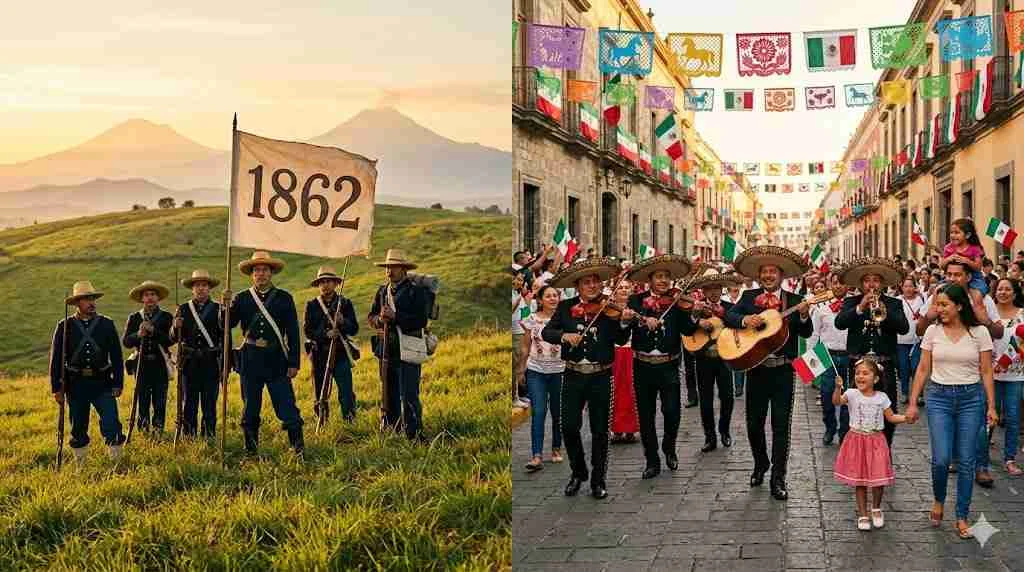

Cinco de Mayo means “Fifth of May” in Spanish and commemorates Mexico’s 1862 victory over France at the Battle of Puebla. It is not Mexican Independence Day that’s September 16 and remains a regional holiday celebrated mainly in Puebla, not across all of Mexico.
You probably think you know what Cinco de Mayo means.
Most people do. They picture sombreros, margaritas, and a giant party. They assume it’s Mexico’s Independence Day. That’s wrong. And that’s okay. You’re about to learn the truth.
The real Cinco de Mayo meaning is smaller but more powerful than you think. It’s about a ragtag army. A French superpower. And one morning in May when everything changed.
Let me walk you through it. No lectures. No fluff. Just the real story.
What Does Cinco de Mayo Mean? A Straight Answer
Let’s start with the obvious.
Cinco de Mayo translates directly to “Fifth of May” in Spanish. But the phrase carries way more weight than a simple date on a calendar.
So what does Cinco de Mayo actually mean historically?
It marks the Mexican army’s unexpected victory over the French Empire at the Battle of Puebla on May 5, 1862.
That’s it. One battle. One day. One unlikely win.
Here’s the key point you need to remember: This is not Mexican Independence Day. That holiday happens on September 16. More on that later.
For now, lock this in your brain:
Cinco de Mayo definition: A regional Mexican holiday commemorating a single military victory against France. Not independence. Not a federal holiday. Just a damn good underdog story.
The Battle of Puebla: What Actually Happened
You can’t understand the Cinco de Mayo meaning without knowing the battle itself. So let’s go back to 1861.
Why France Invaded Mexico
Mexico had problems. Big ones.
After years of internal wars, the country was broke. President Benito Juárez (a Zapotec lawyer who became a national hero) made a tough call. He suspended all foreign debt payments for two years.
Spain, England, and France got angry. All three sent ships to Veracruz to demand payment. But Spain and England eventually backed down. They negotiated and went home.
France didn’t.
Napoleon III (the nephew of the famous Napoleon) saw an opening. He wanted to build a French empire in the Americas. Mexico stood in his way. So he sent a massive, battle-hardened army to invade.
Key fact: The French army hadn’t lost a major battle in nearly 50 years. They called themselves the finest soldiers on Earth. And they planned to march from Veracruz to Mexico City without breaking a sweat.
They were wrong.
The Mexican Army: Outnumbered but Not Outfought
General Ignacio Zaragoza led the Mexican forces. He was only 33 years old. His army had about 4,000 men. Many of them were indigenous soldiers with outdated muskets. Some carried machetes.
The French sent General Charles de Lorencez with roughly 6,000 to 8,000 troops. Better weapons. Better training. An d better uniforms. On paper, this wasn’t a fight. It was an execution.
But battles don’t happen on paper.
Here’s a quick breakdown:
| Side | Commander | Troop Count | Advantage |
|---|---|---|---|
| Mexican | Ignacio Zaragoza | ~4,000 | Home terrain, strong motivation |
| French | Charles de Lorencez | ~6,000–8,000 | Superior weapons, battle experience |
The French attacked the town of Puebla at dawn. They tried three separate charges up the hill toward Mexican forts Loreto and Guadalupe. Each time, Mexican defenders repelled them.
Rain made the ground slippery. Cannons roared. Men fell.
By the evening, the French retreated. They lost nearly 500 soldiers. Mexico lost fewer than 100.
One historian called it “a bullet that should not have missed but did.”
Why This Victory Meant So Much
Let’s be clear: France eventually won the war. They took Mexico City in 1863. They installed a puppet emperor named Maximilian I (a random Austrian archduke). That empire lasted until 1867 when Juárez finally kicked them out.
So why does the Battle of Puebla still matter?
Three reasons.
First: It shattered the myth of French invincibility. For one day, a smaller, poorer army proved that raw determination could beat superior firepower.
Second: It gave Mexico hope. The country was fractured and exhausted. This victory unified people around a shared pride.
Third: It delayed the French advance by a full year. That bought Juárez time to organize resistance. Without Puebla, the French might have won faster and held on longer.
So the Cinco de Mayo meaning isn’t about winning the war. It’s about refusing to lose the spirit.
“On May 5, 1862, Mexico proved that giants can bleed.” Common saying in Puebla
Cinco de Mayo in Mexico: A Quiet Pride
Here’s where most Americans get confused.
If Cinco de Mayo is such a big deal, why doesn’t Mexico throw a giant party?
Simple. It’s a regional holiday, not a national one.
Puebla: The Heart of the Celebration
In the state of Puebla (where the battle happened), May 5 matters. Schools close. Government offices shut down. The city holds a massive parade every year.
What does that parade look like?
Thousands of locals dress as Mexican and French soldiers. They reenact the battle on the same hills where the real fight happened. Bands play. Families picnic. Speeches honor General Zaragoza.
It’s proud. It’s respectful. But it’s not wild.
The Rest of Mexico: Barely a Blip
Outside Puebla, Cinco de Mayo is a regular workday. Banks stay open. Kids go to school. No one gets the day off.
Some schools hold brief morning ceremonies. A teacher might explain the battle. Students sing the national anthem. Then it’s back to math class.
That’s it.
No parades in Mexico City. No national fireworks. And no drinking holidays.
Compare that to Mexican Independence Day on September 16. That’s the big one. The president rings a bell from the National Palace. Fireworks explode across every major city. Families stay up late shouting “Viva México!”
So why did the U.S. flip the script?
Cinco de Mayo in the United States: How a Small Holiday Became Huge
The U.S. version of Cinco de Mayo looks nothing like the Mexican version.
Here’s how that happened.
The 1960s: Chicano Activists Take the Lead
Mexican-American communities in California faced discrimination. Schools punished kids for speaking Spanish. Employers paid lower wages to brown-skinned workers.
Activists needed a symbol of pride. Something that celebrated Mexican heritage without asking permission.
They chose Cinco de Mayo.
Why? Because the Battle of Puebla showed Mexicans fighting back against a foreign invader. That story resonated with Chicano civil rights movements. It wasn’t about alcohol. It was about dignity.
Key fact: Early Chicano celebrations included educational workshops, poetry readings, and cultural performances. No beer commercials. No party hats.
The 1980s and 90s: Corporate Marketing Takes Over
Then came the money.
Alcohol brands noticed that Mexican-Americans had a growing celebration with no official sponsor. So they jumped in. Beer companies ran Cinco de Mayo ads. Tequila brands created special promotions. Restaurants added margarita specials.
By the 2000s, the original Cinco de Mayo meaning had faded. Many Americans thought the holiday was about sombreros and shots.
Today, the U.S. spends over $600 million on Cinco de Mayo beer alone. That’s not a cultural celebration. That’s a sales event.
Side-by-Side Comparison: Mexico vs. The United States
| Aspect | In Puebla, Mexico | In the United States |
|---|---|---|
| Official status | Regional holiday | No official status |
| Business closures | Banks, schools, govt offices closed | All businesses open |
| Typical activity | Military parade, battle reenactments | Parties, bar crawls, taco specials |
| Historical awareness | High (most locals know the story) | Low (many think it’s Independence Day) |
| Commercial influence | Minimal | Extremely high |
| Who participates | Puebla residents and visitors | Everyone, regardless of heritage |
So if you want to honor the real Cinco de Mayo meaning, skip the bar crawl. Learn the battle instead.
Common Myths: What Cinco de Mayo Is NOT
Let’s clear up the confusion once and for all.
Myth 1: Cinco de Mayo is Mexican Independence Day
Wrong. Mexican Independence Day is September 16. That marks the 1810 call to arms against Spain. Two different countries. Two different centuries.
Myth 2: It’s Mexico’s biggest holiday
Not even close. Independence Day and Day of the Dead (November 1–2) draw far bigger crowds. Cinco de Mayo ranks third at best, even in Puebla.
Myth 3: Mexico defeated Spain on May 5
No. Spain lost control of Mexico in 1821. The Battle of Puebla happened in 1862 against France. Wrong enemy, wrong century.
Myth 4: Everyone in Mexico celebrates with parties
False. As we covered, outside Puebla, most Mexicans treat May 5 like any other Thursday.
Myth 5: The holiday has always been commercial
Not true. The corporate version only appeared in the last 40 years. Before that, Mexican-American communities used May 5 for education and activism.
One more time for the people in back:
Cinco de Mayo ≠ Mexican Independence Day.
Save that fact. Use it at your next party. You’ll sound like the smartest person in the room.
The Real Cultural Significance of Cinco de Mayo
You might still wonder: Why should I care?
Fair question.
The Cinco de Mayo meaning goes beyond history books. It speaks to something universal.
An Underdog Story That Travels
Everyone loves a good underdog. David vs. Goliath. Rocky vs. Apollo. The 1980 U.S. hockey team.
Mexico against France fits that same mold. A smaller, poorer force looked certain to lose. They won anyway. That’s not just Mexican history. That’s human inspiration.
A Symbol of Mexican and Mexican-American Resilience
For generations, Mexican-Americans faced pressure to assimilate. Schools banned Spanish. Media portrayed Mexicans as lazy or dangerous.
Cinco de Mayo gave those communities a chance to say, “We belong here. Our history matters. And we fight back.”
That’s why the Chicano movement adopted May 5. Not for beer. For belonging.
A Chance to Celebrate Without Stereotypes
Here’s an uncomfortable truth: Many Cinco de Mayo parties lean on offensive stereotypes. Fake mustaches. Ponchos. Broken Spanish.
That’s not celebration. That’s caricature.
The real cultural significance of Cinco de Mayo is simpler. Eat at a family-owned Mexican restaurant. Learn about Benito Juárez. Listen to a mariachi band play “Cielito Lindo.” Donate to a Latino scholarship fund.
Respect isn’t hard. It just takes effort.
“If you want to honor May 5, honor the people who lived it.” Common refrain from cultural educators
Cinco de Mayo for Kids: A Simple Explanation
Need to explain this holiday to a child? Keep it clean and clear.
One-sentence takeaway: “A long time ago, a small Mexican army beat a big French army on May 5. It proved that courage matters more than size.”
Easy facts for young learners:
- The battle happened in 1862. That’s over 160 years ago.
- The Mexican general’s name was Ignacio Zaragoza.
- The French had better guns but worse luck.
- Rain helped the Mexican defenders. It made the hill slippery.
- The whole battle lasted just one day.
Quick activity idea: Draw a simple timeline. Mark 1862 for the battle. Mark 1867 for France’s final defeat. And mark today as a day to remember.
Picture book recommendation (no link, just a title): Cinco de Mayo: A First Look by Percy Leed. Simple words. Clear pictures.
Kids don’t need every detail. They just need the heart of the story: sometimes the little guy wins.
Cinco de Mayo Traditions and Customs That Honor the Real History
Want to celebrate the right way? Here’s how people in Puebla actually observe May 5.
Military Parade in Puebla City
The main event happens on the battlefields of Los Fuertes (the forts). Thousands gather to watch soldiers, veterans, and school marching bands parade past monuments to Zaragoza.
Battle Reenactments
Local history groups dress in reproduction uniforms. They fire blank muskets. They “charge” up the hill. The French side always loses. Crowds cheer.
Traditional Food: Mole Poblano
Puebla gave the world mole poblano. That’s a thick, dark sauce made from chiles, chocolate, nuts, and about 20 other ingredients. People serve it over turkey or chicken. It’s rich. It’s complex. And it has nothing to do with nachos.
Other typical foods:
- Chalupas (small fried tortillas with salsa, meat, and onion)
- Chiles en nogada (stuffed poblano peppers with walnut cream sauce)
- Tamales wrapped in banana leaves
No Alcohol-Focused Events
You won’t find drunk crowds in Puebla on May 5. Families attend parades. Grandparents tell battle stories. Children wave flags. It’s closer to a Fourth of July picnic than a frat party.
If your celebration looks different, you’re probably doing the U.S. commercial version.
FAQs
Is Cinco de Mayo a federal holiday in Mexico?
No. Only Puebla closes schools and government offices. The rest of the country works normally.
Do people in Mexico City celebrate May 5?
Some schools hold brief morning ceremonies. But there are no parades, no closed streets, and no major events.
Why do Americans celebrate Cinco de Mayo more than Mexicans?
Two reasons. First, Chicano activists in the 1960s used May 5 to build pride. Second, alcohol companies in the 1980s saw a marketing opportunity. Combine those, and you get a massive U.S. holiday with little connection to Mexican traditions.
What’s the #1 fact people get wrong about Cinco de Mayo?
That it’s Mexico’s Independence Day. That holiday is September 16. Always has been. Always will be.
Should I celebrate Cinco de Mayo?
Yes. But celebrate with respect. Learn the Battle of Puebla. Eat authentic food from a local Mexican restaurant. Skip the fake mustache and the sombrero. Don’t call it “Cinco de Drinko.”
What happened to General Zaragoza after the battle?
Sadly, he died less than four months later. He caught typhoid fever in September 1862. He was only 33 years old. Mexico buried him with full honors.
Did France ever win in Mexico?
Yes. They captured Mexico City in 1863 and installed Emperor Maximilian I. But Mexican forces led by Benito Juárez fought back. They executed Maximilian in 1867. France gave up.
Is Cinco de Mayo celebrated anywhere else outside Mexico and the US?
Small communities in Canada, Australia, and Japan hold festivals. But those events usually copy the U.S. commercial model, not the Mexican one.
Conclusion
So here’s the truth.
The real Cinco de Mayo meaning has nothing to do with beer specials or party hats. It honors a single morning in 1862 when 4,000 Mexican soldiers stood their ground against a French army that hadn’t lost in decades.
They won. Not because of better weapons or superior numbers. They won because they refused to quit. That’s the story you should remember. That’s the story you should share.
So this May 5, skip the “Happy Cinco de Mayo” cliché. Instead, tell a friend about General Zaragoza. Make mole poblano from scratch. Watch a documentary about the French-Mexican War. Donate to a Latino history organization.
Celebrate smarter. Celebrate respectfully. And never confuse this day with Mexican Independence Day again. Because now you know the real Cinco de Mayo meaning. And knowing it changes everything.
Discover More Related Articles:
- “A Burger and a Grape Snow Cone” Mean: in Social Media Slang Guide In 2026
- “Diddy” Meaning in Texting: When & How It’s Used In 2026
- “SMH” Mean in Text: Don’t Misuse This Acronym In 2026