
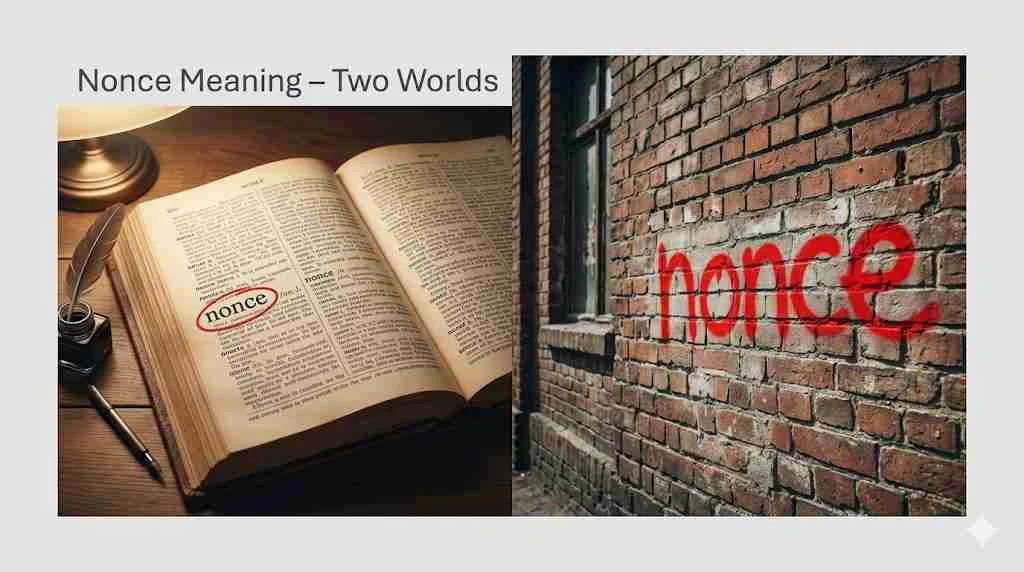

In British slang, nonce is a highly offensive term for a sex offender, especially one who targets children. In linguistics, a nonce word is a temporary word coined for a single occasion or specific use.
Ever seen someone get called a “nonce” online and felt completely lost? You’re not alone. This small five-letter word carries massive weight. But here’s the catch: it means two totally different things.
In one world, “nonce” is a quiet linguistics term. Professors use it. Poets love it. It describes a word invented for a single moment.
In the other world? It’s a brutal British insult. One of the worst you can throw at someone. We’re talking prison-yard serious.
So which one do you need to know? Probably both. But especially the second one if you’re watching UK TV, scrolling British social media, or traveling to London.
Let’s break it all down. No fluff. Just clear answers.
What Does Nonce Mean? The Quick Answer
Let’s start simple. Here’s a snapshot of both meanings side by side.
| Context | Meaning | Real Example |
|---|---|---|
| Linguistics | A word made up for one specific occasion or use | “Slithy” from Lewis Carroll’s Jabberwocky |
| British slang | A sex offender – especially one targeting children | “They put him in a cell with other nonces.” |
That’s the core. Everything else is detail.
If you hear someone say “nonce” in a pub in Manchester, they aren’t talking about poetry. If you read it in a linguistics textbook, they aren’t accusing anyone of a crime. Context is everything.
Now let’s dive deep into each meaning.
Nonce Meaning in British Slang | The Serious One
You came here likely for this. The slang definition dominates UK streets, prisons, TV dramas, and comment sections. Let’s get into what it really means, where it came from, and why you should handle it with care.
What Does Nonce Mean in the UK?
In modern British slang, a nonce is a child sex offender or a pedophile. Prisoners use the term to mark the lowest rung of the inmate hierarchy. Police officers hear it in arrest vans. Kids on playgrounds? They sometimes toss it around without fully knowing its weight.
The word carries raw disgust. Calling someone a nonce isn’t light teasing. It’s an accusation that can end friendships, jobs, or worse.
Here’s how you’ll hear it used naturally:
- “That bloke in the news got 22 years. Absolute nonce.”
- “They don’t mix nonces with regular prisoners.”
- “Don’t sit next to him. Everyone says he’s a nonce.”
See the pattern? Short sentences. Direct anger. No confusion.
Why Do People Say Nonce?
This gets murky. No one knows the exact origin. But we have three strong theories.
Theory 1: The Prison Acronym (Probably Fake)
Many people claim “nonce” stands for “Not On Normal Courtyard Exercise.” The story goes that prisons separated sex offenders from other inmates, so they didn’t get yard time with the general population. Catchy, right? Only one problem: no historical evidence supports this. Linguists call this a backronym – a fake origin created after the word already existed.
Theory 2: Shortened from “Nonsense”
Some slang researchers trace “nonce” to a dialect version of “nonsense.” In Northern England, “nonce” once meant a stupid or worthless person. Over time, that general insult narrowed specifically to sex offenders. This shift likely happened in working-class communities and spread through prisons.
Theory 3: Romany or Cant Origins
A lesser-known theory points to the Romany word “nonce” (meaning worthless or good-for-nothing) or old British criminal cant (thieves’ slang). Both could have fed into prison vocabulary.
Most credible linguists settle on a blend of theory 2 and 3. The acronym? Ignore it. It’s a myth that won’t die.
Is Nonce a Bad Word? (Offensive Level)
Yes. Unequivocally yes.
Imagine the worst insult in your culture. That’s “nonce” in the UK. It ranks alongside or above words like “rapist” or “beast.”
Here’s what makes it so potent:
- It’s specific. You’re not calling someone dumb or ugly. You’re accusing them of a specific horrific crime.
- It carries prison consequences. In UK jails, nonces go into protective segregation. Other inmates might attack them on sight.
- It ruins reputations. A false “nonce” accusation can destroy someone’s life, even if proven untrue later.
So no, don’t use it as a joke. Don’t call your friend a nonce for stealing your fries. That’s not clever. It’s just ugly.
How to Use Nonce in a Sentence
If you’re writing fiction or reporting on UK culture, here’s how the word actually appears in the wild.
Example sentences (slang context):
“The guards moved the nonce to a separate wing after breakfast.”
“You hear what they found on his hard drive? Yeah. He’s a nonce.”
“In prison, nonces have to watch their backs 24/7.”
What NOT to do:
- Don’t use it lightly on social media.
- Don’t call a celebrity a nonce without evidence.
- Don’t teach it to children as a funny word.
This isn’t slang to collect. It’s slang to understand.
Nonce Meaning in Linguistics | The Harmless One
Now for a complete 180. In linguistics, “nonce” has nothing to do with crime or insults. It’s a technical term for temporary words. Let’s explore that world.
What Is a Nonce Word?
A nonce word is a word that someone coins for a single occasion or a very specific purpose. You use it once, then toss it away. No dictionary entry. No long life. Just a quick linguistic spark.
The term comes from the older phrase “for the nonce,” which means “for the occasion.” Think of it like a disposable camera for language. You snap the picture, then the camera’s job is done.
Nonce words pop up all the time in:
- Poetry and literature
- Children’s books
- Advertising slogans
- Everyday conversation when the right word doesn’t exist
Here’s the key difference: a nonce word might become permanent if people keep using it. But by definition, most don’t.
Nonce Word Meaning | Simple Examples
Let’s make this concrete. You’ve seen nonce words before. You just didn’t know the label.
Lewis Carroll’s Jabberwocky
Carroll wrote the poem “Jabberwocky” in Through the Looking-Glass. It’s full of beautiful nonsense:
- “Slithy” (lithe + slimy)
- “Mimsy” (miserable + flimsy)
- “Galumphing” (gallop + triumphant)
Those are classic nonce words. Carroll made them up for that poem. But here’s the twist: “galumphing” actually entered the dictionary because people loved it. So it started as a nonce word and graduated to a real one.
Shakespeare’s One-Time Creations
Shakespeare loved inventing words. Some stuck (like “bedazzled”). Others appeared exactly once in his entire body of work. Those are nonce words.
Example: “Honorificabilitudinitatibus.” Yes, that’s real. It appears once in Love’s Labour’s Lost. It means “the state of being able to achieve honors.” He never used it again. That’s a true nonce word.
Modern Advertising
Ever see a slogan like “Got milk?” or “Finger-lickin’ good”? Those aren’t dictionary words in the traditional sense. They’re brand-specific nonce phrases created for a campaign. Some fade. Some become permanent catchphrases.
Nonce Term vs. Neologism | What’s the Difference?
People mix these up all the time. Let’s fix that.
| Term | Definition | Example |
|---|---|---|
| Nonce word | Created for one use or short period | “Brillig” (Carroll) |
| Neologism | A new word that spreads and sticks | “Selfie,” “blog,” “ghosting” |
Think of it like a pop song. A nonce word is a one-hit wonder. A neologism is a classic that radio stations still play ten years later.
How a nonce word becomes a neologism:
- Someone invents a word for a specific situation.
- Other people like it and start using it.
- It spreads beyond the original context.
- Dictionaries eventually add it.
“Chortle” (Carroll again – blend of chuckle and snort) made that leap. So did “nerd” (from Dr. Seuss). So even temporary words can grow up.
Nonce Word in Linguistics | Deeper Examples
Linguists study nonce words to understand how humans create and process new language. Here are some real research examples.
The Wug Test (Jean Berko Gleason, 1958)
Researchers showed children a picture of a made-up bird called a “wug.” Then they showed two of them and asked, “Now there are two ___.” Children who said “wugs” proved they understood English plural rules without ever hearing the word before. “Wug” was a nonce word for the experiment. It still appears in linguistics textbooks today.
Spontaneous speech errors
In everyday conversation, people produce nonce words constantly. You might say “I need to unsqueak that door” because “fix” slipped your mind. That’s a nonce word. You invented “unsqueak” for that moment. It worked. Then you forgot it. That’s how language really works.
Literary nonce words in modern fiction
Anthony Burgess’s A Clockwork Orange features “Nadsat” slang. Words like “horrorshow” (good) and “droog” (friend) started as nonce words for the novel. Some entered pop culture. Most stayed in the book.
Nonce Pronunciation | Say It Right
Let’s clear up any confusion. You say it like this:
/nɒns/
Rhymes with “once” (without the w sound). One syllable. Short o. Soft n at the end.
Not “non-see.” Not “nohns.” Just nonce.
Here’s a simple breakdown:
| Incorrect | Correct |
|---|---|
| Non-see | Nonce (rhymes with “bounce” minus the b) |
| Nohnce (long o) | Nonce (short o as in “on”) |
| Non-chay | Nonce (hard s sound, not sh) |
Test yourself: Say “once.” Now put an n in front. “Nonce.” Perfect.
Nonce Origin | Where Did the Word Come From?
We have two separate origin stories. One for each meaning. They don’t connect. Let’s trace both.
The Old English Path (Linguistics Side)
The linguistics “nonce” goes back to Middle English. Around the 14th century, people said “for þan anes,” meaning “for the one purpose.” That phrase contracted over time to “for the nones.” Then a linguistic quirk happened.
People misheard “for the nones” as “for then ones.” Then “nones” became “nonce.” By the 1500s, “for the nonce” was a fixed phrase meaning “for the occasion.”
Here’s the timeline:
- 1300s: “for þan anes” (for the one purpose)
- 1400s: “for the nones”
- 1500s: “for the nonce” appears in print
- 1800s: “nonce word” becomes a linguistics term
Edmund Spenser and William Shakespeare both used “for the nonce” in their writing. So this word has serious literary street cred.
The Slang Origin (Darker Path)
The slang “nonce” has a much shorter history. It appears in UK prison records from the 1970s. But it likely existed orally for years before that.
Leading theory: Prisoners in the 1960s used “nonce” as a shortening of “nonsense” or “nancy boy” (old slang for an effeminate man). Over time, it specialized to mean sex offender. This fits how prison slang works – words drift in meaning quickly behind bars.
Supporting evidence: Dialect dictionaries from Northern England in the early 1900s list “nonce” as meaning a stupid or worthless person. That’s a clear stepping stone to the modern insult.
British TV spread it: Shows like EastEnders (BBC) and The Bill (ITV) used “nonce” in storylines about crime and prisons. Millions of viewers learned the word from their sofas. By the 1990s, it was common knowledge across the UK.
So the slang “nonce” isn’t ancient. It’s a late 20th-century invention. But it hit hard and fast.
Nonce on Social Media and Texting
The internet changed how “nonce” spreads. Now teenagers in Glasgow and gamers in Texas both know the word. But they use it differently.
How People Use Nonce Online
Gaming chats (Twitch, Discord, Xbox Live):
Young players sometimes call opponents “nonce” as a generic insult. It’s often ironic or exaggerated. Example: “You camped the spawn point? You absolute nonce.” This usage dilutes the original weight. And that’s a problem.
TikTok and Instagram comments:
British creators use “nonce” seriously to call out real offenders. But American audiences sometimes misunderstand it as a mild joke. This causes huge fights in comment sections.
X (Twitter) and Reddit:
UK subreddits like r/CasualUK use “nonce” correctly as a serious accusation or dark humor. But moderators often remove posts that use it loosely. Reddit’s content policy bans harassment, and “nonce” qualifies.
Warning: Ironic Use Still Hurts
Here’s the danger. Some people think, “I’m just joking. Everyone knows I don’t mean it literally.” But the person reading that joke might be a survivor of abuse. Or someone falsely accused. Or just someone who doesn’t think child sexual abuse is funny.
Even sarcastic “nonce” comments can get you banned from platforms. Or punched in real life. So think twice.
Platform Notes
| Platform | Typical Usage | Risk Level |
|---|---|---|
| TikTok | British creators using it seriously | Moderate |
| X (Twitter) | Arguments, call-outs, dark humor | High |
| Reddit (UK subs) | Sometimes serious, sometimes banned | High |
| YouTube comments | Often misused by teens | Moderate |
| Rare – older user base | Low |
Nonce Synonyms and Related Terms
You might hear other words for the same concepts. Here’s a quick glossary.
Slang Synonyms for Nonce (UK Offender Meaning)
| Term | Region | Notes |
|---|---|---|
| Beast | UK prisons | Very common inside jails |
| Rock spider | Australia, UK | Refers to hiding under rocks |
| Short eyes | US prisons | From “short” = child |
| P- word | Global | Avoid writing it directly |
| Chomo | US prisons | Short for “child molester” |
These are all offensive. This list is for understanding media, not for active use.
Linguistics Synonyms for Nonce Word
| Term | Meaning |
|---|---|
| Hapax legomenon | A word that appears only once in a text or entire corpus |
| Occasionalism | A word coined for a specific occasion |
| Protologism | A newly coined word not yet accepted |
| Ad hoc formation | A word made up on the spot |
Example of hapax legomenon: In the entire works of Shakespeare, “honorificabilitudinitatibus” appears once. That’s a hapax legomenon and a nonce word.
FAQs
Q: What does nonce mean in British slang?
A: A sex offender, specifically one who targets children. It’s a severe insult.
Q: Is nonce a bad word?
A: Yes. It’s one of the most offensive words in UK English.
Q: What does nonce mean in English (non-slang)?
A: A temporary word invented for one occasion. Harmless and academic.
Q: Where did the word nonce come from?
A: Two origins. The linguistics side comes from Middle English “for þan anes.” The slang side likely comes from 1970s UK prison shortening of “nonsense.”
Q: Can I use nonce in a sentence without offending someone?
A: Only if you’re clearly talking about linguistics. Example: “That children’s book uses a nonce word on every page.”
Q: What does nonce mean on social media?
A: Usually an insult. Sometimes ironic, but still risky. Avoid using it casually.
Q: How do you pronounce nonce?
A: /nɒns/ – rhymes with “once.”
Q: What’s a nonce word example from a movie?
A: “Supercalifragilisticexpialidocious” from Mary Poppins. It was coined for the film.
Q: Is nonce in the dictionary?
A: Yes. Both meanings appear in major dictionaries like Cambridge and Oxford.
Q: Why is nonce offensive but not other slang?
A: Because it accuses someone of a specific horrific crime. That’s not name-calling. That’s life-ruining.
Conclusion
We’ve covered a lot. Let’s pull it together. One word. Two worlds.
In linguistics, nonce means a playful, temporary word. Poets love it. Professors study it. No one gets hurt.
In British slang, nonce means a child sex offender. Prisons use it. Streets fear it. One accusation can destroy a life. So here’s the takeaway: know your audience.
If you’re writing a paper on Shakespeare, use “nonce word” freely. If you’re in a London pub, never call anyone a nonce unless you have absolute proof and a very good reason.
The same letters. The same pronunciation. Completely different consequences. Now you know the difference. Use that knowledge wisely.
Discover More Related Articles:
- “STG” Slang Meaning : What It Really Means in Texting In 2026
- “Azizam” Meaning : Why People Use This Romantic Word In 2026
- “IMY” Meaning in Texting: What You Should Know Today In 2026