

Monogamy means choosing one romantic partner at a time. You stick with that person exclusively emotionally and sexually while the relationship lasts, without keeping backups or starting something new on the side.
Most people think monogamy just means “no cheating.” That’s like saying a wedding is just cake.
Sure, cake is part of it. But you don’t show up for the frosting alone.
Monogamy runs deeper than rules. It touches trust, daily choices, and how you structure your entire romantic life. So let’s strip away the fluff. Let’s get the real monogamy meaning.
What Is Monogamy?
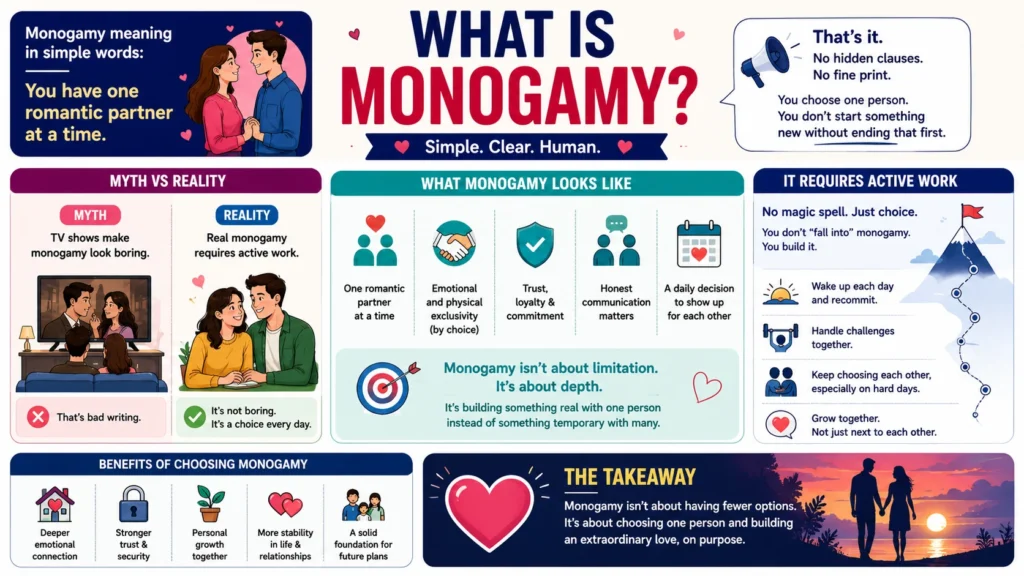
You don’t need a sociology degree to understand this.
Monogamy meaning in simple words: You have one romantic partner at a time.
That’s it. No hidden clauses. No fine print.
You choose one person. You don’t start something new without ending that first.
TV shows make monogamy look boring. That’s bad writing. Real monogamy requires active work. It asks you to wake up each day and recommit. No magic spell. Just choice.
A Quick Reference Table
| TermPlain English Meaning | |
|---|---|
| Monogamy | One partner at a time |
| Serial monogamy | One partner → break up → new partner (repeat) |
| Social monogamy | Living as a couple, sharing a home and resources |
| Sexual monogamy | Only one sexual partner |
| Emotional monogamy | Only one deep romantic emotional bond |
The definition is simple. But living it? That’s another story.
Monogamous Relationship Meaning | What It Actually Looks Like Daily
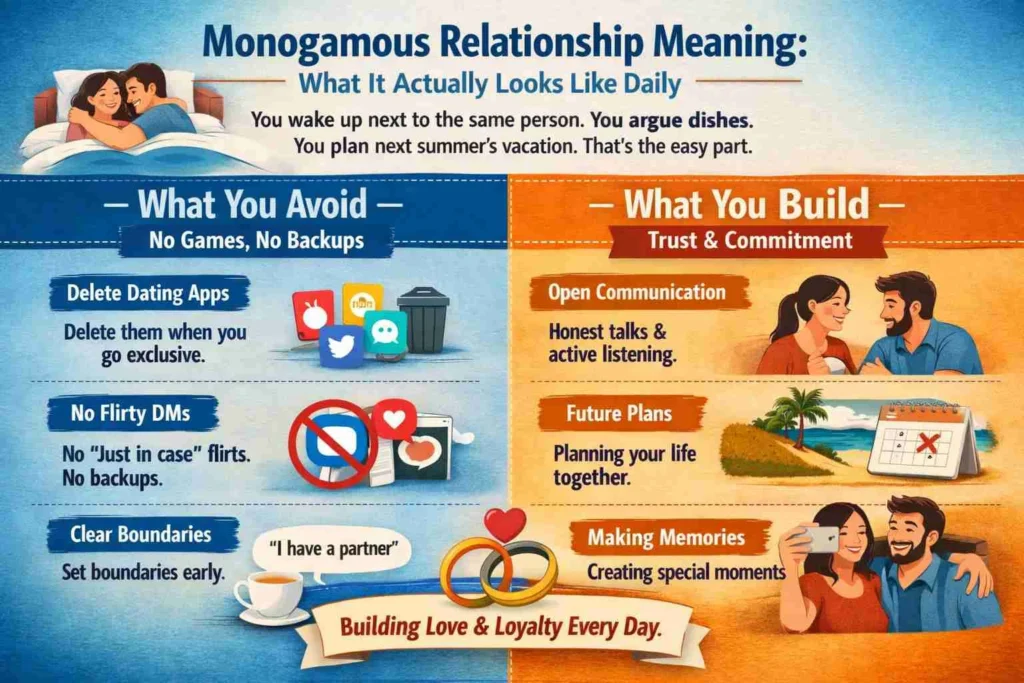
You wake up next to the same person. You argue about dishes. You plan next summer’s vacation. That’s the easy part.
The real monogamous relationship meaning shows up in smaller moments.
Examples of real monogamy in action
You delete dating apps when you go exclusive. Not later. Not “just in case.” You delete them.
You don’t keep “backup” flirts on social media. No sliding into DMs “just to see.”
You tell someone “I have a partner” before a friendly coffee turns weird. You don’t wait for them to make a move. You set the boundary early.
Monogamy is not just about what you avoid. It’s about what you build.
An Analogy to Make It Stick
Think of monogamy like a library card. You can only check out books from one library at a time. You don’t burn the other libraries. You just don’t borrow from them.
Or try this one. Monogamy is like a gym membership. You pick one gym. That doesn’t mean you hate other gyms. You just commit to showing up at one place.
Here’s another. Monogamy is a garden. You plant seeds in one plot. You water it. You pull weeds. You don’t start digging up someone else’s yard.
Does that mean you never notice another garden? Of course not. But you don’t climb the fence.
Monogamy vs Polygamy vs Polyamory | The Real Differences
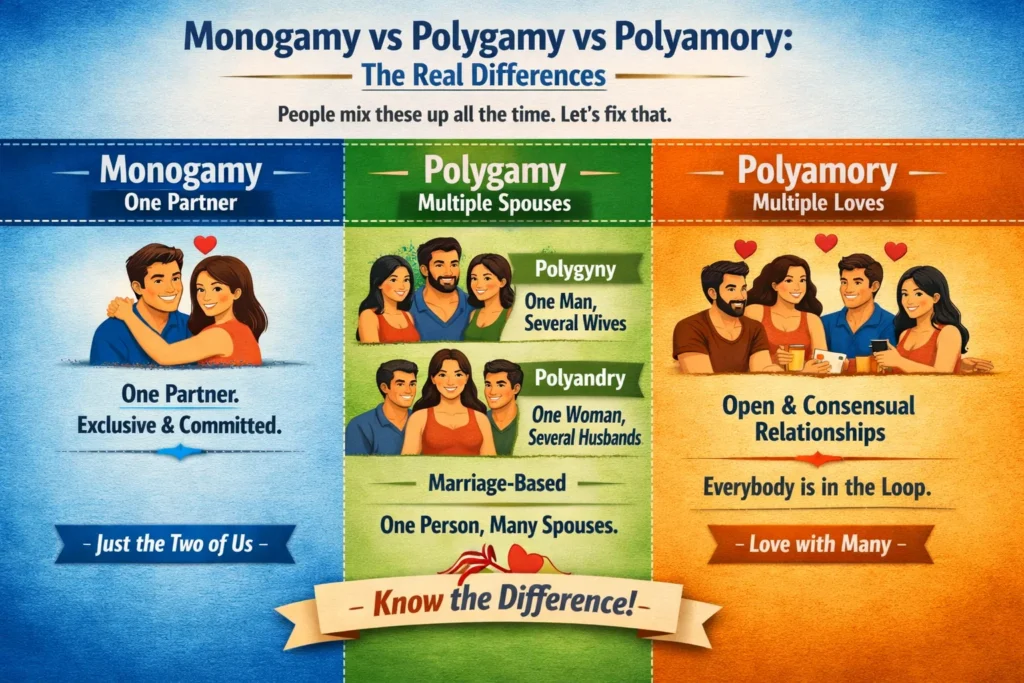
Polygamy means one person with multiple spouses. This is usually marriage-based. Historically it meant one husband with multiple wives. That’s called polygyny. Less common is one wife with multiple husbands. That’s polyandry.
Polyamory means multiple consensual romantic relationships at the same time. Everyone usually knows about everyone else. It’s not secret. It’s not cheating. It’s a different structure entirely.
Monogamy means one partner. Full stop.
Quick Bullet Breakdown
- Polygamy = multiple spouses (often religious or historical)
- Polyamory = multiple loving relationships (everyone consents)
- Monogamy = one exclusive partner (sexually and emotionally)
Example to Make It Stick
Monogamy is owning one dog. You love that dog. You feed it. You walk it. You don’t bring home a second dog without a serious conversation.
Polyamory is owning three dogs that all get along. Different breeds. Different needs. But everyone shares the couch.
Polygamy is being legally required to own three dogs. You want to or not. They fight or not.
Not a perfect analogy. But you get the idea.
One More Distinction| Open Relationships
An open relationship is not the same as polyamory. Open relationships usually allow sexual encounters with others but not romantic ones. Polyamory allows full relationships. Monogamy allows neither outside the couple.
| Relationship Type | Sexual Exclusivity | Emotional Exclusivity | Legal Marriage Required? |
|---|---|---|---|
| Monogamy | Yes | Yes | No |
| Open relationship | No | Yes | No |
| Polyamory | No | No | No |
| Polygamy | No (within spouses) | No (within spouses) | Yes (usually) |
Monogamy in Psychology | Why Humans Mostly Choose It
You’ve heard people say “humans aren’t meant to be monogamous.” That’s only half true.
Pair bonding is real
Humans form strong attachments. Oxytocin plays a big role. That’s the “bonding hormone.” You release it during sex, childbirth, and even hugging.
But here’s the twist. Oxytocin doesn’t force monogamy. It encourages bonding with whoever you’re close to. That could be one person. Or several. The chemical doesn’t care about your relationship rules.
Are humans naturally monogamous?
Not exactly. Some species are purely monogamous. Prairie voles are the classic example. They pair up for life. If you separate them, they show signs of depression.
Humans are more flexible. That’s why monogamy is a choice, not a reflex.
According to biological anthropology, only about 3-5 percent of mammal species practice social monogamy. Humans fall in that small group. But we’re sloppy at it.
So why do most people still choose monogamy?
Culture plays a huge role. Religion. Laws. Family expectations. Most societies reward monogamy with stability. That doesn’t make it “natural.” It makes it practical.
Monogamy meaning in psychology: It’s a social contract reinforced by emotion, not instinct. You stay monogamous because you promised to. Not because your genes force you.
A Fact to Keep in Mind
Studies on infidelity suggest that about 20 to 25 percent of married men and 13 to 15 percent of married women report having sex outside their marriage at some point. That means the vast majority of married people do not cheat. Monogamy is common. It’s just not automatic.
Monogamy in Marriage | Does Marriage Automatically Mean Monogamy?
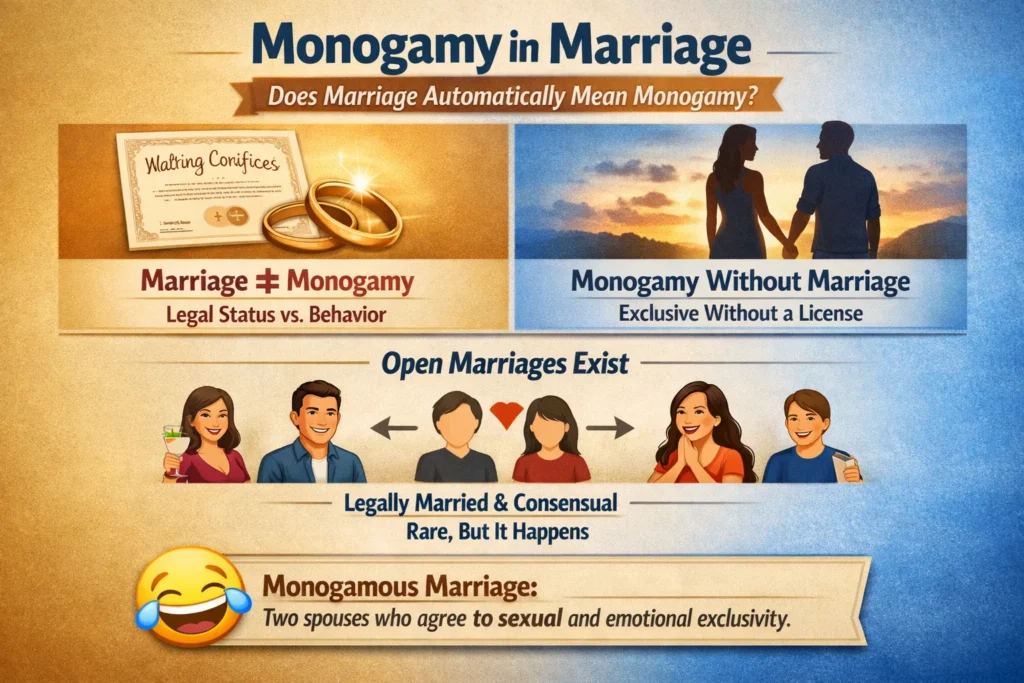
No. And this surprises a lot of people.
Marriage is a legal status. Monogamy is a behavior. You can have one without the other.
You can be married and not monogamous. Some couples have open marriages. They stay legally married. They might even live together. But they agree to see other people.
That’s rare. But it exists.
You can also have monogamy without marriage. Many couples stay exclusive for decades without a certificate. No rings. No license. Just a quiet agreement to be with only each other.
Monogamous marriage definition: Two spouses who agree to sexual and emotional exclusivity.
That’s the traditional model. The one most people picture when they say “I do.”
Here’s a real fact you can use
A 2021 survey from the General Social Survey in the US found that about 80 percent of married people believe extramarital sex is “always wrong.” That leaves 20 percent who see it as “not wrong at all” or “sometimes wrong.”
So marriage doesn’t guarantee monogamy. Commitment does. Two very different things.
Signs Your Marriage Actually Reflects Monogamy
- You both turn down flirting without making a big show of it
- You don’t hide your phone screens
- You make long-term plans that include only each other
- Neither of you keeps “just in case” contacts
Signs of a Monogamous Relationship
Most articles list red flags. Let’s flip that. What does a healthy monogamous relationship look like?
Positive signs, not fear-based
You introduce each other as “my partner” without hesitation. Not “this is my friend” or “this is my roommate.”
You don’t hide your phone. Not because you check each other. Because there’s nothing to hide. That’s a huge difference.
You make long-term plans together. Not “maybe next year.” Actual plans with dates and budgets.
You turn down flirting naturally. No dramatic speech. No “how dare you.” Just a simple “I’m with someone” and you move on.
Table| Signs vs. Red Flags in Monogamous Relationships
| Healthy Sign | Red Flag |
|---|---|
| Talks about future together | Refuses to define the relationship |
| Open phone policy (trust, not surveillance) | Hides conversations or uses secret apps |
| Says “we” naturally | Always says “I” or “mine” |
| No secret exes | Keeps exes on the back burner “as friends” |
| You’ve met each other’s close friends | You’ve never seen their phone screen once |
| They introduce you by name | They call you “my friend” in public |
Benefits of Monogamy
Let’s be honest. Monogamy gets a bad reputation. People call it boring. They say it’s unnatural. But it has real upsides. Let’s name them.
Lower STI risk
If both partners are clean and stay exclusive, the risk of sexually transmitted infections drops dramatically. No new partners means no new exposures. That’s simple math.
Emotional safety over time
You don’t have to wonder if they’ll come home. You don’t split your emotional energy across three people. That safety builds deep trust. Deep trust builds better sex. Better sex builds more trust. It’s a loop.
Deeper intimacy from repetition
You learn their body. Their moods. Their silent signals. That doesn’t happen overnight. It happens after a thousand small mornings. Monogamy rewards patience.
Simpler logistics
One family calendar. One set of in-laws. One holiday plan. Try coordinating Christmas with two other partners. Go ahead. We’ll wait.
Financial stability
Two incomes, one household. That’s the classic setup. It works. Divorce is expensive. Multiple relationships are expensive. Monogamy simplifies money too.
But Let’s Be Fair. There Are Costs.
Monogamy asks you to give up novelty for depth. You won’t have first-date butterflies again. Not with a new person anyway. You trade variety for familiarity.
That’s not bad. That’s just a trade-off.
Don’t sell monogamy as perfect. Just describe it honestly. Some people thrive on routine. Others feel trapped. Know yourself before you commit.
Monogamy and Commitment | The Unspoken Part
Here’s what nobody tells you.
Monogamy is not a one-time decision. It’s a thousand small decisions.
You decide not to flirt back. You decide to come home instead of staying out. You decide to work on the fight instead of walking away.
Commitment is the backbone of monogamy meaning. Without commitment, monogamy is just a rule you resent. With commitment, it’s a structure that frees you.
Think of it this way
A fence doesn’t trap you. It defines the yard. You know where you belong. You know what’s yours to tend. Monogamy works the same way. Boundaries aren’t prisons. They’re promises.
Monogamy in Sociology | How Society Shapes the One-Partner Rule
Sociologists look at monogamy as a system, not just a personal choice.
Why did most societies adopt monogamy?
Several reasons come up again and again.
- Resource distribution: One man with one wife prevents wealthy men from hoarding multiple women. That reduces social conflict.
- Stability for children: Two parents (in traditional models) provide more consistent care.
- Disease control: Monogamy slows the spread of STIs across populations.
- Religious influence: Many major religions formalized monogamy as the only acceptable model.
But monogamy isn’t universal
Even today, some cultures practice polygyny. Some practice serial monogamy informally. Some have no formal marriage at all.
The rise of legal monogamy in the West happened gradually. The Roman Empire favored monogamy. The Catholic Church enforced it. Colonial powers exported it.
Now monogamy is the default in most legal systems. Not because it’s “best.” Because it’s what the laws were built around.
A fact to sit with
The United Nations Universal Declaration of Human Rights mentions marriage but does not specify monogamy. Many countries still legally allow polygamy, including parts of Africa, the Middle East, and Asia.
Monogamy is common. It is not universal.
Emotional Monogamy vs. Sexual Monogamy| They Are Not the Same
Most people assume monogamy covers both. But they don’t always line up.
Sexual monogamy means only one sexual partner. No exceptions.
Emotional monogamy means only one deep romantic emotional bond.
You can have one without the other.
Examples
A couple in an open relationship might be emotionally monogamous but not sexually monogamous. They love only each other. But they sleep with other people.
A couple in a dead bedroom might be sexually monogamous (no one else) but emotionally distant. They don’t cheat. But they also don’t connect.
Which one matters more?
That depends entirely on the couple. Some people care more about sexual exclusivity. They can handle emotional friendships but not physical intimacy with others.
Others care more about emotional exclusivity. A fling is forgivable. Falling in love with someone else is not.
The key is talking about it. Most couples never separate these two. They assume monogamy means both. Then they get hurt when assumptions break.
A practical tip
Before you go exclusive, ask each other: “What would hurt you more? A one-night stand or an emotional affair?” The answer might surprise you.
The History of Monogamy in One Short Paragraph
Monogamy didn’t start with religion. It started with survival.
Early hunter-gatherers likely practiced a mix of strategies. Some pair bonding. Some group arrangements. Then agriculture changed everything. Property needed heirs. Paternity needed certainty. Monogamy became useful.
Ancient Greeks and Romans favored monogamy for citizens. Not for slaves. Not for the elite. But for the average person, one spouse was the rule.
Christianity spread monogamy across Europe. By the Middle Ages, it was law. Not just custom.
Today, monogamy is the legal default in most countries. But the reasons have shifted. Now we talk about love, choice, and equality. Not just inheritance.
Why People Fail at Monogamy
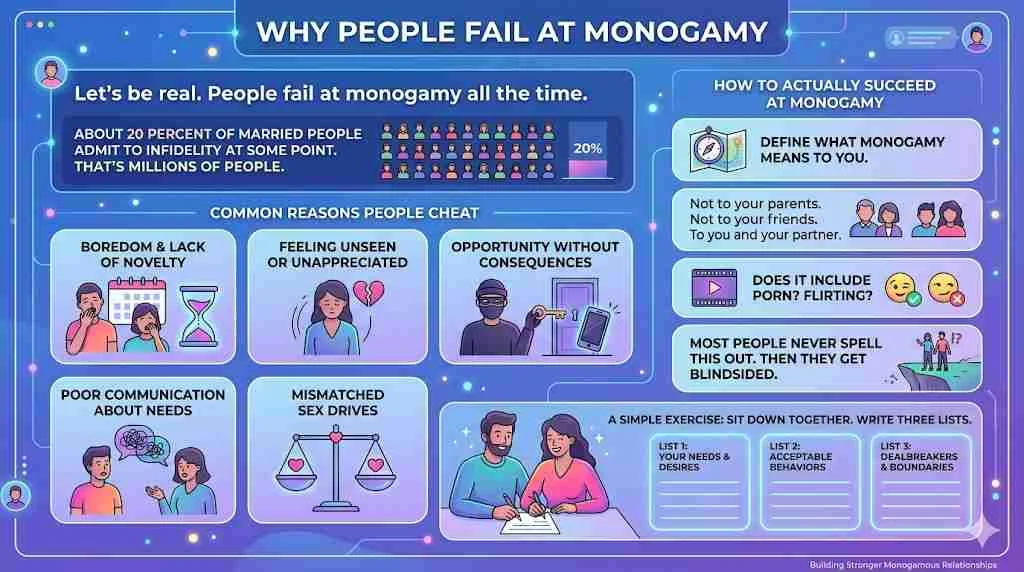
Let’s be real. People fail at monogamy all the time. About 20 percent of married people admit to infidelity at some point. That’s millions of people.
Common reasons people cheat
- Boredom or lack of novelty
- Feeling unseen or unappreciated
- Opportunity without consequences
- Poor communication about needs
- Mismatched sex drives
How to actually succeed at monogamy
Define what monogamy means to you. Not to your parents. Not to your friends. To you and your partner.
Does it include porn? Does it include flirting? Most people never spell this out. Then they get blindsided.
A simple exercise
Sit down together. Write three lists.
- Green light: Things that feel fine (watching porn, having close friends of the gender you’re attracted to)
- Yellow light: Things that need a conversation first (getting drinks with an ex, sleeping in the same bed as a friend)
- Red light: Things that are clearly off limits (kissing someone else, secret dating apps)
Most fights happen in the yellow zone. People assume. Then they get hurt.
Monogamy succeeds when you stop assuming and start asking.
FAQs
What does monogamy mean in simple words?
One partner. No others while you’re together. That’s the core.
Is monogamy natural for humans?
Partly. We lean toward pair bonding. But we can adapt to other structures. Nature gives us flexibility. Culture gives us rules.
Can a relationship be monogamous without marriage?
Yes. Absolutely. Monogamy is an agreement between two people. Marriage is a legal contract. You don’t need one to have the other.
What’s the difference between monogamy and fidelity?
Fidelity means keeping promises within your relationship structure. Monogamy is one specific structure. You can be non-monogamous and still be faithful if you follow your agreements. Fidelity is about honesty. Monogamy is about exclusivity.
Why do people choose monogamy?
Security. Simplicity. Cultural norms. Religious beliefs. Love. Or just personal preference. No single answer fits everyone.
What is serial monogamy?
You have one partner at a time. You break up. Then you find another partner. Repeat. You never have multiple at once. But you also don’t stay together for life. That’s serial monogamy. It’s the most common relationship pattern in Western countries today.
Does monogamy mean you never feel attraction to others?
No. Feeling attraction is automatic. Acting on it is a choice. Monogamy governs action, not passing feelings.
What Is Monogamy?
Monogamy is a relationship structure where two people commit to being romantically and sexually exclusive with each other. In a monogamous relationship, partners agree not to pursue romantic or intimate relationships with others.
What is a monogamous relationship?
A monogamous relationship is a romantic or marital relationship in which two people commit to being exclusive with each other, meaning they do not have other romantic or sexual partners.
Conclusion
Monogamy doesn’t work for everyone. That’s fine.But it works for millions of people every single day. Not because they’re weak. Not because they’re brainwashed. Because they prefer the depth of one over the variety of many. Monogamy relationship.
Monogamy is like driving one car. You could drive different cars each week. Different colors. Different speeds. But you pick one and learn its quirks. You learn where the blind spot is. You learn how it handles in rain.
That’s the trade-off. Novelty versus knowledge. Excitement versus ease. Monogamous meaning.
Know what you’re choosing. Talk it through with your partner. Don’t assume monogamy means the same thing to both of you. Spell it out. Write it down if you have to. And remember. Monogamy is not a cage. It’s a garden. You water it daily or it dies.
Discover More Related Articles:
- “RS” Mean in Text: You’ve Seen It Everywhere In 2026
- “ION” Mean in Text: Don’t Misunderstand This Slang In 2026
- “Chuzz” Meaning in Social Media: Why People Are Using It In 2026