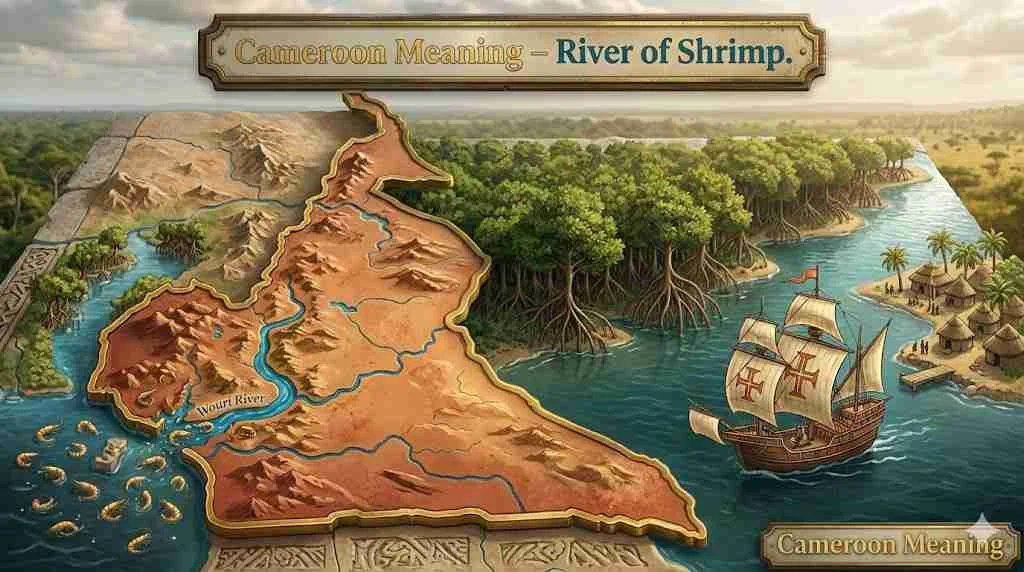

Cameroon means “River of Shrimp” a name Portuguese explorers gave to the Wouri River in 1472 after finding it teeming with shrimp. That simple phrase, Rio dos Camarões, eventually became the name of the entire Central African nation.
Let’s cut straight to the point. Cameroon means “river of shrimp.” No exaggeration. No metaphor. Just a bunch of hungry Portuguese sailors who saw a river full of crustaceans and decided to name the whole place after them.
That sounds ridiculous, right? But it’s 100% true.
The name Cameroon comes from the Portuguese phrase Rio dos Camarões. Translate that, and you get “River of Shrimp” or “River of Prawns.” Over 500 years later, that shrimp river became the name of a Central African nation with nearly 30 million people.
So how did a tiny sea creature name an entire country? Stick around. This story has explorers, colonizers, bad pronunciation, and one very shrimpy river.
What Does Cameroon Mean?
Before we dive deep, here’s the quick version.
| Question | Answer |
|---|---|
| What does Cameroon mean? | River of Shrimp |
| Original language | Portuguese |
| Original phrase | Rio dos Camarões |
| Who named it? | Portuguese explorers (1472) |
| Which river? | The Wouri River (near Douala) |
| Modern country name | Republic of Cameroon |
Cameroon meaning is straightforward. It’s not political. It’s not religious. And it’s a Portuguese grocery list item turned into a national identity.
The meaning of Cameroon surprises most people. They expect something grand like “Land of the Brave” or “Mountain of God.” Nope. Shrimp.
But here’s the beautiful part. Cameroonians own that name now. They’ve built a diverse, powerful, and culturally rich nation under a name that started as a sailor’s offhand comment.
The Full Origin of the Name Cameroon
Portuguese Explorers and a River Full of Shrimp
Let’s rewind to 1472.
Europe was deep in the Age of Exploration. Portugal led the charge. Portuguese explorers sailed down the West African coast looking for gold, spices, and a sea route to India.
One of those explorers was Fernando Pó (also spelled Fernão do Pó). He led an expedition into the Gulf of Guinea. Near modern-day Douala, they found a massive river estuary.
The water was brackish. The mangroves were thick. And the river? Crawling with shrimp.
Not just a few shrimp. Thousands of them. Big ones. The sailors had never seen anything like it. They needed fresh water and food. The shrimp solved both problems.
So they named the river Rio dos Camarões. Rio means river. Camarões (pronounced cah-mah-ROYNSH) means shrimp or prawns.
Rio dos Camarões = River of Shrimp.
That name stuck on European maps. Over time, the river’s name spread to the surrounding coast. Then to the interior. Then to the entire territory.
From Camarões to Cameroon| A Name in Transit
Languages twist names. It’s just what they do.
| Language | Spelling | When Used |
|---|---|---|
| Portuguese | Camarões | 1472 – 1600s |
| Spanish | Camerones | 1500s – 1600s |
| German | Kamerun | 1884 – 1916 |
| English | Cameroon | 1916 – present |
| French | Cameroun | 1916 – present |
The Portuguese Camarões became Camerones on Spanish maps. The English dropped the “es” and softened the ending. Germans turned it into Kamerun during their colonial period.
But the root never changed. Every version still points back to shrimp.
Why Did the Name Stick?
Good question. Africa has thousands of ethnic groups and languages. Most places had local names long before Europeans arrived.
So why did Cameroon survive?
Three reasons:
- Portuguese mapping power – Portugal controlled early African cartography. Their names appeared on all major maps.
- Colonial continuity – First Germany, then France and Britain used variations of the same name.
- Simplicity – Cameroon was easier for Europeans to say than many local names.
When Cameroon gained independence in 1960 (for French Cameroon) and 1961 (for British Southern Cameroons), the new government kept the name. It was already known worldwide. Changing it would cause confusion.
So a shrimp river became a republic.
The Wouri River| The Real “Cameroon”
You can’t understand the Cameroon name origin without understanding the Wouri River.
The Wouri River flows through the southwestern part of the country. It empties into the Gulf of Guinea near Douala Cameroon’s largest city and economic capital.
Quick facts about the Wouri River:
- Length: About 160 kilometers (100 miles)
- Source: Confluence of the Nkam and Makombé rivers
- Mouth: Gulf of Guinea (Atlantic Ocean)
- Known for: Mangrove swamps, shrimp, and heavy ship traffic
- Major city on its banks: Douala (over 3 million people)
The river’s estuary is wide and brackish. Saltwater mixes with freshwater. That mixture creates a perfect breeding ground for shrimp and prawns.
Portuguese explorers weren’t exaggerating. Even today, the Wouri River produces tons of shrimp annually. Local fishermen have harvested these waters for centuries.
So when you ask what does Cameroon mean, you’re really asking about that river. The meaning of Cameroon is etched into its muddy banks and salty tides.
Pronunciation| How to Say Cameroon Correctly
Let’s clear this up once and for all. Most people say it wrong.
Correct English pronunciation: kam-uh-ROON
- Stress the last syllable: “ROON”
- First syllable: “kam” (like the start of “camera”)
- Middle syllable: “uh” (very short)
Incorrect versions:
- CAM-uh-roon (flat, Americanized)
- cah-muh-ROON (wrong vowel sounds)
- kuh-MER-oon (just no)
Portuguese original: cah-mah-ROYNSH
- Nasal “ão” sound hard for English speakers
- Rolling “r” in the middle
French version: Cameroun pronounced kam-ROON
- Drops the middle “uh”
- Sharper ending
German version: Kamerun pronounced KAH-meh-roon
- Stress on first syllable
- Clear “eh” sound
Here’s a simple table to compare:
| Language | Spelling | Pronunciation | Stressed Syllable |
|---|---|---|---|
| English | Cameroon | kam-uh-ROON | Last |
| Portuguese | Camarões | cah-mah-ROYNSH | Second-to-last |
| French | Cameroun | kam-ROON | Last |
| German | Kamerun | KAH-meh-roon | First |
| Spanish | Camerún | cah-meh-ROON | Last |
If you want to sound smart, stress that last syllable. kam-uh-ROON. Say it like you mean it.
What Cameroon Does NOT Mean
The internet loves fake facts. Let’s kill a few right now.
Myth 1: Cameroon means “Land of Beasts”
Nope. No connection. Some people guess this because Cameroon has lions, elephants, and gorillas. But the name has zero relation to animals (except shrimp).
Myth 2: It’s an indigenous African name
False. The name comes entirely from Portuguese explorers. Local groups like the Duala, Bassa, and Bamileke had their own names for the land. Cameroon was an outsider’s label.
Myth 3: It means “Mountain of the Moon”
This sounds poetic but it’s completely made up. Mount Cameroon is a real volcano. But its name came from the country, not the other way around.
Myth 4: The name means “Friend of Ships”
Another invention. Camarões sounds a bit like “camaraderie” in some languages. That’s a coincidence. No meaning connection.
Myth 5: Cameroon is named after a person
No historical evidence supports this. No explorer, king, or leader named Cameroon ever existed.
So here’s the truth. The Cameroon definition is simple. It means shrimp river. Nothing more. Nothing less.
| Myth | Reality |
|---|---|
| Land of Beasts | River of Shrimp |
| Indigenous African name | Portuguese name |
| Mountain of the Moon | Named after Wouri River |
| Friend of Ships | No connection |
| Named after a person | Named after shrimp |
Why the Name Matters| Geography and Identity
You might think a name is just a name. But it’s not. The Cameroon meaning in geography ties directly to the land itself.
Cameroon sits in West Central Africa. It touches the Gulf of Guinea at the Bight of Bonny. That’s where the Wouri River meets the ocean.
Cameroon’s location facts:
- Latitude: 2° to 13° North
- Longitude: 8° to 16° East
- Borders: Nigeria (west), Chad (northeast), Central African Republic (east), Republic of Congo (southeast), Gabon (south), Equatorial Guinea (southwest)
- Coastline: 402 kilometers (250 miles)
- Total area: 475,442 square kilometers (183,569 square miles)
The country is often called “Africa in miniature.” Why? Because it has almost every major African ecosystem.
Ecosystems within Cameroon:
- Sandy beaches on the coast
- Mangrove swamps near Douala
- Rainforests in the south and east
- Grassy savannas in the center
- Dry Sahel desert scrub in the far north
- Mountains (including Mount Cameroon 4,040 meters / 13,255 feet)
That’s incredible variety. Beaches, jungle, grassland, desert, and snow-capped volcano all in one country.
So the cameroon country meaning isn’t just historical. It’s geographical too. The name points to the shrimp-rich estuary that started it all. But the country itself is so much more.
How Cameroon Compares to Other African Country Names
Cameroon isn’t the only African country with a surprising name origin. Let’s look at some neighbors and near-neighbors.
| Country | Name Origin | Literal Meaning |
|---|---|---|
| Cameroon | Portuguese | River of Shrimp |
| Nigeria | English (Latin) | Niger River area |
| Ghana | Soninke (ancient Ghana Empire) | Warrior King |
| Chad | Kanuri (local language) | Lake (Lake Chad) |
| Gabon | Portuguese | Hooded coat (shape of river estuary) |
| Equatorial Guinea | Spanish/Portuguese | Equator + Guinea region |
| Central African Republic | French/Latin | Central + Africa + Republic |
| Republic of Congo | Kongo Kingdom (Kikongo) | Hunters |
| Democratic Republic of Congo | Kongo Kingdom (Kikongo) | Hunters |
| Benin | Bight of Benin (from Itsekiri) | Bench / Hometown |
| Togo | Ewe (local language) | Water’s edge / Hill |
See the pattern? Many African countries have foreign names. Portuguese, French, English, and German colonizers labeled the map without asking local people.
But some kept indigenous names:
| Country | Name Origin | Literal Meaning |
|---|---|---|
| Zimbabwe | Shona | Stone Houses |
| Malawi | Chichewa | Flames / Fire |
| Botswana | Tswana (people group) | The Tswana people |
| Lesotho | Sotho (people group) | The Sotho people |
| Eswatini | Swati (people group) | Land of the Swazi |
| Rwanda | Kinyarwanda | Possibly “domain” |
| Burundi | Kirundi | Land of the Rundi |
So Cameroon sits in the middle. Not proudly indigenous like Zimbabwe. Not completely generic like Central African Republic. It’s quirky. It’s specific. And that makes it memorable.
The cameroon significance comes from that specificity. A shrimp river is weird. But weird is memorable. Nobody forgets the shrimp country.
Colonial History and the Name’s Survival
You can’t understand the history of the name Cameroon without understanding colonialism. Here’s the timeline.
1472 – Portuguese arrive. Name the Wouri River Rio dos Camarões.
1500s–1600s – Portuguese trade along the coast. No deep colonization. Just trading posts for slaves, ivory, and pepper.
1600s–1800s – Dutch, British, and French traders arrive. They use Portuguese maps. The name Cameroon spreads.
1884 – Germany claims the area as Kamerun during the Scramble for Africa. This is the first real colonial occupation.
1916 – Germany loses WWI. France and Britain split Kamerun. France gets most (French Cameroun). Britain gets two thin strips along Nigeria (British Cameroons).
1960 – French Cameroun becomes independent Republic of Cameroon.
1961 – British Cameroons votes: north joins Nigeria, south joins Cameroon. Republic of Cameroon becomes Federal Republic of Cameroon.
1972 – New constitution creates United Republic of Cameroon.
1984 – Name changes again to Republic of Cameroon (still official today).
Through all of that, the name stayed. Germans called it Kamerun. French called it Cameroun. English called it Cameroon. Different spellings. Same shrimp origin.
The cameroon etymology survived wars, colonization, independence, and constitutional changes. That’s staying power for a name based on crustaceans.
What Locals Call Cameroon
Here’s something most articles skip. The cultural meaning of Cameroon differs depending on who you ask.
Over 250 ethnic groups live in Cameroon. They speak 250+ languages. Each group has its own name for the land.
| Language | Name for Cameroon | Rough Meaning |
|---|---|---|
| Duala | Kamerun (adapted from German) | Borrowed name |
| Ewondo | Kamerun | Borrowed name |
| Fulfulde | Kameru | Borrowed name |
| Bassa | Kamerun | Borrowed name |
| Bamileke (Ghɔmálá’) | Kamerun | Borrowed name |
Wait they all use borrowed names? Mostly, yes. That’s unusual.
Most African countries have local alternatives. Zimbabwe has Zimbabwe in Shona. Malawi has Malawi in Chichewa. But Cameroon’s indigenous groups often just adapted the European name.
Why? Two reasons.
First, Cameroon as a unified country didn’t exist before colonization. The area was a patchwork of kingdoms, chiefdoms, and stateless societies. No single indigenous name covered the whole territory.
Second, colonial borders divided ethnic groups. The same people might live in Cameroon, Nigeria, or Chad today. So a shared name for the country never developed.
That makes the Cameroon word meaning unusual. Unlike Egypt (Misr in Arabic) or Ethiopia (Ityopp’ya in Amharic), Cameroon doesn’t have a widely used indigenous alternative. The shrimp name truly became the name.
Cameroon Meaning for Students and Trivia Lovers
Teaching kids or preparing for a quiz night? Here’s the fast version.
Quick facts about Cameroon’s name:
- The meaning of Cameroon is “River of Shrimp”
- Portuguese explorers named it in 1472
- The original phrase was Rio dos Camarões
- The Wouri River was the specific location
- Cameroon is the only country named after a shellfish
- The name never changed just got translated
Fun trivia to impress your friends:
- Cameroon is the world’s only country named after a crustacean.
- The shrimp in question are mostly Macrobrachium vollenhovenii a type of giant river prawn.
- You can still catch those prawns in the Wouri River today.
- The country’s soccer team, the Indomitable Lions, has nothing to do with shrimp. That nickname came from their 1990 World Cup performance.
- Mount Cameroon is one of Africa’s largest volcanoes. Its local name is Mongo ma Ndemi (Mountain of Greatness). But the country’s name overruled it.
The cameroon meaning for students is simple enough for a child to understand. But the history behind it keeps adults interested too.
The Shrimp Connection| Biological and Economic Reality
Let’s talk about the actual shrimp. Because without them, the Cameroon definition wouldn’t exist.
The Wouri River estuary hosts several shrimp and prawn species. The most common is the African river prawn (Macrobrachium vollenhovenii).
Facts about the African river prawn:
- Grows up to 30 cm (12 inches) long
- Lives in brackish and freshwater
- Spends juvenile stage in estuaries
- Adults migrate upstream into rivers
- Harvested by local fishermen for food and trade
Portuguese explorers weren’t seeing tiny cocktail shrimp. They saw monster prawns as long as their forearms. No wonder they remembered the place.
Today, shrimp fishing remains important to Cameroon’s economy.
Cameroon shrimp industry facts:
- Annual shrimp catch: thousands of metric tons
- Primary fishing method: small-scale artisanal boats
- Main markets: Local consumption and export to Europe
- Biggest challenge: Overfishing and mangrove destruction
So the name isn’t just historical. It’s economic. Shrimp put Cameroon on the map. Shrimp still feed Cameroonian families today.
The origin of the Cameroon name and the country’s modern economy share the same DNA. That’s rare. Most country names have zero connection to current industry. But Cameroon? Still shrimping after 550 years.
Linguistic Breakdown| How “Camarões” Became “Cameroon”
Language nerds, this one’s for you.
The cameroon linguistic origin follows a clear path:
Step 1 – Portuguese (1472)
Original word: Camarões
Meaning: Shrimp (plural)
Pronunciation: cah-mah-ROYNSH
Step 2 – Spanish influence (1500s)
Spanish maps wrote Camerones
Same meaning. Spelling shifted slightly.
Step 3 – English adaptation (1600s–1800s)
English traders dropped the “es” from Camerones
Cameron appeared on some early maps
Step 4 – German colonial period (1884–1916)
Germans changed Cameron to Kamerun
Why? German prefers K over C in foreign words.
Step 5 – French/British period (1916–1960)
French used Cameroun
British used Cameroon
Two spellings. Same pronunciation root.
Step 6 – Independence (1960–1961)
The English spelling Cameroon won for the unified country.
French spelling Cameroun remains for the French-speaking region.
Phonetic changes summarized:
| Stage | Spelling | Change |
|---|---|---|
| Portuguese | Camarões | Original |
| Spanish | Camerones | Added “e” before final “s” |
| Early English | Cameron | Dropped “es” |
| German | Kamerun | C → K, changed ending |
| French | Cameroun | Soft ending |
| Modern English | Cameroon | Added second “o” |
The Cameroon in English meaning kept the shrimp core but lost the Portuguese nasal sound. That’s how language works. Words travel. Words change. Meaning survives.
How to Use the Word “Cameroon” Correctly
You’d think a country name is simple. But people make mistakes.
Correct uses:
- “The Republic of Cameroon is in Central Africa.”
- “Cameroon’s largest city is Douala.”
- “She is Cameroonian.” (not “Cameroonish” or “Cameroonese”)
- “Cameroonians speak French and English.”
- “The Cameroon national team plays soccer.”
Incorrect uses:
- ❌ “Cameroon is a language” (no it’s a country)
- ❌ “Cameroonese food” (just say “Cameroonian food”)
- ❌ “The Cameroons” (old colonial term don’t use it unless referencing history)
Demonym (word for people from Cameroon): Cameroonian
Adjective form: Cameroonian (example: Cameroonian music)
Languages of Cameroon: French and English (official), plus over 250 indigenous languages.
The cameroon name meaning doesn’t change with grammar. River of shrimp is river of shrimp. But using the right form makes you sound like an expert.
Why This Name Matters Today
Let’s zoom out. Why should anyone care about the meaning behind Cameroon?
Three reasons.
First, it’s a lesson in history. The name reminds us that Africans didn’t name their own continent. Europeans did. That doesn’t make the name bad. But it’s worth knowing.
Second, it’s memorable. Try forgetting a country named after shrimp. You can’t. That’s marketing power. Cameroon has a storytelling advantage over places named “Central African Republic.”
Third, it connects geography and culture. The Wouri River estuary created the shrimp. The shrimp named the river. The river named the country. Every Cameroonian carries that estuary in their country’s name.
The cameroon country meaning isn’t deep in a philosophical sense. But it’s deep in a human sense. Explorers saw something real. They named it honestly. And that honest name survived 550 years of war, colonization, and change.
That’s not fluff. That’s fact.
Final Summary| Everything You Need to Know
Here’s the whole story in one table.
| Question | Answer |
|---|---|
| What does Cameroon mean? | River of Shrimp |
| What language is the name from? | Portuguese |
| What’s the original phrase? | Rio dos Camarões |
| Which river started the name? | Wouri River (near Douala) |
| Who named it? | Portuguese explorers in 1472 |
| How do you pronounce it? | kam-uh-ROON (stress last syllable) |
| Is the name African? | No it’s European |
| Does Cameroon have an indigenous alternative name? | Not widely used |
| What are people from Cameroon called? | Cameroonians |
| Is Cameroon still connected to shrimp? | Yes shrimp fishing still active |
And here’s the one-sentence version:
Cameroon means “River of Shrimp” a name Portuguese explorers gave the Wouri River in 1472, which eventually became the name of the entire Central African nation.
FAQs
1. What does Cameroon mean in English?
Cameroon means “River of Shrimp” in English. The name comes from the Portuguese phrase Rio dos Camarões, which Portuguese explorers gave to the Wouri River in 1472.
2. Why is Cameroon called Cameroon?
Cameroon is called Cameroon because Portuguese explorers saw the Wouri River full of shrimp and named it Rio dos Camarões (River of Shrimp). Over time, that name spread from the river to the entire country.
3. Who named Cameroon?
Portuguese explorers named Cameroon in 1472. The expedition leader was Fernando Pó (also called Fernão do Pó). His crew saw thousands of shrimp in the Wouri River and named it accordingly.
4. Is Cameroon named after a river?
Indirectly, yes. The Wouri River was originally called Rio dos Camarões. That river name eventually became the country’s name. So Cameroon is named after a river that was named after shrimp.
5. What does Rio dos Camarões mean?
Rio dos Camarões is Portuguese for “River of Shrimp” or “River of Prawns.” Rio means river. Camarões means shrimp or prawns.
6. How do you pronounce Cameroon correctly?
The correct English pronunciation is kam-uh-ROON – stress the last syllable. Not CAM-uh-roon and not kuh-MER-oon. The Portuguese original is cah-mah-ROYNSH.
7. Does Cameroon have an indigenous African name?
No widely used indigenous name exists for the whole country. Over 250 ethnic groups live in Cameroon, and most use a borrowed version of Cameroon or Kamerun. The country never had a single local name before Portuguese arrival.
Conclusion
Cameroon means “River of Shrimp.” No grand political statement. No ancient royal lineage. Just a river full of crustaceans and a crew of hungry Portuguese sailors. That humble origin gave the world one of the most memorable country names on the map. And honestly? That’s what makes it stick. You don’t forget the shrimp country.
The meaning of Cameroon matters because it’s real. It’s not manufactured or mythical. It ties directly to the Wouri River estuary, the shrimp that still live there, and the Cameroonian fishermen who harvest them today. A name that started as a practical observation in 1472 survived 550 years of colonialism, war, and independence. That’s not fluff. That’s history. And now you know it.
Discover More Related Articles:
- “DND” Meaning in Slang: What It Really Means in Messages In 2026
- “PFP” Meaning in Texting: What You Should Know Today In 2026
- “KYS” Meaning : Internet Slang You Should Be Careful With In 2026