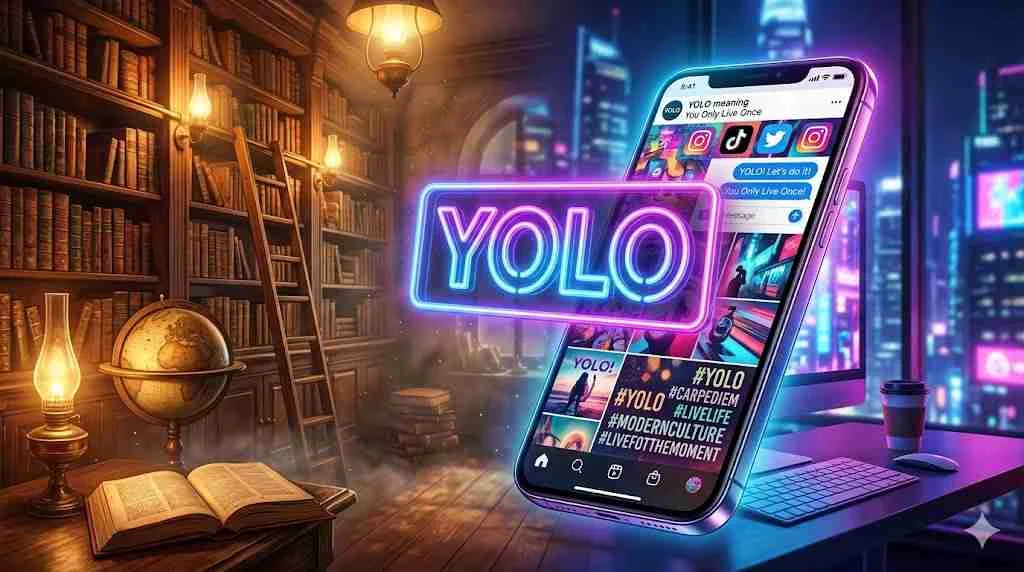

YOLO stands for “You Only Live Once.” It’s a popular internet acronym and slang term used to justify spontaneous, risky, or adventurous decisions by emphasizing that life is short and opportunities should be seized in the moment.
You’ve seen it everywhere. Scrolling through Instagram, you spot a friend jumping off a cliff into crystal blue water. The caption reads “YOLO.” Your cousin texts you saying they quit their job to start a food truck. You reply “YOLO?” They respond with a hundred emojis and a “You know it.”
But what does yolo meaning actually entail? Is it just a convenient excuse for bad decisions? Or is there something deeper behind these four letters?
Let’s be honest. Most people use the term without really thinking about its weight. They throw it around like confetti at a wedding. But the yolo definition carries a fascinating history, a complex cultural evolution, and a philosophy that has captivated humanity for centuries.
In this comprehensive guide, we’ll unpack everything you need to know about this iconic slang term. We’ll explore where it came from, how to use it properly, why it became so controversial, and it still matters in 2026.
Grab your favorite drink and get comfortable. This is going to be a wild ride through internet history, pop culture, and human psychology.
What Does YOLO Actually Mean?
Let’s start with the basics. YOLO stands for “You Only Live Once.”
That’s the yolo full form in all its glory. Simple enough, right? Four words. One powerful message.
But the meaning of yolo goes far beyond its literal translation. This isn’t just a statement about human mortality. It’s a call to action. It’s a battle cry for the spontaneous. It’s permission to take that leap of faith you’ve been avoiding.
Think about it. When someone says “YOLO,” they’re not just stating a biological fact. They’re saying, “Life is short and unpredictable. So why not make this moment count?”
The yolo expression meaning shifts depending on context. Sometimes it’s serious. Sometimes it’s ironic. Sometimes it’s downright reckless. But at its heart, it represents a fundamental human desire to squeeze every drop of joy out of existence.
The Official Definition
Let’s get technical for a moment. According to major dictionaries, YOLO functions as both an interjection and a verb.
As an interjection, it’s used to justify impulsive or risky behavior. For example: “I bought those concert tickets even though I’m broke. YOLO!”
As a verb, it describes the act of taking such risks. Example: “We’ve been YOLOing all weekend.”
Dictionary.com defines it as “You only live once” and notes it’s used especially as a rationale for spontaneous or reckless actions. Merriam-Webster echoes this definition, emphasizing its informal nature.
The Risk vs. Reward Tension
Here’s where things get interesting. The yolo slang meaning contains an inherent tension. On one side, it promotes living boldly. On the other, it can justify genuine stupidity.
This duality is what makes the term so compelling. It’s also what got it into so much trouble.
Consider the tragic case of Ervin McKinness. In 2012, this aspiring rapper tweeted from his car: “Drunk af going 120 drifting corners #FuckIt YOLO.” Hours later, he died in a crash. The tweet went viral for all the wrong reasons.
This dark example illustrates the yolo phrase meaning at its most dangerous. When you use life’s brevity to rationalize genuinely harmful choices, you’re missing the point entirely.
The healthier interpretation is more balanced. It’s about calculated risks. It’s about saying yes to opportunities that align with your values. It’s about not letting fear hold you back from experiences that could enrich your life.
The Surprising History of YOLO
You might think YOLO is a recent invention. A product of the smartphone era. Something Drake dreamed up in a recording studio.
You’d be wrong.
The sentiment behind “You Only Live Once” stretches back centuries. The actual acronym has an unexpectedly long history. And the modern slang version? That’s just the latest chapter in a very old story.
The 1700s: Philosophical Roots
The concept of living fully because life is short appears throughout human history. Ancient philosophers like Epicurus discussed it. Religious texts touched on it. But the exact phrasing starts appearing in the 1700s.
One of the earliest known examples comes from a 1777 English translation of a French play. The line reads: “One only lives once in this world.” It’s not quite the modern phrasing, but the sentiment is identical.
1896: The First Exact Match
Here’s a fun fact for your next trivia night. The earliest known exact use of “You only live once” in English appears in an 1896 translation of Honoré de Balzac’s novel La Comédie Humaine.
The translator wrote: “You only live once, but if you live well, once is enough.”
That last part is crucial. The original author understood something that modern YOLO users often forget. Living once isn’t the point. Living well is.
1968: The Acronym Is Born
The actual acronym made its debut in 1968. The Associated Press published a story about a boat named “YOLO.” Yes, a boat.
That’s right. Someone in the late 1960s thought “You Only Live Once” was such a great concept that they named their vessel after it. The AP article reported that the owner, a man from California, chose the name to reflect his adventurous spirit.
This proves the yolo acronym meaning wasn’t entirely new when Drake popularized it. It had been floating around (pun intended) for decades.
The 2000s: Commercialization Begins
Before Drake, there were attempts to turn “YOLO” into a brand.
In the early 2000s, Adam Mesh, a reality TV star from The Average Joe, launched a clothing line called “YOLO.” The line sold t-shirts and hats emblazoned with the acronym. It didn’t achieve massive success, but it planted seeds.
Then in 2010, someone trademarked “YOLO” for a frozen yogurt shop. Yogurt and life advice. An odd combination, but you have to admire the hustle.
2011: The Drake Explosion
Everything changed in 2011. Drake released “The Motto,” featuring Lil Wayne. The chorus declared: “You only live once: that’s the motto nigga, YOLO.”
The song became a massive hit. The acronym exploded into mainstream consciousness. Suddenly, everyone was saying it. Celebrities tweeted it. Teenagers shouted it at parties. Parents rolled their eyes at it.
The yolo trend meaning had officially arrived.
What made Drake’s version so powerful? Two things. First, the song was catchy. Second, the term filled a cultural gap. We needed a shorthand for that specific feeling of “screw it, let’s do this.” YOLO provided it.
YOLO vs Carpe Diem | What’s the Difference?
People often compare YOLO to “carpe diem.” On the surface, they seem like twins. Both encourage living in the moment. Both reject excessive caution. Both sound cool when you say them in a deep voice.
But there’s a crucial distinction.
Carpe Diem: The Original
“Carpe diem” is Latin for “seize the day.” It comes from a poem by Horace, written in 23 BC. The full quote translates to: “Seize the day, putting as little trust as possible in tomorrow.”
Horace wasn’t telling people to get wasted and make bad decisions. He was urging them to take action. To be productive. To make the most of their time on earth.
The carpe diem meaning leans toward proactive, ambitious behavior. It’s about building something meaningful. It’s about not wasting your potential.
YOLO: The Modern Twist
YOLO is different. It’s often more defensive or reactive. It justifies impulses rather than encouraging ambition.
Urban Dictionary famously defines YOLO as “carpe diem for stupid people.” That’s harsh but not entirely unfair. The term became associated with regrettable tattoos, dangerous stunts, and questionable romantic decisions.
But here’s the nuance. YOLO isn’t inherently worse than carpe diem. It’s just applied differently.
Carpe diem says: “Make your life extraordinary through intentional action.”
YOLO says: “Make this moment count, whatever it takes.”
One is strategic. The other is tactical. Both have their place.
Which One Should You Follow?
The answer depends on the situation. Before a big business pitch? Carpe diem. Take charge. Own the room. Before buying an expensive handbag you don’t need? Maybe YOLO isn’t the best advisor.
The healthiest approach combines both. Use carpe diem to build a life you’re proud of. Use YOLO to occasionally break the rules and have fun. The balance is what matters.
How to Use YOLO in Sentences
Understanding the yolo definition is one thing. Using it naturally is another. Let’s look at how this versatile acronym fits into real conversations.
In Texting and Chat
When you’re texting, yolo meaning in chat is usually straightforward. It signals spontaneity or risk-taking.
Here are some examples:
- Friend: “I just booked a flight to Japan for next week.”
- You: “YOLO! That’s amazing.”
- Friend: “Should I ask my crush out?”
- You: “YOLO. Just do it. What’s the worst that could happen?”
- You: “I’m going to eat this entire pizza by myself.”
- Friend: “YOLO?”
In these contexts, YOLO serves as encouragement or approval. It says, “Yes, this is impulsive. Yes, you should do it anyway.”
On Social Media
YOLO meaning on Instagram and other platforms often leans toward documentation. People use it as a hashtag or caption to emphasize that they’re living their best life.
Consider these examples:
- Instagram caption: “Cliff diving in Hawaii. #YOLO”
- TikTok text overlay: “Spent my savings on this trip. YOLO!”
- Snapchat caption: “Quitting my job tomorrow. YOLO.”
On YOLO meaning on Snapchat, the term often accompanies quick, ephemeral content. It’s perfect for that platform’s spontaneous, in-the-moment vibe.
YOLO meaning on TikTok is similar but often more ironic. Gen Z uses it to mock the very concept of living wildly. Posting a video of yourself doing something mundane like “I ate a granola bar today #YOLO” is a form of absurdist humor.
In Gaming
The yolo meaning in gaming is specific and practical. It describes a high-risk, high-reward strategy.
For example:
- Team member: “Should we push the enemy base?”
- You: “YOLO. Rush them now.”
In competitive games, a YOLO play can win or lose the match. It’s the opposite of cautious, strategic gameplay. Sometimes it pays off spectacularly. Other times, it ends in disaster.
That unpredictability is what makes it exciting.
In Everyday Conversation
Offline, YOLO works in similar ways. You might hear it in:
- Social settings: “Let’s stay out until 4 AM. YOLO.”
- Professional settings: “I’m going to pitch that crazy idea to the boss. YOLO.” (Use with caution.)
- Personal decisions: “I’m going to learn to surf even though I’m terrified. YOLO.”
The key is matching the context. Using YOLO at a funeral? Probably not appropriate. Using it to encourage a friend to ask someone on a date? Perfectly fine.
The Backlash | Why Everyone Started Hating YOLO
Every cultural phenomenon faces a backlash. YOLO is no exception.
By 2013, the term had become a punching bag. Critics dismissed it as dumb, shallow, and dangerous. It became the symbol of everything wrong with modern youth culture.
Why did this happen?
The Overuse Problem
First, people overused it. Way overused. Every minor decision became a YOLO moment.
“I’m going to have cereal for breakfast. YOLO.”
“Brushing my teeth today. YOLO.”
This dilution stripped the term of any real meaning. When everything is a YOLO moment, nothing is. The term became a joke.
The Reckless Association
Second, YOLO became linked with genuinely bad behavior. The McKinness tragedy was just the most extreme example.
Stories emerged of people doing dangerous things while shouting YOLO. Drink driving. Illegal stunts. Substance abuse. The term started to seem like an excuse for self-destruction.
This isn’t what the phrase originally meant. But when enough people use it that way, the meaning shifts.
The Parody
In 2013, comedy trio The Lonely Island released a parody song called “YOLO.” It featured Adam Levine and Kendrick Lamar. The song mocked the term mercilessly.
Lyrics included gems like:
“One life, no consequences, here we go.”
“YOLO, we just gonna do stupid stuff.”
The parody captured public sentiment perfectly. YOLO had become ridiculous. Everyone knew it. The comedy just confirmed it.
Drake’s Apology
Even Drake eventually apologized. During a 2014 Saturday Night Live monologue, he said:
“I actually think I need to apologize for YOLO. Because every time I look at someone who’s doing something dangerous or reckless, they’re yelling YOLO. And there’s a time and place for YOLO. And that time is never. It’s never a good time to do that.”
Drake’s remorse was partly performative but also genuine. He’d watched his creation spin out of control. The yolo definition had strayed far from what he intended.
Is YOLO Still Relevant Today?
With all that backlash, you might assume YOLO is dead. Just another forgotten internet relic. A time capsule of 2012.
You’d be wrong.
The Evolution
YOLO hasn’t disappeared. It has evolved. The term matured, just like the generation that popularized it.
In 2026, YOLO carries different connotations. It’s less about reckless partying. More about intentional experiences.
People use it to justify:
- Quitting unfulfilling jobs
- Traveling to unfamiliar places
- Taking creative risks
- Speaking their truth
- Investing in personal growth
The teenage impulse is gone. The adult philosophy remains.
YOLO and Mental Health
Here’s an interesting development. In recent years, YOLO has connected with mental health conversations.
Therapy often encourages people to step outside their comfort zones. To try new things. To break patterns that aren’t serving them. Sound familiar?
YOLO provides a playful shorthand for serious growth. It’s the encouragement you need to book that therapy appointment. To end that toxic relationship. To finally pursue that dream career.
YOLO in Finance
The term also found new life in financial contexts. During the January 2021 GameStop short squeeze, Redditors on the WallStreetBets forum used YOLO constantly.
In this context, the yolo meaning shifted again. It described high-risk, high-reward investing. Users would post screenshots of their massive stock purchases with the caption “YOLO.”
This became a movement. Individual investors pooled their resources to challenge hedge funds. They weren’t just gambling. They were making a statement. YOLO became a symbol of financial rebellion.
YOLO and Nature
Another surprising development: YOLO has connected with the “boho aesthetic” and nature bathing movement.
People use it to justify:
- Spending time in nature
- Disconnecting from technology
- Embracing minimalist living
- Prioritizing experiences over possessions
This version of YOLO is peaceful and reflective. It’s about living fully but deliberately.
Tables, Lists and Visual Elements
Let’s organize what we’ve covered into easy-to-digest formats. These will help you remember the key points about YOLO.
Table 1: YOLO Meaning Across Different Platforms
| Platform | Meaning | Common Usage |
|---|---|---|
| Texting/Chat | “I’m taking a chance” | Encouraging risky but positive decisions |
| Snapchat | “This moment is special” | Capturing spontaneous experiences |
| “Documenting my adventurous life” | Hashtags and captions for posts | |
| TikTok | “This is ironic or absurd” | Comedic content and memes |
| Gaming | “High-risk strategic play” | Rushing or taking big chances |
| Finance | “High-stakes investment” | Bold trading decisions |
Table 2: YOLO Evolution Timeline
| Year | Event | Significance |
|---|---|---|
| 1777 | First similar phrase in English | “One only lives once in this world” |
| 1896 | First exact match | “You only live once, but if you live well…” |
| 1968 | First acronym use | Boat named YOLO appears in AP article |
| 2000s | Commercial attempts | Clothing lines, frozen yogurt trademarks |
| 2011 | Drake releases “The Motto” | Acronym explodes into mainstream |
| 2013 | Lonely Island parody | Cultural peak and backlash begins |
| 2021 | GameStop YOLO movement | Term connects with financial rebellion |
| 2026 | Current usage | Matured, more intentional meaning |
Bullet Points: Key YOLO Facts
- YOLO stands for “You Only Live Once”
- The acronym was first used in 1968 for a boat name
- Drake popularized the term in 2011 through “The Motto”
- Urban Dictionary defines it as “carpe diem for stupid people”
- The term faced significant backlash by 2013
- It has evolved into a more thoughtful philosophy in recent years
- YOLO is used across social media, gaming, finance, and daily conversation
- The sentiment behind YOLO is centuries old
List: When to Use YOLO
- Taking positive risks – Starting a business, asking someone out
- Trying new experiences – Travel, learning new skills
- Breaking negative patterns – Leaving toxic situations
- Making spontaneous choices – Impulse decisions that bring joy
- Encouraging others – Supporting friends in their bold moves
- Personal growth moments – Stepping outside comfort zones
- Financial investments – Calculated risks with money
List: When NOT to Use YOLO
- Dangerous activities – Driving recklessly, substance abuse
- Life-altering decisions – Without proper consideration
- Financial ruin – Gambling life savings recklessly
- Harming others – Making selfish choices
- Trivial matters – Every small decision doesn’t need YOLO
- Serious situations – Funerals, emergencies, professional contexts
- When it’s insincere – Don’t just say it because it’s trendy
The Psychology Behind YOLO
Why does YOLO resonate so deeply with people? There’s real psychology at play here.
Mortality Awareness
Humans are unique in our awareness of death. We know our time is limited. This knowledge creates anxiety. It also creates motivation.
YOLO taps into that mortality awareness. It acknowledges the finite nature of existence. Then it challenges us to make the most of it.
This isn’t morbid. It’s liberating.
The Fear of Missing Out (FOMO)
FOMO and YOLO are connected. FOMO is the anxiety that you’re missing out on something better. YOLO is the solution.
When you say YOLO, you’re refusing to let fear hold you back. You’re choosing action over paralysis. You’re deciding that regret is worse than failure.
The Opportunity Cost
Every moment you spend doing one thing, you’re not doing another. YOLO highlights this reality.
If you only live once, every choice matters. That’s weighty. But it’s also empowering. You’re always making decisions. You might as well make them count.
The Authenticity Drive
Modern culture emphasizes authenticity. We want to be true to ourselves. YOLO supports this goal.
When you YOLO, you’re often choosing your own path over social expectations. You’re being honest about what you want. You’re refusing to play small.
Common Misconceptions About YOLO
Let’s clear up some confusion.
Misconception 1: YOLO Means Being Reckless
The truth: YOLO can mean taking calculated risks. It doesn’t require stupidity. The healthiest uses involve thoughtful spontaneity, not dangerous impulses.
Misconception 2: YOLO Is Just for Young People
The truth: People of all ages use YOLO. Older adults often appreciate the term because they understand the finality of life more deeply.
Misconception 3: YOLO Is Dead
The truth: YOLO evolved but didn’t disappear. It’s still used across multiple platforms and contexts. The usage has matured.
Misconception 4: YOLO Is Just an Excuse
The truth: Sometimes it is. But sometimes it’s genuine motivation. The context matters more than the term itself.
Misconception 5: YOLO Means You Can’t Plan
The truth: YOLO and planning can coexist. You can YOLO strategically. Plan your spontaneous adventures. Think through your risks before taking them.
YOLO Around the World
The yolo phrase meaning transcends borders. While it started in English-speaking internet culture, it’s gone global.
United States
The birthplace of modern YOLO. From Drake to WallStreetBets, America has embraced and transformed the term repeatedly.
United Kingdom
Brits use YOLO similarly, often with added irony. The dry British humor pairs well with the term’s absurdist potential.
Australia
Australians love YOLO. It fits perfectly with their adventurous, outdoorsy culture. Cliff diving? YOLO. Shark diving? YOLO. Anything dangerous? Probably YOLO.
India
YOLO has integrated into Indian English, especially among younger generations. It appears in Bollywood films and social media conversations.
Japan
The concept resonates with Japanese culture’s emphasis on making the most of limited time. The term appears in localized internet slang.
Brazil
Portuguese speakers use “SÓ SE VIVE UMA VEZ,” a direct translation. Brazilian internet culture has fully adopted the sentiment.
The Future of YOLO
Where is YOLO headed? Let’s look ahead.
Continued Evolution
Language never stands still. YOLO will keep changing. The core sentiment will remain, but the specific usage will adapt to new generations.
Integration with AI
As artificial intelligence becomes more prevalent, human spontaneity becomes more valuable. YOLO could become a celebration of what makes us human. Our unpredictability. Our willingness to take chances.
New Media Contexts
Virtual reality, augmented reality, and the metaverse will create new contexts for YOLO. Taking virtual risks may become as common as taking real ones.
Resilience Against Critics
YOLO has survived multiple waves of criticism. It will likely survive future ones. The underlying philosophy is too universal to disappear.
Connection with Mindfulness
YOLO and mindfulness share common ground. Both emphasize living fully in the present moment. This alignment will likely grow stronger.
FAQs
What does YOLO mean in texting?
In texting, yolo meaning is about taking chances. It’s a quick way to say “I’m doing something spontaneous or risky, and I’m okay with that.” It often appears in response to bold decisions.
What does YOLO stand for?
YOLO stands for “You Only Live Once.” That’s the yolo full form and the core of its meaning.
Where did YOLO come from?
The yolo slang origin traces back to the sentiment appearing in 18th-century literature. The acronym first appeared in 1968 on a boat name. Drake popularized the modern slang version in 2011.
Is YOLO still popular?
Yes, YOLO remains relevant. Its usage has evolved from reckless impulse to thoughtful motivation. It appears in social media, gaming, finance, and daily conversation.
How do you use YOLO in a sentence?
“I bought tickets to Paris on a whim. YOLO!” or “I’m going to ask for that promotion. YOLO.” The term signals spontaneity and risk-taking.
Is YOLO the same as carpe diem?
Not exactly. Carpe diem is about proactive ambition. YOLO often justifies impulsive action. However, both emphasize making the most of your time.
Why did pople hate YOLO?
People criticized YOLO for overuse and association with reckless behavior. The term became a symbol of thoughtless impulsiveness. Even Drake eventually apologized for popularizing it.
What is the YOLO meaning on social media?
On social media, YOLO often appears as a hashtag or caption for adventurous content. It signals that the poster is living fully and embracing experiences.
Is YOLO used in business?
Sometimes. YOLO can justify bold business moves. However, professional contexts usually require more formal language.
What’s the opposite of YOLO?
The opposite would be excessive caution or risk avoidance. Terms like “playing it safe” or “FOMO” (Fear of Missing Out) represent the mindset YOLO opposes.
Conclusion
The yolo meaning is both simple and profound. Yes, it stands for “You Only Live Once.” But that’s just the surface.
Underneath, YOLO represents our deepest human desires. We want to matter. We want to experience everything life has to offer. We want to look back without regret. We want to make our limited time count.
The term has traveled a long road. From a 19th-century French novel to a 1960s boat name. From Drake’s chart-topping hit to a parody song that mocked its excesses. From internet slang to a financial battle cry. From thoughtless impulse to thoughtful philosophy.
YOLO has matured, just like the generation that popularized it. The teenage recklessness has faded. The adult wisdom remains.
So the next time you find yourself hesitating at the edge of something new, remember the yolo definition. Remember that you only get one shot at this life. Remember that playing it safe isn’t always the safest choice.
But also remember the nuance. YOLO isn’t about doing stupid things. It’s about doing meaningful things. It’s about taking the risks that matter. It’s about refusing to let fear keep you from your best life.
Discover More Related Articles:
- “YN” Mean on TikTok: You’ve Seen It Everywhere In 2026
- “HN” Mean in Text: Here’s What It Really Means in Text In 2026
- “FML” Mean in Text: The Truth Behind This Popular Expression In 2026