
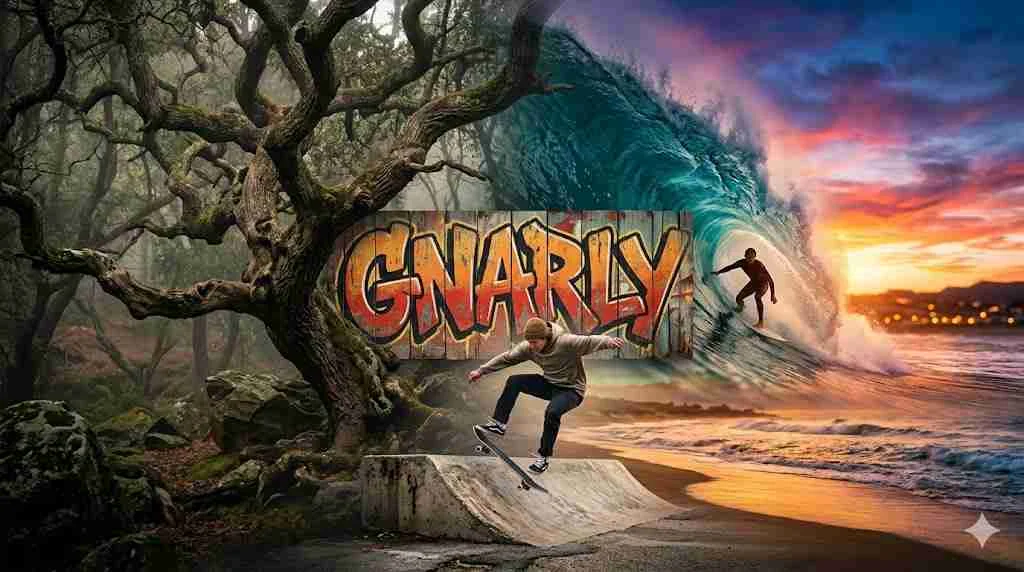

Gnarly means twisted and knotted in its literal sense (like an old tree), but as slang it flips between meaning “awesome and impressive” or “dangerous, difficult, and downright gross” all depending on who’s saying it and what they’re describing.
You’re scrolling through social media and someone calls a video “gnarly.” The clip shows a skateboarder landing a trick that defies physics. But wait the next post uses the same word to describe a moldy sandwich found in a backpack. Two completely different things. Same word. Same spelling. And you’re left wondering what gnarly actually means.
Here’s the truth: the gnarly meaning changes depending on who you’re talking to and what they’re describing. It can mean something amazing, something terrifying, or something downright disgusting. This little five-letter word has lived multiple lives across centuries of English language history.
And it’s not going anywhere.
Today, we’re unpacking everything about the gnarly meaning. The literal definition. The slang evolution. The surf culture that made it famous. The skateboarders who kept it alive. The social media generation that still uses it. Plus pronunciation, examples, synonyms, and the cultural staying power that makes this word genuinely fascinating.
Gnarly Definition
“Gnarly” is an adjective that originally means something rough, twisted, or difficult, like a gnarled tree branch. In modern slang, it can also mean something extreme, impressive, or very intense—either in a good or bad way depending on context.
Examples:
- The surf was gnarly today (very rough or intense waves)
- That trick was gnarly! (amazing or impressive)
What Is the Gnarly Meaning in Simple Terms
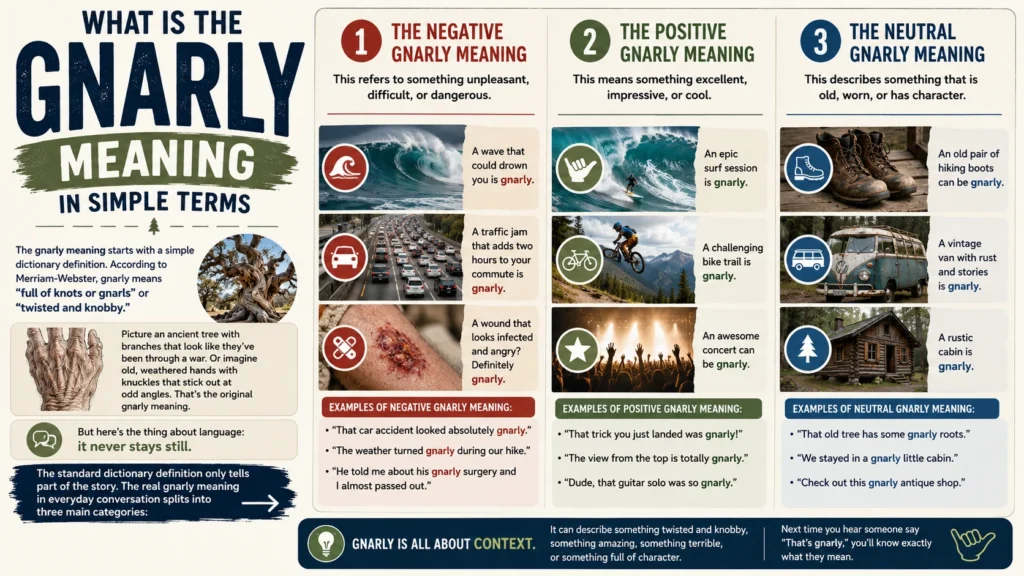
The gnarly meaning starts with a simple dictionary definition. According to Merriam-Webster, gnarly means “full of knots or gnarls” or “twisted and knobby.” Picture an ancient tree with branches that look like they’ve been through a war. Or imagine old, weathered hands with knuckles that stick out at odd angles. That’s the original gnarly meaning.
But here’s the thing about language: it never stays still. Gnarly meaning surf.
The standard dictionary definition only tells part of the story. The real gnarly meaning in everyday conversation splits into three main categories:
The Negative Gnarly Meaning
This refers to something unpleasant, difficult, or dangerous. A wave that could drown you is gnarly. A traffic jam that adds two hours to your commute is gnarly. A wound that looks infected and angry? Definitely gnarly.
Examples of negative gnarly meaning:
- “That car accident looked absolutely gnarly.”
- “The weather turned gnarly during our hike.”
- “He told me about his gnarly surgery and I almost passed out.”
The Positive Gnarly Meaning
This is the slang version that most people know. Here, gnarly means awesome, impressive, incredible, or extreme. A guitar solo that melts faces is gnarly. A skateboard trick that seems impossible is gnarly. A party that goes down in history as legendary? You guessed it gnarly.
Examples of positive gnarly meaning:
- “That concert was so gnarly I can’t even speak.”
- “She landed a gnarly 1080 on her snowboard.”
- “The fireworks display was absolutely gnarly.”
The Neutral Gnarly Meaning
Sometimes gnarly simply means intense. It describes something that’s a lot good or bad. It’s like saying something is “wild.” You can use it when you don’t want to commit to a positive or negative label.
Examples of neutral gnarly meaning:
- “The whole situation got pretty gnarly.”
- “That’s a gnarly challenge you’ve got there.”
- “His energy is just gnarly.”
The gnarly meaning in text messages works the same way. When someone texts you “that’s gnarly,” look at the context. Did you send a photo of your new car or a photo of a spider the size of your hand? That will tell you everything.
Where Did Gnarly Come From? The Twisted History
The origin story of gnarly is as winding as the tree branches that inspired the word. To truly understand the gnarly meaning, you need to travel back through centuries of English language history.
The Old English Roots
The story starts around 1600. The word gnarled appeared first. It described something full of knots and twists. This came from an older root possibly a variant of knur, which meant a hard knot in wood. Think about oak trees. Think about ancient olive trunks. And think about any plant that survives harsh conditions by growing tough and twisted.
For two hundred years, gnarled stayed in this literal lane. Trees were gnarled. Hands were gnarled. Wood was gnarled. Nothing exciting. Just descriptive language for things that looked beaten up by time and weather.
The 1970s Surf Revolution
Then came the 1970s. California surf culture exploded. Surfers needed a word to describe waves that were big, powerful, and dangerous. A wave isn’t just “big.” It’s a force of nature that can crush you, hold you under, and break your bones. But it’s also exhilarating.
Enter gnarly.
Surfers adapted gnarled into gnarly to describe these monstrous waves. A gnarly wave meant one that was difficult to ride. One that demanded respect. One that could hurt you but would also give you the ride of your life.
This surf culture gave the gnarly meaning its first big shift. It went from describing wood to describing water. From static knots to moving danger. From boring to exciting.
The 1980s Skate and Mainstream Explosion
By the 1980s, skateboarders picked up the term. Skate culture in California shared DNA with surf culture. The same attitudes. The same vocabulary. And the same love for pushing limits.
Skateboarders used gnarly to describe tricks that were impressive but also risky. A rail slide down a steep staircase? Gnarly. A massive vert ramp jump? Gnarly. Any trick that could end in broken bones got the gnarly label.
But here’s where things got interesting. In the 1980s, teenagers across America started using gnarly for everything. It became a general-purpose adjective for anything extreme, cool, or gross. Teen movies from that era like Fast Times at Ridgemont High and Bill & Ted’s Excellent Adventure featured characters using the word. It became mainstream.
The 1990s to Today: A Word That Endures
Unlike most slang from the 1980s, gnarly stuck around. It never became completely obsolete like “groovy” or “far out.” It just settled into certain subcultures.
Surfers still use it. Skateboarders still use it. Snowboarders love it. Extreme sports enthusiasts across the board embrace the gnarly meaning because it perfectly captures the combination of danger and excitement they seek.
Today, you’ll also find it on social media. TikTok creators use gnarly to describe impressive stunts. Instagram captions feature gnarly for both epic vacations and disgusting finds. The word has found a second wind with younger generations who appreciate its retro vibe and flexible meaning.
The Evolution of the Gnarly Meaning: A Timeline
Let’s break down the gnarly meaning journey into a clear timeline:
| Era | Usage | Context |
|---|---|---|
| 1600s | Literal meaning | Describing knotted wood and twisted branches |
| 1800s | Extended literal | Still describing physical objects with knots |
| 1970s | Surfer slang | Massive, dangerous waves that challenge riders |
| 1980s | Skate slang | Impressive but risky tricks |
| 1980s-90s | Mainstream teen slang | General adjective for anything extreme |
| 2000s | Subculture staple | Surf, skate, snowboard communities keep it alive |
| 2010s-20s | Social media revival | Used on TikTok, Instagram, YouTube for impressive content |
How to Pronounce Gnarly Correctly
One of the most common questions about gnarly is how to pronounce it. People see the “gn” and think it might be silent like in “gnome.”
It’s not.
The correct gnarly pronunciation is NAR-lee.
It rhymes with “car-lee” or “bar-lee.” The “g” is fully pronounced. Say it out loud right now: NAR-lee. The first syllable rhymes with “far,” and the second syllable is a crisp “lee.” Not “guh-nar-lee” and not “nar-lee” with a silent g.
Some surfers and skaters draw it out for emphasis. You might hear “Naaaar-leee” in an exaggerated California drawl. But the standard pronunciation is simple: NAR-lee.
Here’s a quick breakdown:
- First syllable: NAR (rhymes with car, bar, far)
- Second syllable: lee (rhymes with see, be, tree)
- Stress: Emphasis on the first syllable
Pronunciation practice examples:
- “That wave was gnarly” = “That wave was NAR-lee”
- “He did a gnarly trick” = “He did a NAR-lee trick”
- “This sandwich is gnarly” = “This sandwich is NAR-lee”
Gnarly as an Adjective | Understanding Its Role in English
The gnarly meaning functions primarily as an adjective. This means it modifies nouns and pronouns. It describes something.
In grammatical terms, here’s how it works:
Attributive use: Placed directly before a noun
- “He landed a gnarly kickflip.”
- “They faced gnarly conditions on the mountain.”
Predicative use: Placed after a linking verb like “is” or “was”
- “That wave was gnarly.”
- “Her attitude is gnarly these days.”
The flexibility of the gnarly meaning as an adjective allows it to fit into almost any conversational context. You can use it to describe:
- Physical objects: “The tree has gnarly roots.”
- Events: “The party got gnarly after midnight.”
- People: “That gnarly dude just walked in.”
- Experiences: “My job interview was gnarly.”
- Weather: “We drove through gnarly thunderstorms.”
This grammatical versatility is part of why the word has survived. It’s easy to use. It fits anywhere an adjective fits. And it brings immediate attitude to any sentence.
Gnarly Meaning in Slang Culture
The gnarly meaning in slang culture deserves its own section because that’s where most people encounter it today. Unless you’re a botanist or a woodworker, you probably first heard gnarly as slang.
Gnarly Meaning in Surfing
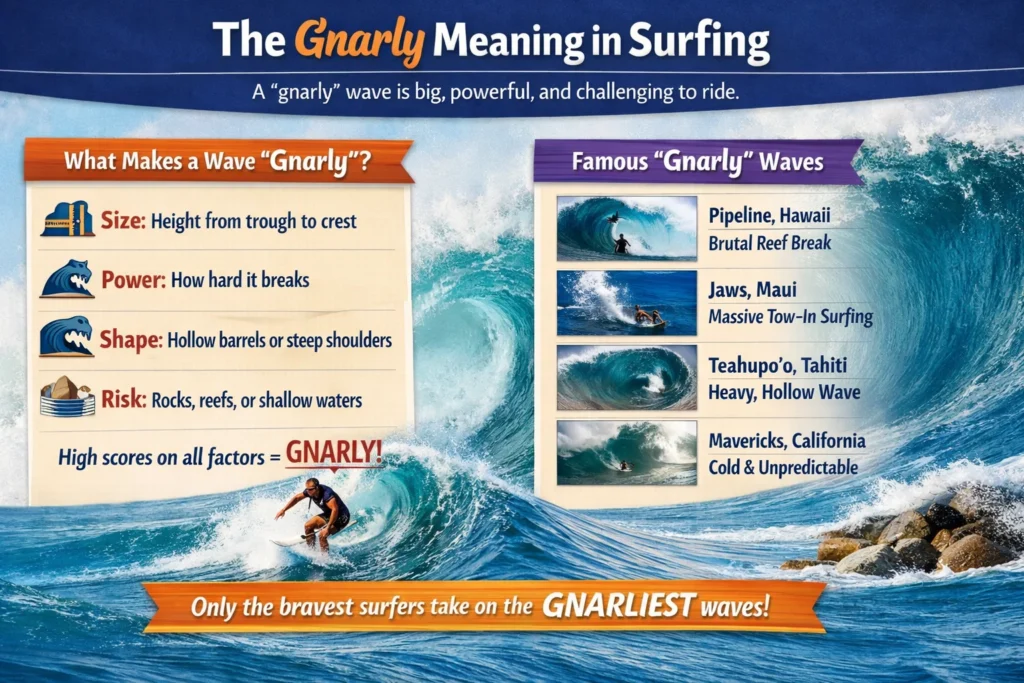
In surfing, gnarly means a wave that’s big, powerful, and potentially dangerous. But there’s nuance. A gnarly wave isn’t necessarily the biggest wave in the world. It’s a wave that demands skill and courage to ride.
Surfers judge waves based on several factors:
- Size (height from trough to crest)
- Power (how hard it breaks)
- Shape (hollow barrels or mushy shoulders)
- Risk factors (rocks, reefs, shallow bottoms)
A wave scores high on all these factors gets the gnarly label. And surfers love gnarly waves because they offer the best rides.
Famous gnarly waves include:
- Pipeline in Hawaii (brutal reef break)
- Jaws in Maui (massive tow-in surfing)
- Teahupo’o in Tahiti (heavy, thick, hollow wave)
- Mavericks in California (cold, big, and unpredictable)
Gnarly Meaning in Skateboarding
Skateboarders use gnarly to describe tricks that are impressive but risky. The gnarly meaning in skateboarding focuses on difficulty and commitment. A trick is gnarly if it takes guts to even try.
Skateboarding factors that make something gnarly:
- Height (how high you go)
- Speed (how fast you’re moving)
- Technical difficulty (complex footwork)
- Consequences (what happens if you fall)
Examples of gnarly skate tricks:
- Tre flip down a big set of stairs
- Kickflip over a gap
- Nose grind on a high rail
- Any trick on a vert ramp that goes above the coping
Gnarly Meaning in Extreme Sports Culture
Beyond surfing and skateboarding, the gnarly meaning extends to:
- Snowboarding
- Skiing
- BMX
- Mountain biking
- Parkour
- Motocross
Any activity that combines skill with physical risk can feature gnarly moments. The word captures that thrill. The combination of fear and excitement. The push to do something most people wouldn’t even consider.
Gnarly Meaning in American Slang
In broader American slang, gnarly works as a catch-all intensifier. It’s like saying “very” but with attitude.
- “That’s gnarly cool” = “That’s really cool”
- “That was gnarly dumb” = “That was really dumb”
- “She’s a gnarly singer” = “She’s a great singer”
This flexible gnarly meaning has helped the word survive decades of slang evolution. It didn’t lock itself into one narrow definition. It stayed flexible enough to adapt.
Gnarly Meaning Gen Z and Social Media
Gen Z has brought gnarly back into the spotlight. But they’ve added their own twist. On TikTok, gnarly often carries an ironic or exaggerated tone. You might see someone describe an average sandwich as “absolutely gnarly” for comedic effect. Or they might use it genuinely to describe an impressive gymnastics routine.
Instagram uses gnarly mostly for extreme sports content. Surf clips, skate videos, and snowboarding reels all carry the label. It fits perfectly with the visual nature of Instagram.
In chat and text messages, gnarly functions as a quick reaction. Someone sends a video of a close call, and you reply “gnarly.” Someone shows off their new trick, and you reply “gnarly.” It’s efficient and expressive.
Gnarly Meaning in Different Contexts
The same word can mean radically different things depending on the situation. Let’s explore how the gnarly meaning shifts across contexts.
Gnarly Meaning in Nature
Back to the roots literally. When describing trees or plants, gnarly means twisted and knotted. It describes ancient growth. Things that have weathered storms and survived decades.
Trees with gnarly features include:
- Ancient oaks
- Olive trees
- Banyan trees
- Juniper trees in harsh climates
A gnarly tree is a survivor. Every twist tells a story of wind, drought, or competition for light. It’s a badge of resilience.
Gnarly Meaning in Weather
Gnarly weather means severe and potentially dangerous conditions:
- Thunderstorms with lightning
- Hurricane-force winds
- Blizzards with whiteout conditions
- Tornadoes and funnel clouds
When the weather service issues warnings, a surfer might look at the waves and say “gnarly.” That’s the bridge between the slang and literal meanings.
Gnarly Meaning in Health
Medical contexts use gnarly to describe:
- Severe injuries (compound fractures, deep wounds)
- Ugly rashes
- Infections
- Surgical procedures
A doctor wouldn’t officially use the term. But patients and friends will. “His leg was gnarly after the accident” is a common phrase.
Gnarly Meaning in Problems
Life throws gnarly problems at everyone:
- Complicated work situations
- Difficult relationships
- Financial crises
- Legal battles
Using gnarly to describe problems acknowledges their difficulty. It adds a touch of humor to a stressful situation. “My mortgage situation got gnarly” is more conversational than “I’m facing significant financial challenges.”
Common Synonyms and Antonyms for Gnarly
Understanding the gnarly meaning involves knowing what words are similar and which are opposite.
Synonyms for Gnarly
The synonyms depend on which meaning you’re going for:
For the literal meaning (twisted, knotty):
- Gnarled
- Knotty
- Twisted
- Rugged
- Rough
- Craggy
- Bumpy
For the positive slang meaning (awesome):
- Awesome
- Epic
- Incredible
- Spectacular
- Amazing
- Stellar
- Rad
- Sick
- Brutal (in a positive way)
- Insane (in a positive way)
And for the negative slang meaning (difficult, gross):
- Terrible
- Awful
- Nasty
- Disgusting
- Revolting
- Horrific
- Horrendous
- Brutal (in a negative way)
- Intense
Antonyms for Gnarly
Opposites of literal gnarly:
- Smooth
- Straight
- Even
- Unblemished
- Regular
Opposites of positive slang gnarly:
- Mediocre
- Average
- Boring
- Unimpressive
- Ordinary
And opposites of negative slang gnarly:
- Pleasant
- Easy
- Mild
- Gentle
- Simple
- Delightful
Gnarly vs Similar Slang Words

The gnarly meaning often gets compared to other slang adjectives. Let’s clarify the differences.
Gnarly vs Sick
Sick has a nearly identical dual meaning. It started negative (illness) and flipped to positive (amazing). Both words come from the same era of surf and skate culture. “That trick was sick” and “that trick was gnarly” mean roughly the same thing.
Key difference:
- Sick leans more positive in modern usage
- Gnarly remains more balanced between positive and negative
Gnarly vs Rad
Rad is short for radical. It came from 1980s surf and skate culture just like gnarly. But rad stayed mostly positive. It means excellent. It never developed that dark, dangerous edge that gnarly has.
You can say “rad day at the beach” for a good day. You’d say “gnarly day at the beach” only if there were massive waves or something intense happened.
Gnarly vs Epic
Epic means something of monumental scale. It’s always positive. A gnarly wave could be epic. But a gnarly injury wouldn’t be epic it would just be gnarly.
Epic feels larger than life. Gnarly feels more personal and immediate.
Gnarly vs Brutal
Brutal often overlaps with negative gnarly. Both describe difficult, harsh, or unpleasant situations. But brutal usually stays negative. You wouldn’t call an amazing experience brutal. You could call an amazing experience gnarly.
Gnarly vs Cool
Cool is the grandfather of all slang. It’s always positive. It’s never negative. Gnarly can be both. A gnarly situation might be cool or might be terrifying.
How to Use Gnarly Correctly
Using gnarly correctly isn’t complicated. The biggest challenge is making sure your audience understands which meaning you intend.
Tips for Using Gnarly
1. Read the room
If you’re talking to older people, they might only know the literal definition. If you’re talking to surfers, they’ll understand the slang. Adjust accordingly.
2. Use context clues
If someone just showed you a photo of a giant wave, calling it gnarly is safe. If they showed you a photo of a spider, calling it gnarly works for the gross or scary meaning.
3. Combine with other words
Using “super gnarly” or “absolutely gnarly” adds emphasis. It reinforces that you mean extreme, not just ordinary.
4. Match the tone
Deadpan delivery works for negative gnarly meaning. Enthusiastic delivery works for positive gnarly meaning. Your tone does the heavy lifting.
5. Don’t overuse it
Like any slang, gnarly loses impact if you use it every sentence. Save it for moments that genuinely deserve the label.
Common Mistakes to Avoid
Mistake 1: Using it in formal writing
Gnarly belongs in casual conversation, social media, and creative writing. It doesn’t belong in business emails or academic papers.
Mistake 2: Assuming only positive meaning
Many people think gnarly only means “awesome.” That’s only half the picture. Don’t be surprised if someone uses it for something negative.
Mistake 3: Over-pronouncing the “g”
Remember: NAR-lee, not guh-NAR-lee. The “g” isn’t separated into its own syllable.
Mistake 4: Using it without context
If your audience doesn’t know the slang, they might picture a tree. Provide enough context so they know what you’re talking about.
Gnarly in Sentences | Real-World Examples
Here are 50 examples showing the gnarly meaning in action across different contexts.
Positive Examples
- “That concert last night was absolutely gnarly.”
- “She threw down a gnarly run on the halfpipe.”
- “The sunset over the ocean looked gnarly.”
- “He cooked a gnarly meal for everyone.”
- “The new album has some gnarly guitar work.”
- “We caught gnarly waves all morning.”
- “Her gymnastics routine was gnarly.”
- “The special effects in that movie were gnarly.”
- “That’s a gnarly setup you’ve got there.”
- “His storytelling is gnarly keeps you hooked.”
- “The dance battle got gnarly toward the end.”
- “This car has a gnarly engine.”
- “The view from the summit was gnarly.”
- “She gave a gnarly performance on stage.”
- “That board game session was gnarly.”
Negative Examples
- “He wiped out and took a gnarly fall.”
- “The food poisoning hit me gnarly.”
- “That injury looks gnarly.”
- “The drive through the mountains got gnarly.”
- “My sunburn is gnarly today.”
- “They had a gnarly argument in public.”
- “The customer service at that place was gnarly.”
- “I stepped on a gnarly nail.”
- “The traffic was gnarly this morning.”
- “His attitude was gnarly all day.”
- “That crash on the highway looked gnarly.”
- “The hike was gnarly with all the mud.”
- “She had a gnarly reaction to the medication.”
- “The plumbing situation is gnarly.”
- “That pothole is gnarly avoid it.”
Neutral Examples
- “Things got gnarly at the meeting.”
- “The weather turned gnarly fast.”
- “This puzzle is pretty gnarly.”
- “The competition is gnarly this year.”
- “It’s a gnarly decision to make.”
- “The project requirements are gnarly.”
- “We faced some gnarly challenges.”
- “Her schedule is gnarly this week.”
- “The whole situation is gnarly.”
- “This sauce is gnarly not sure if I like it.”
Surf and Skate Examples
- “Pipeline was gnarly today.”
- “That wave closed out gnarly.”
- “He charged a gnarly set at Jaws.”
- “The rip current was gnarly.”
- “She paddled into a gnarly bomb.”
- “That rail is gnarly for a backside lipslide.”
- “The vert ramp was gnarly.”
- “He broke his board on a gnarly pit.”
- “The swell built into something gnarly.”
- “That air was gnarly.”
Is Gnarly a Compliment or an Insult?
The gnarly meaning as a compliment or insult depends entirely on context. But let’s break it down more specifically.
When Gnarly Is a Compliment
- Describing skill: “His surfing was gnarly” means he was impressive.
- Describing an event: “That party was gnarly” means it was excellent.
- Describing creativity: “Her painting is gnarly” means it’s striking.
- Describing bravery: “He went after a gnarly wave” means he’s courageous.
When Gnarly Is an Insult
- Describing appearance: “That haircut is gnarly” means it’s unattractive.
- Describing behavior: “His attitude was gnarly” means it was bad.
- Describing something gross: “That sandwich is gnarly” means it’s disgusting.
And when Gnarly Is Neither
- Describing a challenge: “The problem is gnarly” just acknowledges difficulty.
- Describing weather: “The storm was gnarly” states intensity.
- Describing an experience: “The trip was gnarly” could mean anything from amazing to terrible.
The listener’s interpretation depends on three factors:
- Tone of voice – Enthusiastic means positive, alarmed means negative.
- Facial expression – Smiling means compliment, grimacing means insult.
- Context – What are you actually describing?
The Positive and Negative Sides of Gnarly
Let’s dig deeper into the duality of the gnarly meaning.
The Positive Gnarly Meaning
When gnarly lands on the positive side, it means something is:
- Impressive to witness
- Skilled in execution
- Bold or daring
- Extraordinary or exceptional
This positive gnarly meaning connects to the extreme sports world. When someone does something that most people couldn’t do, it’s gnarly. When someone takes a risk and succeeds, it’s gnarly. And when someone pushes boundaries in any field art, music, sports, business it’s gnarly.
The Negative Gnarly Meaning
When gnarly lands on the negative side, it means something is:
- Dangerous to approach
- Difficult to handle
- Unpleasant to experience
- Ugly to look at
This negative gnarly meaning connects back to the original literal definition. Those twisted knots on a tree aren’t beautiful they’re rugged and rough. The negative gnarly meaning preserves that sense of harshness.
Why One Word Can Hold Both Meanings
This duality isn’t unusual in English. Many words carry both positive and negative connotations:
- Sick: amazing OR ill
- Bad: excellent OR poor
- Deadly: awesome OR fatal
- Crazy: wild and fun OR mentally unstable
- Insane: incredible OR medically unwell
- Serious: important OR grim
- Critical: essential OR negative judgment
The common thread with gnarly is intensity. Positive gnarly means intensely good. Negative gnarly means intensely bad. In either case, the word signals that whatever you’re describing is not average. It’s noteworthy. It’s extreme.
Shred the Gnar and Other Offshoots
The gnarly meaning has spawned several offshoot phrases that are worth knowing.
Shred the Gnar
This phrase means to ride with exceptional skill, speed, or enthusiasm. It’s most common in surfing, snowboarding, and skateboarding.
Origin: “Shred” means to ride aggressively and skillfully. “The gnar” is short for gnarly conditions or terrain. Put them together, and you get “shred the gnar.”
Usage examples:
- “We’re heading to the mountain to shred the gnar.”
- “She shredded the gnar on that wave.”
- “The conditions were perfect for shredding the gnar.”
Who uses it: Extreme sports enthusiasts primarily. You’re unlikely to hear it at the office.
The Gnar
Short for gnarly conditions. This is shorthand for challenging terrain or waves.
Usage examples:
- “The gnar was heavy today.”
- “He paddled out into the gnar.”
- “She charges the gnar like a pro.”
Who uses it: Same crowd that says shred the gnar. It’s insider language.
Gnar Points
This comes from a ski culture phenomenon called “G.N.A.R. Points,” created by skiers Robb Gaffney and Shane McConkey. They invented a ridiculous point system for skiing.
Positive points:
- Skiing naked
- Carrying a ski instructor in a backpack
- Completing a lap without stopping
- Landing a backflip
Negative points:
- Not skiing for an entire run
- Getting caught by ski patrol
- Wearing a helmet (they reversed this later)
- Complaining about conditions
The system was satire. It mocked the hyper-masculine, risk-taking culture of extreme sports. But it also celebrated it. The name stuck, and “gnar points” became a running joke in ski communities.
Gnarly Around the World
Is the gnarly meaning understood outside the United States? Yes and no.
Gnarly in British English
In the UK, gnarly exists but isn’t as common. British people might use it ironically or when imitating American slang. But it’s not part of everyday British vocabulary.
Gnarly in Australian English
Australia has its own rich surf culture. Gnarly appears in Australian surfing communities. However, Aussies also use local terms like “hectic,” “mental,” and “fully sick” to similar effect.
Gnarly in New Zealand English
NZ surfers use gnarly. Like Australia, they also have local variations.
Gnarly in Canada
Canadian extreme sports communities use gnarly. Snowboarding in British Columbia brings the word into regular rotation.
Gnarly in Non-English Speaking Countries
In countries where English is a second language, gnarly rarely appears except among:
- Extreme sports enthusiasts
- People consuming American media
- Younger generations exposed to social media
The gnarly meaning in these contexts is almost always the positive slang meaning. The literal meaning and negative slang meaning are much less common.
Why Gnarly Has Survived for Decades
Most slang dies within a few years. New generations develop their own words. Old words fade away. But gnarly has stuck around for over 50 years. Why?
1. It’s Flexible
A word that only means one thing is limited. A word that can mean “awesome,” “terrible,” or “extreme” finds more use cases. People can adapt it to new situations.
2. It’s Fun to Say
Try saying “gnarly” out loud. The “nar” sound is satisfying. The “lee” ending is light. It feels like a word that’s meant to be exclaimed.
3. It Has Cultural Roots
Surf and skate cultures keep gnarly alive. As long as people ride waves and boards, the word will have a home. These subcultures pass it down to new generations.
4. It’s Nostalgic
People who grew up in the 1980s remember gnarly from their youth. They use it for nostalgia. They introduce it to their kids. The cycle continues.
5. Social Media Keeps It Visible
TikTok, Instagram, and YouTube expose new users to gnarly constantly. Extreme sports content often uses the word. Young viewers pick it up and start using it.
The Future of Gnarly
Where does the gnarly meaning go from here? The word has already survived longer than most slang. Let’s look at possible paths forward.
Continued Subculture Use
Surf, skate, and snowboard communities will keep using gnarly. It’s embedded in their vocabulary. New members learn it from older members. The cycle continues.
Social Media Growth
As extreme sports content grows on social media, gnarly will remain relevant. A skate video on TikTok will use the word. That video will get millions of views. New users will learn the word.
Nostalgia Cycles
Every decade or so, older slang makes a comeback. People get nostalgic for past decades. They start using words from their youth. This brings words like gnarly back into the mainstream for brief periods.
Permanent Slang Status
Gnarly might achieve what “cool” and “awesome” have achieved. It might never be cutting-edge again. But it might never die either. It becomes a permanent part of American English.
The Literal Meaning’s Decline
The literal gnarly meaning (twisted wood) will probably continue fading. Most people now learn the slang meaning first. The dictionary definition becomes secondary.
Summary | The Many Faces of Gnarly
Let’s recap everything we’ve covered about the gnarly meaning.
Literal definition:
- Twisted, knotted, and rough
- Originally described trees and wood
- Still used in botanical contexts
Positive slang definition:
- Awesome, impressive, and incredible
- Used for skill, performance, and boldness
- Common in sports and creative fields
Negative slang definition:
- Difficult, dangerous, and unpleasant
- Used for injuries, problems, and gross things
- Connects back to the original harsh meaning
Neutral slang definition:
- Intense and extreme
- Neither good nor bad, just significant
- Acknowledges that something is noteworthy
Pronunciation:
- NAR-lee
- Stress on the first syllable
- The “g” is pronounced
Origins:
- 1600s: literal meaning
- 1970s: surf culture adoption
- 1980s: skate culture and mainstream explosion
- Today: social media revival
Cultural significance:
- West Coast American roots
- Surf and skate culture heritage
- Extreme sports vocabulary
- Flexible slang that refuses to die
FAQs
What does gnarly mean?
Gnarly has three main meanings: (1) twisted and knotted (literal), (2) awesome and impressive (positive slang), and (3) difficult, dangerous, or gross (negative slang).
Is gnarly a bad word?
No. Gnarly is informal slang, not profanity. It’s safe to use in almost any casual context.
Where does gnarly come from?
It comes from “gnarled,” an Old English word describing twisted wood. Surfers adapted it in the 1970s, and it spread through skate and extreme sports culture.
How do you pronounce gnarly?
It’s pronounced NAR-lee. The “g” is pronounced. It rhymes with “car-lee.”
What does gnarly mean in text?
In text, gnarly usually means impressive or intense. But the exact meaning depends on context. Look at what’s being discussed.
Is gnarly positive or negative?
It can be both. Positive gnarly means awesome. Negative gnarly means difficult, dangerous, or gross. Context determines which meaning applies.
What’s the difference between gnarly and awesome?
Awesome is always positive. Gnarly can be positive, negative, or neutral.
What does gnarly mean in surfing?
In surfing, gnarly means a wave that’s big, powerful, and potentially dangerous. It’s usually positive because surfers seek out these waves.
What does gnarly mean on TikTok?
On TikTok, gnarly often appears with extreme sports content. It means impressive, intense, or wild. It can also be ironic or hyperbolic for comedic effect.
Can you use gnarly in formal writing?
Generally, no. Gnarly belongs in casual conversation, social media, and creative writing. It’s not appropriate for business, academic, or formal contexts.
Is gnarly still used?
Yes! While it’s not the freshest slang, it maintains steady usage in surf, skate, and extreme sports communities. Social media has given it a second life.
What are some gnarly synonyms?
For positive meaning: awesome, epic, sick, rad. For negative meaning: nasty, brutal, terrible. And for literal meaning: gnarled, knotty, twisted.
What does “shred the gnar” mean?
It means riding with exceptional skill in challenging conditions. Common in surfing, snowboarding, and skateboarding.
How do you use gnarly in a sentence?
“That wave was gnarly.” “He landed a gnarly trick.” “The traffic was gnarly.” “She has a gnarly sunburn.”
What does gnarly mean in chat?
Same as text usually impressive or intense. The exact meaning depends on context.
What does “gnar” mean?
“Gnar” is a slang term derived from “gnarly,” and it refers to something extreme, wild, difficult, or impressive, often used in surfing, skateboarding, or action sports culture.
What does “gnarly” mean?
“Gnarly” is an informal slang word that means something is very extreme, difficult, rough, or impressive. It is often used to describe challenging situations or something exciting and amazing, especially in sports or casual speech.
Conclusion
The gnarly meaning is a fascinating case study in how language evolves. One word started as a boring description of trees. It got adopted by surfers. Skateboarders picked it up. Teenagers made it mainstream. Decades later, it still thrives on social media.
What makes gnarly special isn’t just its flexibility. It’s that it captures something real. That feeling when you see someone do something incredible. That recognition when you face something genuinely difficult. That acknowledgment when something is just too extreme to ignore.
So the next time you encounter something impressive, gross, difficult, or just wild, you know what to say. “That’s gnarly.” And people think you’re praising them or warning them, you’ll be speaking a word with a rich, twisted history.
Now go out there and encounter something gnarly. Surf a big wave. Land a trick. Face a challenge. Or just find a moldy sandwich in the back of your fridge. However you use the word, you’ll be part of a story that spans centuries.
Discover More Related Articles:
- “GNG” Meaning Slang: Everything You Should Understand In 2026
- “TBD” Meaning Slang: What It Means, How to Use It & When It Matters In 2026
- “OMS” Meaning in Slang: How People Use It in Conversations In 2026