


Aloof means emotionally and physically keeping your distance from others not out of rudeness or fear, but as a deliberate choice to stay uninvolved and detached. It’s a state of cool reserve where you observe life from the sidelines rather than jumping into the social fray, often as a shield to protect your independence or avoid emotional overwhelm.
Picture this. You walk into a bustling coffee shop. Friends laugh at corner tables. Laptops glow. Baristas shout orders. Yet in the corner sits someone completely still. They sip their drink slowly. They watch the chaos unfold with a faint, unreadable smile. They’re present but somehow absent. You can’t tell if they’re judging everyone, lost in deep thought, or simply bored.
That person? They’re probably aloof.
We throw the word around like confetti at a wedding. We call the quiet coworker aloof. Ans we describe that mysterious stranger at the party as aloof. But what does aloof actually mean?
Here’s the truth. Most people get the aloof meaning wrong. They think it’s just another word for rude. Or shy. Or arrogant. But the real aloof definition runs much deeper. It’s a fascinating mix of self-protection, emotional regulation, and social strategy.
This article won’t just hand you a dry dictionary definition. We’ll unpack the psychology behind aloof behavior. We’ll explore the body language cues that give aloof people away. And we’ll dig into the surprising benefits of being aloof and the painful downsides. Most importantly, we’ll help you figure out if you’re aloof yourself or if you’re dealing with someone who is.
What Does Aloof Mean?
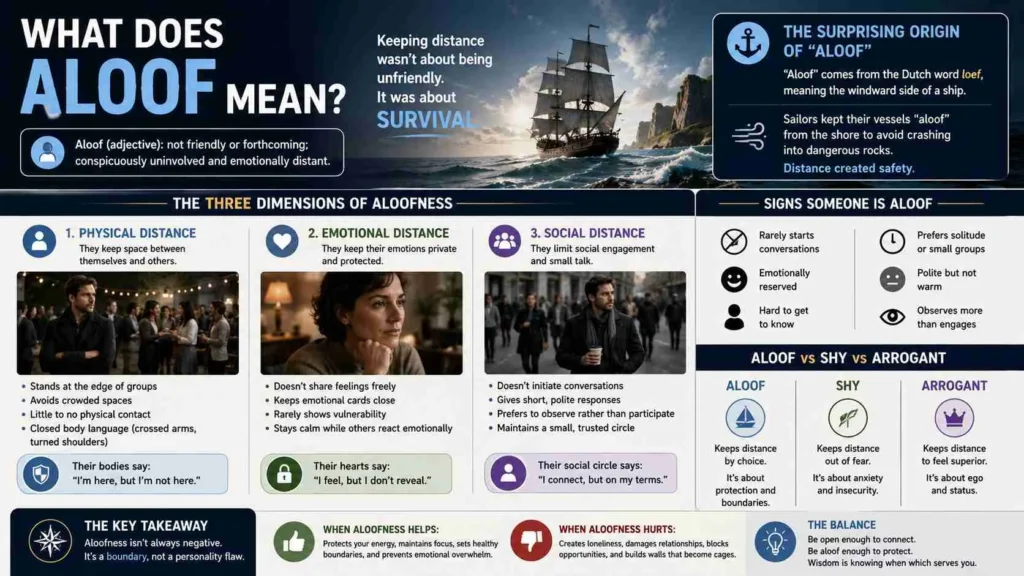
Let’s start with the basics. The aloof meaning in English is straightforward yet layered.
Aloof (adjective): not friendly or forthcoming; conspicuously uninvolved and emotionally distant.
But that simple aloof definition doesn’t capture the full picture. To truly understand what it means to be aloof, we need to look at where the word comes from.
The Surprising Origin of “Aloof”
Here’s a fun fact. The word “aloof” has nautical roots. It comes from the Dutch word loef, which means the windward side of a ship. Sailors would keep their vessels “aloof” from the shore to avoid crashing into dangerous rocks. They maintained distance for safety.
Think about that for a moment. Keeping aloof wasn’t about being unfriendly. It was about survival. It was about protecting the ship from harm.
That same instinct drives human aloofness today. People don’t act aloof because they’re inherently cold. They act aloof because somewhere along the way, they learned that keeping distance keeps them safe.
The Three Dimensions of Aloofness
The aloof meaning breaks down into three distinct layers. Understanding each one helps you spot aloof behavior in real life.
Physical Distance
Aloof people literally stand apart. They position themselves at the edge of groups. They avoid crowded spaces. And they don’t initiate physical contact like handshakes or hugs. Their bodies stay closed off with crossed arms or turned shoulders.
Emotional Distance
This is the heart of the aloof meaning. Aloof people don’t share their feelings freely. They keep their emotional cards close to their chest. They might feel deeply inside but show very little on the surface. They’re the ones who stay calm during family drama while everyone else loses their minds.
Social Distance
Aloof people don’t engage in the usual social rituals. They skip small talk. They don’t ask about your weekend. And they participate in group activities but remain observers rather than active contributors.
When you combine these three dimensions, you get the complete aloof definition. It’s not just one behavior. It’s a whole pattern of keeping people at arm’s length.
Aloof vs The Imposters | Stop Confusing These Terms
Here’s where things get interesting. Most people misuse the word aloof. They confuse it with other personality traits that look similar but come from completely different places.
Let’s clear up the confusion once and for all.
Aloof vs Arrogant
This is the most common mix-up. Many people assume aloof means arrogant. But the aloof meaning has nothing to do with superiority.
Arrogance comes from believing you’re better than others. Arrogant people look down on everyone else. They dismiss others because they think they’re superior.
Aloofness comes from self-preservation. Aloof people keep distance because they feel safer that way. They’re not judging you. They’re protecting themselves.
Here’s the key difference. Arrogant people want to dominate social situations. Aloof people want to escape social situations. Arrogance is aggressive. Aloofness is defensive.
Aloof vs Shy
Shy people and aloof people can look identical from the outside. Both might stand quietly at parties. Both might avoid eye contact. And both might give short answers.
But the internal experience is totally different.
Shyness is fear-based. Shy people want to connect but feel anxious. They desperately wish they could join the conversation but fear being judged or rejected.
Aloofness is choice-based. Aloof people can connect. They simply don’t want to most of the time. They’re not afraid of rejection. They’re just not interested in playing the social game.
Think of it this way. A shy person thinks, “I want to talk but I’m scared.” An aloof person thinks, “I could talk but I’d rather not.”
Aloof vs Introverted
Introversion gets confused with aloofness constantly. And it’s easy to see why.
Both introverts and aloof people:
- Need alone time
- Don’t enjoy constant socializing
- Can seem quiet or reserved
But here’s the crucial difference.
Introversion is about energy. Introverts get drained by social interaction. They need solitude to recharge. But they can be warm, engaged, and deeply connected when they do interact.
Aloofness is about distance. Aloof people aren’t necessarily drained by socializing. They just don’t want to get close to others. They maintain emotional walls even when they have plenty of energy.
An introvert might love a deep one-on-one conversation. An aloof person might avoid that too.
Aloof vs Cold
This distinction is subtle but important.
Cold people actively push others away. They’re harsh. They’re unfriendly. They lack warmth in a way that feels hostile or punitive.
Aloof people are neutral. They’re not warm but they’re not cold either. They simply don’t engage. There’s no hostility. Just… distance.
Coldness feels like rejection. Aloofness feels like absence. One is aggressive. The other is passive.
Quick Comparison Table
| Trait | Core Motive | Social Energy | How It Feels to Others | Can They Change? |
|---|---|---|---|---|
| Aloof | Self-preservation | Detached but present | Mysterious or confusing | Yes, with effort |
| Arrogant | Self-elevation | Domineering | Insulting or condescending | Rarely |
| Shy | Fear of judgment | Avoidant | Nervous or hesitant | Yes, with support |
| Introverted | Preference for solitude | Selective | Quiet but approachable | No, it’s a trait |
| Cold | Self-protection with hostility | Rejecting | Hurtful or unkind | Yes, with therapy |
How to Spot an Aloof Person| Signs and Behaviors
Now that we’ve nailed the aloof definition, let’s get practical. How do you actually recognize aloof behavior in the wild?
The signs are subtle but unmistakable once you know what to look for.
Body Language Cues
Aloof people broadcast their distance through their bodies. Watch for these classic signals.
Minimal Eye Contact
Aloof people might look at you briefly then look away. Or they might hold eye contact in a way that feels unsettling like they’re looking through you rather than at you. Their gaze seems distant, unfocused, or detached.
Closed-Off Postures
Crossed arms are the classic giveaway. But there are others. Turned shoulders. Angled bodies. Arms tucked behind the back. Hands in pockets. Anything that creates a barrier between them and others.
The Poker Face
Aloof people don’t show emotion on their faces. Their expressions remain flat and unreadable. They might smile faintly but it rarely reaches their eyes. You can’t tell if they’re happy, sad, angry, or bored.
Limited Gestures
Watch their hands. Aloof people rarely gesture when they talk. Their movements stay small and controlled. They don’t point, wave, or use expressive body language.
Personal Space Invasion (But the Other Way)
Aloof people maintain more physical distance than normal. If you step closer, they’ll step back. They prefer at least an extra foot of space compared to most people.
Conversational Habits
The way aloof people talk gives them away every time.
The Short Answer Syndrome
Ask an aloof person a question. “How was your weekend?” You’ll get a one-word answer. “Fine.” No elaboration. No follow-up question about your weekend. And no opening for more conversation.
Deflecting Emotional Topics
Bring up something personal or emotional. Watch them pivot. They’ll change the subject. And they’ll make a joke. They’ll offer a logical observation that sidesteps the feelings entirely.
Rarely Asking Questions
Aloof people don’t inquire about others. They don’t ask “How are you?” or “What do you think?” or “Tell me more about that.” They simply don’t engage in the back-and-forth that builds connection.
Monotone Delivery
Listen to their voice. Aloof people often speak in a flat, even tone. No excitement. No urgency. And no warmth. Just… neutral. Like a news anchor reading a script.
Social Patterns
How aloof people navigate social situations reveals everything.
The Observer Role
Aloof people show up but they don’t participate. They watch. And they observe. They notice who’s talking to whom and what dynamics are playing out. But they stay on the sidelines.
Never Initiating
They don’t make plans. They don’t send the first text. And they don’t suggest grabbing coffee.
Avoiding Drama
When everyone else is panicking, arguing, or gossiping, the aloof person stays calm. They seem unbothered by chaos that riles everyone else up. This can be a superpower or a major red flag depending on the situation.
Coming and Going Quietly
Aloof people slip in and out of social situations without fanfare. They don’t announce their arrival. They don’t say dramatic goodbyes. And they just… appear and disappear.
Real-World Examples of Aloof Behavior
Let’s make this concrete. Here are some scenarios that perfectly illustrate the aloof meaning.
The Office Example
Sarah works in a busy open-plan office. Her teammates chat about their weekends. They share photos of their kids. They complain about the coffee machine. Sarah keeps her headphones on and stays focused on her work. When someone asks how she’s doing, she says “Good” and turns back to her screen. She’s not mean. She’s not rude. She just doesn’t engage. Her colleagues call her aloof.
The Party Example
Mark attends his girlfriend’s family gathering. Everyone’s laughing and reminiscing. Mark sits quietly in the corner, sipping his drink and watching. He smiles politely but says little. When his girlfriend’s aunt asks about his job, he gives a brief answer and doesn’t reciprocate the question. Everyone wonders if he’s having a bad time. He’s not. He’s just being Mark.
The Relationship Example
Emma has been dating Tom for eight months. She’s told him she loves him. He’s never said it back. He’s reliable and thoughtful in actions. He remembers her coffee order and picks her up from the airport. But he rarely shares his feelings. He doesn’t talk about his past. He keeps his emotional life private. Emma feels loved but also feels like she’s hitting a wall. She calls him aloof.
The Psychology of Aloofness | Why Do People Act This Way?
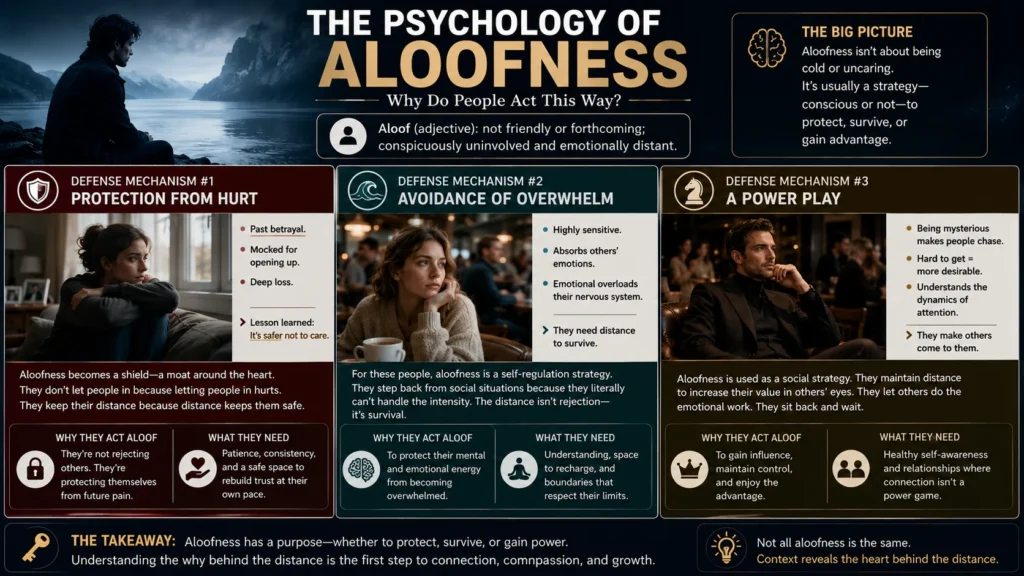
Now we’re getting to the good stuff. The aloof meaning isn’t complete until you understand the why.
People don’t become aloof for no reason. There’s always psychology behind the distance.
Defense Mechanism #1: Protection from Hurt
This is the most common driver of aloof behavior. By far.
Imagine you’ve been hurt before. Maybe you trusted someone who betrayed you. Maybe you opened up and got mocked. And maybe you loved deeply and lost everything.
After enough pain, you learn a simple lesson: it’s safer not to care.
Aloofness becomes a shield. A moat around your heart. You don’t let people in because letting people in hurts. You keep your distance because distance keeps you safe.
This aloof meaning is tragic when you think about it. The aloof person isn’t cold. They’re wounded. They’re not rejecting others. And they’re protecting themselves.
Defense Mechanism #2: Avoidance of Overwhelm
Some people are highly sensitive. They absorb the emotions of everyone around them like sponges.
These people don’t become aloof because they’re cold. They become aloof because they’re too sensitive. They need distance to survive. Too much emotional input overloads their nervous system.
For these people, aloofness is a self-regulation strategy. They step back from social situations because they literally can’t handle the intensity. The distance isn’t rejection. It’s survival.
Defense Mechanism #3: A Power Play
Here’s a less sympathetic driver of aloof behavior.
Some people use aloofness as a social strategy. They’ve figured out that being mysterious makes people chase you. Being hard to get makes you more desirable.
This is the aloof meaning that gets confused with arrogance. But it’s not about thinking you’re better. It’s about understanding the dynamics of attraction and attention.
Aloof people in this category maintain distance to make others come to them. They let others do the emotional work. They sit back and wait.
The Attachment Style Connection
Psychology gives us a deeper framework for understanding aloofness. It’s called Attachment Theory.
Aloof behavior strongly correlates with the Dismissive-Avoidant attachment style. People with this style:
- Equate intimacy with loss of independence
- Feel uncomfortable with emotional closeness
- Prefer self-reliance over relying on others
- Downplay the importance of relationships
- Keep partners at arm’s length
This attachment style usually develops in childhood. Maybe they had emotionally unavailable parents. Maybe they learned that showing emotion gets you dismissed. And maybe they had to be self-sufficient from a very young age.
Whatever the cause, the pattern persists into adulthood. The aloof person becomes the aloof adult. Distance becomes their default setting.
Cultural and Environmental Factors
Not all aloofness comes from psychology. Sometimes it comes from culture.
Certain cultures value reserve and emotional control. Some Asian cultures prioritize harmony over emotional expression. Some European cultures value privacy and self-containment.
If someone grows up in a culture that values emotional restraint, they might read as aloof to outsiders. But within their cultural context, they’re perfectly normal.
Sometimes aloofness is just a family trait. Some families express love through actions rather than words. Some families don’t hug or say “I love you.” Their version of warmth just looks different.
The Aloof Personality: Is It a Trait or a State?
Here’s an important distinction.
Some people are habitually aloof. It’s their baseline personality. They’re like this with everyone, in every situation, all the time.
Other people are situationally aloof. They’re warm and engaged in some contexts but distant in others. Maybe they’re aloof at work but open with friends. Maybe they’re aloof with strangers but vulnerable with partners.
Understanding someone is chronically aloof or situationally aloof changes everything. A situational aloof person has the capacity for closeness. A chronically aloof person might not.
Aloof in Action | Relationships, Love and Friendship
The aloof meaning takes on different flavors depending on the context. Let’s explore how aloofness plays out in different types of relationships.
Aloof in Romantic Relationships
This is where aloofness gets the most attention. And for good reason. Romantic aloofness can be intoxicating and devastating in equal measure.
The Seductive Phase
Here’s a truth few people admit. Aloofness can be incredibly attractive at first.
That mysterious person who doesn’t pursue you aggressively? They stand out. Everyone else is texting too much, talking too much, trying too hard. The aloof person sits back and lets you come to them. It feels like a challenge. It feels like they have options. And it feels exciting.
This is why aloof people often succeed in dating. Their distance creates intrigue. Their lack of neediness makes them seem powerful.
The Reality Phase
But here’s where things get complicated.
Once you’re actually in a relationship, aloofness becomes painful. You want connection. They keep distance. You want reassurance. They stay neutral. You want to merge lives. They protect their independence.
Over time, this dynamic wears you down. You start wondering if they love you at all. You start feeling like you’re “begging” for affection. And you question yourself. Am I too needy? Too emotional? Too much?
The answer is usually no. You’re just dating someone who can’t meet your emotional needs.
The Aloof Partner’s Internal Experience
Here’s what’s happening inside the aloof person’s mind during a relationship.
They probably do love you. They probably do care. Abd they show love through actions: showing up on time, fixing things around the house, remembering practical details.
Saying “I love you” feels awkward. Sharing their feelings feels vulnerable. They retreat to protect themselves.
They also genuinely value their independence. And they don’t want to lose themselves in a relationship. Maintaining separate lives feels healthy to them. They don’t realize how much distance hurts their partner.
Can an Aloof Person Love?
This is one of the most common questions about the aloof meaning. Can aloof people actually love?
The answer is absolutely yes. Aloof people fall in love just like everyone else. They just express it differently.
An aloof partner might never write you a poem. But they’ll drive across town to pick you up when your car breaks down. They might never say “I miss you.” But they’ll remember your favorite takeout order.
The love is there. It’s just hidden under layers of distance.
The challenge isn’t aloof people can love. It’s they can love in a way that makes their partner feel loved.
Aloof in Friendships
Friendship with an aloof person is a unique experience. The dynamic is different from romantic relationships.
The Reliable But Distant Friend
Aloof friends are paradoxes. They’re incredibly reliable but emotionally unavailable.
If you call them at 2 AM because you’re stranded somewhere, they’ll show up. Without hesitation. Without complaint. They’re the friend you want in a crisis.
But if you call them to talk about a promotion or a breakup or a personal victory? They’ll be present but disconnected. They’ll listen but they won’t engage emotionally. And they’ll offer practical advice but not emotional support.
The Low-Maintenance Friend
Aloof friends are easy to have. They never demand your time. They never get jealous. And they never drain you with their problems. They’re happy to see you but equally happy to say goodbye.
This can feel refreshing. But it can also feel hollow. You want someone who needs you sometimes. You want reciprocal investment. The aloof friend doesn’t give you that.
The Friend Who’s Hard to Read
Have you ever wondered if your aloof friend actually likes you? That’s a universal experience.
They never initiate plans. They rarely text first. And they don’t say sweet things. You’re left wondering: do they actually want to be friends or am I bothering them?
Here’s the secret. If an aloof person keeps showing up, they want to be there. Aloof people don’t waste time on people they don’t like. If they’re still your friend after years, they value you. They just can’t show it in conventional ways.
Aloof in the Workplace
Aloofness in professional settings is a double-edged sword.
The Advantages
Aloof employees have real superpowers.
They don’t get sucked into office politics. They don’t engage in gossip. And they keep their heads down and do their work.
Aloof people excel under pressure. Their emotional distance means they don’t panic. While everyone else is losing their minds over deadlines and crises, the aloof person stays calm and productive.
They make excellent impartial decision-makers. They’re not swayed by emotions, personal relationships, or drama. They evaluate situations based on logic and facts.
The Disadvantages
But there’s a cost to aloofness at work.
Aloof people get passed over for leadership roles. Why? Because leadership requires connection. You can’t inspire people if you can’t connect with them.
Aloof people miss networking opportunities. Promotions and career advancement often come from relationships, not just performance. If people don’t know you or like you, you’ll get overlooked.
Aloof people can seem untrustworthy. Their emotional distance reads as deception or dishonesty. Team members wonder what they’re really thinking. The lack of transparency creates suspicion.
The Unapproachable Manager
When an aloof person becomes a manager, the problems multiply.
Direct reports don’t feel comfortable coming to them with problems. They’re afraid of seeming weak or incompetent. They suffer in silence rather than asking for help.
The aloof manager doesn’t provide emotional support. They give instructions and feedback but no warmth. Employees feel like cogs in a machine rather than valued team members.
The result is high turnover, low morale, and poor performance. All because one person can’t or won’t connect emotionally with their team.
Is Being Aloof a Bad Thing? The Double-Edged Sword
Now for the big question. Is aloofness good or bad?
The answer is neither. It’s complicated.
The Downsides: When Aloofness Hurts
Let’s start with the negative aspects of the aloof meaning.
You Get Misinterpreted
This is the most immediate consequence. People will think you’re arrogant, rude, or unfriendly. They’ll assume you don’t like them. They’ll take your distance personally.
This happens even when you’re not trying to be cold. You’re just being yourself and people read hostility into your neutrality.
People Stop Trying
Eventually, people give up on reaching you. They stop inviting you to things. They stop texting first. And they stop trying to connect.
This happens gradually. One day you realize you haven’t heard from anyone in weeks. You’ve become isolated without realizing it.
You Miss Opportunities
Connection drives success in every domain. Personal. Professional. Romantic. Creative.
When you’re aloof, you miss opportunities. The friend who could have introduced you to someone amazing. The coworker who could have advocated for your promotion. The person who could have been the love of your life.
All of these slip away because you didn’t engage.
Your Relationships Suffer
Aloofness damages relationships. It creates misunderstandings. And it makes friends feel unimportant. It alienates coworkers and family members.
Even if you care deeply, your inability to express it hurts the people who love you.
The Upsides: The Hidden Strengths
But there’s another side to the aloof meaning. Aloofness has real benefits.
Better Decision-Making
Emotions cloud judgment. Aloof people can see situations clearly because they’re not caught up in the emotional noise.
This leads to better decisions in every domain. Finances. Relationships. Career moves. Aloof people don’t make choices based on temporary feelings. They evaluate objectively.
Freedom from Drama
Aloof people don’t get dragged into other people’s chaos. They stay detached when others lose their minds. This makes them incredibly stable and reliable.
They’re not swayed by gossip. They don’t get caught up in social contagion. They stay rational while everyone else panics.
Strong Boundaries
Aloof people have excellent boundaries. They don’t overcommit. They don’t overshare. And they don’t let others drain their energy.
This protects their mental health. They don’t burn out from caretaking or people-pleasing. They maintain their own lives separate from others.
A Calming Presence
Here’s an unexpected benefit. In chaotic situations, aloof people bring peace.
Their stillness is stabilizing. Their lack of reactivity soothes others. They create a pocket of calm in the middle of storm.
This is why aloof people often excel in crises. They don’t add to the chaos. They reduce it.
Independence
Aloof people don’t need others to be okay. They’re self-sufficient. They can handle being alone. They don’t depend on external validation.
This independence is a form of strength. It means they’re not desperate for relationships. They choose connections freely rather than from neediness.
When Aloofness Becomes a Problem
Here’s a crucial distinction. Aloofness is healthy when it’s a choice. It’s unhealthy when it’s a compulsion.
Healthy aloofness means you can connect when you want to. You just choose not to most of the time. You have the skills and emotional capacity for intimacy. And you simply prefer distance.
Unhealthy aloofness means you can’t connect. You want to but you’re blocked. Fear or trauma or psychological damage prevents closeness. Your distance isn’t a choice. It’s a cage.
The line between the two isn’t always clear. But it’s worth examining.
The Aloof Person’s Dilemma
Here’s what the aloof person needs to understand.
Your aloofness protects you. It keeps you safe from hurt. It gives you independence and clarity. And it makes you self-sufficient.
But it also costs you. You miss out on the profound connection that makes life meaningful. You hurt people who love you. And you stay in your own bubble while the world spins around you.
The question isn’t aloofness is good or bad. The question is you’re using it wisely.
How to Use “Aloof” in a Sentence | Real-World Examples

Let’s make the aloof meaning concrete with real-world sentences. Here are examples across different contexts.
Professional Context
“Despite the chaotic meeting, the CEO remained aloof, observing the debate with an unreadable expression.”
“The new manager’s aloof demeanor made team members hesitant to approach him with concerns.”
“Her aloof response to the client’s complaint suggested she didn’t care about losing their business.”
“She wasn’t aloof because she thought she was better than everyone. She was aloof because she didn’t know how to connect.”
Romantic Context
“She grew tired of his aloof demeanor. He would hold her hand but his heart seemed miles away.”
“I tried to be aloof and mysterious. It worked too well. She thought I wasn’t interested and moved on.”
“His aloof attitude masked a deep fear of getting hurt. He pushed people away before they could leave him.”
“She described him as aloof, but I saw how he looked at her when he thought no one was watching.”
Social Context
“He wasn’t unfriendly, just aloof. He preferred watching the bonfire from the edge of the circle rather than joining the singing.”
“Her aloof behavior at parties wasn’t rudeness. It was social anxiety dressed up in armor.”
“He seemed aloof at first. Turns out he was just observing the room before deciding who to talk to.”
“I catch myself being aloof at gatherings. Not because I’m bored but because small talk drains me dry.”
Self-Reflective Context
“I’ve been called aloof my whole life. It used to hurt. Now I understand it’s just how I move through the world.”
“My aloofness is a wall I built around myself. It kept me safe. But it also locked me in.”
“I thought I was being aloof but I was actually being avoidant. There’s a difference.”
“The aloof meaning I’d internalized was wrong. I thought it meant I was broken. It just meant I was careful.”
The Power of the Pivot | How to Be Less Aloof
Okay. You’ve read all of this. Maybe you recognize yourself in the aloof meaning. And maybe you want to change.
Good news: you absolutely can.
The Micro-Connection
Start incredibly small. Tiny gestures that build connection without overwhelming you.
Hold eye contact for one second longer than usual. Smile with your eyes when you greet someone. Nod when someone speaks to show you’re listening.
These micro-connections don’t require deep vulnerability. They just signal that you’re present. That you see the other person. That you’re not completely closed off.
The Two-Minute Rule
When someone talks to you, give them two minutes of genuine attention.
Two minutes isn’t long. It won’t drain you. But it’s enough to make someone feel heard. Ask a follow-up question. Show interest. Be fully present.
After two minutes, you can retreat back to your aloof comfort zone. You’ve done your social duty. You’ve connected enough to be polite.
Share a Tiny Flaw
Aloofness comes across as perfection sometimes. You seem like you have everything together. This makes you unapproachable.
Break the illusion. Share a small vulnerability. Admit you’re tired. Say you’re nervous. Mention a mistake you made.
Nothing dramatic. Just a crack in the armor. It humanizes you instantly. People relax around you when they see you’re not superhuman.
Ask a Stupid Question
Aloof people often resist asking for help or information. It feels like weakness. It feels like revealing inadequacy.
But asking questions builds bridges. It says “I don’t know everything” and “I value your input.” It invites people into your world.
Ask about something you genuinely want to know. Their opinion on a movie. How to fix something. Their recommendation for a restaurant. Keep it simple and low-stakes.
Mirror the Other Person
Aloof people stay frozen in their own posture and energy. Try mirroring instead.
If they lean in, lean in a little. If they’re animated, let your voice lift. And if they’re quiet, lower your volume.
Mirroring builds unconscious rapport. People feel comfortable with people who match their energy. It signals that you’re on the same wavelength.
The Emotional Offering
This is the hardest one. But it’s the most powerful.
Offer an emotion occasionally. Say “I’m so happy for you.” Admit “I’m stressed about this.” Express “That hurts my feelings.”
You don’t have to become a feelings volcano. Just drop a genuine emotional response into the conversation now and then.
This is the antidote to aloofness. Emotion creates connection. Sharing emotion creates deep connection. You can’t be aloof and vulnerable at the same time.
Remember: You Don’t Have to Change Everything
Here’s the most important thing. You don’t need to become a different person.
Your aloof nature has strengths. Independence. Calmness. Clarity. Boundaries. You don’t want to lose those.
The goal isn’t to become warm and fuzzy all the time. The goal is to become available when it matters. To lower the drawbridge occasionally and let the right people in.
You can keep your distance most of the time and still have deep connections. The two aren’t mutually exclusive.
The Aloof Person’s Journey
Changing aloofness is a journey. It doesn’t happen overnight.
Start with one person. One relationship. One situation where you want to be different. Practice being more open with that person in that context.
Pay attention to what happens. Usually, people respond positively. They feel seen. They get closer. This positive reinforcement makes you want to try again.
Be patient with yourself. Aloofness is a habit. Breaking habits takes time.
FAQs
Is aloof a negative word?
The aloof meaning is neutral on paper but carries negative connotations in practice. We live in a culture that values warmth and connection. Being aloof goes against those values. So most people perceive aloofness negatively, even though it’s not inherently bad.
What’s the difference between aloof and shy?
Shyness is fear of judgment. An aloof person isn’t afraid. They simply don’t want to engage. Shy people want to connect but can’t. Aloof people can connect but won’t.
Can an aloof person fall in love?
Absolutely. Aloof people fall in love just like everyone else. They just express it differently. Through actions rather than words. Through reliability rather than romance. And through quiet loyalty rather than grand gestures.
What causes someone to be aloof?
Common causes include past trauma, fear of vulnerability, dismissive-avoidant attachment style, high sensitivity, cultural conditioning, and learned family patterns. There’s almost always a protective reason behind the distance.
How do you deal with an aloof person?
Be patient. Don’t take it personally. Understand their distance isn’t about you. Show up consistently. Give them space. Communicate your needs clearly. And recognize that you can’t change them only they can do that.
What does aloof mean in relationships?
In relationships, aloofness means maintaining emotional distance even when intimacy is expected. The aloof partner might be reliable and committed but emotionally unavailable. Their love is hidden under layers of self-protection.
Is aloof the same as introverted?
No. Introversion is about energy drain from socializing. Aloofness is about emotional distance. An introvert can be warm and connected. An aloof person maintains distance regardless of energy levels.
What is the aloof meaning in a sentence?
“Despite his aloof demeanor, everyone respected his calm leadership.” “She was friendly but aloof, keeping her personal life private.” “His aloof attitude made him seem arrogant, but he was just protecting himself.”
How do you know if someone is aloof?
Look for closed-off body language, minimal eye contact, short answers, avoiding emotional topics, never initiating social interaction, and staying on the sidelines in group situations. They’re present but not engaged.
What is the aloofness meaning in psychology?
In psychology, aloofness is a defense mechanism. It’s a way of maintaining distance to avoid emotional pain, overwhelm, or vulnerability. It’s often associated with dismissive-avoidant attachment style.
Is Aloof a Bad Thing?
Not necessarily. Being aloof simply means appearing emotionally distant, reserved, or detached. While some people may see aloofness as unfriendly, others are aloof because they are shy, introverted, cautious, or prefer observing before engaging.
Conclusion
what’s the real aloof meaning? It’s not a life sentence of loneliness or a badge of coldness. It’s a strategy a way of moving through the world that prioritizes self-protection, clarity, and independence. Some people use aloofness as armor against past wounds. Others use it as a filter to avoid emotional chaos. And yes, a few wield it like a subtle power move to keep others guessing.
Here’s the bottom line. The aloof meaning isn’t good or bad it’s all about context and intention. If your aloofness is a choice that serves you well, own it. If it’s a cage that keeps everyone at arm’s length, consider cracking the door open. Is being aloof bad. You don’t have to become the life of the party or spill your deepest feelings to everyone you meet. But learning when to lower the drawbridge for the right people?
Discover More Related Articles:
- “A Burger and a Grape Snow Cone” Mean: in Social Media Slang Guide In 2026
- “Diddy” Meaning in Texting: When & How It’s Used In 2026
- “SMH” Mean in Text: Don’t Misuse This Acronym In 2026